Pool House Flooring That Handles Wet Feet and Chlorine Drips
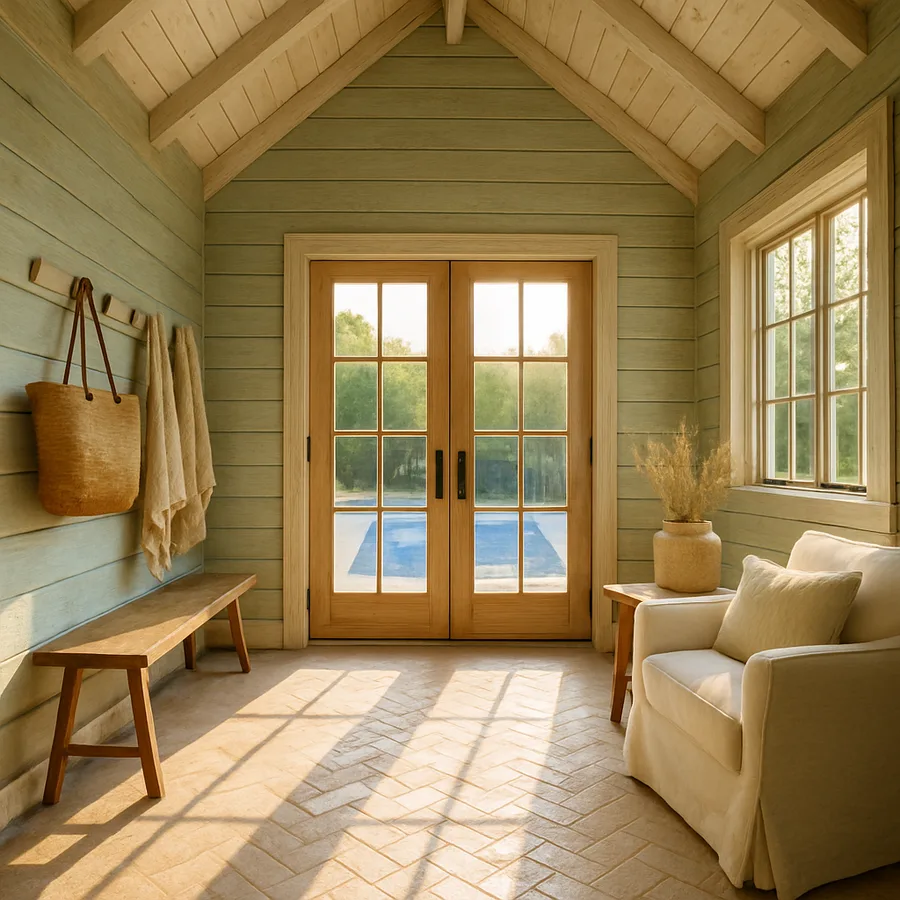
Pool house flooring lives a hard life. Every wet footprint, every dripping swimsuit, every splash of sunscreen, every dropped popsicle, every late-summer thunderstorm that drives sandy guests inside, all of it lands on the floor. Choose the wrong material and you spend years watching your investment dull, stain, swell, or quietly become a slip hazard. Choose the right one and the floor disappears into the background, doing its job through a decade of pool seasons without complaint.
The American National Standards Institute (ANSI) sets a wet dynamic coefficient of friction (DCOF) of 0.42 as the minimum recommendation for level interior surfaces expected to be walked on while wet, and the Tile Council of North America (TCNA) publishes detailed selection guides that align with that standard. With more than 10.7 million U.S. residential pools in service according to the Pool & Hot Tub Alliance (PHTA), pool house flooring has matured into a real specialty. This guide covers the materials that genuinely perform and the ones to leave for indoor rooms.
The Real Performance Criteria for a Pool House Floor
Before comparing materials, get clear on what a pool house floor actually has to do. Five performance criteria matter more than aesthetic preference, and the right material has to meet all five rather than just the most visible one.
First is wet slip resistance. The DCOF rating of 0.42 wet from ANSI A326.3 is the threshold most professionals use, and pool house floors should genuinely meet or exceed it across the entire surface, not just the textured corner of a sample. Second is chlorine and chemical resistance. Chlorinated water dripping from swimsuits, sunscreen oils, and the occasional spilled drink all attack finishes in ways that ordinary household spills never do. Third is moisture stability, meaning the material does not swell, cup, warp, or delaminate when exposed to repeated wetting and drying cycles.
Fourth is thermal comfort. A floor that gets blistering hot in afternoon sun is unusable for bare feet, and a floor that stays icy on cool mornings is equally unwelcome. The ASHRAE Handbook notes that surface temperature significantly affects perceived comfort, especially in transitional indoor-outdoor spaces. Fifth is cleanability. The right floor cleans up with a quick mop or hose-down, not specialty chemicals or professional restoration. Have you thought about which of these five criteria matters most for your actual use?
Porcelain Tile: The Modern Default
Porcelain tile has become the default high-performance pool house floor for good reason. It is impervious to water, completely unaffected by chlorine and pool chemicals, available in textured finishes that easily exceed the 0.42 DCOF threshold, and produced in formats that mimic everything from limestone to weathered wood to concrete. A through-body porcelain (where the color and pattern run through the entire tile thickness) hides chips and scratches well, which matters in a space where dropped goggles and umbrella stands are constant.
For pool house applications, look specifically for tiles labeled with a Class IV or Class V abrasion rating from the Porcelain Enamel Institute (PEI), which indicates the surface can handle heavy foot traffic and outdoor or commercial conditions. The Tile Council of North America (TCNA) publishes installation handbooks that specify the right thinset, grout, and substrate prep for wet-area residential use, and following those standards is what separates a floor that lasts 25 years from one that fails in five.
Grout choice matters as much as the tile itself. Epoxy grout resists staining and chemical attack far better than standard cementitious grout, which will eventually absorb sunscreen oils and grow mildew in damp environments. The cost premium is modest in the context of a full installation, and the maintenance benefit is significant. Architectural Digest has covered numerous pool house projects where the designer specified epoxy grout precisely because of how it handles years of chlorine and sunscreen exposure without yellowing.
Natural Stone: When and How It Works
Natural stone has been a pool house favorite for decades, and certain stones genuinely perform when specified correctly. Travertine in a tumbled or honed finish has been a go-to for warm, classic pool environments because it stays cool underfoot, provides good wet traction, and ages with character. Limestone performs similarly in lighter colors. Bluestone works beautifully in cooler climates where its blue-gray tone reads as elegant rather than cold.
The critical caveat with natural stone is sealing. Unsealed or improperly sealed stone will absorb sunscreen, chlorinated water, and food spills in ways that ordinary indoor stone never sees. The Natural Stone Institute (NSI) recommends penetrating sealers reapplied on a schedule appropriate to the stone and the use intensity, often every one to three years in pool house conditions. A topical sealer can also work but tends to wear in heavy traffic patterns, requiring more frequent touch-ups.
Avoid polished stone in any pool house application. Polished marble, polished travertine, and polished granite all become genuinely dangerous when wet, with DCOF ratings that fall well below the 0.42 minimum and often below 0.30. Even when they look stunning in a sample, the wet performance disqualifies them. Honed and tumbled finishes provide both visual beauty and the surface texture that creates safe wet traction. The Marble Institute of America (MIA) publishes selection guides that specifically address this distinction for wet residential applications.
Concrete and Decorative Concrete Options
Polished or sealed concrete has become an increasingly popular pool house floor because it is durable, customizable, and reasonably priced relative to natural stone. The right concrete finish provides excellent wet traction, accepts color and texture treatments well, and bonds permanently to a properly prepared slab so there are no joints or grout lines to maintain.
The two main approaches are integrally colored polished concrete and microtopping or overlay systems. Integrally colored concrete is the more durable choice because the color runs throughout the slab rather than sitting on top, but it requires the floor to be poured fresh or the existing slab to be ground and densified. Overlays apply a thin decorative layer over an existing slab, opening more design possibilities at the cost of long-term durability. Both should be sealed with a chemical-resistant penetrating sealer rather than a high-gloss topical, which becomes slippery when wet.
Stamped concrete has been popular for pool decks for years and can extend into pool house interiors, though the surface texture varies enormously by stamp pattern and the slip rating depends entirely on the finish texture. The American Concrete Institute (ACI) publishes guidance on slip resistance and surface treatments for residential decorative concrete that is worth consulting before specifying. Have you tested a sample of any concrete finish with bare wet feet before committing to it for the whole floor?
Wood, Wood-Look Tile, and What to Avoid
Real wood flooring should be approached with caution in any pool house. Solid hardwood will cup, swell, and eventually fail with repeated wet exposure, no matter how good the finish. Engineered hardwood holds up better but still struggles with the standing water and high humidity that define a pool house. The exceptions are tropical species like teak, ipe, and cumaru, all of which have natural oil content high enough to handle wet exterior or three-season use. Even these should be installed with proper drainage gaps and finished with a marine-grade penetrating oil rather than a film-forming finish.
Wood-look porcelain tile gives you the visual warmth of wood with the performance of porcelain. Plank formats up to 48 inches long mimic real wood convincingly, and textured finishes provide the wet traction that real wood can never match safely. The Tile Council of North America (TCNA) notes that wood-look porcelain has been one of the fastest-growing categories in residential tile, driven largely by wet-area applications like pool houses, mudrooms, and bathrooms.
What to genuinely avoid: laminate flooring in any form, because the fiberboard core swells permanently with even modest wet exposure. Vinyl plank performs better than laminate in moisture but can warp under direct sun and is rarely rated for pool house conditions. Carpet of any kind is a mildew problem waiting to happen in this microclimate. Cork is beautiful indoors but generally not rated for the chemical exposure of a pool environment. The National Wood Flooring Association (NWFA) explicitly cautions against most wood flooring in true pool house conditions.
Drainage, Substrate, and the Hidden Layers
The most beautiful flooring will fail if the layers beneath it are wrong. Pool house floors should slope subtly toward a drain or doorway, typically one-quarter inch per foot, so that water drains rather than pools. A floor that holds standing water will eventually grow mildew at the perimeter regardless of the surface material, and the slope is invisible enough that no one will notice it visually but everyone will feel the difference in performance.
Substrate prep is where many installations fail invisibly. A concrete slab with hairline cracks, uneven flatness, or moisture transmission will telegraph problems through any tile or stone above it within a few years. The American Society for Testing and Materials (ASTM) publishes test methods (such as ASTM F2170 for relative humidity in concrete slabs) that determine whether a slab is ready for finished flooring. A proper installation includes a crack-isolation membrane beneath tile or stone, and waterproofing membranes in zones near showers or wet entries.
Floor drains in the pool house interior are worth considering for any space adjacent to a shower, changing room, or wet entry. A simple linear trench drain across the doorway from a wet area catches the bulk of dripping water before it migrates into the main floor. The International Association of Plumbing and Mechanical Officials (IAPMO) publishes drainage standards that apply directly to residential wet rooms, and an experienced plumber will know exactly how to integrate a drain without disrupting the visual flow of the floor. ASID case studies frequently highlight the difference proper drainage makes over a decade of use.
Care, Cleaning, and the Long View
Even the best pool house floor needs a simple care routine to perform across years of heavy use. The good news is that the routine is genuinely simple. A weekly sweep or vacuum to remove sand and grit (which is the leading cause of micro-scratching on any finished surface), a damp mop with a pH-neutral cleaner for everyday cleaning, and a deeper clean once or twice a season is enough for porcelain, sealed concrete, and properly sealed stone.
Avoid harsh acidic or alkaline cleaners on natural stone, which will etch the finish over time. Avoid steam mops on most stone and on certain engineered floors, where the heat and pressure can damage finishes. Avoid waxes and high-gloss topical sealers in any wet area, where they create slip hazards. The International Sanitary Supply Association (ISSA) publishes residential cleaning guidance that aligns well with pool house realities if you want a deeper reference.
Have you thought about how the floor will look in year ten, not just year one? Materials that develop a soft patina over time, like honed travertine or sealed concrete, often age better than glossy finishes that look perfect for two summers and then begin to show every wear pattern. The long view is part of the design decision, not just an afterthought.
Conclusion: Match the Floor to the Reality of Use
The right pool house floor is not the most expensive material or the trendiest aesthetic, it is the one that genuinely matches the realities of wet feet, chlorine drips, sunscreen, sand, and the temperature swings of a three-season space. Porcelain tile is the modern default for good reason, with sealed concrete and properly sealed natural stone as the strong alternatives. Wood and laminate belong in indoor rooms unless you are prepared to maintain a tropical hardwood through years of weather exposure.
The hidden layers matter as much as the visible surface. A subtle floor slope, proper substrate prep, waterproofing membranes in critical zones, and one or two strategically placed drains turn a good floor into a great one. The National Association of Home Builders (NAHB) consistently emphasizes that the highest-performing residential installations are the ones where the unglamorous prep work was done correctly, and pool house flooring is no exception to that rule.
Care and maintenance are the last piece of the equation. A floor that demands hours of weekly upkeep will eventually be neglected, and a neglected floor in a wet environment fails predictably. Choose materials and finishes that you can maintain with a five-minute routine, and your pool house floor will keep performing for the entire life of the structure rather than degrading season by season.
Ready to choose? Order samples of three or four of your top candidates, wet them in a sink or with a hose, and walk on each one barefoot in your actual pool house lighting. The right floor will feel obvious within ten minutes of that test. Take your shortlist to a licensed flooring contractor who works regularly with pool houses, share this guide as your shared vocabulary, and ask for references from installations that are at least five years old. The floor you end up with will quietly carry your pool house through a decade of summers, doing its job so well that no one ever notices it, which is exactly what a great floor does.
More Articles You May Like



Comments
Post a Comment