Pull-Out Pantry Drawers vs Fixed Shelves: What Works Better
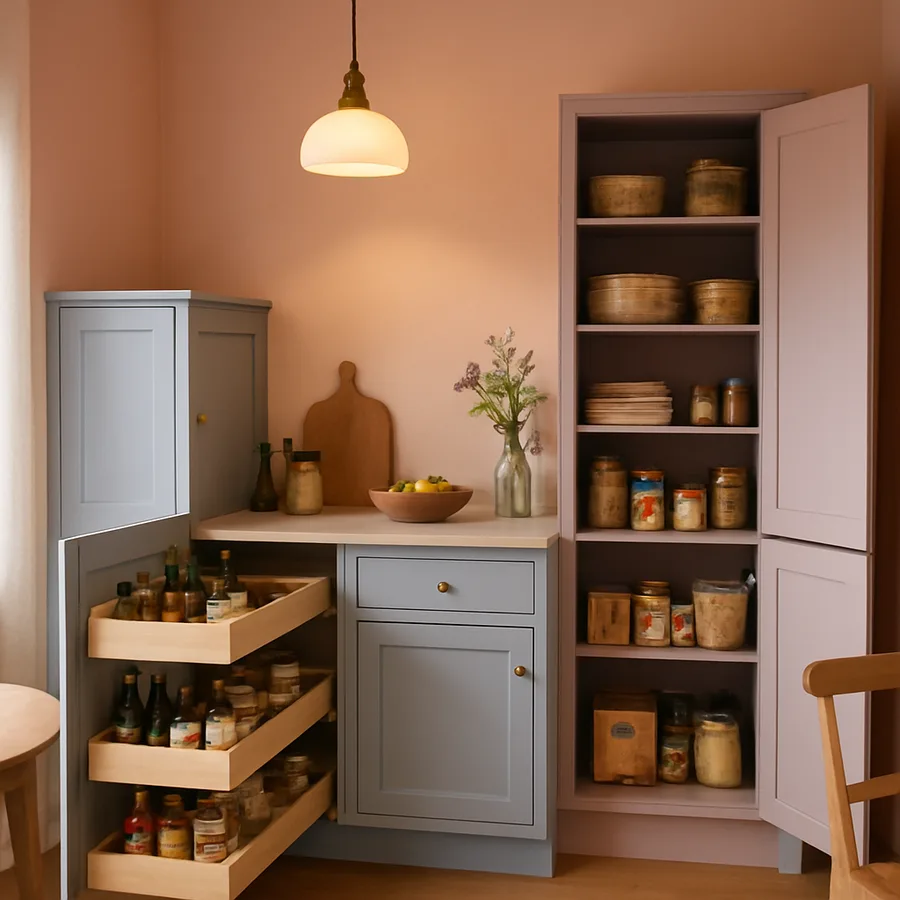
The Storage Debate Every Kitchen Renovation Faces
Choosing between pull-out pantry drawers and fixed shelves is one of those decisions that seems minor during the planning phase but shapes your daily kitchen experience for years. Both options store food. Both fit inside standard pantry cabinets. But the way you interact with each system could not be more different, and that difference compounds over thousands of small moments: reaching for olive oil while cooking, unloading groceries on a Tuesday evening, searching for a specific spice during a holiday dinner. The right choice depends on your habits, your body, and your budget.
Fixed shelves have been the default for generations. They are simple, affordable, and universally understood. You install them, load them up, and that is the end of the story. Pull-out drawers, on the other hand, are a relatively recent mainstream option that emerged from commercial kitchen design and high-end European cabinetry. They slide forward on tracks, bringing the full depth of the shelf out into the open where every item is visible and reachable without contortion.
According to a kitchen design trends survey conducted by the National Kitchen and Bath Association (NKBA), pull-out storage features rank among the top five most-requested upgrades in kitchen renovations. That demand reflects a genuine shift in how homeowners think about accessibility and visibility inside their pantries. But popularity alone does not make something the right fit for every household. A deeper comparison reveals that each system has distinct strengths worth understanding before committing.
This article breaks down the practical differences between pull-out drawers and fixed shelves across six critical dimensions: accessibility, visibility, cost, durability, capacity, and adaptability. By the end, you will have enough concrete information to make a confident decision for your own pantry, whether you are building from scratch or retrofitting an existing space.
Accessibility and Ergonomics
The most compelling argument for pull-out drawers is full-depth access. A standard pantry cabinet runs 22 to 24 inches deep. On a fixed shelf, items at the back sit nearly two feet from the front edge, which means reaching, leaning, and sometimes removing front items just to grab what is behind them. Pull-out drawers eliminate this problem entirely. You pull the drawer forward, and everything from front to back is within arm's reach at a comfortable distance.
For anyone with limited mobility, joint pain, or back problems, this difference is not a luxury; it is a functional necessity. The AARP and aging-in-place design advocates consistently recommend pull-out shelving in kitchens intended for long-term livability. Bending and reaching into deep fixed shelves becomes increasingly difficult with age, and a pantry that requires awkward physical movement discourages regular use. Pull-out drawers keep heavy items like canned goods and bottles accessible without stooping or stretching overhead.
Fixed shelves do offer one ergonomic advantage: they allow you to see and grab items at eye level instantly, without any mechanical action. There is no handle to pull, no drawer to extend, no waiting for the glide to fully open. For the top two or three shelves in a pantry that fall between shoulder and eye height, fixed shelves provide the fastest possible access. The items you use most frequently, those you grab every single day, may actually benefit from the immediacy of a simple fixed shelf at the right height.
Have you considered how many times per day you open your pantry? If the answer is ten or more, the cumulative time spent pulling drawers open and closed adds a small but real friction to your routine. For lower shelves and deep cabinets, that friction is worth it because the alternative is digging blindly into shadows. But for upper zones, fixed shelves remain the more efficient option. The best pantries often combine both: pull-out drawers below waist height and fixed shelves above.
Visibility and Item Tracking
Visibility is where pull-out drawers deliver their most dramatic improvement over fixed shelves. When a drawer extends fully, you gain a bird's-eye view of every item from above. This top-down perspective makes it nearly impossible for items to hide, which directly reduces food waste from forgotten or expired products. The Natural Resources Defense Council (NRDC) reports that American households waste approximately 30 to 40 percent of purchased food annually, and poor pantry visibility is a contributing factor that organized storage can address.
Fixed shelves rely on a front-facing view, which means you see only the first row of items unless you physically move things aside. Deeper pantries amplify this problem. A 24-inch-deep fixed shelf can hide three or four rows of cans behind the front row, and the back row might as well not exist for all the attention it receives. Shelf risers and turntables help, but they are workarounds for a fundamental limitation of the format. You are adding accessories to compensate for a design that does not show you what you own.
Pull-out drawers also make inventory-taking faster and more accurate. When you can see every item by pulling a drawer open, a quick visual scan before grocery shopping takes thirty seconds per drawer. Contrast that with the several minutes required to examine each fixed shelf, moving items forward and checking behind larger containers. For households that meal-plan or maintain a running grocery list, this visibility translates directly into better purchasing decisions and fewer wasted trips to the store.
One visibility advantage that fixed shelves do hold is vertical stacking. Tall items like cereal boxes, wine bottles, and large jars stand upright on fixed shelves and present their labels forward. Pull-out drawers require items to be stored standing up as well, but the drawer sides can block labels on taller items when the drawer is only partially extended. Choosing drawers with low sides, typically 3 to 4 inches, preserves label visibility while still preventing items from sliding during the pull-out motion.
Cost Comparison and Installation Realities
Fixed shelves are the clear winner on upfront cost. A set of five melamine or plywood shelves with basic shelf pins for a standard pantry cabinet costs between 50 and 150 dollars in materials. Installation requires a drill, a level, and an hour of work. There are no moving parts, no hardware to maintain, and no specialized knowledge needed. For budget-conscious renovations or rental properties where you want functional storage without a major investment, fixed shelves remain the practical choice.
Pull-out drawers cost significantly more. A quality full-extension, soft-close drawer slide rated for 75 to 100 pounds runs 30 to 60 dollars per pair, and you need one pair per drawer. The drawer boxes themselves, whether purchased pre-made or built custom, add another 40 to 120 dollars each depending on material. A pantry cabinet with six pull-out drawers can easily cost 400 to 800 dollars in hardware and materials alone, not including professional installation if you hire it out. That is four to eight times the cost of fixed shelves for the same cabinet.
Installation complexity also rises with pull-out drawers. The slides must be mounted perfectly level and parallel, with precise spacing to prevent binding. Shimming, scribing, and careful measurement are essential, and mistakes mean drawers that stick, scrape, or derail under load. A skilled DIYer can handle the work, but it takes three to five hours per cabinet compared to one hour for fixed shelves. Professional installation adds 150 to 300 dollars per cabinet depending on your market, according to estimates from contractors listed on Houzz's professional directory.
Is the higher cost justified? For pantry cabinets deeper than 18 inches, most kitchen designers say yes without hesitation. The usability gains in deep cabinets are substantial enough that the additional expense pays for itself in reduced food waste and improved daily convenience. For shallow pantries under 16 inches deep, the cost-benefit equation tips back toward fixed shelves, which work perfectly well when items are only one or two rows deep. Your pantry's depth is the single most important variable in this financial decision.
Durability and Long-Term Maintenance
Fixed shelves have an almost unlimited lifespan when properly installed. A 3/4-inch plywood shelf supported at the back wall and front edge, with spans no wider than 36 inches, will hold its shape for decades under normal pantry loads. There are no moving parts to wear out, no lubricant to reapply, and no mechanical failure modes. The shelf either holds weight or it does not, and a well-built shelf holds weight essentially forever. Maintenance consists of occasional wiping with a damp cloth.
Pull-out drawer slides, by contrast, are mechanical components subject to wear. Ball-bearing full-extension slides from reputable manufacturers like Blum, Hettich, and Accuride are rated for 50,000 to 100,000 cycles, which translates to roughly 15 to 30 years of daily use. Budget slides from generic brands may last only a fraction of that before developing play, stiffness, or failure. The quality of the slide hardware directly determines how long your pull-out drawers will function smoothly, which makes this a category where spending more upfront saves frustration later.
Drawer boxes themselves can also degrade over time, particularly if made from thin particleboard or stapled joints. A drawer loaded with 40 pounds of canned goods experiences significant stress each time it is pulled and pushed, and weak joints will eventually loosen. Solid wood or Baltic birch plywood drawer boxes with dovetail or dado joints offer the best longevity. If you are investing in pull-out hardware, skimping on the drawer box is a false economy that undermines the entire system within a few years.
Cleaning pull-out drawers is slightly more involved than fixed shelves because spills can reach the slide mechanisms. A sticky jam jar leaking onto a ball-bearing slide can cause stiffness and premature wear. Periodic cleaning of the slides with a dry cloth and light lubrication with a silicone-based spray keeps the action smooth. It is a minor task, perhaps ten minutes twice a year, but it is a maintenance obligation that fixed shelves simply do not have. For households that prefer zero-maintenance solutions, this is worth factoring into the decision.
Storage Capacity and Space Efficiency
At first glance, fixed shelves appear to offer more total storage volume because they have no drawer sides, no slide mechanisms, and no wasted space for hardware. A fixed shelf uses the full width and depth of the cabinet interior. Pull-out drawers sacrifice roughly 1 to 1.5 inches on each side for the slide mechanism, reducing usable width by 2 to 3 inches total. In a 15-inch-wide cabinet, that is a 15 to 20 percent reduction in width, which translates to one fewer column of cans per drawer.
However, effective capacity tells a different story. Fixed shelves may hold more in theory, but pull-out drawers hold more in practice because every item is actually used. The back third of a deep fixed shelf often accumulates forgotten items that expire and get thrown away, contributing nothing to your household's food supply. A pull-out drawer where everything is visible and accessible achieves close to 100 percent utilization. The theoretical capacity advantage of fixed shelves shrinks or disappears entirely when you account for real-world usage patterns.
The National Association of Home Builders (NAHB) has noted that kitchen storage satisfaction correlates more strongly with accessibility than with raw cubic footage. Homeowners with smaller but well-organized pantries consistently report higher satisfaction than those with large, cluttered ones. This finding supports the argument that pull-out drawers, despite their slightly smaller footprint, deliver a better storage experience because they keep inventory visible, rotated, and fully utilized.
What about mixing both systems in the same pantry? This hybrid approach is increasingly popular and arguably the most pragmatic solution. Use pull-out drawers for the lower half of the pantry where deep storage is hardest to access, and install fixed shelves from waist height to the ceiling where items are naturally visible and within reach. This layout captures the ergonomic benefits of drawers where they matter most while preserving the full capacity and simplicity of fixed shelves where they work perfectly well. Many designers featured on Architectural Digest's pantry galleries showcase exactly this combination.
Adaptability to Changing Household Needs
Households change. Children grow up, dietary needs shift, bulk-buying habits evolve, and hobbies like canning or fermenting may come and go. A pantry system that cannot adapt to these changes becomes a source of frustration rather than convenience. Fixed shelves with adjustable pins offer excellent vertical adaptability because you can reposition shelf heights in minutes to accommodate new items. Adding or removing a shelf requires only lifting it off the pins and resetting them at a new height.
Pull-out drawers are less flexible in the vertical dimension. Once the slides are mounted at specific heights, moving a drawer to a different position means unscrewing the slides, filling the old screw holes, and remounting at the new height. This is a 30-to-60-minute job per drawer rather than a 30-second adjustment. If you anticipate frequent changes to your pantry layout, this relative inflexibility is a meaningful drawback. Some high-end systems from manufacturers like NKBA-certified suppliers offer track-based mounting that allows vertical repositioning without new screw holes, but these systems carry a premium price.
In terms of horizontal configuration, pull-out drawers come in various widths and can be mixed: narrow drawers for spices alongside wide drawers for bulk storage. Fixed shelves span the full width of the cabinet uniformly. If your storage needs include both small items and large items in the same vertical zone, pull-out drawers offer more granular control over how that space is subdivided. You can install a half-width spice drawer next to a half-width can drawer at the same height, something that is not possible with a single fixed shelf.
Ultimately, the adaptability question comes down to how settled your household's routines are. A young family with evolving needs benefits from the quick adjustability of fixed shelves on pins. An established household with stable buying habits and clear preferences may find that the optimized access of pull-out drawers serves them better over the long haul. Neither answer is universally correct, and recognizing where your household falls on that spectrum is essential to making the right call for your kitchen.
Conclusion: Matching the System to Your Kitchen Life
The pull-out drawer versus fixed shelf debate does not have a single winner because the best choice depends on your pantry's depth, your physical needs, your budget, and how much you value visibility versus raw storage volume. For deep cabinets over 18 inches, pull-out drawers provide a substantial daily improvement in accessibility and food waste reduction. For shallower cabinets, upper shelves, and tight budgets, fixed shelves remain an excellent and time-tested solution.
The hybrid approach, pull-out drawers below and fixed shelves above, captures the strengths of both systems while minimizing their respective weaknesses. It is the configuration that kitchen design professionals recommend most often, and it works in pantries of virtually any size. If you can afford to invest in quality slide hardware for the lower section and pair it with adjustable fixed shelves above, you will have a pantry that is ergonomic, visible, adaptable, and built to last.
Take fifteen minutes this week to measure your pantry cabinet depths and note which shelves you avoid reaching into. Those avoided zones are where pull-out drawers will make the biggest impact. Start there, invest in quality hardware from a reputable manufacturer, and build out the rest of your pantry with fixed shelves where they already work well. The result will be a storage system tailored to the way you actually cook and shop, not a one-size-fits-all default that ignores your daily reality.
More Articles You May Like



Comments
Post a Comment