Pocket Door vs Barn Door Cost and Privacy Comparison
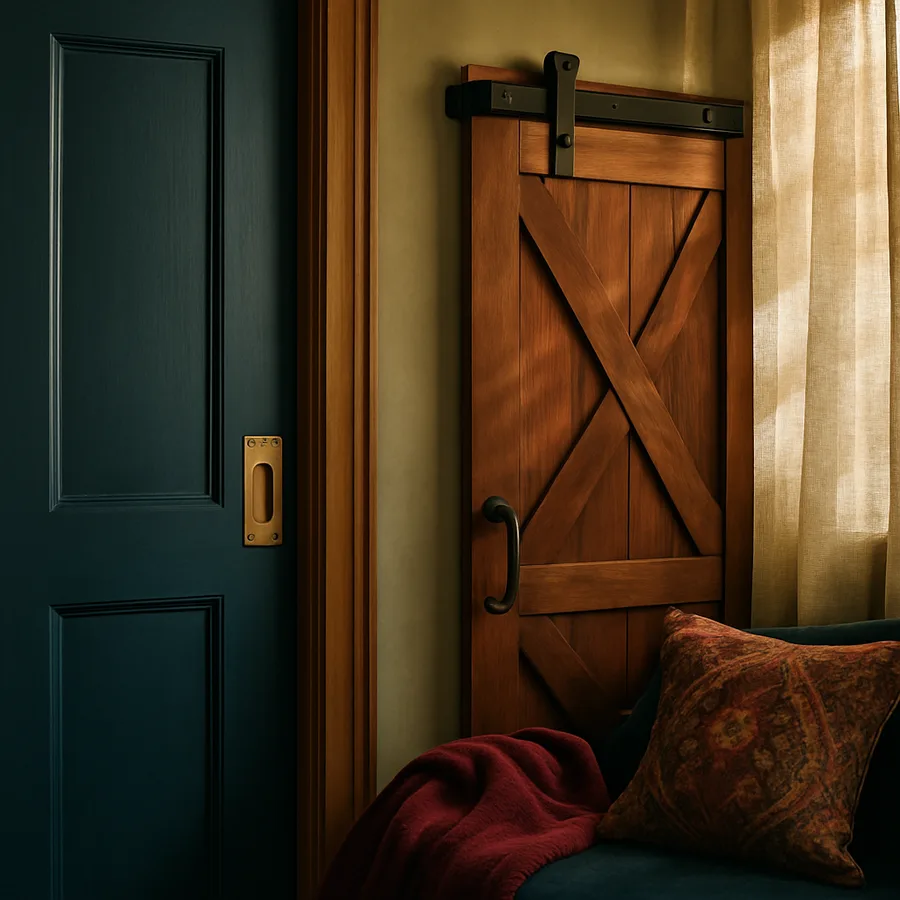
The choice between a pocket door and a barn door comes up in nearly every renovation that involves opening up the layout, and the conversation almost always gets sidetracked into aesthetics before the practical comparison happens. Both doors solve the same basic problem of separating two spaces without consuming the swing arc of a hinged door, but they solve it in profoundly different ways, with cost, privacy, sound, and durability profiles that diverge sharply once you look past the surface. This article compares the two systems on the practical dimensions that actually matter in daily use.
The takeaway up front: pocket doors win on privacy, sound isolation, and clean visual integration at meaningfully higher installed cost; barn doors win on installation simplicity, retrofit cost, and bold aesthetic statements with significant compromises on privacy and sound. Either can be the right answer for a given room, and the wrong choice usually traces back to optimizing for the wrong factor at the spec stage.
Installed Cost: What Each Door Actually Costs to Put In
The sticker price of a barn door kit is one of the loudest selling points for the format, but installed cost tells a more complete story. A basic barn door kit (track, hangers, slab, hardware) runs $400 to $1,200 at home centers, with mid-range and designer kits climbing to $2,500 or more. Installation is straightforward enough that a competent homeowner can handle it in an afternoon, and even professional installation rarely exceeds $300. Total installed cost for a typical barn door: $700 to $3,000, with most installations landing in the $1,000 to $1,800 range.
Pocket doors carry significantly higher installed cost because the frame kit and the labor to install it inside an existing wall are both more expensive. The pocket frame kit alone runs $250 to $800. The slab and hardware add another $300 to $1,500 depending on weight and quality. Installation into an existing wall, including drywall removal and reinstallation, header work if required, and finish painting, runs $1,200 to $4,000 for a single-door installation. Total installed cost for a typical pocket door: $1,800 to $6,500, with most installations landing in the $2,500 to $4,000 range.
The cost gap narrows in new construction, where the pocket frame is installed before drywall and the labor premium largely disappears. New-construction pocket doors typically cost only $400 to $800 more than barn doors of comparable quality. The National Association of Home Builders tracks remodeling cost data and reports that retrofit pocket installations have grown about 18 percent in average cost over the last five years as labor rates have risen, while barn door installations have stayed nearly flat because they require so much less skilled labor. Have you priced both options recently? The gap between them depends heavily on whether the house is being renovated or built from scratch.
Privacy: Locks, Gaps, and What Each Door Actually Closes
Privacy is where the two door types diverge most dramatically. A pocket door, when properly installed with a strike jamb and a privacy lock, closes flush against the jamb on three sides (top, leading edge, and bottom over a small floor reveal). A privacy lock with hook-bolt engagement is widely available and standard on most pocket installations. The result is privacy that approaches a conventional swing door, suitable for bathrooms, bedrooms, and home offices.
A barn door, by contrast, hangs in front of the wall opening with significant gaps on every side. The slab is typically 1 to 2 inches wider than the opening and overlaps the wall around the opening, but the gap between the slab and the wall surface is usually 1/2 inch to 3/4 inch. The top and sides have visible light gaps, and the bottom usually has a 1 inch or larger floor gap to allow for floor variation. Privacy locks for barn doors do exist, with brands like Goldberg Brothers and Real Sliding Hardware offering surface-mounted hook locks that engage the wall, but the locks are visually obvious and offer only modest privacy compared to a pocket door lock.
For bathrooms specifically, this gap matters enormously. Light, sound, and odor all pass freely through the gaps around a barn door, which is why building inspectors and the International Code Council have raised concerns about barn doors as primary bathroom doors. Some jurisdictions now require additional measures (such as supplemental ventilation or warning labels) when barn doors are used on bathrooms in new construction. Pocket doors, with their tighter seal, raise none of these issues.
Sound Transmission: STC Ratings and Real-World Performance
The acoustic performance of a door is measured by Sound Transmission Class (STC), with higher numbers blocking more sound. A solid-core pocket door installed with a tight strike jamb and a soft-close achieves STC 28 to 32, comparable to a typical interior swing door. With acoustic seals around the jamb (available as upgrade kits from most premium frame manufacturers), the rating climbs to STC 35 to 40, which begins to provide meaningful conversation privacy.
A barn door, hanging in front of an open wall with gaps on all sides, performs much worse. Even a heavy solid-core barn door slab achieves only STC 18 to 22 in typical installations because the gaps around the slab dominate the sound transmission. Adding brush seals around the door perimeter can raise the rating to STC 24 to 26, but these brush seals are visually obvious, wear out within a few years, and never approach the performance of a properly sealed pocket door.
For rooms where sound matters (bedrooms, home offices, media rooms, bathrooms), the STC difference between the two door types is the single biggest functional gap. A 10-point STC difference is the difference between hearing a conversation clearly through the door and hearing only muffled tones. The American Institute of Architects publishes acoustic guidelines for residential interiors that recommend STC 30 minimum for bedroom doors, which barn doors cannot achieve in standard configurations. If acoustic privacy is a real requirement, the door choice is largely made for you.
Installation Complexity and Retrofit Considerations
Installation complexity is the area where barn doors win decisively. A barn door installation requires only mounting a track to the wall above the opening, hanging the slab, and installing a floor guide and a wall-mounted handle. The wall behind the door is untouched. Total installation time for a competent installer is two to four hours, and the project disturbs no finishes other than four to six lag-bolt holes in the wall above the opening. The track is the only structural concern, and a 2x6 mounting board lag-bolted into wall studs handles any residential door.
Pocket door retrofits, as covered in detail elsewhere in this guide series, require opening at least one face of the wall, removing existing studs, installing a frame kit, possibly engineering a new header, and finishing the drywall back to invisible. Even with the keystone-cut method that preserves one wall face, a pocket retrofit is a 16 to 32 hour project for a skilled remodeler, requires a clean drywall finish to look right, and creates dust and disruption that affects the surrounding rooms.
This installation gap is the single biggest argument for barn doors in retrofit applications. If the wall geometry simply will not support a pocket door (because of plumbing, wiring, or structural conflicts), a barn door is the only sliding option. This Old House has documented many renovations where barn doors were chosen specifically because pocket doors were impossible, and the resulting installations work well as long as the privacy and acoustic limitations are accepted at the spec stage rather than discovered later.
Aesthetic Vocabulary and Style Compatibility
The two door types speak different visual languages. Pocket doors disappear into the wall when open, leaving only the head jamb and the floor channel as evidence they exist. The aesthetic effect is one of seamless space-making, where the wall opening can transform between fully open and fully closed without any visible apparatus. This makes pocket doors the natural choice for minimalist contemporary, transitional, and historically inspired interiors where the door should not draw attention to itself.
Barn doors are the opposite. The slab, the track, and the hardware are all fully visible at all times, and the door becomes a primary aesthetic element of the room whether you want it to or not. This works beautifully in farmhouse, industrial, rustic, and modern eclectic interiors where a bold sliding element is part of the design vocabulary. It works less well in formal traditional, historically accurate, or quiet contemporary interiors where the visible track and hardware feel like an interruption.
Hardware quality affects both door types but in different ways. A poorly chosen barn door track looks like a hardware-store afterthought; a well-chosen Krownlab or Goldberg Brothers track reads as intentional design. A poorly chosen pocket door pull and edge pull combination can make even a well-installed pocket look cheap; well-chosen Emtek or Hafele hardware reads as luxury. The American Society of Interior Designers consistently rates door hardware as one of the highest-impact-per-dollar specifications in residential design, and that holds true for both door types.
Choosing Between Them: A Decision Framework
The decision between pocket and barn doors comes down to four questions in order. First, does the wall support a pocket installation? Answer with a borescope inspection and an honest assessment of structural and mechanical conflicts. If no, the choice is barn or swing door. Second, is privacy or sound isolation a real requirement? Bathrooms, bedrooms, and home offices say yes; closets, pantries, and aesthetic dividers between living spaces say no. If yes, pocket door wins decisively.
Third, does the architectural style favor visible or hidden hardware? Farmhouse, industrial, and rustic say visible (barn); contemporary, transitional, and historical say hidden (pocket). Fourth, does the budget support the higher installed cost of a pocket door? In retrofit applications, the cost gap is significant and may be the deciding factor regardless of the other considerations. The National Association of the Remodeling Industry reports that homeowners who choose barn doors on cost grounds and later wish they had spent on pocket doors usually cite the privacy and sound issues as the reason for the regret, and the inverse case (choosing pocket and wishing for barn) is much rarer.
One more practical question: where does the door go when open? A barn door slides along the wall and consumes wall length on one side of the opening; pictures, switches, outlets, and adjacent doorways all have to clear the door's parked position. A pocket door consumes wall length inside the wall, leaving the wall surface entirely available for art, light fixtures, and switches. For walls with active wall surfaces, this is often the deciding factor.
Conclusion
The pocket door versus barn door comparison is rarely won decisively by either side because the two doors solve subtly different problems. Pocket doors are the choice when privacy, sound isolation, and seamless visual integration matter; barn doors are the choice when retrofit cost, installation simplicity, and visible hardware aesthetics matter. The middle ground (a moderate-quality installation of either type) usually performs adequately for its intended use as long as the choice was matched to the requirements at the spec stage.
Cost matters but should not dominate the decision. The cost gap in a retrofit typically runs $1,000 to $4,000, which seems large in isolation but is small relative to the overall project budget for any renovation that involves opening up walls. Spending the additional money for a pocket door makes sense when the room genuinely needs the privacy and acoustic benefits; saving the money on a barn door makes sense when those benefits are not needed and the visible hardware suits the aesthetic.
The most successful installations of either type share a common discipline: the door type is chosen at the schematic design stage based on use case, and the design develops around that choice rather than discovering halfway through that the wrong door was specified. Make the choice early, document the reasoning, and resist the pressure to switch types late in the process when contingencies emerge. The door you live with for the next twenty years should be the door that best fits the use, not the door that was easiest to install when the framing started.
Trying to decide between pocket and barn doors for a specific opening? Walk through the four-question decision framework in this article using your actual room, then mock up both options at full scale with painter's tape and a piece of cardboard. Living with the mock-up for a few days surfaces issues that no spec sheet can predict, from how the open door interacts with sight lines to how the closed door affects light and airflow in the adjoining space. The cost of two days of mock-up is essentially zero, and the insight it provides is what separates a satisfied installation from a regretful one.
More Articles You May Like



Comments
Post a Comment