Small Pantry Door Alternatives: Barn Doors, Pocket Doors, Curtains
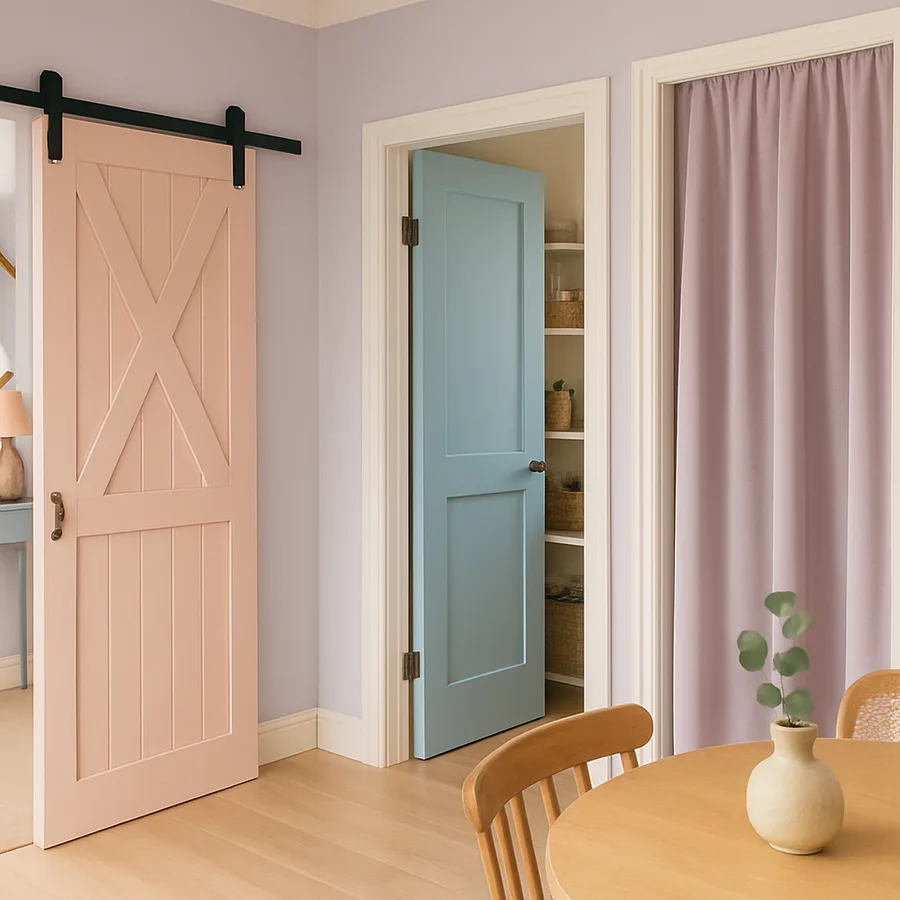
When a Standard Door Simply Does Not Fit
Standard hinged doors need roughly 9 square feet of clear floor space to swing open, and in a small kitchen, that arc collides with islands, appliances, traffic paths, and other cabinet doors. For pantries tucked into tight corners or narrow alcoves, the standard door becomes an obstacle rather than a convenience. You end up opening it partway, squeezing through the gap, and bumping into it every time you walk past. The door that is supposed to provide access ends up restricting it, and that daily friction adds up over months and years of cooking.
The good news is that alternative door systems have matured considerably in both quality and variety. Barn doors, pocket doors, and curtains each solve the clearance problem in a different way, and each brings its own set of trade-offs in terms of cost, installation complexity, aesthetics, and sound isolation. None of them require the swing radius that makes standard doors impractical in small kitchens, and all three have been embraced by professional designers for exactly that reason.
The American Society of Interior Designers (ASID) has noted a sustained increase in client requests for alternative door solutions in kitchens and pantries, driven partly by the popularity of open-concept floor plans where every square inch of floor space matters. When the kitchen, living room, and dining area share a single open volume, a pantry door that swings into the cooking zone disrupts movement through the entire space. Eliminating that swing radius is not just a pantry improvement; it is a whole-kitchen improvement.
Choosing the right alternative depends on three factors: how much wall space you have adjacent to the pantry opening, whether you need full closure for dust and pest control, and how much you want to invest. The following sections examine each option in detail so you can match the solution to your specific situation rather than following a trend that might not serve your home.
Barn Doors: Statement Pieces That Slide
The sliding barn door mounts on a track above the pantry opening and glides horizontally along the wall beside it. Because the door moves parallel to the wall rather than swinging into the room, it requires zero floor clearance. A barn door needs only a few inches of depth for the track hardware and the door slab itself, making it one of the most space-efficient closure options available. The visual impact is significant, too: a well-chosen barn door becomes a design focal point in the kitchen rather than a utilitarian afterthought.
Installation requires a clear wall section beside the pantry opening that is at least as wide as the opening itself. If your pantry doorway is 30 inches wide, you need 30 inches of unobstructed wall to the left or right for the door to slide into when open. This wall section cannot have light switches, outlets, or other doors within the slide path. Measure carefully before purchasing hardware, because a barn door with nowhere to park when open defeats the entire purpose. The track must be anchored into wall studs or a structural header, as a loaded barn door and hardware assembly can weigh 80 to 150 pounds depending on the door material.
Material choices range from reclaimed wood planks that embrace the rustic origin of the barn door concept to sleek painted MDF panels, frosted glass, and metal-framed designs that suit modern and transitional kitchens. A solid wood barn door provides excellent visual privacy and decent sound dampening, though it does not seal as tightly as a hinged door because of the necessary gap between the door face and the wall. For pantry applications, this gap is rarely a problem; you are blocking sightlines, not soundproofing a recording studio.
Cost for a barn door system varies widely. A basic hardware kit with a flat-track rail, rollers, and guide runs 80 to 200 dollars from manufacturers like Winsoon and Smartstandard. The door slab itself ranges from 100 dollars for a simple hollow-core panel to 600 dollars or more for a custom solid-wood design. Professional installation adds 200 to 400 dollars. All told, a complete barn door installation runs between 400 and 1,200 dollars, which is competitive with replacing a standard door and frame. According to remodeling cost data compiled by Houzz, barn doors consistently rank among the most cost-effective kitchen upgrades relative to their visual and functional impact.
Pocket Doors: The Invisible Solution
A pocket door slides into a cavity within the wall itself, disappearing completely when open. This is the cleanest solution aesthetically because the door is simply gone when you do not need it. No hardware is visible, no door slab occupies wall space, and the pantry opening stands fully clear. When closed, a pocket door looks identical to a standard hinged door, providing complete visual and physical separation. For small pantries where both floor space and wall space are limited, the pocket door is often the only option that does not compromise something.
The trade-off is installation complexity. Pocket doors require a wall cavity that is free of plumbing, electrical wiring, and structural elements. The cavity must be at least twice as deep as a standard stud wall to house the door slab and the track mechanism. Most pocket door installations use a specialized split-stud frame system that replaces the existing wall framing around the opening. This is a significant construction project, typically requiring drywall removal, reframing, and drywall repair on both sides of the wall. It is not a weekend DIY project for most homeowners.
Modern pocket door hardware has improved dramatically over the older systems that many people associate with sticky, rattling, derailing doors. Contemporary soft-close pocket door kits from manufacturers like Johnson Hardware and Hafele use precision ball-bearing carriages that glide smoothly and retract the door gently into the pocket without slamming. These systems are rated for 100,000 cycles or more and carry weight ratings of 100 to 200 pounds, which accommodates any standard interior door slab. The unreliability that gave pocket doors a bad reputation in previous decades is largely a solved problem with current hardware.
Is a pocket door worth the construction effort for a pantry? If you are already opening walls as part of a kitchen renovation, the incremental cost and labor to add a pocket door frame are modest: roughly 150 to 300 dollars for the frame kit and an additional half-day of carpentry. If the wall is not already open, the project becomes more invasive and expensive, potentially 800 to 1,500 dollars including drywall work and painting. The National Kitchen and Bath Association (NKBA) considers pocket doors a premium feature that adds both resale value and daily usability, making them a sound investment when the wall conditions permit.
Curtains and Fabric Panels: Soft, Simple, and Affordable
For homeowners who want a fast, budget-friendly solution with easy reversibility, fabric curtains over a pantry opening deliver surprising results. A tension rod or a simple curtain rod mounted above the opening supports a fabric panel that can be pulled aside with one hand. The cost is minimal: a tension rod runs 10 to 20 dollars, and a single curtain panel costs 15 to 50 dollars depending on fabric quality. Total installation time is under 15 minutes with no tools required if using a tension rod, or 20 minutes with a drill for a mounted rod.
The aesthetic range of curtain options is broader than most people realize. A heavy linen panel in a neutral tone creates a relaxed, European-farmhouse feel. A crisp cotton canvas in white or cream suits coastal and Scandinavian interiors. A patterned fabric can introduce color and texture to an otherwise plain kitchen wall. Unlike rigid door systems, curtains can be swapped seasonally or whenever you want a fresh look, making them the most adaptable option by far. Renters who cannot make permanent modifications to their kitchens find curtains especially valuable.
The functional limitations of curtains are real but manageable. Fabric does not seal against dust, pests, or odors the way a solid door does. In regions with pantry pest concerns, such as weevils or pantry moths, a curtain alone may not provide sufficient protection, and you would need to rely on airtight containers for your dry goods regardless. Curtains also offer no sound dampening, which is irrelevant for a pantry but worth noting for completeness. And fabric requires periodic washing, especially in kitchens where cooking grease and steam can settle on nearby surfaces.
Have you dismissed curtains as too informal for your kitchen? Consider the approach used by many high-end European kitchens, where tailored fabric panels with weighted hems and clean pleats serve as deliberate design elements rather than afterthoughts. A floor-length linen curtain with a Roman shade header, mounted inside the pantry frame, looks polished and intentional. Interior design publications like Architectural Digest regularly feature fabric pantry covers in professionally designed kitchens, demonstrating that the approach can work at any style level when executed thoughtfully.
Comparing the Three Options: A Practical Breakdown
Choosing between barn doors, pocket doors, and curtains comes down to evaluating five practical criteria for your specific situation. Space requirements favor curtains (zero wall or floor space needed) and pocket doors (zero visible space when open), while barn doors need a clear wall section equal to the opening width. If your pantry is flanked by a refrigerator on one side and a window on the other, a barn door has nowhere to slide and is eliminated immediately.
Budget clearly favors curtains at 25 to 70 dollars total, followed by barn doors at 400 to 1,200 dollars, and pocket doors at 300 to 1,500 dollars depending on whether the wall is already open. However, budget alone should not drive the decision. A pocket door installed during a renovation adds permanent value to the home, while a curtain adds none. A barn door adds visual character that can increase a kitchen's appeal to future buyers. Consider the investment horizon: are you staying in this home for two years or twenty?
Closure quality ranks pocket doors first (they seal nearly as well as hinged doors), barn doors second (a small gap remains between door and wall), and curtains third (fabric drapes but does not seal). If keeping pantry contents hidden from view is important, perhaps because the pantry is visible from a dining area or living room, the pocket door provides the most complete concealment. Barn doors cover the opening but leave a visible gap at the edges. Curtains move with air currents and may not hang perfectly flat at all times.
Installation difficulty reverses the order: curtains are trivially easy, barn doors require moderate skill with a drill and level, and pocket doors demand significant carpentry or professional help. If you are renting, curtains are the only realistic option. If you are doing a light renovation with intact walls, barn doors make the most sense. If you are gutting the kitchen to the studs, a pocket door costs relatively little to add and delivers the best long-term result. Match the installation scope to the renovation scope.
Creative Variations and Hybrid Approaches
Beyond the three main categories, several hybrid and unconventional options deserve consideration. Bifold doors fold flat against the wall beside the opening, requiring half the swing space of a standard door. They work well for wider pantry openings (36 to 48 inches) where a single barn door slab would be impractically large. Bifold doors are available in louvered, paneled, and glass-insert styles, and they mount on a simple overhead track that most DIYers can install in under an hour.
Beaded curtains or bamboo strand curtains offer a distinctive alternative for kitchens with bohemian, eclectic, or tropical design themes. They provide a visual boundary and a tactile signal that you are entering a different zone, but they do not block sightlines or seal the opening. Beaded curtains work best for open pantries where the contents are deliberately organized and displayed rather than hidden. They also allow air circulation, which can be beneficial in pantries that tend to trap humidity.
A Dutch door, split horizontally into upper and lower halves that open independently, offers an unexpected pantry solution with genuine practical benefits. The lower half stays closed to contain pets and toddlers while the upper half opens for quick access. This configuration is especially useful for pantries at the end of a hallway or in a corner where the door opening is visible from the main living area. The upper half opens like a window into the pantry, creating a charming visual connection. Dutch doors require swing clearance like standard doors, but only the lower half needs to clear floor-level obstacles.
For the most seamless look, consider a concealed or jib door that is designed to blend with the surrounding wall surface. The door panel matches the wall texture, paint color, and trim profile so closely that it becomes nearly invisible when closed. Push-latch hardware eliminates the need for visible handles. This approach works beautifully in minimalist and modern kitchens where the pantry is meant to disappear entirely when not in use. The ASID has highlighted concealed doors as a growing trend in residential design, particularly in open-concept homes where visual clutter reduction is a priority.
Conclusion: Choosing the Right Door for Your Pantry and Lifestyle
The best pantry door alternative is the one that solves your specific problem without creating new ones. If floor space is your primary constraint, all three main options, barn doors, pocket doors, and curtains, eliminate the swing radius that standard doors demand. If budget is the driving factor, a well-chosen curtain panel delivers immediate improvement for under 50 dollars. If you want a permanent architectural upgrade that adds resale value and design interest, a barn door or pocket door is worth the higher investment.
Consider the broader context of your kitchen before committing. A barn door adds character and becomes a visual anchor in the room, which is wonderful if your kitchen needs a focal point but potentially overwhelming if the space is already busy with competing design elements. A pocket door contributes subtlety and sophistication, disappearing when it is not needed and presenting a clean face when it is. A curtain adds softness and warmth, qualities that hard-surfaced kitchens often lack. Each option shapes the kitchen's personality as much as it solves a practical problem.
Measure the wall space beside your pantry opening and the clearance in front of it this weekend. Those two numbers will immediately tell you which options are feasible for your layout. From there, weigh your budget, your renovation timeline, and your design preferences to select the solution that fits your kitchen and your life. A certified kitchen designer through the NKBA can help you evaluate structural feasibility if you are considering a pocket door, or you can start with a curtain today and upgrade later when the time and budget align.
More Articles You May Like



Comments
Post a Comment