Piano Room Acoustic Treatment to Avoid Harsh Bright Sound
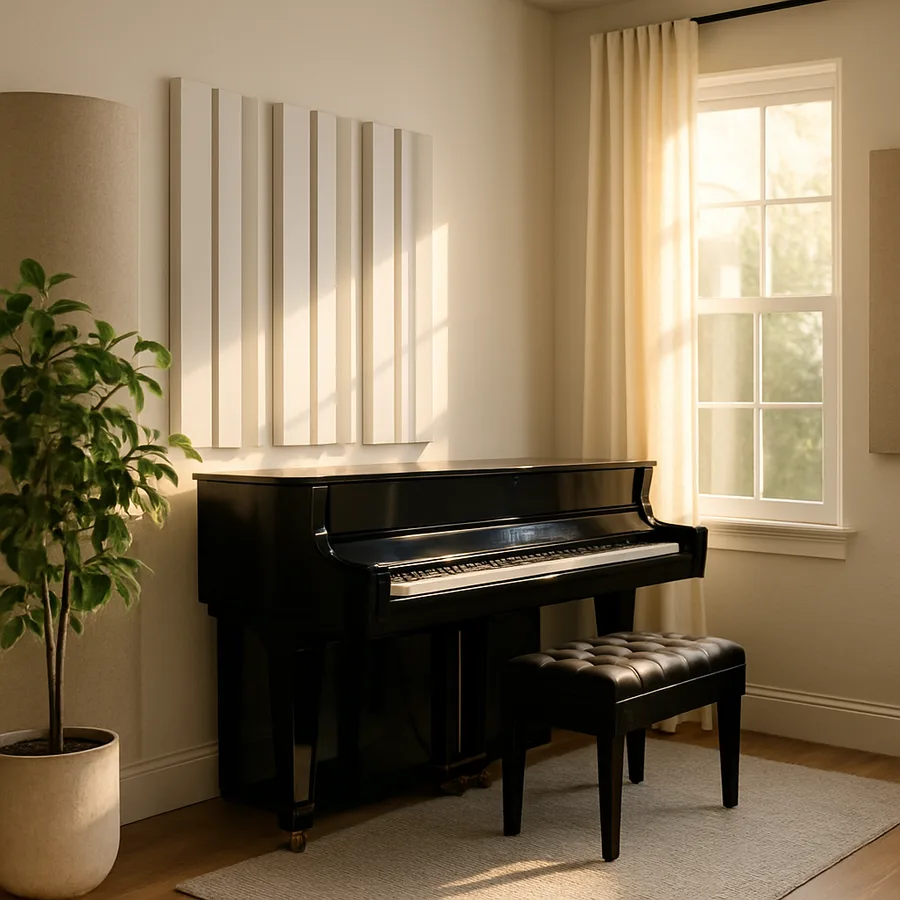
A new grand piano arrives, the movers leave, and the owner sits down to play the first chord in the carefully chosen music room. Then the chord lands, and the room screams. The treble is glassy, the high octaves bite, the soft pedal does almost nothing, and the instrument that sounded warm in the showroom now sounds like it is being amplified through tile. This is the most common piano-room complaint in residential acoustics, and it is rarely the piano's fault. It is the room misbehaving, and the cure is well understood, well documented, and very rarely applied correctly.
This guide explains why so many home piano rooms sound harsh and bright, and what to do about it without turning the space into a studio control room. The goal is not a dead, flat, recording-engineer's room; it is a musically pleasing space that flatters the instrument across its dynamic range, supports practice without listener fatigue, and feels like a room people want to spend time in. Done well, the treatment is also nearly invisible, integrated into millwork, ceiling details, drapery, and rugs that read as interior design rather than as acoustic engineering.
Why So Many Piano Rooms Sound Harsh
The harshness people describe is almost always a combination of three measurable problems. The first is excess reverberation in the upper midrange and lower treble, typically between roughly 1 kHz and 5 kHz, where the human ear is most sensitive. A small living room with hardwood floors, plaster walls, and large windows will routinely measure a reverberation time above 0.8 seconds in that band, which is more than twice what feels comfortable for a piano played at normal practice volume. The second problem is strong early reflections from nearby parallel walls, which arrive within milliseconds of the direct sound and confuse the brain's localization, producing the "in your face" quality players describe.
The third problem is the often-overlooked low-frequency boom that hides under the harshness. Rooms with strong low-frequency room modes pump bass energy in standing-wave patterns, and the brain compensates by hearing the unmasked treble as relatively brighter than it actually is. A room that is too live in the treble and too modal in the bass is the classic small-room signature, and treating only the treble side of the problem will leave the player frustrated even after thousands of dollars of fabric panels go up. The Acoustical Society of America's small-room tutorials document this coupling clearly, and any serious residential treatment plan addresses both bands.
Have you ever closed your eyes during a passage in your own piano room and felt the high octaves ringing in your ears for a second after the keys release? That is the upper-midrange decay tail, and it is the single most common cause of practice fatigue in untreated home piano rooms.
Setting a Reverberation-Time Target
Before placing a single panel, set a numeric target. For a residential piano room of roughly 1,500 to 3,000 cubic feet, a useful working target is a mid-band reverberation time, called RT60, of approximately 0.4 to 0.6 seconds, sloping gently upward toward the bass. That target is consistent with the ranges discussed in the Audio Engineering Society's small-room literature and matches what working piano teachers typically describe as a comfortable practice acoustic. Larger formal music rooms and home recital spaces can comfortably run a little longer, up to roughly 0.8 seconds, before clarity starts to suffer.
The target is achievable with surprisingly modest treatment when the room is approached as a system. A single thick wool rug under the piano, lined floor-to-ceiling drapery on a single window wall, an upholstered seating cluster, and a few cleverly placed absorptive panels will routinely take a small living room from RT60 around 1.0 seconds to roughly 0.5 seconds at 1 kHz, which is close enough to the target that most players hear the room "click into focus." Measurement is cheap; the Audio Engineering Society has published procedures that work fine with a calibrated USB microphone and freely available software, and one weekend of measurement before treatment will save thousands of dollars of guessing.
A second worthwhile target is the ratio of high-frequency to low-frequency reverberation. A pleasant piano room has slightly more bass decay than treble decay; the bass should feel supported, not overwhelming, while the treble should feel quick and clear, not metallic. If your room measures the opposite ratio, with longer treble decay than bass decay, the piano will sound bright no matter how much money you have spent on the instrument.
Distributed Absorption Beats a Single Big Panel
The single biggest mistake in residential piano-room treatment is concentrating absorption on one surface, usually the wall behind the piano, and leaving the rest of the room reflective. Concentrated absorption creates a directional dead spot that the player feels as the piano "disappearing into the wall," while the rest of the room continues to ring. The pleasing approach is the opposite: distribute moderate-strength absorption across many surfaces so that the energy decay is uniform in time and direction rather than localized.
A working distribution for a typical residential piano room places one to two inches of high-density mineral wool wrapped in fabric on roughly 15 to 25 percent of the wall surface area, broken into several smaller panels rather than one continuous installation. Add a heavy lined drapery on at least one window wall, draped with at least 50 percent fullness so the fabric wave itself contributes to scattering, and a thick wool rug at least as large as the piano's footprint plus four feet on the keyboard side, where the player's primary listening position lives.
For the ceiling, the highest-leverage move is a coffered or beamed treatment that breaks up the parallel-surface relationship between ceiling and floor. A coffered ceiling with shallow panels of dense mineral wool inside each coffer is acoustically excellent and visually reads as traditional millwork; many owners do not realize the room is treated until they look up. The American Home Furnishings Alliance and several traditional millwork associations have published reference details that meet both the acoustic and the aesthetic targets simultaneously.
Bass Traps Are Not Optional
Skipping low-frequency treatment is the second great mistake. Every rectangular room has predictable low-frequency room modes, calculable from the simple ratio of length, width, and height, and these modes pump bass energy into standing-wave hot spots and nulls. A piano with a strong low register, played in a small untreated room, will sound boomy at some notes and thin at others depending entirely on where the listener's head sits relative to those modes, and no amount of upper-midrange absorption will fix that.
The solution is broadband corner treatment. Vertical bass traps in the room's vertical corners, ideally floor to ceiling, addressing the highest-pressure points for low-frequency modes. A practical residential build is a triangular prism filled with stacked 4-inch mineral wool, faced with acoustically transparent fabric and integrated into the room's millwork as a built-in bookcase or display niche so it disappears into the design. Even a partial treatment, treating just two opposite vertical corners, typically buys five or six decibels of reduction at the worst modal frequency, which is audible and substantial.
Two questions come up constantly. First, do you really need bass traps if the room "doesn't sound boomy"? Yes, because human ears adapt quickly to a steady-state bass coloration, and the piano will still sound subjectively "harsh" because the brain compensates for the unheard boom by perceiving the treble as brighter. Second, what about the often-recommended idea of leaving an air gap behind a thin absorber to extend its low-frequency reach? That works, but the gap-extended approach is much less effective than a thick corner trap of equivalent depth, so prefer thickness over cleverness when corners are available.
Furniture, Layout, and the Player's Ears
The piano's position in the room matters more than most owners realize. Pulling a grand piano even two feet away from the nearest wall meaningfully reduces the strength of the wall's first reflection back into the player's ears, and angling the instrument so the lid does not fire directly at a parallel wall reduces flutter echo dramatically. A working rule for grands is to place the bend of the case at roughly the diagonal of the room rather than parallel to a wall, with the lid opening into the largest open volume rather than into a near-wall.
For uprights, the back of the instrument should face a treated rather than a bare wall, because most of the soundboard radiation exits through the back. A heavy wool tapestry, a built-in bookcase loaded with irregular books, or a fabric-wrapped panel behind an upright will all soften the upright's notoriously direct treble and bring the instrument's tone closer to what the manufacturer voiced it for. Do not push an upright tight against a hard wall; one or two inches of air gap behind the instrument adds negligible visual difference and changes the tone audibly.
Furniture also helps. Upholstered seating, even a single deep sofa with high arms and back, contributes meaningful absorption in the lower midrange where panel absorbers struggle. A piano room with a comfortable conversation grouping in front of the instrument almost always sounds better than a piano-only room, partly because of the absorption and partly because the additional shapes scatter rather than reflect midrange energy.
HVAC Noise, Lighting Hum, and the Quiet-Floor Problem
Acoustic treatment fixes how the room sounds, but the room also has to be quiet enough to play in. A piano room with a noisy supply diffuser blowing 35 dBA into the listening position will mask the instrument's softest dynamics, and fortissimo will feel like the only honest volume. ASHRAE's noise criteria guidelines for residential music spaces target roughly NC 25 or quieter, which usually requires a larger supply diffuser sized for low face velocity, a duct silencer if the system is shared, and careful selection of the diffuser face geometry to avoid throw turbulence at low flows.
Lighting is the second silent contributor. Cheap LED drivers introduce audible buzz at distances of a few feet, and a piano played at pianissimo will sit right at the noise floor of a poorly chosen recessed fixture. Specify low-noise drivers, dim from a quiet electronic dimmer rather than a buzzy magnetic one, and keep dimmers physically distant from the listening area when possible. The National Electrical Manufacturers Association publishes test methods for lighting electromagnetic noise that responsible manufacturers report against, and choosing fixtures whose data sheets include those numbers is a useful filter.
Squeaky wood floors are the third common offender; a player who shifts weight on the bench will hear the floor click before the instrument's softest note finishes decaying. If the floor is original to a renovated room, screw the subfloor down through the finish layer before laying the rug, and use a thick felt or wool rug pad under the piano rug rather than a thin synthetic one. The American Home Furnishings Alliance's residential rug guidance covers underlayment thickness ranges that work well acoustically while still letting the rug breathe.
Conclusion
A piano room that flatters the instrument is not a dead room and not a live room; it is a tuned room. The tuning sets a mid-band reverberation time near half a second, distributes absorption around the room rather than concentrating it on one wall, treats the corners for the low end that most owners forget, and locates the instrument so its first reflections do not slap straight back into the player's ears. Each of those moves is well-documented in the published acoustical literature, and each of them is achievable with materials that read as interior design rather than as studio gear.
The rooms that succeed are the ones treated as a system rather than as a checklist. Fabric panels alone will not fix a boomy room, drapery alone will not fix a flutter-echo ceiling, and a rug alone will not fix a hard parallel-wall slap. The synergy comes from layering moderate amounts of absorption, scattering, and modal control across many surfaces, and from choosing a piano position and a furniture layout that supports rather than fights the treatment.
If your piano sounds harsh and bright, please resist the temptation to start with a wall of foam panels behind the instrument. Take a measurement first, set a numeric reverberation target, and treat the corners and ceiling before the walls. The Acoustical Society of America's published room-mode calculators and the Audio Engineering Society's small-room references will give you a credible plan in an evening, and the materials list for that plan will be a fraction of what most owners spend on guesswork.
Ready to hear your instrument the way the voicer intended it? Start with a calibrated mic and a room sweep, calculate your room's modal frequencies, and design from the bass up rather than the treble down. The harshness you blamed on the piano will quietly disappear into the rug, the drapery, the ceiling coffers, and the corner traps, and the instrument will finally sound like itself.
More Articles You May Like


Comments
Post a Comment