Mural Wallpaper for Dining Rooms and Powder Room Statement Walls
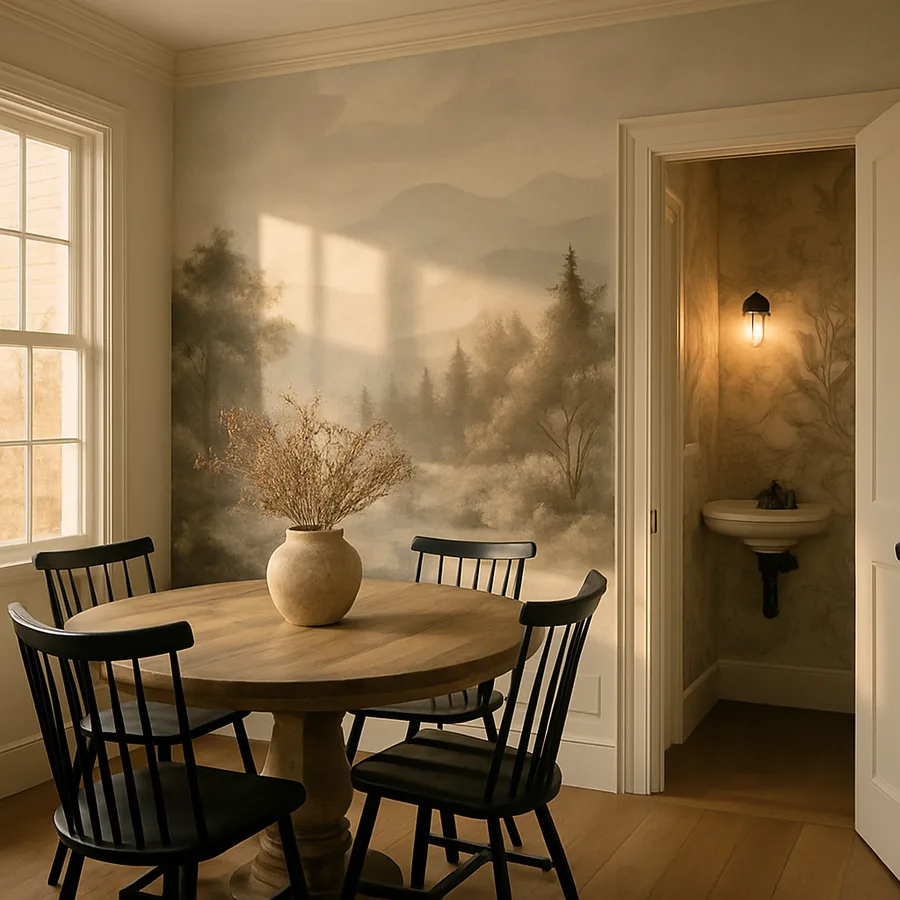
Two rooms in most homes are uniquely suited to mural wallpaper, and most homeowners install it in neither. Dining rooms are physically and emotionally framed for immersive visual statements, diners sit for extended periods facing the same walls, and the room functions almost as a small theater for the meal. Powder rooms are the smallest and most architecturally bounded rooms in the home, where guests spend a few minutes alone with whatever the walls do, and where the design risk-reward ratio dramatically favors bold choices that would overwhelm larger spaces.
Mural wallpaper, distinct from repeating-pattern wallpaper, treats the wall as a continuous painted or photographic image, a chinoiserie garden scene, a hand-painted landscape, an abstract gradient field, an architectural perspective, a botanical study. Done well, mural wallpaper functions as installed art at a fraction of the cost of equivalent gallery painting. Done poorly, it dominates a room in ways that fight rather than enhance the architecture. This guide walks through mural categories, the dining and powder room conditions that favor each, installation realities, cost benchmarks, and the design moves that separate magazine-worthy results from regrettable purchases.
The Mural Categories That Define the Market
Mural wallpaper divides into four distinct categories, each with different aesthetic vocabularies, price ranges, and installation requirements. The first is hand-painted chinoiserie murals, the historical category that defines the genre and still represents its luxury peak. These are painted by artisans on silk or specialty paper, often in studios in China, the UK, or France, and feature naturalistic flora, fauna, and landscape scenes in the chinoiserie tradition. They run $400 to $1,200 per panel, with a typical dining room requiring 8 to 16 panels.
The second category is printed scenic murals, which reproduce hand-painted artwork or photographic imagery using high-resolution digital printing on paper or vinyl substrates. Quality varies enormously across this category. Premium printed murals from established design houses (de Gournay's printed line, Paul Montgomery, several European studios) deliver near-hand-painted quality at $200 to $600 per panel. Mid-market printed murals from companies like Anthropologie, Rebel Walls, and Spoonflower run $30 to $120 per panel and serve well in less critical applications.
The third category is contemporary photographic and abstract murals, which depart from traditional scenic vocabulary and use photography, large-scale abstract painting, or graphic design as source material. This category has expanded dramatically with digital printing capabilities and now includes everything from museum-quality reproductions of fine art to original commissioned work from contemporary illustrators. Prices range from $50 to $1,500 per installation depending on source and exclusivity. The fourth category is custom-designed murals, where a designer or artist creates an original mural specifically for a particular wall, with prices varying from $500 to $25,000 depending on the artist's reputation and the complexity of the work.
Why Dining Rooms Favor Different Murals Than Powder Rooms
The viewing dynamics of these two rooms are fundamentally different and should drive mural selection. Dining rooms are seen primarily from a seated position, often for 30 to 90 minutes at a stretch, by people who are partially distracted by conversation and food. Murals in dining rooms therefore need to reward extended viewing with detail and discoverability, chinoiserie scenes succeed because diners discover new birds, flowers, and small narrative moments meal after meal, while not being so visually demanding that they compete with the social activity of dinner.
Powder rooms are seen primarily from a standing position, often within three to five feet of the wall, for two to seven minutes at a time, by people who are alone and visually unoccupied. Murals in powder rooms can therefore be much bolder, more saturated, and more graphically intense than in any other room in the house. The brevity of viewing time means the visual impact does not become exhausting, and the proximity rewards detail and texture. The smallness of the room means the cost of a premium mural remains manageable even when the per-square-foot price is high.
The American Society of Interior Designers regularly publishes case studies of powder rooms designed as "jewel boxes" with bold mural treatments, and the consistent professional observation is that powder rooms tolerate more design risk than any other room because the consequences of a bold choice are bounded, the room is small, it is not lived in, and if the choice no longer pleases in five years it can be replaced for a fraction of the cost of redoing a primary living space. Have you considered which of your rooms is most suited to a mural before falling in love with a specific design?
Selecting a Mural That Fits Your Room and Lighting
Three room conditions should drive mural selection more than personal aesthetic preference. The first is natural light orientation. North-facing rooms get cool, even, indirect light throughout the day and benefit from murals with warm color palettes (terracotta, gold, warm green, cream backgrounds) that compensate for the cool light. South-facing rooms get warm, dynamic, often direct light and tolerate cooler palettes (blue, green, gray) that would feel cold in a north-facing space.
The second is artificial lighting color temperature. Warm 2700K lighting renders warm-palette murals beautifully and can mute or muddy cool-palette murals. Cool 4000K lighting handles cool-palette murals well and can wash out warm-palette work. If your dining room or powder room uses 3000K to 3500K lighting (the most common contemporary range), most mural palettes will read acceptably, but extremes in either direction will look better under matched lighting.
The third is existing finish materials. Murals compete visually with whatever else is on the walls and floors. A dining room with heavy crown molding, wainscoting, hardwood floors with traditional rugs, and substantial draperies already has a lot of visual weight; introducing a busy mural risks overload. A powder room with quiet flooring, simple plumbing fixtures, and minimal accessories provides clean visual context for almost any mural to read clearly. Architectural Digest case studies consistently show successful mural installations in rooms where the surrounding finishes were intentionally simplified to support the mural rather than compete with it.
Installation Realities and What Determines Cost
Mural wallpaper installation is fundamentally different from repeating-pattern installation and almost always requires an experienced paperhanger rather than a general handyman. The reason is panel matching: mural panels arrive numbered and must be hung in exact sequence with carefully aligned pattern joins, and any misalignment is permanently visible because there is no repeating pattern to hide errors. A mistake on panel three of an eight-panel chinoiserie mural can require reordering the entire wall.
For a typical dining room (four walls, 200 to 320 square feet of mural surface depending on door and window cuts), professional installation runs $1,200 to $3,500 depending on substrate condition, panel count, and the paperhanger's experience with mural work specifically. Add $300 to $800 if the existing walls require skim-coating to a smooth Level 5 finish, which most premium murals require to look their best. Add $200 to $500 for furniture moving, prep work, and finish trim around the installation.
For a powder room (typically 80 to 140 square feet of mural surface), installation runs $400 to $1,200, with the cost driven more by the complexity of cuts around the toilet, vanity, mirror, and any plumbing fixtures than by total square footage. The National Association of Home Builders tracks specialty paperhanging as one of the higher-skill finish trades, and competent mural installers in major metropolitan areas command rates of $75 to $150 per hour. DIY installation is technically possible for simple printed murals but realistically requires multiple practice walls before attempting a premium product, and an installation mistake on a $400-per-panel hand-painted mural is genuinely expensive.
Cost Benchmarks Across Mural Categories and Room Sizes
For a powder room treated with a premium printed mural ($300 per panel, four panels) plus professional installation ($800), expect a total project cost of approximately $2,000, substantial for a small room but proportional to the visual impact and durable for ten or more years with proper care. The same powder room treated with a hand-painted chinoiserie mural ($800 per panel, four panels) plus installation ($1,000) reaches approximately $4,200, which is the entry point for the luxury tier of mural treatments.
For a dining room treated with a mid-market printed mural ($60 per panel, ten panels) plus professional installation ($1,800), expect a total project cost of approximately $2,400, accessible for a substantial room treatment and appropriate for projects where the homeowner is testing the look before committing to a premium product later. The same dining room treated with a premium hand-painted chinoiserie mural ($800 per panel, ten panels) plus installation ($2,500) reaches approximately $10,500, with high-end installations from the most prestigious studios extending well into the $20,000-and-up range.
For perspective, the higher numbers in this range exceed the cost of most fine art that homeowners would consider for the same space, and the visual impact is substantially more immersive. The decision is essentially whether you want one large painted statement or whether you want the entire wall surface to function as the painted statement. Reviewing the project archives at the American Institute of Architects and American Society of Interior Designers shows how successful mural installations function as the design centerpiece of the entire room.
Maintenance, Durability, and Replacement Realities
Mural wallpaper longevity depends heavily on substrate, installation quality, and the room's environmental conditions. Hand-painted murals on quality silk substrates, properly installed in stable temperature and humidity environments, last 30 to 80 years and develop subtle aging that is generally considered desirable. Premium printed murals on specialty paper substrates last 15 to 30 years before color fade or surface degradation becomes noticeable. Mid-market printed murals last 8 to 15 years.
Powder rooms present particular humidity challenges that affect all mural categories. Even with proper ventilation, the temperature and humidity swings of bathroom use cause more substrate stress than dining rooms experience. Specifying vinyl-coated substrates for powder room installations significantly extends life expectancy, though vinyl coatings can slightly alter the visual character of the mural surface. Discuss substrate options with your supplier before ordering, particularly for premium murals where the choice has real financial consequences.
Cleaning is straightforward for most modern mural products. Damp-wipe cleaning with a soft cloth handles routine maintenance. Specialty products like silk-substrate hand-painted murals require professional cleaning every five to ten years and dry-cloth-only routine care. Repair of damaged sections is generally possible for printed murals (reorder the affected panel, have a professional installer replace the section) but more complex for hand-painted murals where matching the exact brushwork requires the original studio's involvement.
Design Pairings That Make Murals Earn Their Keep
Successful mural installations almost always involve deliberate restraint in the room's other design elements. The mural is the design statement, and competing statements undermine the impact. In a dining room with a substantial mural, the furniture should be quieter than the wall, solid wood dining tables in muted finishes, upholstered chairs in solid colors or subtle textures, lighting that complements rather than competes with the mural's color palette. Reserve any second statement (a dramatic chandelier, an unusual table material) for situations where the mural is intentionally restrained.
In a powder room with a bold mural, the fixtures and surfaces should similarly defer. A simple vanity in a finish that picks up one color from the mural, plumbing in a single coordinated metal finish (brass for warm-palette murals, polished nickel for cool-palette murals), and lighting that illuminates the mural without creating glare on its surface. Powder room mirrors deserve particular attention because they reflect the mural and effectively double its visual presence in the room, a generous mirror amplifies a great mural and exaggerates the issues with a mediocre one.
The other significant pairing decision is whether to install the mural on one wall, two walls, or all four walls of the room. Single-wall installations work for budget reasons and for situations where the mural functions as a backdrop to a specific feature (the dining room sideboard, the powder room sink). Two-wall installations (typically the entry wall and the wall opposite the entry) create immersion without the cost of full enclosure. Four-wall installations create the fullest immersive effect and are particularly powerful in powder rooms where the small dimensions make the cost manageable. Which approach matches your room's specific architectural moments?
Conclusion: The Wall That Functions as Installed Art
Mural wallpaper, when matched correctly to the right room and the right design context, delivers visual impact that no other interior treatment can replicate at the same cost point. A $4,000 powder room mural transforms a small utilitarian room into a memorable design statement that guests reference for years. A $10,000 dining room chinoiserie mural functions as installed art that appreciates in cultural value as the chinoiserie tradition continues to be recognized as one of the great decorative arts of the past three centuries. Neither investment is small. Both are dramatically less expensive than equivalent fine art.
The risk in mural wallpaper is mismatch, wrong scale, wrong color palette for the room's lighting, wrong style for the home's overall design language, wrong placement for the room's viewing dynamics. Avoiding these mismatches requires honest assessment of your room conditions before falling in love with a specific design, willingness to test samples under your actual lighting, and patience to work with a designer or specialty supplier who understands the medium rather than treating mural wallpaper as just oversized regular wallpaper.
Order sample panels from any mural you are seriously considering, tape them temporarily to your wall in their intended position, and live with them for at least two weeks under all your typical lighting conditions. Photograph the samples at morning, midday, evening, and night to see how the colors shift. Discuss substrate, installation method, and warranty terms with your supplier before committing to the full order. Ready to begin your mural project? Identify your room, document your existing lighting and finishes, gather inspiration images that resonate with your aesthetic, and schedule a consultation with at least one mural specialist or experienced interior designer, the right preparation turns the most ambitious wall in your home into the most rewarding one.
More Articles You May Like



Comments
Post a Comment