Sunken Fire Pit Conversation Areas With Built-In Bench Seating
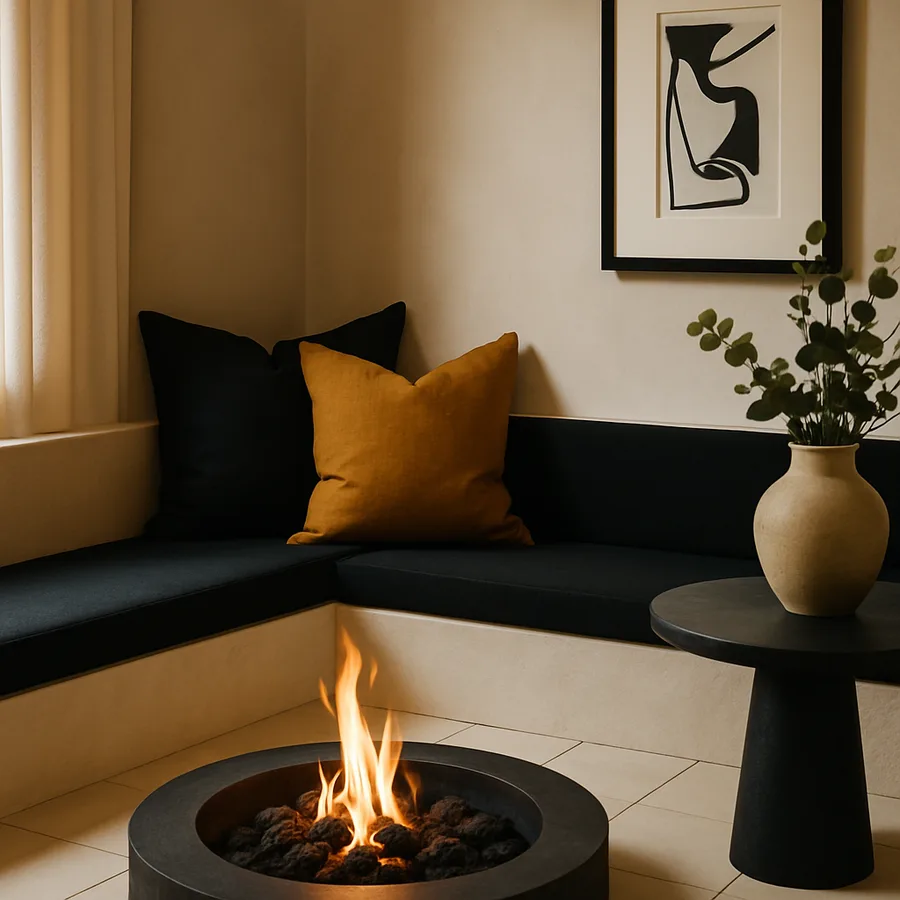
A sunken fire pit conversation area is one of the most architectural moves you can make in a backyard. Drop the floor of a seating circle two or three steps below grade, wrap it with continuous masonry bench seating, center a fire feature, and the result is a destination room that feels enclosed, intimate, and entirely separate from the rest of the yard. Done well, it becomes the place every dinner party migrates to as soon as plates are cleared.
This guide walks through the design logic, the dimensional rules of thumb, the drainage and code considerations, and the styling choices that distinguish a magazine-worthy install from a damp concrete pit. The information here applies whether you are working with a contractor on a $40,000 hardscape project or sketching a more modest weekend version with stacked retaining wall block. Either way, the geometry and the safety rules are the same.
Why Sunken Fire Pit Areas Feel Different
The psychology of a sunken room is well studied in landscape architecture circles. Dropping the floor changes the relationship between people and the surrounding landscape in three measurable ways. Sightlines lower so you see the underside of tree canopies and the silhouettes of plantings rather than rooflines. Noise from the broader yard reduces because the surrounding berm absorbs higher frequencies. Wind speed at face level decreases sharply because you sit below the prevailing flow.
For fire features specifically, the lower position pulls you into a tighter circle of warmth. A flame that would feel modest at a standard table height feels generous when you sit slightly below it. The National Association of Home Builders (NAHB) outdoor living survey routinely reports that sunken seating areas are among the highest-satisfaction outdoor improvements homeowners make, often outperforming pergolas and outdoor kitchens for actual hours of use logged.
There is a price for the magic. Sunken areas demand serious drainage planning, more excavation, more retaining structure, and almost always more permitting than a simple at-grade pit and chair arrangement. Whether the trade-off is worth it depends on your soil, your budget, and how much you value the architectural payoff.
Dimensions and Layout Geometry
Start with the conversation circle diameter. To seat eight adults comfortably with knees turned slightly toward the fire, you need an interior diameter of approximately 12 to 14 feet measured from bench face to bench face. The fire pit itself should occupy the center 36 to 48 inches of that circle, leaving roughly 4 to 5 feet of clear floor between knees and flame. Tighter than 4 feet feels uncomfortably hot. Wider than 5 feet loses the intimate gathering feeling you came for.
Bench height should land at 17 to 18 inches above the sunken floor, matching standard chair-seat ergonomics. Bench depth runs 18 to 22 inches; deeper allows for cushion-and-back combinations, shallower keeps the structure visually light. The drop from surrounding grade to the sunken floor is typically two steps, which translates to roughly 14 inches when each step is a comfortable 7-inch riser. Three steps and a 21-inch drop produces a much more dramatic enclosure but introduces fall risk for guests carrying drinks.
Step risers should follow standard residential code guidance per the International Code Council, with each riser between 4 and 7 inches and each tread at least 11 inches deep. Outdoor steps without a handrail are generally permitted at three risers or fewer in most jurisdictions, but always verify locally because some municipalities require a guard rail for any change in level greater than 30 inches.
Drainage, Subgrade, and Site Preparation
Drainage is the single most important engineering decision in a sunken patio. You are essentially building a bowl in the earth, and any rain that lands inside that bowl wants to stay there until it evaporates or finds an exit. A sunken area without proper drainage becomes a stagnant puddle within one storm and a mosquito factory within a season.
The standard solution is a perforated drain tile set in clean stone beneath a permeable paver floor, daylighting to a downhill exit point or piping to a dry well sized for your local rainfall intensity. Slope the floor 1 to 2 percent toward the inlet to ensure water moves rather than sits. The U.S. Department of Agriculture Natural Resources Conservation Service publishes regional rainfall intensity data that helps size the dry well correctly for your climate.
Soil type changes everything. Sandy soils drain readily and forgive a less aggressive drainage strategy. Heavy clay soils retain water for days and demand a robust subdrain plus a thicker stone base. If you are uncertain about your soil, dig a test pit, fill it with water, and time how long it takes to drain. Anything slower than two inches per hour requires the engineered subdrain approach, and anything slower than one inch per hour really wants a professional opinion.
Bench Construction Materials and Methods
You have three main paths for the bench structure, each with a distinct look and budget profile. Cast-in-place concrete benches produce the cleanest modern look but require formwork skill and reinforcement detailing. Stacked retaining wall block with a cap is the most DIY-friendly option, available at any landscape supply yard, and lends itself to curved layouts. Natural stone veneer over a CMU core looks the most timeless but costs the most in both materials and labor.
Whichever you choose, the bench needs frost-protected footings if you live anywhere that freezes. The NAHB publishes regional frost depth maps that show typical footing depths, ranging from a few inches in the southern U.S. to 48 inches or more across the northern tier. Skipping the footing depth is a classic DIY mistake that produces beautiful first-year benches and cracked, heaving second-year ones.
Cushions transform a hard masonry bench into a daily-use seat. Specify marine-grade Sunbrella fabric over quick-dry foam to handle dew and the occasional rain shower. Plan for a covered storage location nearby because even the best outdoor cushions live longer when they spend off-season months indoors. A cedar or composite cushion box doubling as auxiliary seating is a clean solution that disappears into the landscaping.
Fire Feature Selection and Setbacks
The fire pit itself in a sunken area should sit slightly higher than you would in an at-grade installation because the surrounding berm shields it from prevailing wind. A finished pit height of 14 to 16 inches above the sunken floor reads as roughly 2 to 4 inches above bench seat level, which keeps flames at a comfortable visual height for seated guests.
For setback compliance, the same code rules that govern at-grade installations apply to sunken pits. NFPA 1, the Fire Code published by the National Fire Protection Association, requires permanent recreational fires to sit at least 25 feet from structures with portable units allowed at 15 feet. The sunken position does not change that requirement; measure horizontally from the nearest combustible structure, not vertically. A pit that sits below the eave of a covered porch can still violate horizontal setback even though it feels visually distant.
Gas versus wood matters more in a sunken installation than at grade because the surrounding bench walls trap smoke. A wood-burning pit in a sunken area can be a smoke nightmare on a still evening, with smoke pooling in the bowl rather than dispersing. Gas fire pits with low-particulate flame avoid that problem and integrate more cleanly into a paved sunken floor. If wood is non-negotiable, consider a secondary-burn smokeless design to mitigate the pooling issue.
Climate, Microclimate, and Seasonal Use Patterns
The sunken design changes how the area performs across seasons in subtle ways worth understanding before you commit. In summer, the lower position and surrounding berm create a slightly cooler microclimate that holds onto evening cool air longer than the surrounding yard. This is a real comfort advantage on hot July nights and one of the underrated reasons sunken patios get used so much. In shoulder seasons, the same berm shelters the area from spring and fall winds that would otherwise drive guests indoors.
Winter performance depends heavily on snow management. Sunken areas collect snow that drifts from surrounding higher ground and can become impossible to access during heavy snow events without active shoveling. If you live in a snowy climate and want year-round usability, plan a clear access path from the house and consider radiant heat mats embedded in the steps. Without that planning, the sunken area essentially closes for four to five months annually.
Rain handling is the other seasonal stress point. Even with a properly engineered subdrain, intense rainfall can overwhelm the system temporarily, leaving the sunken floor wet for hours after the storm. Permeable pavers help by allowing water to drain through the joints rather than relying on a single inlet. Plan to walk the area with a leaf blower after major storms to clear standing water from low spots before guests arrive.
Lighting, Plantings, and Finishing Touches
The sunken area should feel composed even when the fire is not lit. Low-voltage path lighting on the steps prevents trips and reads as architectural rather than utilitarian. Wash lighting on the back of the bench from below adds warmth without glaring into anyone's eyes. Skip overhead lighting; it flattens the intimate cave-like quality you worked so hard to create.
Plantings around the perimeter soften the masonry transition between sunken and surrounding grade. Ornamental grasses such as switchgrass or little bluestem move beautifully in evening breeze and visually anchor the structure to the landscape. Avoid anything that drops a heavy fruit or seed load directly into the seating area; you do not want to be sweeping crab apples or magnolia leaves out of the sunken floor every weekend.
Storage is the unsung hero of a great fire-pit area. Plan for a discreet firewood niche if you are running wood, or a hidden propane tank cubby if you chose gas. A small built-in cabinet at the back of the bench can hold lighters, fire-starting kindling, blankets, citronella, and a first-aid kit, all the items that distinguish a well-managed gathering from a frantic one.
Conclusion
A sunken fire pit conversation area with built-in bench seating is not a casual weekend project, but the payoff is a destination room that will define your backyard for the next two decades. The geometry rewards careful drafting; the drainage rewards engineering humility; the masonry rewards patient craft. Cut corners on any of these three and the project will frustrate you within a year. Get them right and you will host more dinners outside than inside between April and October.
Before you commit, walk your yard at sunset and again at midnight. Notice where the light falls, how the wind moves, where the eye wants to land. The right location for a sunken room is rarely the geometric center of the yard; it is more often a quiet corner protected by existing trees and angled to capture a long view. Spending an hour observing your space at the time of day you most want to use it will produce a better location than any contractor sketch.
Have you considered who will actually maintain this once it is built? Drains need clearing, cushions need swapping, and masonry needs occasional repointing. The most beautiful sunken patios are owned by people who genuinely enjoy the small rituals of outdoor maintenance; the saddest ones are owned by households who imagined the gatherings but underestimated the upkeep.
Budget realism deserves a paragraph of its own. A professionally built sunken fire pit area with masonry bench seating, integrated drainage, and a quality gas pit feature typically lands somewhere between $25,000 and $60,000 depending on regional labor rates, material selections, and the complexity of your site. DIY builders working with retaining wall block, a portable pit insert, and their own labor can produce a credible version for $4,000 to $8,000 in materials. The middle path, where you act as your own general contractor and hire specialty trades for masonry, gas, and electrical work, often produces the best balance of quality and cost at roughly $12,000 to $20,000.
Resale value tracks closely with overall yard quality, not with the sunken patio specifically. Realtor surveys conducted by the National Association of Realtors consistently show outdoor living improvements recovering 50 to 80 percent of their cost at sale, with the strongest returns going to projects that look professionally integrated rather than bolted-on. A sunken area that flows naturally from the rest of the yard reads as an asset; one that looks like an afterthought reads as deferred maintenance. Pay particular attention to material continuity between the sunken patio, surrounding hardscape, and the home's exterior finishes.
Ready to start designing yours? Stake out a 14-foot circle in your yard with garden flags this weekend, sit inside it with three friends and a portable fire bowl, and see how the space feels. That single afternoon will tell you more about whether a sunken area is right for your lot than any number of Pinterest boards. If the conversation lasts past the first beverage, you have your answer; book the contractor consultation Monday.
More Articles You May Like



Comments
Post a Comment