Painting Studio Ventilation for Oil Paints and Solvents Safety
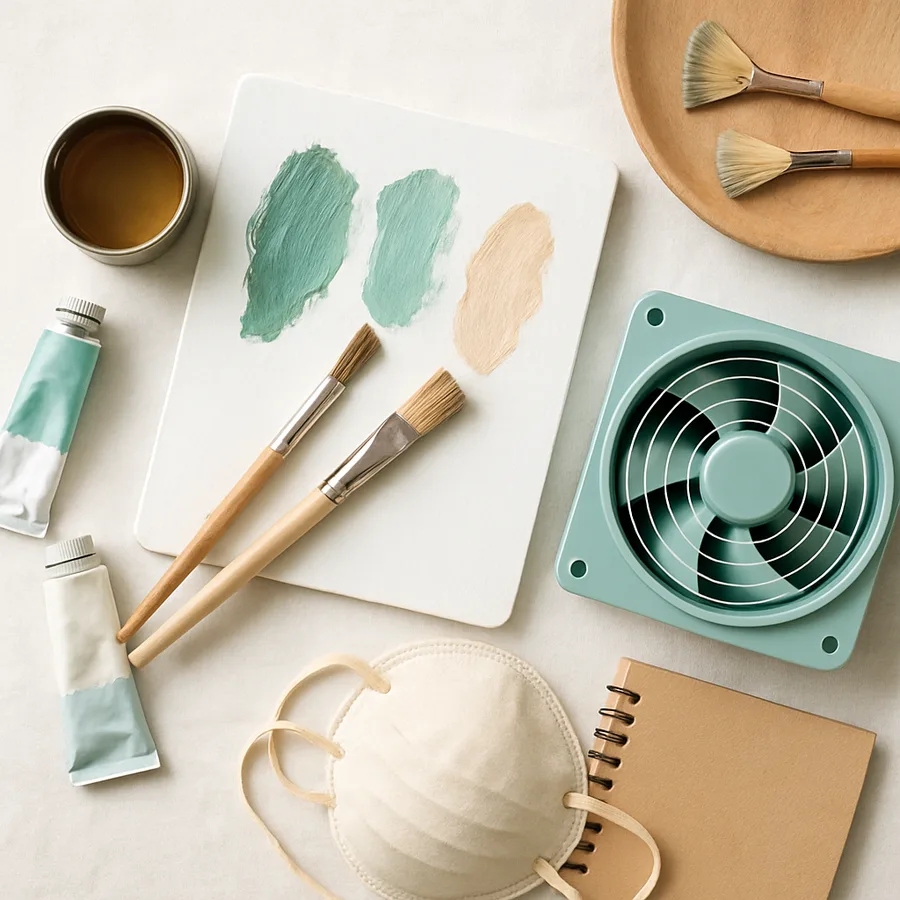
Oil painters spend years perfecting brushwork, color theory, and composition, and almost no time at all thinking about the chemistry quietly accumulating in the air around them. That oversight is dangerous in ways that build up slowly over decades. The classic studio aroma - turpentine, linseed oil, retouch varnish, dammar, mineral spirits - is not just nostalgia. Each of those compounds releases volatile organic compounds, or VOCs, that you breathe in and absorb through skin contact every time you paint. Acute exposure causes headaches, dizziness, and respiratory irritation. Chronic exposure has been linked to neurological symptoms, liver damage, and elevated cancer risk for several solvents commonly used in fine art practice. The good news is that simple, well-designed ventilation eliminates most of the risk for a few hundred dollars and a weekend of installation.
This guide walks through the chemistry of common oil-painting solvents, the airflow math that determines how much ventilation a studio actually needs, the specific fan and duct hardware that does the job, and the personal protective equipment that closes the remaining gap. Whether you paint in a converted bedroom, a basement studio, or a dedicated outbuilding, the principles below scale to your space. Have you ever finished a long studio session with a faint headache or a slightly metallic taste in your mouth? That is your nervous system telling you the ventilation is inadequate, and the next sections explain exactly how to fix it.
The Chemistry of What You Are Actually Breathing
Traditional gum turpentine, distilled from pine resin, releases alpha-pinene and beta-pinene VOCs that are absorbed through inhalation and skin contact. Mineral spirits, often labeled "odorless," still emit aliphatic and aromatic hydrocarbons, just at lower concentrations and with a less detectable smell - which is more dangerous, not less, because it removes the natural warning signal. Damar varnish solvent, retouch varnish, alkyd mediums, and many drying agents add their own VOC profiles. Even linseed oil itself slowly off-gasses aldehydes during the curing process, which is why a closed studio with rags from a single session can smell strongly forty-eight hours later.
The Occupational Safety and Health Administration publishes Permissible Exposure Limits, or PELs, for most studio solvents. Mineral spirits carry a PEL of 100 parts per million averaged over an eight-hour shift; turpentine carries the same. The American Conference of Governmental Industrial Hygienists recommends stricter Threshold Limit Values, often half the OSHA PEL, on the grounds that long-term exposure data has tightened since the original limits were set. The point is not to memorize the numbers but to recognize that exposure has a measurable, regulated ceiling, and that a poorly ventilated studio routinely exceeds it during active painting.
Some solvents are dramatically worse than others. Methyl ethyl ketone, methylene chloride, and toluene - sometimes found in cheap mediums or strippers - are categorically more hazardous than mineral spirits and should be avoided entirely in residential studios. Read every Safety Data Sheet for every product on your shelf. The SDS lists ingredients, exposure limits, and required ventilation in plain language, and most manufacturers post them online. If a product does not have an SDS available, do not use it indoors.
Calculating Air Changes Per Hour for Your Studio
Ventilation effectiveness is measured in Air Changes per Hour, or ACH - how many times the entire volume of air in the room is replaced with fresh outside air every hour. Residential bathrooms typically run at four to eight ACH. Commercial paint booths run at sixty to one hundred. A working oil-painting studio with regular solvent use should target a minimum of ten to fifteen ACH, with twenty ACH being the sweet spot for serious daily practice. Below ten, vapors accumulate faster than the system can clear them. Above twenty, you start fighting the system to keep the room warm in winter.
The math is straightforward. Multiply the room's length, width, and ceiling height in feet to get total cubic volume. Multiply that volume by your target ACH to get the cubic feet per minute, or CFM, your exhaust fan must move. A 12-by-15-foot studio with an 8-foot ceiling has 1,440 cubic feet of volume. At fifteen ACH, you need to move 21,600 cubic feet per hour, which is 360 CFM of continuous exhaust. That is well within the capacity of a quality bathroom or inline exhaust fan and dramatically below the cost of any commercial system.
Make-up air is the part most people forget. An exhaust fan moving 360 CFM out of the studio creates 360 CFM of negative pressure that must be balanced by air coming in somewhere. If the studio is sealed tight, the fan will struggle and cycle on and off, sometimes pulling air backward through any other vent in the building. The fix is a dedicated intake - a louvered window cracked open, a passive vent installed in the opposite wall, or a small intake fan synchronized with the exhaust. Cross-ventilation is the goal: clean air entering on one side of the room, contaminated air leaving on the other, with the painting station in between but downstream of the intake.
Fan Selection, Ducting, and Installation
A bathroom-style fan rated for 200 to 400 CFM is sufficient for most home studios and runs roughly one hundred to three hundred dollars. For larger spaces or more aggressive ventilation targets, an inline duct fan mounted in the attic or above the ceiling delivers higher CFM with lower noise because the motor is physically distant from the room. Look specifically for fans rated for continuous duty cycles; cheap intermittent-use fans burn out within a year if you run them through every painting session.
Ducting should be smooth-walled rigid metal whenever possible, with the shortest, straightest run to the exterior wall. Every elbow in flexible ducting reduces airflow by ten to fifteen percent, and every foot of insulated flex adds friction that the fan has to overcome. A 2019 study published by the Home Ventilating Institute found that real-world airflow in residential exhaust systems averaged just sixty percent of the rated CFM because of poor duct design. Plan the duct route before buying the fan, and oversize the fan rating by twenty to thirty percent to compensate for installation losses.
The exhaust termination matters as much as the fan. A wall-cap with a backdraft damper prevents cold winter air from blowing back into the studio when the fan is off. Locate the exhaust termination at least ten feet away from any window, intake vent, or neighbor's fresh air supply, because the discharged air carries every VOC you painted with. Where you locate the intake is equally critical: pull from a clean exterior side of the building, not from a garage, attic, or anywhere that might harbor radon, mold, or vehicle exhaust. The whole system is only as healthy as the air entering it.
Workspace Layout to Maximize Airflow Effectiveness
A perfect ventilation system can still fail if the painting station is positioned wrong relative to the airflow. The principle borrowed from industrial hygiene is simple: the contaminated source should always be downstream of the painter and upstream of the exhaust. In practice that means the intake vent or open window is behind the painter, the easel and palette are in front of the painter, and the exhaust is directly behind or above the easel. Air flows past you, picks up vapors at the source, and leaves the room without ever passing back through your breathing zone.
Position solvent containers, brush-cleaning jars, and rag bins as close to the exhaust intake as possible. A small countertop hood mounted directly above the brush-washing area captures vapors at their highest concentration, before they have a chance to disperse into the room. Some studio painters add a desktop fume extractor - the same appliance soldering hobbyists use - positioned right at the palette to grab vapors before they reach face level. Source capture beats dilution every time, because it deals with contamination at the point of release rather than after it has spread.
Closed metal containers for solvent rags are non-negotiable. Linseed-oil-soaked rags can spontaneously combust as the oil cures and releases heat, and a 2018 National Fire Protection Association report identified oily-rag combustion as one of the most common causes of artist studio fires. A self-closing oily waste can with a tight-fitting lid costs forty dollars and removes a real fire hazard while also containing the off-gassing during the curing process. Empty it weekly into outdoor trash, never into a household garbage bag. Have you ever left a turpentine-soaked rag balled up on a counter overnight? The next time you do, smell the room when you walk in the morning. The system is begging for an exhaust fan.
Personal Protective Equipment That Actually Works
Ventilation reduces ambient exposure but does not eliminate it, especially during high-emission tasks like brush cleaning, varnishing, or working with concentrated mediums. A properly fitted respirator closes the remaining gap. The right device for solvent work is a half-face respirator with organic vapor cartridges, not a dust mask. Dust masks filter particulates and do nothing for VOCs; an N95 against turpentine is theater. Look for a NIOSH-approved respirator rated for organic vapors, with replaceable cartridges that you swap on a documented schedule.
Cartridge life is finite and depends on humidity, work intensity, and the specific solvent. As a rule of thumb, change cartridges every forty hours of active use, or sooner if you can detect the solvent smell through the cartridge - which means saturation breakthrough is starting. Mark the cartridge with a date when you install it. A 2021 NIOSH bulletin recommended pairing organic vapor cartridges with P100 particulate filters when working with pigment-laden mists from spray varnishing, because solid particles can clog the carbon and reduce cartridge life.
Skin protection matters too. Many solvents absorb readily through bare skin, and simply cleaning brushes barehanded delivers a meaningful exposure dose over a long session. Nitrile gloves rated for solvent contact, available in bulk for under fifty cents per pair, prevent dermal absorption almost entirely. Wash hands with a non-solvent cleaner at the end of every session - products like the citrus-based hand cleaners sold at auto parts stores work without adding more solvent to your skin. The Environmental Protection Agency publishes a Solvent Substitution Manual with safer alternatives for many traditional studio solvents, and switching to citrus-based brush cleaners eliminates a category of exposure entirely.
Monitoring, Maintenance, and Long-Term Habits
The ventilation system needs regular verification, not just installation. Fans accumulate dust on the blades that reduces airflow over time, ducts can develop minor leaks, and dampers can stick. Pull out a small smoke pencil - available from HVAC supply stores for around fifteen dollars - and verify airflow direction at the intake and exhaust every six months. Smoke moving briskly toward the exhaust confirms the system is working. Stagnant or reverse smoke flow is a warning that something needs attention.
Affordable VOC sensors have become genuinely useful in the past few years. A small countertop unit costs roughly one hundred fifty to three hundred dollars and reads total VOC concentration in real time, often with smartphone alerts when levels spike. These are not laboratory-grade instruments, but they are excellent at confirming that your ventilation is actually working during a painting session, and at flagging unexpected leaks from a poorly sealed solvent container. Set a baseline reading with the studio at rest, then watch how levels change when you start working. If concentrations climb above the baseline by more than a small amount, the ventilation is undersized for the activity.
Build the habits into your routine. Turn the exhaust fan on before you uncap any solvent, and leave it running for at least thirty minutes after you finish cleaning brushes. Open a window during the cleaning portion of every session, even if the fan is running. Replace cartridges on schedule. Empty rag containers weekly. Track the hours your fan runs so you know when motor service is due. Ventilation is not a one-time project; it is an ongoing practice, and treating it as such is the difference between a long, healthy career and a slow, invisible accumulation of harm. Are you tracking the hours your fan has run since installation? If not, today is a good day to start.
Conclusion
Oil painting is one of the most rewarding creative practices ever developed, and it is also one of the most chemically intensive hobbies the average person undertakes in their own home. The risks are real but completely manageable. A target of ten to fifteen air changes per hour, a properly sized exhaust fan with smooth ducting, a workspace laid out so airflow moves contamination away from your face, an organic-vapor respirator for high-emission tasks, and a few hundred dollars of disciplined habits eliminate almost all of the exposure that an unventilated studio quietly accumulates over years.
The single biggest mistake painters make is assuming that "I can handle the smell" means the air is safe. Olfactory adaptation is the body's response to chronic exposure, and it is the worst possible feedback signal because it tells you danger has stopped at exactly the moment when danger has become routine. A VOC sensor or a smoke pencil tells you the actual physical truth, and the data almost always reveals that the room is more contaminated than the painter believed. Trust the instruments, not the nose.
If you have been painting in a poorly ventilated room for years, do not panic, but do start the upgrade this week. Calculate your room volume, pick a target ACH, order an appropriately sized exhaust fan, and budget a weekend for installation. Buy a fitted respirator and the correct cartridges. Replace your most aggressive solvents with citrus-based alternatives where the work allows it. Step into your studio tonight, smell the air, and decide whether the room you are creating in is actually a safe one. The work you make over the next decade depends on the answer.
More Articles You May Like


Comments
Post a Comment