Soapstone Countertops Patina and Mineral Oil Maintenance Cycle
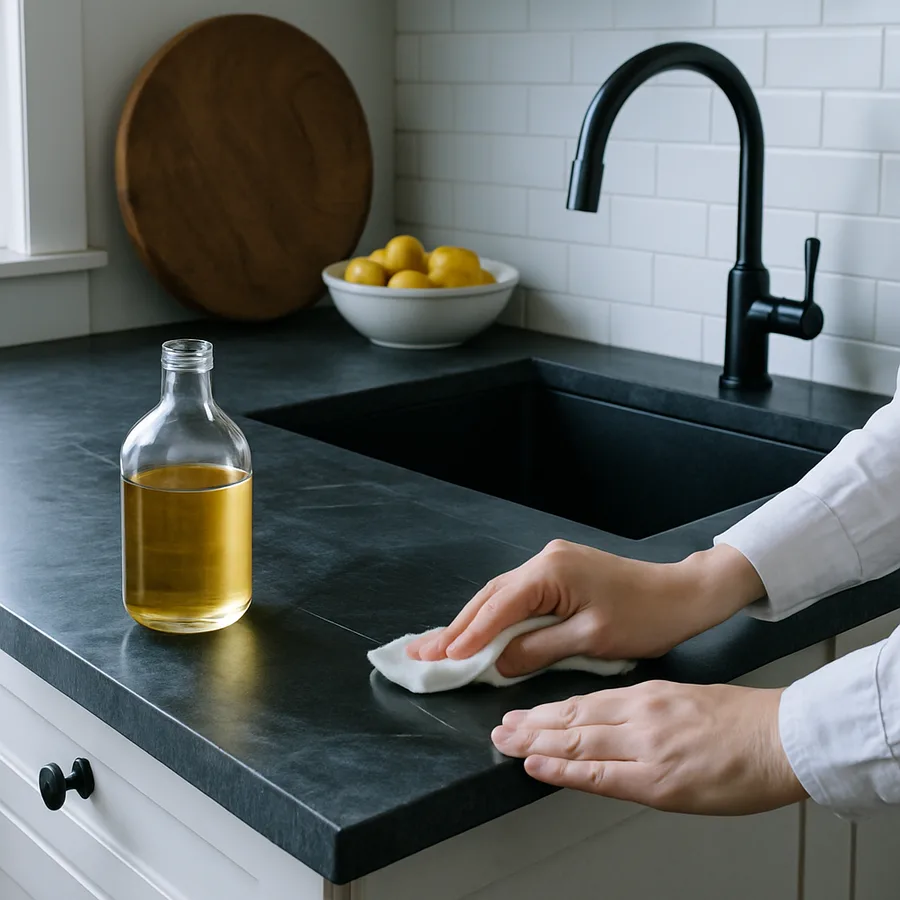
Few surfaces inspire as much quiet devotion among kitchen designers as soapstone. Quarried in Brazil, Vermont, and Virginia, this dense metamorphic rock has anchored farmhouse sinks, laboratory benches, and Federal-era hearths for more than two centuries. Today, a new generation of homeowners is rediscovering its tactile charm, but most arrive with a question that quickly turns into a learning curve: how do you keep that velvet matte finish, and what is the right rhythm for mineral oil application? Understanding the patina cycle, the chemistry of the stone, and the maintenance habits that bring it to life is essential for anyone considering this material for a serious renovation.
This guide approaches soapstone the way a thoughtful designer would approach any heritage material. We will cover the geology that creates its characteristic softness, the role of mineral oil in accelerating darkening, and the realistic care schedule you should plan for during the first year and beyond. Along the way, we draw on guidance from the Natural Stone Institute, the National Kitchen and Bath Association, and field observations from working stone fabricators. By the end, you should be able to specify, install, and steward soapstone with confidence.
Why Soapstone Behaves Differently From Granite or Quartzite
Soapstone is composed primarily of talc, chlorite, magnesite, and trace amounts of amphibole. The high talc content is what gives the stone its soft, soapy feel and explains why a fingernail can sometimes leave a faint impression. Architectural-grade soapstone, the kind used for countertops, contains a higher proportion of magnesite and chlorite, which adds density and durability while preserving that distinctive hand. According to the Natural Stone Institute, architectural soapstone typically registers between 2.5 and 3.5 on the Mohs hardness scale, meaningfully softer than granite, which sits closer to 6 to 7.
That softness matters, but not in the way most consumers fear. Because soapstone is non-porous, it resists staining from wine, lemon juice, tomato sauce, and the acidic kitchen culprits that plague marble. You will not need to seal it for stain protection. What it does show, however, are scratches, especially in heavily used prep zones. Most of these can be smoothed away with fine sandpaper, an unusual repair option that many homeowners only learn about after the fact. Have you ever owned a kitchen surface you could literally re-finish with a sanding block?
The other behavior to understand is oxidation. As soapstone interacts with air, light, water, and oils, its surface gradually darkens. This is the patina process, and it is not a flaw. It is the entire point of choosing the material. Some homeowners hate it for the first month, then fall in love with it by month four, when the stone settles into a deep charcoal or near-black tone with whisper-thin veining. Setting the right expectations from the start is the single most important step a designer can take with a soapstone client.
The slab supply chain is also worth understanding before you begin. Architectural soapstone is quarried primarily in Minas Gerais, Brazil and in a small set of historic operations in central Vermont. Brazilian stones typically offer larger block sizes, more dramatic veining, and a cooler base tone, while Vermont quarries produce smaller blocks with warmer charcoal undertones and a tighter, denser grain. Neither is universally superior, and the right answer depends on the visual register you are pursuing. Visit the slab yard in person whenever possible because, more than any other countertop material, soapstone varies meaningfully from block to block in ways photographs cannot capture.
The Chemistry of Mineral Oil and Why It Works
Mineral oil is a clear, food-safe petroleum derivative refined to remove aromatic hydrocarbons and impurities. The NSF International tests and certifies food-grade mineral oils for use on cutting boards and food contact surfaces, and the same product is what the vast majority of fabricators recommend for soapstone. When applied to the stone, mineral oil seeps slightly into the microscopic surface texture, fills minor scratches, and uniformly darkens the stone by changing how light interacts with the surface.
It is critical to understand what mineral oil does not do. It is not a sealer. It does not chemically bond with the stone. It does not provide stain protection that the stone did not already have. Its sole job is cosmetic: to accelerate and even out the patina. Over the first 12 to 18 months, repeated oil applications speed up what air and ambient moisture would do anyway, only without the patchy, uneven appearance that sometimes results from natural darkening alone.
Some fabricators offer wax treatments instead of oil, and a smaller subset recommend specialty soapstone enhancers that combine mineral oil with carnauba wax. According to a 2024 industry survey by Stone World magazine, roughly 78 percent of professional soapstone installers still recommend pure mineral oil as the default product because of its simplicity, low cost, and reversibility. If you wax and then change your mind, you will have a much harder time stripping the surface back to a neutral state.
The First-Year Maintenance Cycle Explained
The cadence of mineral oil application during the first year is the single most discussed topic in soapstone owner forums. Here is the schedule that most reputable fabricators, including members of the Marble Institute of America (now part of the Natural Stone Institute), suggest. In the first week after installation, oil the surface daily. In the second through fourth week, oil weekly. From month two through month six, oil monthly. After six months, oil only when the surface looks dry or uneven, which for most kitchens means every two to three months.
The technique itself is forgiving. Pour a small amount of oil onto a clean, lint-free cotton cloth, work it across the surface in overlapping circles, then let it sit for 20 to 30 minutes. Wipe off any excess with a dry cloth. The stone should feel smooth, not slick. If oil pools on the surface or feels tacky after an hour, you applied too much. This is purely cosmetic, not damaging, and the excess will absorb or evaporate over a day or two.
Pay special attention to the perimeter near sinks, the area immediately around the cooktop, and the prep zone next to the dishwasher. These three regions see the most water exposure and tend to lighten faster than the rest of the slab. Spot-oiling these zones in between full applications keeps the patina even. After about 18 months, the stone reaches what fabricators call terminal patina, the darkest color it will achieve. From that point forward, oil becomes optional and largely a matter of personal aesthetic preference.
Living With Scratches, Dings, and Heat
Soapstone has earned a reputation for being indestructible in the ways that matter and surprisingly forgiving in the ways most homeowners worry about. Heat is the headline benefit. The stone has been used as the working surface of wood stoves and pizza ovens for centuries, and it can handle a 500-degree cast iron skillet pulled directly from the oven without thermal shock or discoloration. The National Association of Home Builders notes in its kitchen materials guidance that soapstone is one of only two natural stone surfaces, alongside granite, that does not require trivets for hot cookware in routine use.
Scratches are the trade-off. A dropped knife, an aggressive cheese grater, or a sliding ceramic dish can leave visible marks. The repair process is what wins converts. Light scratches usually disappear with a fresh application of mineral oil because the oil fills and disguises them. Deeper scratches respond to a quick pass with 220-grit sandpaper followed by 400-grit, then a re-oiling. This is a 10-minute repair you can perform yourself, with no specialty tools and no need to call a fabricator.
Edge chips are the most serious damage soapstone tends to suffer, particularly along eased or bullnose profiles. Most chips can be repaired with a two-part epoxy tinted to match the slab. Have you ever wondered why so many soapstone kitchens use a simple straight or slight chamfer edge? It is partly aesthetic, but partly because those profiles are more chip-resistant than ornate edges and easier to dress up if a small impact does occur.
Cost expectations should be set realistically at the start of any project. Installed pricing for residential soapstone typically runs between $80 and $180 per square foot, with the variation driven primarily by slab origin, edge profile, and the experience of the fabricator. This places the material between mid-tier granite and high-end engineered quartz in overall budget. Lead times generally fall between four and eight weeks from final template to install, slightly longer than typical stone projects because of the smaller pool of experienced fabricators and the need to source matched slabs from a single quarry block. The fabricator relationship is the other pillar of a successful project, since not every stone shop works regularly in soapstone and the techniques for templating and finishing differ enough that experience matters.
Designing the Kitchen Around the Patina
Soapstone develops its character over time, which means the kitchen palette should be selected with the final color in mind, not the freshly installed stone. Most architectural soapstones start as a soft gray with cool undertones and finish at a deep charcoal or graphite black with greenish or bluish veining, depending on the quarry. Vermont soapstones tend toward warmer charcoal tones, while many Brazilian variants finish closer to true black with whiter veining.
This evolution makes soapstone a strong partner for unpainted wood cabinetry, especially white oak, walnut, and rift-cut maple, where the stone's eventual depth provides a grounding contrast. Painted cabinetry in muted greens, deep navys, and warm whites also flatters mature soapstone. Brass and unlacquered nickel hardware patinas at a similar timeline, creating a coordinated aging effect that few other countertop materials can match.
Lighting is worth a serious conversation with your client. Soapstone reads dramatically different under warm 2700K bulbs than under cooler 3500K. Under-cabinet lighting in particular can wash out the patina or, worse, exaggerate the unevenness during the first six months. According to the NKBA, dimmable warm-tone task lighting is the most flattering option for stones in the soapstone-slate-leathered-granite family.
Common Mistakes That Ruin a Soapstone Project
The most frequent installation error is using the wrong cleaner during the early patina period. Bleach, ammonia-based products, citrus-based degreasers, and heavy-duty stone cleaners can all strip the developing oil layer and leave blotchy patches that take months to even out. Warm water and a few drops of dish soap on a soft sponge is the only daily cleaner that soapstone needs. Save the heavy duty products for grease or burned-on residue, and even then use them sparingly.
Another common mistake is impatience. Some homeowners, frustrated by the lighter early appearance, attempt to force darkening with mineral oil applications every day for two months. This produces a stone that looks waxy and feels slightly slick to the touch, neither of which is the goal. The patina will arrive on its own schedule, and the stone tells you when it needs oil by lightening visibly in dry zones.
The third mistake is mismatching slab batches. Soapstone, more than almost any other countertop material, varies meaningfully from quarry block to quarry block. If your project requires multiple slabs, all of them should be sourced from the same block, ideally laid out and dry-fitted before fabrication. Coordinated veining across an island and perimeter is the difference between a kitchen that feels considered and one that feels assembled.
Conclusion
Soapstone rewards the homeowner who understands it. The patina is not a problem to be managed but a feature to be welcomed, and the mineral oil cycle is more ritual than chore once you settle into the rhythm. From the first daily oiling in the week after installation, through monthly applications in the early months, to the relaxed quarterly touch-ups of the mature stone, the maintenance arc mirrors the relationship many homeowners describe developing with the surface itself.
Designers and renovators who specify soapstone with a clear-eyed understanding of its evolution find that clients almost universally describe the material as their favorite element of the finished kitchen. The combination of heat resistance, stain immunity, repair-ability, and quiet visual presence has no real equivalent among modern engineered surfaces. The trade-offs are real, but for the right client and the right kitchen, they tilt heavily in soapstone's favor.
If you are weighing soapstone against quartz or granite for an upcoming renovation, schedule a visit to a local stone yard, ask to see slabs at multiple ages, and bring home a small sample to oil and observe over a few weeks. The decision will become much easier once you have lived with the stone, even at sample scale. Your future kitchen, and your future morning coffee on a deep charcoal countertop, will thank you for the patience.
More Articles You May Like


Comments
Post a Comment