One-Piece Toilet vs Two-Piece Cleaning and Style Differences Explained
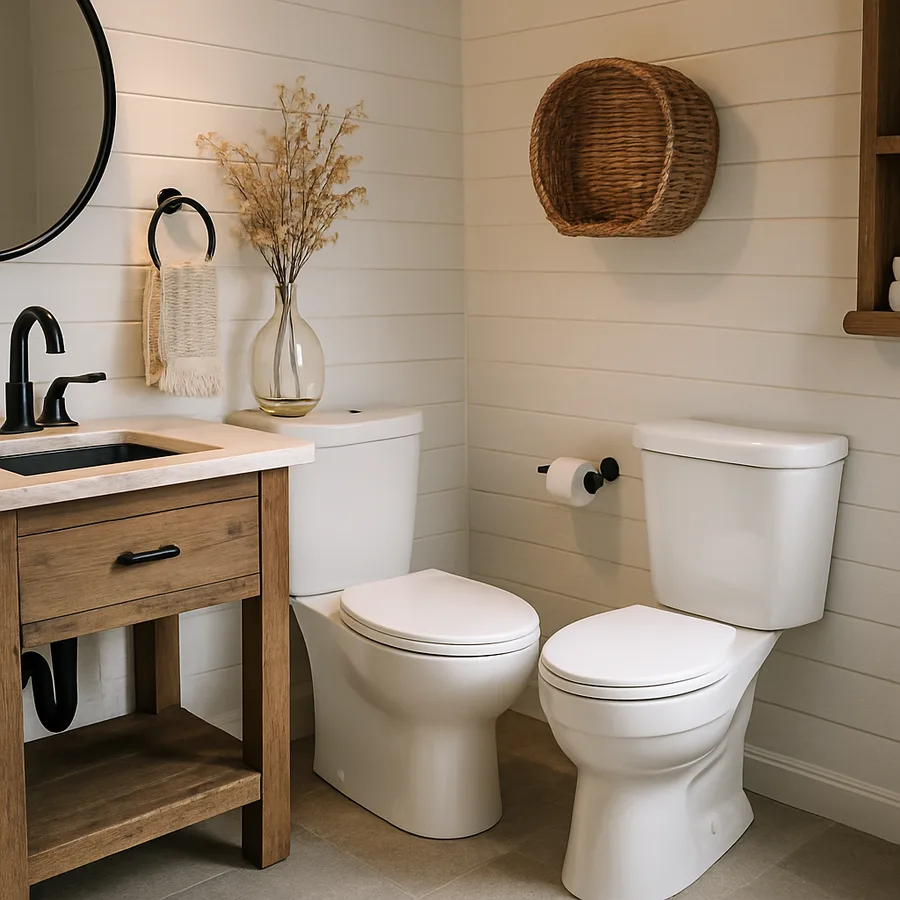
Walk into any plumbing showroom and you will find two camps of toilets staring back at each other across the aisle. On one side sits the sculpted, single-mold one-piece toilet, all curves and shadow-free silhouettes. On the other stands the familiar two-piece, with its visible seam between tank and bowl. The two designs flush water in nearly identical ways, yet they live very different lives once installed. The differences show up most clearly in three places homeowners care about: how easy the toilet is to keep clean, how it shapes the visual mood of the bathroom, and how it behaves during installation, repair, and resale.
This guide breaks down the practical contrasts so a remodel decision becomes a confident one rather than a coin flip. According to data shared by the National Kitchen and Bath Association, bathroom remodels remain the second most common home renovation in the United States, behind only kitchens, and the toilet is one of the longest-lived fixtures in the room. A toilet purchased today is likely to outlast the flooring, the paint, and even the vanity. Choosing well, then, is less about today's mood board and more about a quiet daily relationship that will continue for fifteen or twenty years.
Anatomy: How the Two Designs Are Actually Built
A two-piece toilet is the design most Americans grew up with. The tank and bowl are separate vitreous china castings, joined at the factory or at install with a rubber tank-to-bowl gasket, two or three brass bolts, and rubber washers. Water flows from the tank into the bowl through a flush valve seated in the gasket. Because the parts are made independently, manufacturers can mix and match: the same bowl might be sold with three different tank styles, and replacement tanks are common decades later.
A one-piece toilet, by contrast, is fired in a single mold. There is no gasket joint between the tank and the bowl, no exposed bolts at the top of the bowl, and no horizontal seam. The trapway, the tank, the bowl, and the rim channels are all part of one continuous ceramic shell. Inside, the working parts are similar: a fill valve, a flush valve, a flapper or canister, and an overflow tube. From the outside, however, the unit reads as one sculpted object rather than two stacked components.
The choice of single mold or two has knock-on effects in every other category. A single mold means fewer seams to clean, fewer gaskets to fail, and a heavier, more rigid shipping box. Two pieces mean lighter handling, lower factory shipping costs, and a more familiar service profile for plumbers. Neither approach is technically superior at moving waste; the International Association of Plumbing and Mechanical Officials certifies flush performance the same way for both formats under its Uniform Plumbing Code testing protocols. The differences are about ownership, not engineering.
Cleaning: Where the Real Daily Difference Lives
If you have ever scrubbed a bathroom on a Saturday morning, you already know the spots that take the longest. On a two-piece toilet, the worst offenders are predictable: the gap between tank and bowl, the two bolt caps at the top of the bowl, and the underside of the tank where the gasket sits. Dust, hair, and aerosolized droplets settle into these crevices and stay there. A toothbrush and a small amount of bathroom cleaner are usually required to reach them. Multiply that by every cleaning, every week, for fifteen years, and the time adds up.
The one-piece design eliminates most of these traps. With no horizontal seam and no exposed bolts, a single wipe of a microfiber cloth covers about ninety percent of the upper surface. Many one-piece models also use a "skirted" or "concealed trapway" bowl, which means the outside of the bowl is a smooth curve rather than the bumpy, ribbed shape of a traditional two-piece. The result is a fixture that can be cleaned in roughly half the time, and that hides far less grime in places you cannot see.
Have you ever wondered why hotels and high-end short-term rentals so often install one-piece toilets? Cleaning labor is one big reason. According to a survey summarized by the Plumbing-Heating-Cooling Contractors Association, hospitality clients consistently rank ease of cleaning as a top-three factor in fixture selection, ahead of price. The same logic applies to family bathrooms with small children, to aging-in-place projects, and to anyone who simply does not enjoy detailed scrubbing.
Style: Visual Weight, Sightlines, and the Feel of the Room
Style is harder to quantify but easy to feel when you walk into a room. A two-piece toilet sits firmly in the tradition of American residential plumbing. It reads as familiar, honest, and a little workmanlike. In a farmhouse bathroom, a craftsman cottage, or a faithfully restored mid-century space, that visual familiarity is a feature rather than a bug. The visible tank-to-bowl line is part of what signals "bathroom" to the eye, and removing it can feel oddly futuristic in a period-correct room.
A one-piece toilet, on the other hand, fits naturally into contemporary, minimalist, hotel-modern, and Japandi-influenced bathrooms. The continuous silhouette aligns with the same visual logic that drives undermount sinks, frameless shower enclosures, and curbless showers. Everything wants to read as a single sculptural gesture rather than an assembly of parts. In a small bathroom especially, the lower visual weight of a one-piece can make the room feel a few inches larger, because the eye is not stopping at every horizontal seam.
Height plays into this too. Most one-piece toilets sit lower in overall height than a comparable two-piece, even when both use the same comfort-height bowl. The tank on a one-piece is typically shorter and integrated into the bowl curve, while a two-piece tank stands up tall and proud above the rim. For homeowners working with a window sill behind the toilet, or with a wainscoting line they want to preserve, the lower profile of a one-piece can be the deciding factor. Which silhouette better matches your tile, your vanity, and the rest of your fixtures?
Installation, Repair, and the Plumber's Perspective
Ask three plumbers about installing toilets and you will get three opinions, but they tend to agree on the basics. A two-piece toilet ships in two boxes, weighs less per box, and can be carried up a flight of stairs by a single average-size adult. The bowl is set first on the wax ring, then the tank is bolted to the bowl after the bowl is anchored. If the bathroom doorway is narrow or the route involves a tight stair turn, the two-piece is forgiving.
A one-piece toilet ships as a single, large, awkward unit that often weighs ninety to one hundred and twenty pounds. Two installers are usually recommended, both for safety and to avoid chipping the porcelain on a doorframe. Once on the floor, however, the install is faster: there is no tank-to-bowl gasket to seat, no tank bolts to torque, and no leak path between tank and bowl to test. In raw labor minutes after the unit reaches the bathroom, a one-piece is typically the quicker install.
Repair is where the calculus shifts. On a two-piece, a cracked tank can be replaced for a fraction of the cost of a new toilet, and many manufacturers stock matching tanks for fifteen years or more. On a one-piece, a crack in the tank usually means the entire fixture must be replaced, because the tank and bowl are a single ceramic body. Internal flush components, fill valves, and flappers are user-replaceable on both designs, with no meaningful difference in service complexity.
Water Use, Performance, and the Numbers That Matter
Both formats are available in high-efficiency configurations that meet or exceed the EPA WaterSense threshold of 1.28 gallons per flush. The U.S. Environmental Protection Agency estimates that replacing an older 3.5-gallon-per-flush toilet with a WaterSense-labeled model saves the average family nearly 13,000 gallons of water per year. That figure holds regardless of whether the new toilet is one-piece or two-piece, because flush performance is governed by trapway diameter, rim-jet design, and bowl shape rather than by the seam between tank and bowl.
Where the formats sometimes differ is in dual-flush availability and in advanced rim-rinse systems. Many high-end one-piece models include integrated dual-flush actuators with separate buttons for liquid and solid waste, often around 0.8 and 1.28 gallons respectively. Two-piece toilets offer dual-flush configurations as well, but the actuator is more often a top-mounted button retrofitted onto a traditional tank, and the visual integration is less polished.
Noise is another quiet differentiator that owners notice over time. A one-piece toilet's continuous ceramic body damps the sound of refilling water more effectively than a two-piece, where the empty tank can act as a small resonant chamber. The difference is small, but in a bathroom that shares a wall with a bedroom or a home office, a slightly quieter refill cycle can be a daily comfort upgrade.
Cost, Resale, and the Long Decision Horizon
Sticker price still favors the two-piece toilet for most basic models, sometimes by a hundred to two hundred dollars at the entry tier. As the configurations climb toward heated seats, soft-close lids, dual-flush actuators, and skirted trapways, the price gap narrows and often disappears entirely. At the high end of each format, a premium two-piece and a premium one-piece can land within a few dollars of each other. The real question is what you are buying with the extra money: ease of cleaning, sculptural form, and a slightly faster install, or familiar service and tank replaceability.
Resale is harder to measure but worth thinking about. Real estate agents working in mid-to-upper price ranges report that buyers increasingly read sleek, skirted one-piece toilets as a signal that the bathroom has been thoughtfully renovated. A two-piece is rarely a deal-breaker, but in a home where every other fixture is contemporary, a basic two-piece can feel like the one place where the budget got tight. In period homes and traditional designs, the inverse is true: a sculptural one-piece can feel out of place beside a clawfoot tub.
What about your own habits? If you scrub bathrooms thoroughly every week, the cleaning advantage of a one-piece compounds into many hours saved over the life of the toilet. If you tend to do faster cleans and occasional deep cleans, the difference is smaller. If you rent the property out, the durability and consistent appearance of a one-piece often pays back through reduced cleaning labor and fewer guest complaints about visible grime in seams.
Conclusion: Choosing With Confidence Rather Than Habit
Both formats are mature, reliable, and capable of decades of dependable service. The honest answer to "which is better" depends entirely on the room, the household, and the priorities that matter most to the people who will actually use the toilet every day. A two-piece is the right call when the design language of the bathroom is traditional, when the install path is tight, when budget is the primary constraint, or when long-term tank replaceability matters because the property is a rental or a multi-generational home.
A one-piece is the right call when cleaning ease is a daily priority, when the bathroom design leans contemporary or minimalist, when the room is small enough that visual weight matters, or when the household includes someone who values quiet refills and seamless surfaces. The slightly higher price and the more demanding install are real trade-offs, but they buy a fixture that integrates with the rest of a modern bathroom in a way that a two-piece simply cannot match.
Before walking into the showroom, take a few minutes to measure the rough-in distance from the wall to the floor flange, count the doorways and stair turns the new toilet will travel through, and look honestly at the rest of the fixtures already in the room. Bring a photo of the bathroom, a tape measure, and a list of the features that matter most: seat height, flush volume, actuator style, and trapway profile. The salesperson will appreciate the preparation, and the toilet you choose will be one you stop thinking about within a week and quietly enjoy for the next twenty years.
Ready to take the next step on your bathroom remodel? Walk through your existing space tonight with a notebook, photograph each fixture from three angles, and write down the single biggest frustration you have with the current toilet. That one note will guide every showroom conversation and turn an overwhelming category into a clear, confident choice. For a deeper look at certified water-saving models, browse the WaterSense product database before you shop, and ask any plumber for written quotes that separate fixture cost from labor so the trade-offs stay visible all the way through purchase.
More Articles You May Like



Comments
Post a Comment