Round Mirrors vs Rectangular in Bathrooms: Style Comparison
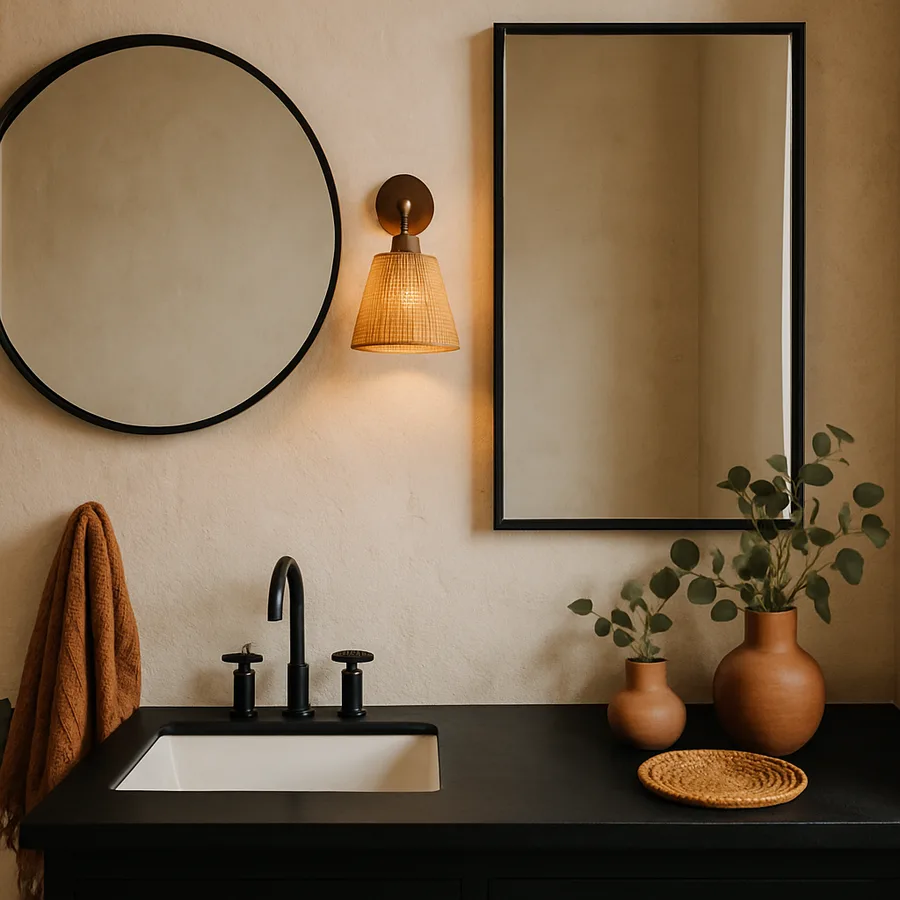
Walk through any sample of bathroom renovation photos published in the last three years and you will notice a quiet argument playing out on the walls above the vanity: round mirrors versus rectangular mirrors. Both shapes are technically defensible, both have long design histories, and both can anchor a bathroom in ways that feel current rather than dated. Choosing between them, however, is not a matter of personal preference alone. The shape of your mirror interacts with the proportions of your vanity, the geometry of your tile, the dimensions of your room, and the lighting design in ways that either reinforce or undermine the overall composition.
This is not a minor decision. According to a National Kitchen and Bath Association (NKBA) trend report published in early 2025, the mirror is rated the single most-photographed element in bathroom renovation projects, outranking the vanity, the tile, and the lighting fixtures. A Houzz consumer survey the same year found that 58% of homeowners completing a bathroom remodel spent more time choosing the mirror than the sink or faucet, and that 34% reported regret about their final choice. The shape of that mirror is almost always the variable that determined whether the regret appeared.
The Visual Language of Each Shape
Shapes carry emotional meaning even before we consciously register them. A circle reads as soft, organic, approachable, and non-confrontational; it has no beginning and no end, which the human eye finds inherently calming. A rectangle reads as stable, formal, architectural, and efficient; it aligns with the grid of a floor plan, the edges of a door, and the frames of a window. These associations are not cultural artifacts that vary by region; they are remarkably consistent across design traditions from Japan to Scandinavia to the American Midwest.
In bathrooms, the interplay becomes specific. Most bathrooms are dominated by rectangular elements: the tile, the vanity, the tub, the shower enclosure, the window, the door. Adding another rectangle, the mirror, reinforces that grid and produces a composition that feels orderly and classical. Adding a circle, by contrast, introduces a counterpoint, a visual release from the rectilinear framework. Many designers describe this as giving the room a place for the eye to rest.
Neither choice is inherently better. A bathroom that feels too busy or over-detailed often benefits from a rectangular mirror that calms the visual field. A bathroom that feels too austere or grid-locked often benefits from a round mirror that introduces softness. The question a homeowner should ask is not "which shape do I prefer?" but "what does my bathroom need more of?"
Sizing Each Shape Correctly
Sizing rules differ between the two shapes because the proportions interact with vanities differently. For a rectangular mirror, the classic guideline is that the mirror should span 70% to 90% of the vanity width, stopping a few inches short of the vanity's outer edges so the composition does not feel cramped. On a 36-inch vanity, that translates to a mirror between 26 and 32 inches wide. Height should generally be 28 to 40 inches, scaled to match the wall space between the backsplash and the light fixture above.
For a round mirror, the guideline shifts because a circle's width and height are identical. The diameter should roughly equal 60% to 75% of the vanity width. On the same 36-inch vanity, a round mirror between 22 and 28 inches in diameter typically looks balanced. Going larger often produces a "clock on the wall" effect where the mirror visually dominates the vanity rather than partnering with it. Going smaller produces a "porthole" effect that can feel undersized unless it is a deliberate maritime-style bathroom.
Designers affiliated with the American Society of Interior Designers (ASID) commonly recommend mocking up both shapes with painter's tape before committing. Outline a rectangle in one sizing and a circle in another, live with both for a day, and photograph each from the bathroom doorway. The photographs often reveal proportional issues that the eye misses in person.
Vanity Compatibility: Single, Double, and Floating
Vanity configuration strongly influences which shape performs better. Above a single vanity, both shapes work, though rectangles tend to feel more classical and rounds feel more contemporary. Above a double vanity, the decision becomes more consequential. A single large rectangular mirror spanning both sinks creates a unified wall that emphasizes the length of the room, while two individual round mirrors, one above each sink, create a rhythm of repeating circles that reads as symmetrical and playful.
A common reader question: should a double vanity use one mirror or two? The answer depends on ceiling height, vanity width, and how formal the room is meant to feel. A formal master bathroom typically benefits from a single wide rectangular mirror, while a casual family bathroom often looks better with paired round mirrors. A 2024 professional survey by Architectural Digest found that 64% of designers specified two round mirrors for double vanities under 72 inches wide, while 71% specified a single rectangular mirror for double vanities over 84 inches wide. The tipping point between the two approaches falls somewhere in the 72 to 84 inch range.
Floating vanities, which mount to the wall without touching the floor, introduce another consideration. A floating vanity already creates the illusion of more floor space, and a round mirror reinforces the airy, modern feeling. A heavy rectangular mirror above a floating vanity can visually cancel the float effect by adding weight back to the wall. Designers tend to pair floating vanities with round mirrors more often than rectangular ones, at approximately a 3:1 ratio in published projects.
Lighting Interactions
Mirror shape affects how lighting fixtures appear and function. Traditional sconces mounted on either side of the mirror work with both shapes, but the geometry needs to match. A rectangular mirror aligns naturally with vertical sconces mounted at roughly the mirror's centerline, creating a symmetrical composition. A round mirror creates more empty wall space on either side at the top and bottom, which can either look intentional or look like the sconces are floating awkwardly, depending on sconce size and mounting height.
A single overhead fixture, such as a linear vanity light, tends to pair more naturally with rectangular mirrors because the fixture and the mirror share the same horizontal orientation. Over a round mirror, the overhead bar can look like a hat, separating the mirror from the rest of the composition. A central pendant or a round flush-mount fixture, by contrast, echoes a round mirror's shape and creates a cohesive composition.
Integrated lighting, where LED strips are built into the perimeter of the mirror itself, works equally well on both shapes and is increasingly the preferred solution in small bathrooms where wall space is limited. The U.S. Department of Energy notes that LED integrated mirrors draw 60 to 75 percent less electricity than traditional incandescent sconce setups while producing comparable illumination, a meaningful saving over a mirror's typical 10 to 15 year lifespan.
Style Era Alignment
Certain design eras strongly prefer one shape or the other, and honoring those associations keeps a bathroom feeling coherent. Traditional and Victorian styles tend toward rectangular mirrors with ornate frames, echoing the rectangular architecture of those eras. Art Deco bathrooms feature both shapes but favor rectangles with stepped or chevron detailing. Mid-century modern design, particularly American variants from the 1950s and 1960s, popularized the round mirror, often with a slim metal frame, as a counterpoint to rectangular cabinetry.
Contemporary and Scandinavian designs show a clear preference for round mirrors, often frameless or with the thinnest possible metal edge. These aesthetics prize softness, natural materials, and visual calm, and the round shape supports all three. Industrial bathrooms can use either shape but often prefer rectangles with exposed metal framing to reinforce the factory-inspired aesthetic. Farmhouse and coastal bathrooms lean round, often in distressed wood or rope frames, to counter the rectangular plank and shiplap textures that dominate those styles.
The International Interior Design Association (IIDA) and academic design programs have documented these era-shape correlations extensively, and honoring them produces rooms that feel historically grounded rather than stylistically scrambled. A round mirror in a Victorian bathroom can work if it is done deliberately and paired with other modernizing elements, but a single round mirror dropped into an otherwise Victorian room usually looks accidental.
Installation and Safety Considerations
Both shapes involve similar installation challenges, but round mirrors introduce one specific twist: centering becomes more important and slightly harder. A rectangle has four edges that provide visual references for level and plumb; a circle has no edges, which means the mirror must be centered precisely over the vanity because any offset is immediately visible. Use a measuring tape and a laser level to mark the exact center of the vanity before marking the mounting points.
Weight and anchoring rules are identical for both shapes. Mirrors under 20 pounds hang on standard picture hooks or heavy-duty drywall anchors. Mirrors between 20 and 40 pounds benefit from stud mounting or toggle bolt anchors. Mirrors over 40 pounds require French cleats or dedicated brackets. The U.S. Consumer Product Safety Commission (CPSC) has long tracked injuries from falling wall décor, and bathroom mirrors are overrepresented because of the humidity that gradually loosens standard adhesive mounts. Any adhesive-only bathroom mirror is a bad idea; use mechanical fasteners.
Glass safety also matters. In a bathroom, where slips and falls are possible, choose tempered glass when available. Tempered glass fractures into small rounded pieces that are far less likely to cause lacerations than the shard pattern of annealed glass. The Glass Association of North America labels tempered safety glass with an etched mark in one corner; check for it before purchasing.
Budget, Brands, and Where to Find Quality
Both shapes are available across a wide price range, from under fifty dollars at big-box retailers to several thousand dollars for custom or designer pieces. The quality differences that matter most at the mid-price point, typically $150 to $500, are the silvering backing, the frame construction, and the mounting hardware. Cheap mirrors often use copper-backed silvering that desilvers in humid bathrooms within three to five years, while quality mirrors use copper-free or eco-silver backing that can last fifteen years or longer.
Reliable brands in the round mirror category include West Elm, CB2, Article, and boutique makers like Tom Dixon and Ferm Living at the higher end. Rectangular mirrors are offered by nearly every furniture retailer, but quality standouts include Restoration Hardware, Rejuvenation, and regional artisan makers listed through platforms like Chairish and 1stDibs. Have you considered whether the mirror you are eyeing uses tempered glass, copper-free silvering, and includes mounting hardware rated for its actual weight? Those three specifications separate a mirror worth keeping from one destined for a future landfill.
Another reader question: is it worth investing in a premium mirror for a rental property? The usual answer is no, unless the rental is luxury-tier; a solid mid-price mirror installed correctly will serve tenants well without tying up capital. For owner-occupied homes, particularly primary bathrooms used daily for the next decade, the premium investment usually pays off in both daily satisfaction and resale value.
Conclusion
The decision between round and rectangular bathroom mirrors is ultimately a decision about what your room needs to feel complete. Rectangular mirrors reinforce the architectural grid, align with traditional and formal design languages, and perform well above long vanities and double sinks. Round mirrors soften the room, introduce contemporary and Scandinavian sensibilities, and excel above single vanities, floating vanities, and in bathrooms where the existing design feels too severe. Neither is universally correct, and thoughtful designers regularly specify each in different projects.
Sizing, lighting, and installation considerations matter more than most homeowners expect. A perfectly chosen shape can still be undermined by a mirror that is 20 percent too large, paired with sconces that clash geometrically, or mounted with hardware inadequate to its weight. Paying attention to these details costs little in time and money but dramatically affects the finished room. Measure twice, mock up with tape, photograph from the doorway, and evaluate the overall composition rather than the mirror in isolation.
Above all, remember that the mirror is the element you will make eye contact with every morning and every evening for as long as you live in the home. It is worth getting right. The shape you choose shapes the way you start and end each day, in ways subtle enough to feel intangible but consistent enough to matter. Choose thoughtfully, install carefully, and the mirror will reward you every time you walk into the room.
Ready to pick the perfect shape for your bathroom? Explore the Interior Bliss curated collection of round and rectangular vanity mirrors, download our free bathroom design worksheet, and subscribe to our newsletter for weekly design insights, installation tutorials, and subscriber-exclusive savings.
More Articles You May Like



Comments
Post a Comment