Steam Room vs Sauna Health Benefits and Construction Differences
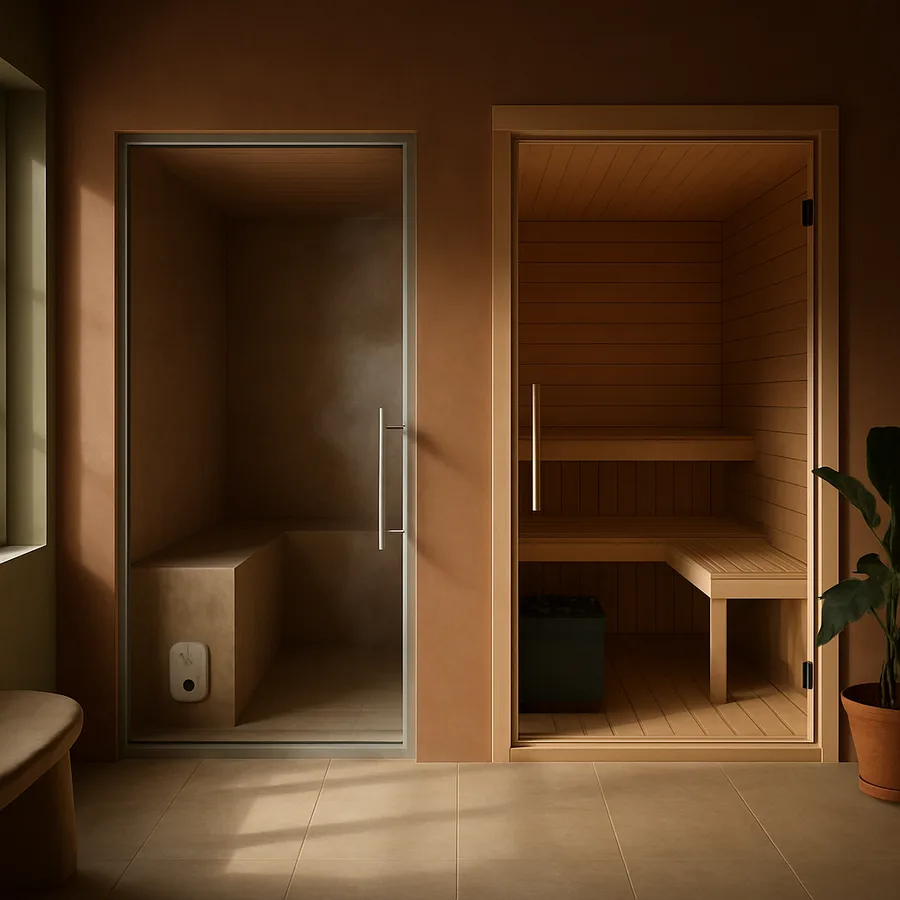
Steam rooms and saunas are often discussed interchangeably, and the marketing copy of most wellness brands does little to clarify the distinction. They are not the same room with different signage. They are physiologically different experiences, structurally different builds, and they reward different homeowners. Choosing between them, or deciding to build both, is a decision worth understanding before construction drawings are finalized.
The shortest framing of the difference: a sauna delivers dry heat at high temperatures, typically 160 to 200 degrees Fahrenheit at 10 to 20 percent humidity. A steam room delivers wet heat at lower temperatures, typically 110 to 120 degrees Fahrenheit at near 100 percent humidity. Both raise core body temperature and trigger many of the same cardiovascular and recovery responses, but the construction requirements diverge dramatically because of how each handles moisture.
The Health Science: What Each Actually Does to Your Body
The wellness benefits of heat exposure are well-documented, and the underlying physiology is similar for both modalities. Core body temperature rises, peripheral blood vessels dilate, heart rate increases to roughly the level of a moderate aerobic exercise, and the body releases heat-shock proteins that are associated with cellular repair. A frequently cited JAMA Internal Medicine study following Finnish men over 20 years found that four to seven sauna sessions per week were associated with a 50 percent reduction in fatal cardiovascular events compared to one session per week, after adjusting for other risk factors.
Saunas tend to produce more vigorous sweating because the dry air evaporates perspiration efficiently; an average session yields roughly one pint of sweat. Steam rooms feel hotter at lower thermometer readings because saturated air prevents evaporative cooling, so the body cannot shed heat the usual way. The result is similar core temperature elevation through different pathways. The Mayo Clinic publishes consumer guidance noting that both modalities can offer cardiovascular benefits, improved circulation, and stress reduction, while cautioning against use during pregnancy or with uncontrolled hypertension.
For respiratory effects, steam wins clearly. The humid environment is therapeutic for sinus congestion, mild asthma, and post-cold recovery, which is why hospital recovery rooms and physical therapy suites historically included steam. Saunas, on the other hand, are better tolerated by people who find humid heat oppressive and are easier on the skin in winter when ambient humidity is already low. Have you ever wondered why Scandinavians prefer dry sauna while the Roman and Turkish traditions preferred steam? The answer is partly cultural and partly climate; dry heat works better as contrast in cold dry winters.
Construction: Why Steam Rooms Are More Demanding
A sauna is, structurally, a wood-lined insulated box with a vapor barrier and a heater. A steam room is closer to a fully waterproofed wet room with a steam generator and a sealed door. The build complexity is meaningfully different, and so is the budget.
Steam rooms must be entirely waterproof on every interior surface because the room operates at the dew point. Walls, ceiling, and floor are typically cement backer board over framing, then waterproofed with a liquid membrane or sheet membrane, then tiled with porcelain or natural stone using epoxy grout. The ceiling is sloped at at least 2 inches of fall per linear foot toward an edge so condensation does not drip on bathers. The door is a fully gasketed glass unit; standard sauna doors will not hold the vapor pressure.
The sauna build, by contrast, uses cedar or hemlock cladding over an air-sealed and vapor-barriered wood-framed wall. There is no waterproof membrane because the wall is designed to keep moisture out of the cavity, not to retain it inside. A sauna can be built into a closet by a competent carpenter; a steam room generally needs a tile contractor with wet-room experience and a plumber who has installed steam generators before. The Tile Council of North America publishes detailed assemblies for steam rooms in its TCNA Handbook that should be specified by name in any contractor's scope of work.
Equipment and Systems: Heater vs Generator
A sauna heater is a relatively simple appliance: a metal cabinet of resistive elements topped with stones, hardwired to a 240-volt circuit, controlled by a thermostat and timer. Sizing is straightforward at roughly one kilowatt per 50 cubic feet of room. Installation is a half-day job for a licensed electrician once the room is finished.
A steam generator is mounted outside the room, typically in a closet or basement near the steam room, and pipes superheated steam through an insulated copper line into a small jet inside the room. Generators are sized in kilowatts based on room volume, surface materials, and exterior wall exposure; a tiled three-by-four-foot residential steam shower commonly uses a 7.5-to-9-kilowatt generator, while larger rooms can require 12 kilowatts or more. Glass walls and exterior walls require upsizing because they radiate heat away faster than insulated stud walls.
Generators require a dedicated 240-volt circuit, a cold water supply line with a shutoff, and a drain line for periodic flushing to prevent mineral scale buildup. They are not maintenance-free appliances. The drain valve should be opened after every few sessions in hard-water areas, and most manufacturers recommend a full descaling once a year. A neglected generator fails in three to five years; a maintained one runs for fifteen.
Cost Comparison: What You Actually Spend
Indoor sauna kits start around $3,500 to $5,000 for a two-person prefabricated unit and run to $10,000 to $20,000 for a custom built-in installation. Detached outdoor cabins range from $8,000 for a basic kit to upwards of $30,000 for a high-end timber-frame cabin with a wood-burning heater and a small vestibule. The bulk of the cost is materials and the heater; labor is moderate because the work is mostly carpentry.
Steam rooms are more expensive at every tier because of the waterproofing and tile work. A residential steam shower built into an existing bathroom typically runs $6,000 to $15,000 beyond the cost of the underlying shower itself, and a dedicated standalone steam room can reach $25,000 to $40,000. The generator is a smaller line item than people expect at $1,500 to $3,500; the budget consumer is the labor and material to build a leak-proof tiled enclosure with proper slope and drainage.
Operating costs favor saunas modestly. A sauna at 6 kilowatts running 90 minutes per session, including warmup, consumes about 9 kWh, costing somewhere between $1.20 and $2.50 per session depending on local electricity rates. A steam generator at 9 kilowatts running 45 minutes plus standby cycling consumes roughly the same and costs comparably, but the steam room also uses 1 to 2 gallons of water per session and accumulates mineral scale that becomes a maintenance line item.
Space, Permits, and Where Each Belongs in a Home
A sauna can fit almost anywhere with a 240-volt circuit and ventilation: a basement, an unused closet near a bathroom, a finished garage, or a detached cabin. The minimum comfortable interior is roughly 5 by 6 feet with a 7-foot ceiling. Steam rooms can be smaller because they are designed for sitting rather than reclining, and a 3-by-4-foot tiled enclosure inside an existing bathroom is a common build, though it should never replace the only shower in the house.
Permitting is required for both in nearly every jurisdiction. Sauna permits cover electrical and ventilation; steam room permits cover electrical, plumbing, and waterproofing. Inspectors will check vapor barrier continuity in saunas and pan-test waterproofing in steam rooms (filling the floor pan with a few inches of water and watching for leaks for 24 hours before tile goes on). The International Residential Code contains the relevant provisions, with local amendments that can shift requirements considerably.
Insurance and resale also vary. Saunas are generally insured under standard homeowners policies if the heater installation is permitted and inspected. Steam rooms are sometimes flagged because of the moisture risk, particularly in homes without continuous mechanical ventilation. The National Association of Realtors notes that wellness features including saunas and steam showers appear in roughly 23 percent of new luxury home builds and consistently rank among the upgrades buyers ask about, with steam showers slightly more common than saunas in urban primary-bedroom suites.
Square footage and layout matter beyond the room itself. A steam shower works elegantly inside an existing primary bathroom remodel because adjacent rooms already have moisture-tolerant finishes. A sauna in a basement, by contrast, often shares walls with finished spaces such as a media room or a bedroom, and the heat transmission through framing can warm those walls noticeably during operation. The fix is improved insulation in the shared wall (typically R-21 mineral wool with a continuous foil vapor barrier) but this is easy to overlook in early framing. Walk the surrounding rooms during initial layout and note what touches the proposed sauna walls before finalizing the location.
Choosing for Your Climate, Your Body, and Your Home
The climate question is the easiest place to start. In dry cold winter climates, a sauna is the more satisfying installation because the dry heat contrasts well with the ambient air and the post-sauna cool-down is invigorating rather than punishing. In humid southern climates, a sauna is still pleasant but a steam room may feel redundant with the outdoor air. Many homeowners in mid-Atlantic and Pacific Northwest climates find both desirable; a steam shower for everyday morning use and a small sauna for weekend rituals.
The body question is personal. People with chronic sinus issues, mild asthma, or dry skin often prefer steam. People with cardiovascular fitness goals, post-workout recovery use, or low tolerance for humidity usually prefer sauna. There is no objective winner; the American Heart Association publishes guidance noting that both modalities can be safe and beneficial for most healthy adults but should be discussed with a physician for anyone with cardiovascular conditions or who is pregnant.
The home question is structural. If you have a tiled bathroom you are already remodeling, a steam shower add-on is a natural extension and the marginal cost is modest. If you have an unfinished basement or a backyard, a sauna is a more flexible installation. Will you actually use it three or more times per week? That is the only question that matters in the long run, because both rooms reward consistent use and both become expensive ornaments if they sit cold most weeks.
Conclusion
The decision between a steam room and a sauna is genuinely about preference and use case, not about which is objectively better. Saunas are simpler to build, easier to permit, and better suited to dry climates and detached installations. Steam rooms integrate elegantly into existing bathrooms, deliver respiratory benefits the dry sauna cannot, and feel decadent in a way that justifies their higher cost in the right home.
If you are building only one and want maximum flexibility, build the sauna. The construction is forgiving, the operating cost is modest, and the installation footprint can be a basement closet or a backyard cabin. If you are remodeling a primary bathroom and want to upgrade an existing shower into something extraordinary, build the steam shower. The marginal cost over a high-end shower is real but defensible, and the daily use case is much higher than a freestanding sauna for most homeowners.
Whichever direction you go, hire specialists rather than generalists. A sauna built by a tile contractor or a steam room built by a sauna installer are both predictably troubled. Ask any contractor for two reference installations you can visit, and ask the homeowners how the room has held up after three years rather than three months. The build mistakes that show up later, particularly around moisture management, are the ones that cost five figures to repair.
Schedule a consultation with a wellness installation contractor this month and ask for a side-by-side cost estimate for both modalities in your specific space. The numbers, once you have them in writing, often make the decision obvious. For evidence-based health information on heat therapy, the Mayo Clinic publishes accessible patient education resources, and the International Code Council is the authoritative source for the construction standards your contractor should be working from.
More Articles You May Like



Comments
Post a Comment