Nursery Closet Organization for Tiny Baby Clothes and Diapers
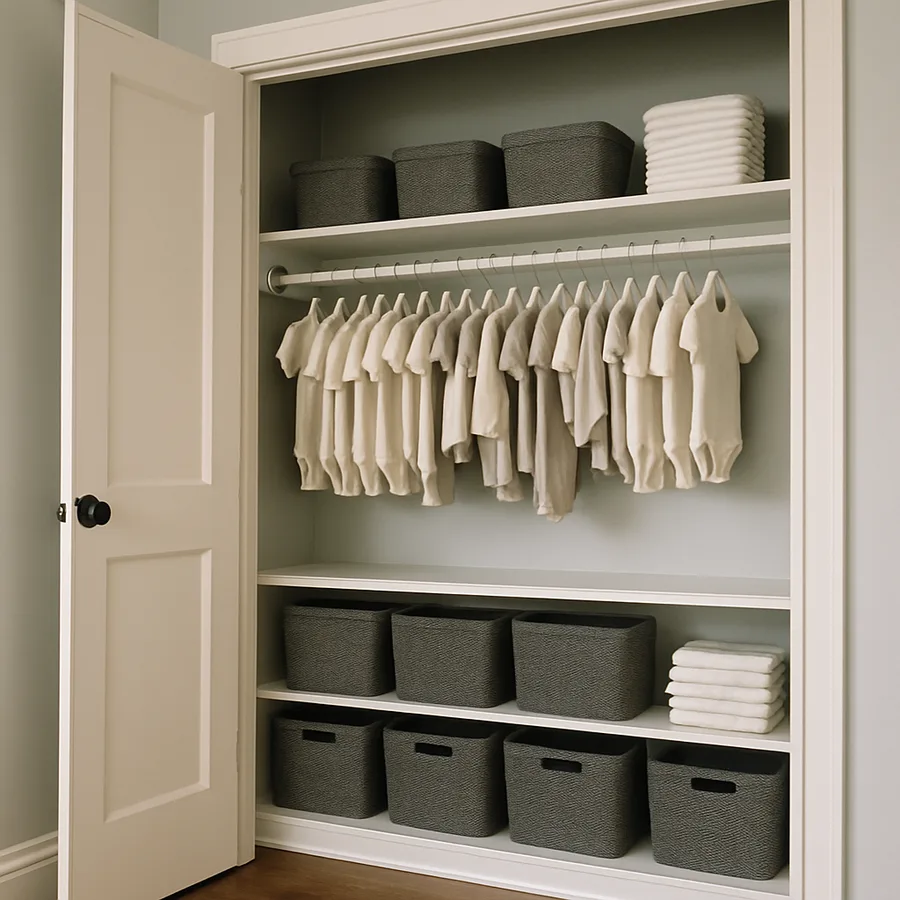
The first time you stand in a nursery closet holding a stack of newborn onesies, the scale problem hits you: standard hangers are too wide, standard shelves are too deep, and standard bins are too tall for the things a baby actually needs every two hours. A well-planned nursery closet system is less about Pinterest-perfect aesthetics and more about reducing the cognitive load of dressing and changing a tiny human at three in the morning. The goal is a closet that a sleep-deprived parent can navigate with one hand while the other holds a wriggling infant.
This guide walks through how to zone the closet by frequency of use, choose hardware that fits doll-sized clothing, build a diaper restocking station that prevents 2 a.m. panics, and adapt the system as your baby grows from newborn to crawler. The recommendations draw on safety guidance from the American Academy of Pediatrics, retail organizing data, and conversations with parents who have done this twice.
Zone the Closet by How Often You Reach In
Before you buy a single bin, divide the closet into three vertical zones based on access frequency. The hot zone sits between waist and shoulder height - this is where your most-used items live: today's outfit, the current diaper size, burp cloths, and a small basket for socks and mittens. Anything you touch ten times a day belongs here, no exceptions.
The warm zone covers the area just above the hot zone and the shelf below it. Use this for items you reach for daily but not constantly: pajamas, the next size up of clothing already laundered, swaddles, and a small basket of seasonal accessories. Keep the warm zone reachable without a stool, because you will inevitably grab from it while holding a baby.
The cold zone is everything above shoulder height and below knee height. This is your storage layer: the next two clothing sizes, off-season gear, gift items still in tags, and the bulky bin of swaddle blankets you have not opened yet. Anything in the cold zone should be in a clear or labeled container, because you will not see it again for weeks. The Better Homes & Gardens closet planning library notes that vertical zoning increases retrieval speed by roughly 40 percent compared to a flat shelf system, and that gain matters more in a nursery than almost any other room.
Pick Hardware Built for Small Garments
Standard adult hangers cause newborn shirts to slip off and stretch shoulder seams. Buy a single style of infant velvet hanger in a 30 to 50-pack and commit to it for the first year. Velvet grips the tiny shoulders, the slim profile lets you hang twice as many outfits per inch of rod, and a single color creates the visual calm that makes a small closet feel intentional rather than chaotic.
Install a second rod roughly 28 inches below the upper rod. Newborn through 12-month clothing rarely exceeds 18 inches in length, so you waste an enormous amount of vertical space with a single rod. Double-hanging effectively doubles your hanging capacity without adding a single shelf. Cheap tension-rod systems work for the first six months, but a screw-mounted secondary rod from a hardware store costs under twenty dollars and will not collapse when a stack of laundry brushes against it.
For shelves, opt for shallow ones - 10 to 12 inches deep maximum. Deep shelves invite stacking, and stacks become avalanches. The Juvenile Products Manufacturers Association, better known as JPMA, recommends keeping nursery storage at a depth where every item is visible from the front edge, because items shoved to the back simply disappear from your mental inventory until your baby has outgrown them.
Sort Clothing by Size, Not by Type
The instinct is to group clothes by category - onesies here, pants there, sleepers in the corner. Resist this. Babies grow through clothing sizes faster than they wear out any single piece, and the only sort that matters in months one through twelve is size. Use bins or labeled dividers for newborn, 0-3, 3-6, 6-9, 9-12, 12-18, and 18-24 months, and put everything regardless of category into the appropriate bin.
This system has one critical benefit: when your baby outgrows a size, you simply remove the entire bin and replace it with the next one from your storage layer. There is no hunting, no sorting, no surprise pile of unworn 0-3 month outfits discovered when the baby is already in 6-9 months. A 2024 industry report from the National Retail Federation estimated that families discard or donate roughly 30 percent of baby clothing they receive as gifts without it ever being worn, much of it because parents never found it in time. Size-based sorting cuts that waste dramatically.
Within each size bin, keep two sub-piles: everyday and special occasion. Everyday is the soft, washable, easy-snap stuff. Special occasion is the holiday outfit, the family photo getup, and the heirloom piece from grandma. Keep special occasion at the back of the bin so you do not accidentally use a baptism gown for a Tuesday.
Build a Diaper Restocking Station
Diapers deserve their own architecture. A newborn goes through 8 to 12 diapers a day, which means a typical 80-count package lasts about a week. The active stash belongs not in the closet at all but on or beside the changing table - usually a basket of 15 to 20 ready-to-grab diapers. The closet's job is to hold the next two boxes and to make refilling the changing-table basket frictionless.
Reserve a single shallow shelf or a pull-out drawer for diapers. Stand the boxes on their narrow side so you can pull one diaper out at a time - this is faster than wrestling with a flap. Many parents repurpose a single under-shelf wire basket as a diaper drawer; it holds about a week's supply, slides out for refills, and never gets confused with clothing storage. Keep two sizes of diapers in rotation once your baby approaches a size threshold, because babies grow overnight and you do not want to be stuck at midnight with only the size that no longer fits.
Store diaper rash cream, wipes refills, and gas drops in a small lidded box on the same shelf - not loose, because they migrate. The U.S. Consumer Product Safety Commission emphasizes keeping any topical product out of a child's reach, so as soon as your baby can stand, this box moves up to the cold zone. Build that transition into your plan from the start so you are not scrambling to childproof at the eight-month mark.
Solve the Sock, Hat, and Mitten Problem
Tiny accessories are the single biggest source of nursery closet chaos. A newborn sock is roughly the size of a credit card, and ten of them in a drawer becomes a tangled cloud within a week. Three solutions work better than any "drawer organizer" you can buy.
First, use a shallow shoebox-sized bin dedicated entirely to socks and mittens, and pair them when they come out of the dryer - never store unpaired. Pairing at laundry time costs ninety seconds and saves you ninety frantic mornings. Second, use a small over-the-door pocket organizer for hats, headbands, and bows; clear pockets let you scan the entire collection without unpacking anything. Third, designate a graveyard bin for single socks. Once a month, reunite the survivors and discard the rest.
For shoes - which babies under twelve months do not really need but inevitably accumulate - use a single small basket on a low shelf. Pre-walking shoes are decorative more than functional, and a basket with a maximum capacity forces you to rotate or discard rather than collect. The American Academy of Pediatrics points out that barefoot is best for non-walking babies because it supports proprioceptive development, which means most of those tiny shoes are going straight from gift wrap to donation pile anyway.
One advanced trick: assign each accessory category a color-coded label and apply that color to both the bin and to the inside of the closet door. A small chart on the inside of the door becomes your at-a-glance map of where every item lives, which matters during the predictable 2 a.m. moment when you cannot remember which bin holds the spare swaddle. Color-coding sounds excessive in the planning phase and reveals itself as essential within the first month of actual use. Many parents who skip it the first time install it after a sleepless week of hunting for missing accessories.
Bibs deserve their own dedicated zone, often overlooked in favor of clothing storage. A newborn produces an enormous volume of laundry through bibs alone - many families cycle through 6 to 10 bibs per day during the spit-up era. Store bibs flat in a single shallow drawer or basket near the changing table, not folded with clothing. Folding them with clothing makes them invisible exactly when you need one urgently, and a parent reaching into a clothing drawer with a spit-up emergency in progress is a parent who will tear the entire system apart.
Plan for the First Twelve Months of Growth
A nursery closet is not a static system; it is a rotation engine. Every six to eight weeks you will retire a clothing size, promote the next one into the hot zone, and pull a new size up from storage into the warm zone. Build this rhythm into your calendar. Many parents do a closet audit on the first weekend of each month - twenty minutes with a donate bag, a "next size" bin, and a trash bag for anything stained beyond recovery.
Keep a sentimental bin at the very top of the closet for the three or four pieces you cannot part with: the coming-home outfit, the first pajamas, the going-to-grandma's dress. Give yourself permission to keep a small number of items - the keepsake limit is more honest than the fantasy that you will preserve everything. The American Society of Interior Designers, known as ASID, has written extensively on the psychology of nursery storage, noting that designated keepsake zones reduce parental guilt about decluttering by giving emotion a defined home.
Finally, photograph your closet layout once it is dialed in. When the baby outgrows the system at around month nine - and they will, because they will start standing and reaching - you will want a reference photo of what worked before you redesign for the toddler years. The baby closet you build today is the toddler closet you rebuild in six months, and a photo makes that rebuild a reorganization rather than a from-scratch project.
Conclusion
A great nursery closet is one you can use without thinking. The combination of vertical zoning, infant-scaled hardware, size-based sorting, and a dedicated diaper-restocking station turns the closet from a daily friction point into a quiet background system. None of the components are expensive, but the order in which you install them - zones first, hardware second, sorting third, accessories last - makes the difference between a closet that calms you and one that defeats you.
The most common mistake new parents make is buying organizing products before deciding on the system. Resist the bin haul at the big-box store. Stand in the empty closet for ten minutes, mark the hot, warm, and cold zones with painter's tape, and only then decide what to buy. Every bin should answer a specific question about a specific piece of gear. Bins purchased speculatively become the storage problem you were trying to solve.
Two questions worth asking yourself before you start: What item have I lost in this closet at least three times? That item belongs in the hot zone, regardless of category. And what do I reach for first when the baby cries at 2 a.m.? That route - from doorway to grab to changing table - should be a straight line with nothing in the way. If your current closet fails either question, it is time to rebuild.
Ready to start? Empty the closet completely this weekend, mark your three zones with tape, and rebuild from scratch. Most parents finish in a single afternoon and report the difference is immediate. Save the photo, schedule a monthly audit, and let your closet do the work that your sleep-deprived brain should not have to.
More Articles You May Like



Comments
Post a Comment