Wire Basket Inserts for Deep Linen Closet Shelves That Stay Neat
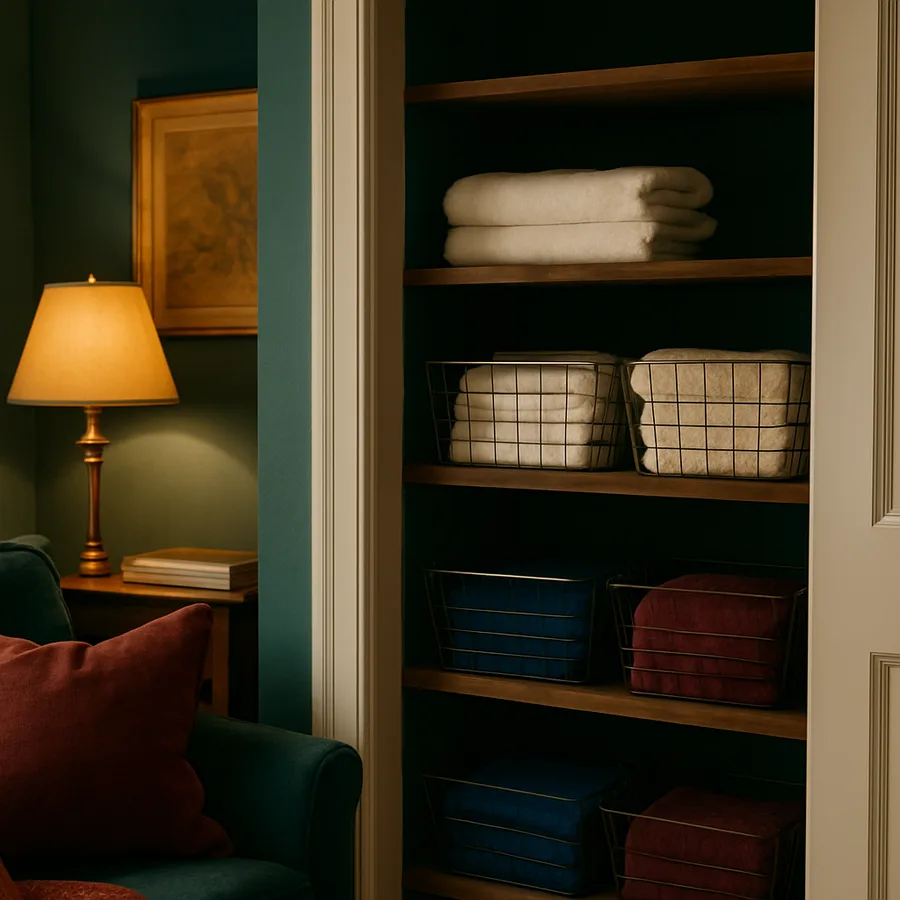
Deep linen closet shelves promise abundant storage and usually deliver chaos. Anything beyond arm's reach disappears into a back zone where items get crushed, forgotten, and eventually rediscovered three years later with a puzzled expression. Wire basket inserts are the single most effective retrofit for this problem, turning an unwieldy 24-inch-deep shelf into a set of clearly bounded pull-out zones that work like drawers without the hardware. The The Container Store reported in its 2024 customer study that wire basket inserts are the third best-selling closet accessory category, behind only hangers and shoe storage.
This guide lays out how to choose the right wire basket dimensions for a deep shelf, which materials hold up longest, how to size inserts so they glide without tipping, and how to label them in a way that survives real family use. It also addresses the quieter questions: how much weight can a basket actually hold, how do you prevent the dreaded ceiling-to-basket lip clearance error, and when is a solid bin better than a wire one? If you have ever pulled out a forgotten bath sheet that smelled vaguely of last winter, this is the upgrade that prevents it from ever happening again.
Why Deep Shelves Need Containment, Not Just Better Folding
A linen closet shelf deeper than 18 inches creates what organizers call a back zone problem: the front 12 inches are accessible, but items pushed to the back tend to stay there indefinitely. The physical issue is leverage. Reaching for a washcloth 20 inches back requires shifting everything in front, which discourages daily use and concentrates activity in the front row. Over weeks, the back row becomes a dead archive and the front row becomes a messy buffer zone.
The National Association of Productivity and Organizing Professionals calls this pattern the depth dead zone and estimates that homeowners waste 25 to 40 percent of shelf depth in closets deeper than 18 inches without containment systems. Wire baskets solve the problem mechanically by creating a pull-out zone that reaches the full depth of the shelf, bringing the back row into the light. Instead of reaching in, you slide out.
Have you ever estimated how much of your closet's cubic footage is actually usable? Grab a tape measure, find your closet's interior depth, and mentally subtract the back 8 to 10 inches. That invisible archive is exactly what a wire basket system reclaims. In a 24-inch-deep closet with five shelves, adding baskets typically recovers 30 to 50 cubic feet of practical storage.
Sizing Baskets to Fit Your Specific Shelf Dimensions
The single biggest mistake homeowners make is buying baskets before measuring. Linen closet interiors vary more than people expect, with widths ranging from 22 to 36 inches and depths from 14 to 28 inches even in production homes. A basket that fits a 24-inch shelf perfectly will bind against a 22-inch shelf or rattle loosely inside a 30-inch one. Measure interior width at three points (top, middle, bottom) because plaster walls and baseboards often reduce available width in subtle ways.
For width, leave at least half an inch of combined clearance so the basket can slide in and out without friction. For depth, choose a basket 2 inches shallower than the shelf so the basket can be fully removed without clearing the shelf above. For height, the basket should be at least 2 inches shorter than the shelf gap to allow for the lip of an upper shelf and for finger room when lifting items out. These three clearance numbers, half inch width, two inch depth, two inch height, are the sizing rules that professional organizers use consistently.
Standard wire basket sizes from major retailers including Martha Stewart Living, Better Homes and Gardens, and The Container Store's Elfa system cluster around 14 by 16 inches, 14 by 22 inches, and 14 by 28 inches. If your shelf width is a non-standard number, consider buying two smaller baskets side by side rather than one custom-width basket. Two 14-inch baskets on a 30-inch shelf work better than one 29-inch basket because the smaller units are easier to lift down from high shelves.
Coated Wire, Chrome, Bamboo, and Fabric: Material Tradeoffs
Wire baskets come in four dominant materials, each with a distinct personality. Epoxy-coated steel, the standard Elfa-style material, offers the best balance of durability, appearance, and price, with white and matte black being the most popular finishes. Chrome-plated steel looks more utilitarian but resists humidity exceptionally well, making it a good choice for linen closets that share a wall with a bathroom. Bamboo or rattan weave baskets add warmth and texture but have solid bottoms and closed weaves that block airflow, which can be a downside for freshly laundered textiles.
Fabric storage bins, while not technically wire, occupy the same category in most home-organization catalogs. Linen-look polyester bins from brands like mDesign and IKEA cost $8 to $25 and look beautiful, but they deform over time and cannot support heavy loads. If you are storing stacks of folded towels, wire wins. If you are storing lightweight items like washcloths, napkins, or small accessories, fabric bins deliver a softer look at a lower price point. Real Simple's 2023 storage guide noted that wire baskets last an average of 12 to 15 years in linen closet use, while fabric bins typically need replacement every 3 to 5 years.
Have you considered whether your baskets need ventilation? If your linen closet is adjacent to a bathroom or laundry room, humidity can be 20 to 40 percent higher than the rest of the house, and trapped moisture in solid-bottom baskets can lead to musty odors. The American Cleaning Institute recommends airflow-friendly storage for textiles in humid zones, and open wire baskets outperform solid bins by a clear margin in this regard.
Finish matters for longevity too. Powder-coated finishes generally last longer than spray-on paint, and matte finishes tend to hide small scratches better than glossy ones. If you live in a coastal climate with high salt content in the air, consider stainless steel or marine-grade coated wire to prevent rust at stress points. Professional organizers who work with waterfront homeowners typically recommend stainless over epoxy for any storage within twenty feet of exterior doors.
Weight Limits and Structural Considerations You Cannot Skip
A wire basket looks light, but a full basket of folded towels can weigh 15 to 25 pounds, and a basket of blankets and comforters can push 30 to 40 pounds. The shelf beneath it needs to support that load across the basket's full footprint, not just at the front lip. Older linen closets with 3/8-inch particleboard shelves can sag or fail under 30-plus pounds of basket weight concentrated over a narrow area.
Before loading heavy baskets, check shelf construction. A properly built linen closet uses at least 3/4-inch plywood or solid wood shelves supported every 32 inches or less with cleats or brackets. If your shelves are thinner particleboard or MDF, add mid-span supports or replace the shelves before stacking heavy baskets. The American Society of Interior Designers (ASID) has published residential storage guidelines recommending no more than 50 pounds of uniformly distributed load per linear foot of standard linen closet shelving.
For basket hardware itself, look for welded steel construction at the corner joints rather than crimped or snapped assembly. Welded joints survive hundreds of pull-in and pull-out cycles, while crimped joints can loosen over time and develop the wobble that eventually becomes a wobble-turned-collapse. Good Housekeeping Institute testing has shown that welded basket frames last roughly three times longer than snap-together frames under normal household use.
Labeling Systems That Survive Dishwashers, Humidity, and Kids
An unlabeled basket is a basket that slowly forgets its purpose. Within six months, the hand-towel basket starts collecting washcloths, the sheet basket accidentally holds a forgotten pajama set, and entropy wins. Labels keep baskets disciplined by giving every item a clear mental home. The question is which labeling system actually holds up under daily family use.
Clip-on metal label frames with replaceable paper inserts are the durable professional standard. The metal frame attaches to the basket wire with a small hook or snap, the paper insert slides in from the top, and you can rewrite labels as needs change. This system tolerates humidity, handles abuse from small hands, and photographs beautifully. Martha Stewart's home team has used this approach in feature shoots for over two decades, and The Container Store sells matching frames for roughly $2 to $4 per basket.
Adhesive chalkboard labels and vinyl sticker labels look great on launch day but fail within a year in humid conditions. Chalkboard labels fade, vinyl stickers peel, and you end up with ghost outlines of old labels and no indication of current contents. If you must use stickers, apply them to the basket itself at a point where they will not catch when sliding the basket in and out. Do you have young children learning to read? Consider pairing a word label with a small icon or photo to make the system accessible to pre-readers, an approach endorsed by early-childhood educators through the Montessori in the Home network.
Combining Baskets With Dividers and Lazy Susans for Complex Closets
Wire baskets solve the depth problem, but deep linen closets often also have a width problem, a height problem, or a corner problem. Pairing baskets with additional hardware unlocks the final 10 percent of usable space. Clear acrylic shelf dividers, mounted between stacks, prevent folded towels from tipping sideways when neighbors are removed. These work particularly well in closets where you keep three or four towel colors and want to preserve crisp color boundaries.
For corner closets or closets with a built-in vanity or appliance cutout, a lazy Susan or rotating turntable can save the unreachable back zone. Two-tier turntables for closet use typically cost $20 to $50 and add the equivalent of a small drawer's worth of organized storage to a previously dead corner. Pottery Barn and Williams Sonoma Home have featured these in their closet accessory collections for years, and professional organizers report strong client satisfaction when corners get this treatment.
Finally, combine baskets on lower shelves with open stacking on upper shelves, not the reverse. Baskets are easier to pull forward at waist and chest height than overhead, where lifting a full basket becomes an ergonomic hazard. Reserve the top shelf for lightweight, rarely accessed items stored in open stacks or soft fabric bins that are easy to lift down. This height-matched approach is endorsed by the ASID residential design guidelines.
Conclusion
Wire basket inserts are the retrofit that makes a deep linen closet behave like an expensive custom system without the custom price tag. By converting dead back zones into pull-out drawers, by sizing inserts correctly, and by choosing durable materials and labels that actually last, you transform a chronic low-grade household frustration into a system that runs itself. The total investment for most standard linen closets lands between 80 and 250 dollars, and the return shows up every single day.
Start with a measuring session before you buy anything. Sketch your closet in elevation, note the interior width, depth, and shelf gaps, and identify the two or three worst zones in your current setup. Most households find that converting just the lower three shelves to wire baskets captures 80 percent of the benefit, so a partial conversion is a perfectly valid first step. If you are unsure about load ratings or shelf reinforcement, a one-hour consultation with a licensed carpenter or a NAPO-certified organizer will resolve the structural questions quickly.
The hallway linen closet is one of the most used storage spaces in any home, and it deserves more attention than it usually gets. Pick up a tape measure this weekend, count your folded stacks, and commit to a wire basket retrofit before the end of the month. Your future self, searching for a fresh bath sheet on a busy Tuesday morning, will thank you for the upgrade.
More Articles You May Like



Comments
Post a Comment