Mudroom Locker Cubbies One Per Family Member System
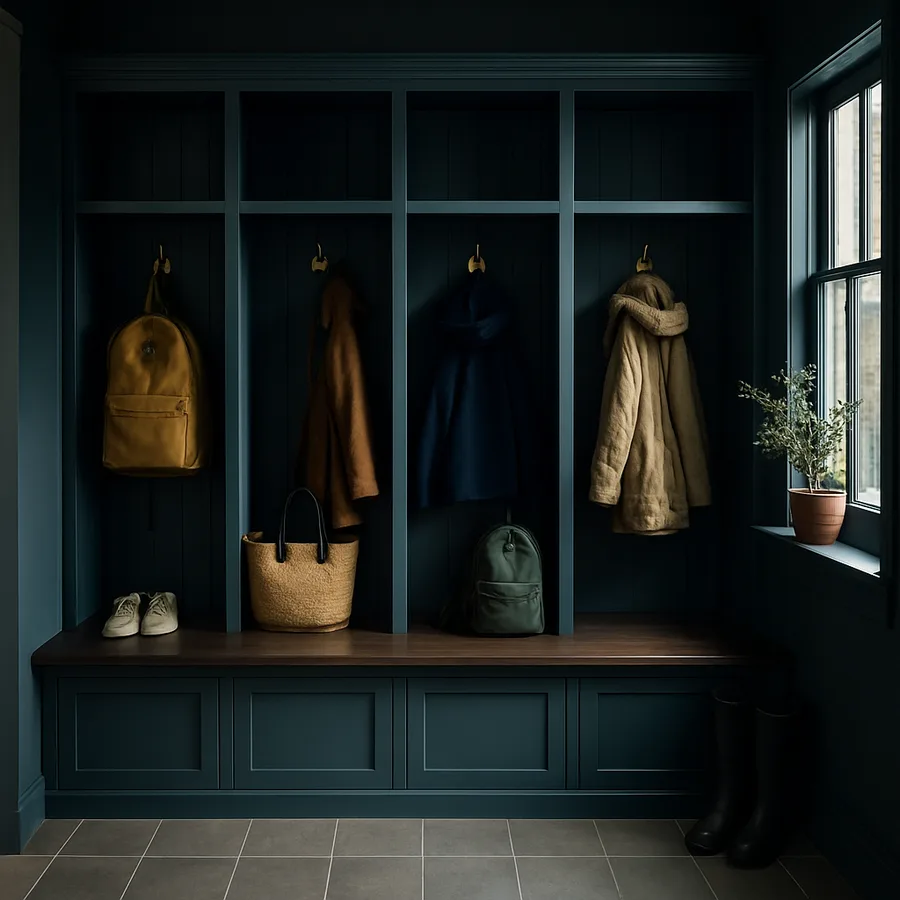
The single most effective organizing principle ever applied to mudroom design is also the simplest: one locker per person. Not one locker per coat. Not one locker per category. One vertical column of dedicated storage assigned to a specific human being who has full custody of its contents and full responsibility for its order. Households that adopt this rule see clutter drop dramatically and almost never go back to shared mudroom storage.
This article walks through how to plan, size, and build a per-person locker system. We will cover column dimensions, age-appropriate fittings, the trade-off between built-in and modular construction, and the social rules that make the system actually function rather than collapse into the same pile of shared chaos. The construction is simple; the discipline is what makes it work.
The Logic of One Column Per Person
Shared storage fails for the same reason that shared chores fail: when responsibility is diffuse, no one feels accountable. A mudroom with a shared bench and a shared row of hooks invites every family member to assume someone else will tidy. Within a week the bench is buried under everyone's gear, and assigning blame is impossible. The per-person locker reverses this dynamic. Each family member has exactly one column, clearly labeled, and can see at a glance whether their column is in order.
The behavioral effect is striking. Children as young as four understand the rule "this is my locker, that is my brother's locker" and respect it within days. Teenagers who would never voluntarily organize a shared space readily maintain a personal one because the social cost of an embarrassing mess is now individually visible. Parents who once nagged the entire household now address only the specific person whose column is failing. The system is a small piece of architecture that quietly enforces individual accountability.
Have you noticed how schools have used locker systems for over a century with this same logic? The design works because it aligns the responsibility for storage with the person who generates the gear. According to the American Society of Interior Designers, accessible at ASID, dedicated personal storage is among the most consistently cited drivers of household-organization success in residential post-occupancy surveys.
Sizing the Locker Columns
A standard locker column should be 14 to 18 inches wide. Narrower than 14 inches and an adult winter coat will not hang flat without bunching. Wider than 18 inches and the column wastes space and starts to invite multi-person occupancy by stealth. The 14 to 18 inch sweet spot is wide enough for any single person's gear and tight enough to enforce the one-person rule by physics rather than rule.
Total column height matters too. Floor-to-ceiling lockers maximize storage but can feel oppressive in a small mudroom. The most usable height is 84 to 90 inches total, leaving the top 12 inches as an open shelf for seasonal items. Bottom 16 inches should be a shoe and boot zone with a slatted shelf or removable tray. The middle 56 to 60 inches is the active zone with hooks, a small accessory shelf, and any drawer or basket fittings. Map these zones consistently across all columns so the system reads as a unified composition.
Depth is the third critical dimension. Lockers with less than 14 inches of interior depth cannot accommodate adult winter coats on hooks; the coat shoulder constantly catches on the door or front edge. Push depth to 16 to 18 inches if your wall allows. The National Kitchen and Bath Association recommends similar depth ranges for entry-storage millwork in its design briefs, available through NKBA, and the dimensions translate directly to mudroom planning.
Age-Appropriate Fittings Within Each Column
The genius of a per-person locker system is that you can tune each column to its occupant. A four-year-old's locker has hooks at 36 inches, a low bin at floor level for shoes she can step into easily, and large open shelves with no doors that a child can navigate without fine motor skills. A teenager's column has hooks at 64 inches, a closed drawer for valuables, and dedicated open shelves for sports gear. Same column footprint, completely different fittings.
Plan for growth. Lockers built with adjustable shelves and hook strips at 4-inch intervals can be reconfigured every two or three years as a child grows. Lockers built with permanently fixed components require renovation as the family ages. For a young family, prioritize modularity and adjustability over the slightly cleaner look of fixed millwork. The cost difference is minor; the future flexibility is enormous.
Each column should also have a small identity element: a name plate, a chalkboard label, a colored hook, or a custom art piece. The visual personalization reinforces the ownership dynamic and is also a quiet kindness; children especially respond to seeing their name in the architecture. The element does not need to be expensive, but it does need to be permanent enough to feel like a piece of the house rather than a temporary sticker.
Built-In Versus Modular Construction
The construction choice has real long-term consequences. Site-built lockers, framed in place from plywood and trimmed with cabinet moldings, look the most architectural and use every inch of available wall length. Custom millwork can incorporate plumbing chases, irregular wall conditions, and bespoke detailing that prefab solutions cannot match. The trade-off is cost: a row of four custom lockers typically runs 4,000 to 8,000 dollars depending on materials and finish.
Modular lockers, either as factory-built cabinet units or DIY installations using stock cabinetry, deliver 80 percent of the function at 30 to 40 percent of the cost. A typical modular installation pairs three or four 18-inch-wide pantry cabinets with custom hook and shelf interiors, finished with crown molding and a continuous bench at the base. Done well, the result is nearly indistinguishable from custom millwork at less than half the price.
According to a 2024 National Association of Home Builders remodeling cost report, available through NAHB, modular mudroom systems represent the fastest-growing category of entry-renovation projects, with installations rising more than 40 percent year-over-year as homeowners discover the cost-to-impact ratio. The growth is driven partly by improved factory-built quality and partly by the realization that mudroom millwork rarely needs to look like furniture-grade cabinetry.
Doors, No Doors, or Half Doors
The decision to enclose each locker with a door, leave it open, or use a partial cabinet front is one of the more consequential aesthetic choices. Open lockers are the cheapest, the easiest to use, and the most forgiving for children who would never consistently open and close a door. The trade-off is the visual reality that personal mess is on permanent display from anywhere in the room.
Full doors, by contrast, create a clean visual surface and let each occupant be tidy or messy in private. The cost is daily friction: every time someone arrives home, they open a door, hang gear, and close the door. Children frequently skip the closing step, and the result is an oddly half-open row of doors that looks worse than open lockers ever did. Doors work best for adult-only households or for families willing to enforce the closing habit.
Half-height doors offer a hybrid solution that rewards thinking it through. The lower 36 to 42 inches of each locker is enclosed by a door, hiding shoes, boots, and sports equipment, while the upper portion remains open for hooks and easily-grabbed items. This arrangement satisfies the daily-access reality of hooks without the visual chaos of fully-exposed shoe storage. It is the configuration most professional designers gravitate toward when given full creative latitude.
Making the System Stick: Rules and Rituals
Architecture alone does not enforce organization; household rules do. The most successful per-person locker systems pair the physical design with a small set of social conventions. A common one is "empty before bed": every family member returns to their column once before sleep and removes any non-locker items. The five-minute habit prevents the slow accumulation that gradually erodes any organizing system.
Another effective rule is "if it's in your column, it's your problem". Items that need washing, repair, or tossing belong only to the column-owner; no one else handles them. The rule sounds harsh and is wonderfully effective. Children quickly learn that leaving wet swim trunks in their locker is their own moisture problem to solve, and the household stops mediating gear-related conflicts.
What does failure look like? It looks like one column quickly turning into the family's dumping ground. The fix is to physically reduce that column's storage capacity until the owner is forced to triage. Remove a bin, take out a shelf, force compression. The behavioral change usually follows within two weeks. According to organizational research summarized by the American Society of Interior Designers at ASID, constraining capacity is one of the most reliable interventions for chronic-clutter spaces.
Conclusion
A mudroom locker system that gives each family member one column is one of the highest-leverage organizational decisions a household can make. The hardware is straightforward, the layout is teachable, and the behavioral effects are immediate. Most families who install per-person lockers report a sharp reduction in mudroom-related arguments within the first month, and a noticeable easing of morning departure friction within the first season. The system pays back in lower household stress as much as in physical tidiness.
If you are designing a new mudroom, build the per-person locker system into the floor plan from day one. Reserve at least 16 inches of wall width per family member, plus 18 inches for any service or storage column. A family of five wants a minimum of 98 inches of dedicated mudroom wall, which often means stealing a few feet from an adjacent garage or hallway. The space is worth taking; few square feet of a home work as hard as well-designed mudroom lockers.
If you are retrofitting an existing space, do not let the imperfection of available walls stop you. A row of three modular cabinets, finished as lockers, in an awkward 60-inch alcove will outperform any shared bench-and-hook arrangement on the same wall. Start with the people, design the columns to fit them, and accept that the millwork will adapt to the architecture. The principle of one column per person is what matters; the specific construction can be elegant or pragmatic depending on your budget.
This weekend, count the people who use your back door and sketch a column for each. Decide on a height, a width, and a basic three-zone interior of shoes, hooks, and overhead shelf. Pick whether you will go custom, modular, or open-cubby, and commit to a date by which the project will be complete. Your future self, walking into a calm, ordered mudroom on a wet Tuesday morning, will recognize the small architectural gift you gave the household. Start the sketch now, and the rest will follow.
One additional planning consideration deserves mention: lighting per column matters more than most homeowners realize. A single overhead fixture in the middle of the mudroom throws shadows into the back of each locker, hiding shoes and small accessories at exactly the wrong moment of a hurried morning. Better practice is a continuous LED strip mounted under the upper shelf of every locker, providing even, shadow-free illumination from the chest down to the shoes. The strips run on a single 24-volt driver, switch with the room lights, and add roughly 60 to 90 dollars to the total project cost. Few small upgrades pay back so visibly in daily use, and the warm light makes each personal column feel like its own deliberate piece of architecture rather than a utilitarian afterthought.
Finally, plan for the day a family member moves out. A college-bound teenager will eventually leave the household, and their column should not become an awkward unused fixture. Design the locker system so that adjacent columns can be combined by removing a single divider panel, converting two narrow lockers into one wider one or repurposing the column entirely as a tall pantry annex. The flexibility costs almost nothing at design time and saves a future renovation when life shifts.
More Articles You May Like



Comments
Post a Comment