Nursery Glider Vs Rocking Chair for Late Night Feedings
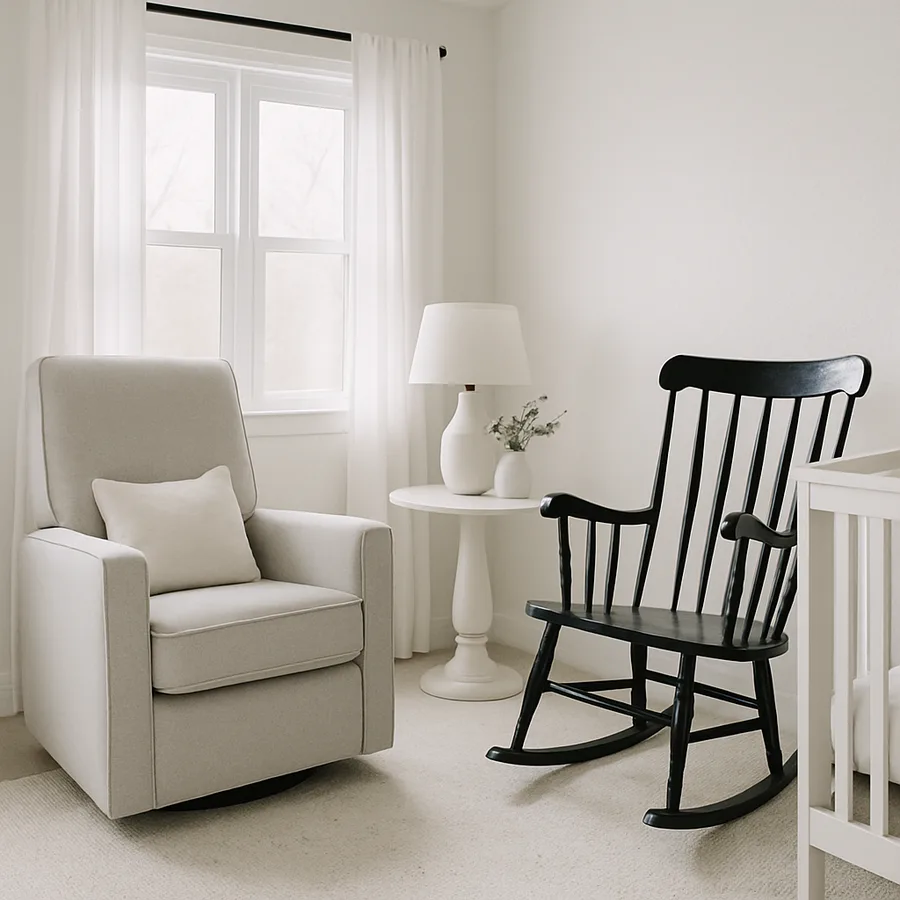
The chair you choose for your nursery is the piece of furniture you will sit in more than any other in your house for the first year of your baby's life. A nursing or bottle-feeding parent spends an average of 4 to 6 hours per day in the nursery chair during the newborn period, and roughly half of that time is between the hours of 10 p.m. and 6 a.m. The decision between a glider and a rocking chair is not aesthetic. It is a decision about whether you will return to bed feeling rested or feeling like the chair was working against you for the entire feeding.
This guide compares the two chair styles across the dimensions that actually matter at 2 a.m.: motion mechanics, arm support, footrest behavior, noise, safety as the baby grows, and total cost over a five-year horizon. The recommendations are practical, occasionally counterintuitive, and grounded in the design choices that distinguish a chair you will love from a chair you will quietly resent.
Understand the Mechanical Difference
A rocking chair moves in a curved path. The chair tips forward and backward along arched runners, which means the seat changes angle as it moves - your body rocks through space. A glider moves in a flat, horizontal path along a hidden bearing system. The seat stays level the entire time; you slide forward and back rather than tipping. This sounds like a small distinction. It is not.
The flat motion of a glider keeps the baby's head at a constant angle relative to the parent's chest, which matters for two reasons. First, a baby being bottle-fed needs head stability for safe swallowing, which the American Academy of Pediatrics highlights in its infant feeding guidance. Second, a level motion is gentler on a parent's neck and shoulders, especially during long feeds where the parent's posture matters as much as the baby's.
A rocking chair's tipping motion can be soothing for soothing-only sessions - the gentle pitch is rhythmic and almost hypnotic. But for active feeding, that same tipping motion forces the parent to constantly adjust their grip and the baby's position to keep the bottle or breast at the right angle. Most parents who own both styles end up using the glider for feeds and the rocker for soothing, if they keep both at all.
Compare Arm Support Carefully
The single most underrated chair feature for night feedings is the height and softness of the arms. A nursing or bottle-feeding parent rests their arms on the chair arms for the entire duration of the feed, and a chair whose arms are too high causes shoulder strain while one whose arms are too low forces the parent to hold the baby's weight without support.
The ideal arm height places the parent's elbow at roughly 90 degrees when the baby is being fed against the chest. For most adults this means the top of the chair arm sits 7 to 9 inches above the seat cushion when the cushion is compressed by sitting weight. Many gliders are designed with this anthropometric data in mind; many traditional rocking chairs are not, having been designed for general adult seating decades before infant feeding ergonomics were studied.
Arm padding matters as much as height. Wooden rocking chair arms become genuinely painful after thirty minutes of feeding, even with a thin nursing pillow. A glider with upholstered arms or a rocker with thick padded arm covers will save your forearms. According to a 2024 ergonomics study referenced by the American Society of Interior Designers, parents using padded-arm chairs reported 45 percent less upper-body discomfort after long feeding sessions compared to those using unpadded wooden chairs.
Evaluate the Footrest Question
A footrest changes everything about the feeding experience. Lifting your feet off the floor by even four inches removes pressure from your lower back and allows the chair to support your full body weight. After a thirty-minute feed in a chair without a footrest, most parents stand up with stiff knees and a tight lower back. After the same feed with a footrest, they stand up feeling closer to neutral.
Modern nursery gliders often come with a matching gliding ottoman that moves in sync with the chair. This is a meaningful upgrade - the syncing motion means your feet stay supported throughout the rocking cycle, and the matched height eliminates the dead-lift moment of moving your feet. A separate non-matching ottoman does not work as well because it does not move with you, and your legs end up either dragged along or held still while the rest of your body glides.
Some gliders include a built-in reclining footrest that pops up like a recliner. These are excellent for soothing sessions where you may doze off, but for active feeding they can position the baby too far below the parent's chest. If you are bottle-feeding or nursing, the upright glide-with-ottoman configuration usually works better than a full recline. Test both before buying if the showroom allows it.
Take the Noise Question Seriously
A creaking chair will wake a sleeping baby, and a sleeping baby is the entire purpose of the chair. Wooden rocking chairs develop creaks over time as the runners wear and the joints loosen - sometimes within the first year of use. The creaking is not a manufacturing defect; it is the nature of wood-on-wood movement under repeated loading.
Gliders use sealed bearing mechanisms that are nearly silent for the first several years if maintained. The trade-off is that when a glider does eventually develop noise, the bearing is usually hidden inside the base and difficult to lubricate without partial disassembly. A wooden rocker can be silenced with beeswax or paste wax on the runners; a glider often requires a service call or replacement.
For the first year, gliders win the noise battle decisively. From years two through five, the gap narrows because both styles develop their own quirks. If you are choosing primarily for the newborn period, prioritize the glider for silence. If you are choosing for long-term living-room use after the nursery years, the maintainability of a wooden rocker may serve you better. The U.S. Consumer Product Safety Commission has not flagged either chair style for safety concerns related to noise mechanisms, but it does emphasize stability - discussed further below.
Plan for the Crawler and Toddler Years
Both styles present safety considerations once your baby becomes mobile. A rocking chair's runners create a pinch point where small fingers can be trapped between the runner and the floor, and the tipping motion makes it possible for a chair to come down on a hand or foot positioned underneath. The CPSC has documented furniture-related injuries to crawling infants and recommends caution with any moving furniture in a room a child can access.
Gliders have their own pinch points - typically between the chair body and the base, or between the gliding ottoman and the floor. Some manufacturers have addressed this with locking mechanisms that immobilize the chair when not in active use, which is a feature worth seeking out specifically for the crawling phase. The Juvenile Products Manufacturers Association, known as JPMA, has published guidance on glider safety features and certifies products that meet stricter pinch-point and stability standards than the legal minimum.
If your nursery doubles as a play space - common in smaller homes - favor a glider with a lock or a rocker placed against a wall that prevents under-runner access. If the chair lives only in the nursery and the room is gated when the parent is not present, the safety gap between the two styles narrows considerably.
Calculate the Five-Year Cost Honestly
A quality upholstered glider with a matching ottoman runs $500 to $1,200, and the better ones include removable, washable cushion covers - a feature whose value becomes obvious approximately three weeks into the spit-up era. A quality wooden rocking chair runs $200 to $600, with upholstered cushions sold separately or included as removable pads.
The five-year cost picture is more complex than the sticker price. Gliders depreciate quickly on the secondhand market because the bearings are hard to evaluate without testing - expect 20 to 30 percent of original value at resale. Wooden rockers hold value much better, often retaining 50 to 70 percent of original value, especially if they are from a respected maker. Better Homes & Gardens has tracked nursery furniture resale trends and consistently finds that classic wooden rockers outperform upholstered gliders in long-term value.
If you plan to use the chair for multiple children spaced two or three years apart, the glider's higher upfront cost amortizes well - you essentially get the chair for half-price per child. If this is your only child or you plan to sell the nursery setup after the toddler years, the wooden rocker's better resale value may make it the more economical choice despite the lower comfort during the newborn period.
One often-overlooked factor in the cost equation is upholstery longevity. A glider with a fixed, non-removable cover will eventually need professional reupholstery - typically $300 to $600 for a quality job - once the cushion fabric absorbs enough spit-up, milk, and snack residue to be permanently discolored. A glider with removable, washable covers can serve a decade with simple machine washing. The price difference at purchase is usually $100 or less; the lifetime difference can be $500 or more. Removable covers are also a meaningful hygiene feature, because nursery furniture absorbs more bodily fluids in its first year than most furniture absorbs over its entire life.
Consider the warranty terms carefully before purchase. A glider mechanism is a moving part, and moving parts fail. The best manufacturers offer limited lifetime warranties on the bearing system specifically, separate from the upholstery warranty. A 90-day warranty on a glider mechanism is a red flag - it signals the manufacturer expects failure outside that window. A 5-year or longer mechanism warranty signals confidence. Read the warranty before you read the catalog copy, because it tells you what the manufacturer actually believes about their own product.
Conclusion
The honest answer to glider versus rocking chair is that for newborn feedings - especially the bleary 2 a.m. ones - a well-chosen glider with a matching gliding ottoman is the more comfortable, quieter, and more ergonomically supportive choice. The flat motion, padded arms, and synchronized footrest combine into a feeding station that is dramatically less fatiguing than a wooden rocker, and the comfort gap is most noticeable precisely when you are most exhausted.
That said, a beautiful wooden rocking chair has virtues a glider cannot match. It transitions out of the nursery with grace, it lasts decades with simple maintenance, it holds value, and the soothing tipping motion is genuinely lovely for non-feeding cuddle time. Many families end up with both - a glider for the feeding years, a rocker that lives in the living room afterward - and consider the combined investment worthwhile.
Two questions to ask before you buy: Will I be feeding from this chair multiple times a night? If yes, prioritize the glider regardless of aesthetic preference. Where will this chair live in five years? If the answer is "still in the house, somewhere," favor a chair you would still want to own when no babies are involved.
One last consideration that often tips the decision: cleanability. A glider with removable, washable cushion covers in a stain-resistant performance fabric will outlast a beautiful but dry-clean-only upholstery by years in real nursery conditions. Spit-up, leaking diapers, and spilled bottles are not occasional events; they are weekly events. The chair that survives them is the chair built to be cleaned, not the chair built to be looked at. A wooden rocker with a wipe-clean wood frame and a single removable cushion pad can match this in cleanability and may outlast a glider whose upholstery cannot be deep-cleaned.
Sit in both before you buy. Bring a 7 to 10 pound bag of rice as a stand-in baby, hold it the way you would feed a newborn, and stay in the chair for at least ten minutes. The chair you would not want to leave is the chair worth bringing home.
More Articles You May Like



Comments
Post a Comment