Track Lighting Layout for Hallway Art Display Spotlighting
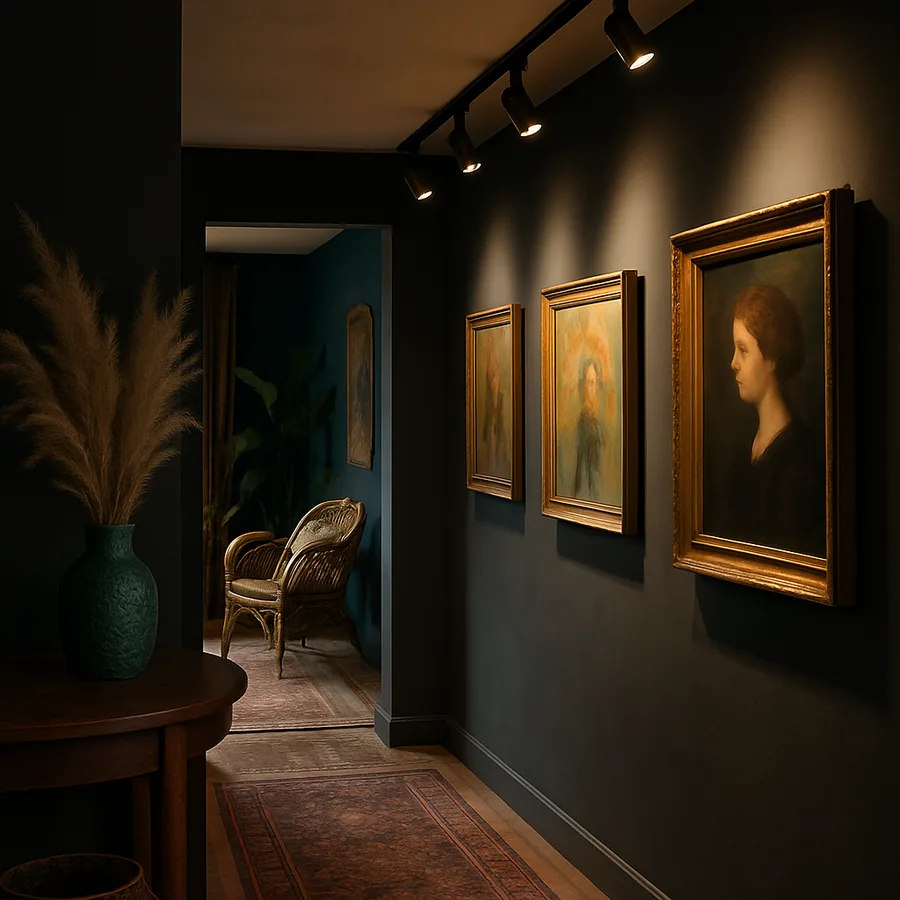
A hallway is the toughest room in the house to light, and the most rewarding once you get it right. The space is narrow, the ceilings are often low, and any artwork hung along the walls competes with shadows cast by people walking through. Track lighting solves all three problems at once when it is laid out with intent. The same track that washes a gallery wall in even, glare-free light at gallery quality can be installed in a residential corridor with surprisingly little fuss. The variables that separate a great install from a mediocre one are track position, head spacing, beam angle, and aiming geometry, and each of them obeys rules you can measure rather than guess.
Why Track Wins for Linear Galleries
Recessed cans, picture lights, and surface-mount fixtures all have their place, but a hallway is a near-perfect use case for track. The geometry is the reason. A corridor presents a long, mostly flat art wall that needs uniform vertical illumination, and a continuous track running parallel to that wall can deliver exactly that with as many or as few heads as you want. Adding or moving a piece of art later requires sliding a head along the track rather than cutting drywall.
The numbers back this up. A 2024 industry report from the American Lighting Association found that 78 percent of professional designers specify track or monorail systems for residential gallery walls and hallway displays, citing flexibility and aiming control as the primary reasons. Track also handles mixed art sizes gracefully; a single eight-foot run can light a 30-inch canvas, a 12-inch print, and a sculptural object on a pedestal without any reconfiguration of the ceiling.
Cost is competitive too. A 96-inch track plus four LED spot heads typically lands between $280 and $480 in residential-grade quality, well under the cost of four individually wired recessed cans plus their drywall patching. Replacement is also easier; track heads are a quick swap rather than an electrician call.
There is one situation where track is not the right call: very short hallways under 6 feet, or hallways where the ceiling is interrupted by a chase, soffit, or sloped section that fragments the available run. In those edge cases, individual directional spots or articulating mini-pendants distributed at art locations may be the cleaner answer. But for any straight, unbroken corridor longer than 8 feet, track remains the most flexible and visually composed option, especially when the gallery is expected to grow over time.
Where to Run the Track
The single most important variable in a hallway track install is the distance from the art wall. Place the track too close to the wall and the light grazes downward at a steep angle that creates harsh top shadows on every frame. Place it too far away and people walking through cast their own shadows directly onto the art. The sweet spot for most residential ceilings is 24 to 36 inches from the face of the art wall, measured at the ceiling.
For ceilings under 8 feet, lean toward 24 inches; for ceilings 9 feet or taller, you can push out to 36 inches and gain a more flattering aiming angle. Within that range, the goal is to land each beam on the art at roughly a 30-degree angle from vertical, which is the angle the Illuminating Engineering Society recommends for minimizing reflective hot spots on framed glass while still reading dimensional texture on canvas and sculptural surfaces.
If the hallway is wider than 5 feet, consider running two parallel tracks, one for each wall, rather than trying to cover both walls with a single center-mounted run. Center mounting is a common shortcut, but it forces every head to aim at a steeper angle and amplifies glare for anyone walking the corridor. The cost of the second track is modest compared with the visual penalty of doing it the easier way.
Ceiling structure also constrains placement. If your hallway has exposed beams, soffits, or HVAC chases, the track has to work around them. The cleanest approach is to run the track within a single uninterrupted plane and stop short of any obstruction, then resume on the other side with a separate run if needed. Splicing track around a corner is technically possible with L-connectors and T-connectors, but the connection points become visually busy and tend to read as compromises. Plan for clean breaks rather than continuous turns.
Head Spacing and Count
Spacing track heads is part math, part intent. The math comes from the beam spread of the lamp you choose. A 25-degree beam at a 7-foot mounting height projects a circle of light roughly 36 inches in diameter at average eye level, while a 15-degree beam projects a tighter 22-inch circle. To light a single piece evenly, you generally want one head per piece for works under 30 inches wide, and two heads for anything wider, spaced symmetrically about the centerline of the frame.
For continuous wall washing rather than individual spotlighting, switch to wider beams (40 to 60 degrees) and place heads on roughly 24-inch centers. This produces an even gradient that flatters salon-style hangs and dense print arrangements where individual aiming would create visual noise. The two approaches can mix on the same track; just dedicate sections rather than alternating heads.
Have you ever seen a gallery wall where one piece looks dramatically brighter than its neighbor? That is almost always a head-count problem rather than a fixture problem. The fix is rarely to raise the wattage of the dim head; it is to add a second head and split the load. The American Society of Interior Designers recommends targeting a 3-to-1 ratio at most between the brightest and dimmest piece on a single wall, and head count is the lever that controls it.
Beam Angles, Color Temperature, and Lamp Selection
Three lamp specifications carry almost all the weight in a residential gallery: beam angle, color temperature, and color rendering index. Beam angle determines the shape of light on the wall. Use 10 to 15 degrees for tight accent on small works, 20 to 25 degrees for mid-size framed pieces, and 35 to 45 degrees for large canvases or wall-washing duty. Most quality LED track heads accept interchangeable lenses, so you can buy one head model and tune the optics per piece.
For color temperature, residential galleries almost always look best at 2,700 to 3,000 Kelvin. Cooler temperatures shift skin tones in figurative paintings toward gray and make warm wood frames read as flat. The color rendering index (CRI) should sit at 90 or higher, with 95-plus preferable for any space displaying original paintings or fine prints. The cheaper 80-CRI lamps that ship in builder-grade fixtures crush red saturation noticeably and are a false economy on a wall full of art.
Wattage is rarely the problem with modern LEDs; 6 to 12 watts per head is plenty for residential viewing. The bigger concern is dimming compatibility. Confirm that your heads are listed as fully compatible with the dimmer model you plan to install, because LED flicker on a poorly matched dimmer is the single most common complaint reported in homeowner reviews of track systems.
Aiming and Adjustment
Aiming is where the install either sings or falls flat. Each head should be tilted to land its beam on the vertical center of the artwork, with the head itself roughly at or slightly forward of the top edge of the frame when viewed in section. The reliable on-site method is to dim the lights to about 30 percent, stand at the far end of the hallway, and walk slowly toward each piece while watching for the moment the frame's top edge picks up a shadow line. That is the cue to tilt the head a few degrees forward.
Aim each head before hanging the next piece if you can. Adjustments on a populated wall are tedious because you are constantly stepping over a ladder among framed glass. Many designers also recommend using a laser line level projected horizontally across the wall at desired hang height as a sighting aid; the laser shows you exactly where the brightest point of each beam will land before you commit.
For glass-fronted pieces, watch for reflection back into the corridor. If a viewer walking the hallway sees the bare lamp reflected in the glass, the aim is wrong. The fix is usually a few degrees of tilt forward or a switch to a matte snoot or honeycomb louver attached to the head, which shields the source from off-axis viewing angles. Many readers ask whether anti-reflective museum glass eliminates the problem entirely. It helps but does not replace good aiming, and museum glass adds $60 to $200 per piece to framing costs that better aiming would render unnecessary.
Wiring, Switching, and Code Compliance
Track lighting is straightforward to install in a hallway with attic access above, somewhat trickier in a single-story flat-ceiling unit, and a real project in a finished basement corridor. The track itself is fed by a single line-voltage feed at one end or in the middle, and the heads pull power along the rail. Most residential systems are rated to a maximum of 20 amps total per circuit, which is far more than a typical four- to eight-head hallway will draw, but the National Electrical Code still requires that the feed be on a properly sized breaker and that the track length stay within the manufacturer's specification.
Switch placement deserves thought. The most usable hallway gallery has a three-way switching scheme with controls at both ends of the corridor, ideally paired with a dimmer at one end. A single-switch setup forces residents to walk back to turn the lights off, which is the kind of friction that ends with the lights left on or the gallery unused. Smart switches with motion or schedule control are an upgrade worth the modest premium, especially in long corridors with bedrooms at the far end.
If you are not a licensed electrician, hire one for the feed connection and the switch leg. The track and heads themselves are typically homeowner-installable once the feed is live, and most manufacturer instructions are clear enough for an attentive DIYer. Always confirm the breaker is off at the panel before opening the junction box, and verify with a non-contact tester even after the breaker is off. The few minutes this takes are non-negotiable.
Plan for the feed location early. The cleanest install lands the feed at the far end of the corridor rather than mid-run, because end-feeds keep the track profile uninterrupted and give you the option to extend later. If a mid-run feed is unavoidable, choose a manufacturer that supplies a flush-mount monopoint matching your track finish; off-the-shelf canopies often look chunky and pull focus from the art below. Many readers ask whether smart-home control adds enough value to justify the wiring complexity. For a hallway with regular foot traffic, motion-triggered or time-scheduled control genuinely improves usability and shaves enough energy off the year to pay for itself within two to three years.
Conclusion
A well-laid-out hallway track lighting system is one of the highest-leverage upgrades a home can receive. It transforms a previously dead corridor into a destination wall, supports a rotating gallery without ceiling repairs, and uses dramatically less energy than the recessed-can grids it replaces. The four variables that decide the outcome are track position, head spacing, beam angle, and aiming, and each of them is a measurable, repeatable decision rather than an aesthetic guess.
The financial case is compelling too. A complete eight-foot, four-head residential install with quality LED lamps, professional aiming, and a dimmer typically lands at $650 to $1,100 depending on labor markets, and the system should run for 25,000 to 50,000 hours before any lamp replacement is needed. Compared with the cost of a single mid-range piece of original art, the lighting that displays it properly is a small fraction of the visual budget.
The visual case is even stronger. Lighting changes how art reads more than the frame, the matting, or the wall color, and a corridor with thoughtful track illumination feels twice as long, twice as architectural, and twice as cared-for as the same hallway under a single overhead fixture. Whether your gallery is three pieces or thirty, the same layout principles apply, and they scale gracefully as the collection grows.
The next step is to measure your hallway tonight. Sketch the wall, mark each piece's center on the elevation, and decide where the track should run before you order anything. If you are unsure between two head counts, choose the higher count; spare aiming flexibility is the cheapest insurance you can buy on a project like this. Then commission the install, take the time to aim properly, and enjoy a corridor that earns its square footage every time you walk through it.
More Articles You May Like



Comments
Post a Comment