Mudroom Drop Zone Hooks at Multiple Heights for Family Sizes
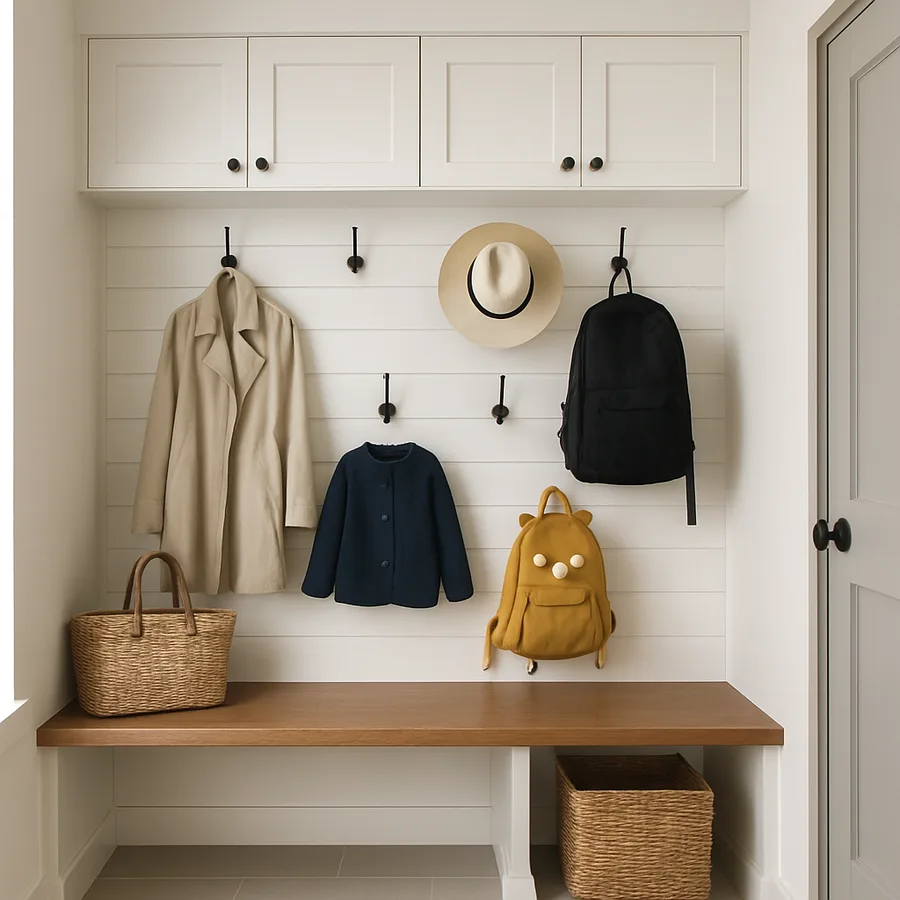
The most underappreciated piece of household infrastructure is the row of hooks just inside the back door. When those hooks live at the wrong height, coats end up on the floor, backpacks pile on chairs, and the very mudroom drop zone meant to keep clutter contained becomes its primary source. The fix is almost laughably simple: install hooks at multiple heights, calibrated to the actual humans who use the space, rather than guessing at a single average that suits no one.
This article walks through the ergonomic, safety, and design logic behind a layered hook system. We will look at standard heights for adults, kids, and assistive users; the hardware that holds up to thirty pounds of wet winter gear without ripping out of drywall; and the visual rhythm that keeps a multi-height arrangement looking intentional rather than chaotic. By the end, you will have a precise plan you can carry to the studs with a tape measure and a level.
Why a Single Hook Height Fails Every Family
Walk into a builder-grade mudroom and you will almost always see hooks installed at a uniform 66 to 72 inches off the floor. That height is fine for a six-foot adult and useless for everyone else. A four-year-old cannot reach it; a child in a wheelchair cannot reach it; a grandparent with limited shoulder mobility will avoid it. The result is a beautifully painted wall serving exactly one user category while the rest of the family invents workarounds, mostly involving chairs and floors.
The American Society of Interior Designers has emphasized for years that universal design is not a special-needs category but the baseline for any well-functioning home. Layering hook heights is one of the cheapest, highest-impact applications of that principle. You spend an extra 20 dollars on additional hardware and 15 minutes of extra installation time, and you get a mudroom that quietly serves a four-year-old and a six-foot teenager equally well. Detailed guidance on accessible residential design is available through the American Society of Interior Designers.
Have you ever watched a child stretch up onto their toes to hang a backpack, miss the hook, and then leave the bag on the floor? The behavior is not laziness. It is a product of a wall that is functionally invisible to them. Lower the hook three feet and the same child will hang their bag every single day without prompting. The hook becomes part of the muscle memory of coming home.
Anthropometric Heights for Real Users
Designers use a body of measurement data called anthropometrics to predict comfortable reach ranges for different populations. For a mudroom, three reach heights cover almost every household: a low row at 36 to 42 inches for children ages three to seven, a middle row at 48 to 54 inches for older children and shorter adults, and an upper row at 60 to 68 inches for taller adults. If a wheelchair user lives in the home, add a fourth row at 40 to 44 inches positioned for forward reach without bumping armrests.
The math is simple but worth doing carefully. Comfortable hanging reach is roughly the user's standing shoulder height minus two inches; that subtraction accounts for the natural arc of the arm as it lifts a coat to the hook. A 42-inch-tall child has a shoulder height around 32 inches, so a hook at 36 inches lets them hang without strain. A 68-inch adult has a shoulder height around 56 inches, putting an ideal hook between 60 and 64 inches. Map your actual family rather than assuming, and the wall will fit.
Account for what is being hung, too. Adult winter parkas need 60 inches of clearance from hook to floor so the hem does not drag, while a child's backpack only needs 30 to 36 inches. Stagger the rows accordingly so a parka does not block a child's hook below it. The general rule of thumb is to leave at least 24 vertical inches between hook rows; less than that and garments overlap, more than that and you waste prime wall real estate.
Hardware That Actually Holds the Load
Mudroom hooks fail because they are screwed into drywall with hollow anchors and then asked to support a saturated wool coat plus a 15-pound backpack. The single most important upgrade you can make is mounting the hooks to a horizontal backer board, typically a 1-by-6 or 1-by-8 piece of poplar or paint-grade pine, secured to wall studs with three-inch wood screws. Once the backer is anchored to studs, you can place hooks anywhere along its length without hunting for studs again.
Specify hooks rated for at least 35 pounds each. Quality hardware is forged or cast metal with a wide, smooth tip that will not slice through a fabric loop. The cheap stamped-steel hooks sold in big-box bins are rated optimistically and tend to bend within a year of daily use. Spend an extra five dollars per hook and the upgrade lasts a decade. According to a 2024 report from the National Association of Home Builders, mudroom hardware ranks among the top five highest-frequency replacement items in family homes, often replaced two or three times during a child's school years. You can find more remodeling-trend data through NAHB.
Spacing matters as much as strength. Place hooks 8 to 10 inches apart on each row, and offset the upper and lower rows by half a hook width so coats hanging from the upper row do not collide with bags hanging from the lower row. If you can, install the upper row first, hang a sample coat, and then mark the lower row to clear the coat hem by an inch. That five-minute mockup prevents a year of daily friction.
Designing the Drop Zone Around the Hooks
Hooks are the centerpiece of a drop zone, but they only succeed when the rest of the wall supports them. Directly below the lowest row of hooks, plan for a shallow shelf or bench 16 to 18 inches deep where bags can land momentarily and shoes can be removed. Above the highest row of hooks, leave open wall for a small bin shelf at 76 to 84 inches that holds seasonal items like sun hats in summer and gloves in winter. The vertical organization keeps daily-use items at hand height and seasonal items overhead.
Lighting is the silent multiplier of any mudroom design. A 36 to 48 inch LED puck or linear strip installed under the upper shelf throws light directly onto the hook zone, eliminating the shadows that make a small space feel cramped. Choose a color temperature between 2,700 and 3,000 Kelvin for an inviting tone, and put the fixture on a motion sensor so it activates the moment someone walks into the space. Few interior upgrades deliver as much delight per dollar as good mudroom lighting.
What feels generous in a paint-store sample feels claustrophobic on a 36-inch-wide wall, so be ruthless about visual edits before installation. Pick a single hook style and finish, repeat it across all rows, and avoid the temptation to mix decorative novelty hooks. Visual repetition is what makes a multi-height arrangement read as intentional rather than as a hardware-store afterthought. Pull the same finish into the bench hardware and any wall sconces for a cohesive composition.
Special Cases: Toddlers, Teens, and Aging Family
Toddlers under three rarely benefit from hooks at all because they cannot yet reliably aim a coat loop. For that age, a low open cubby at 24 to 30 inches off the floor works far better; the child simply tosses the coat in. Plan to retrofit hooks into that cubby zone around age four, when fine motor coordination has caught up. Many families install a single low hook at 30 inches early and let the child grow into the hardware they use.
Teenagers have the opposite problem. Their gear is heavy and varied: school backpack, sports duffle, instrument case, hoodie, jacket. A single hook at adult height collapses under the load. Plan for a teen-specific zone with two or three hooks within an 18-inch span, plus a dedicated bin or open shelf below for sports equipment. Talking to your teenager about their specific kit before installation, rather than assuming, almost always reveals one item you would have missed.
Aging family members and visitors with mobility limitations benefit from a hook installed at seated reach height, typically 40 to 44 inches. The hook should be on a wall section near a bench so the user can sit, remove a coat, and hang it without standing. The Centers for Disease Control reports that one in four adults over 65 falls each year, and unplanned reaching is a known precipitating event. The National Kitchen and Bath Association publishes universal-design checklists at NKBA that translate directly to mudroom planning, with seated-reach guidelines you can copy onto your wall plan.
Installation Walkthrough and Common Mistakes
The installation itself is straightforward if you work in the right sequence. Find and mark the wall studs first, then cut your backer boards to span at least three studs each. Sand and pre-finish the boards before installation; painting them on the wall later means cutting in around hardware and is dramatically more tedious. Use construction adhesive plus three-inch wood screws to fasten each board, with the lowest board installed first and each subsequent board leveled off the one below it.
Mark hook locations on each board with a pencil and a story stick rather than a tape measure. A story stick is just a scrap of wood marked with the spacing you want to repeat; it eliminates the cumulative measurement error that creeps in when you measure each hook independently. After marking, drill pilot holes one size smaller than your hook screw to prevent the board from splitting. The pilot hole is the difference between a clean install and a callback to the hardware store.
The most common installation mistake is mounting the upper row at the height of the tallest user rather than the height of their typical coat. A six-foot user does not need a hook at six feet; they need a hook that lets a 48-inch coat clear the floor by an inch. Doing the math means you might install the upper hook at 62 inches rather than 70, and the lower row drops accordingly. The whole composition becomes more compact, and the wall feels more usable to everyone in the household.
Conclusion
A mudroom drop zone with hooks at multiple heights is one of those rare design upgrades that pays daily dividends for almost no money. The hardware is cheap, the installation is one weekend of work, and the behavioral change in your household is immediate and lasting. Children hang their own backpacks because the hook is finally meant for them. Adults hang heavy coats without crushing the gear below. Visitors find the wall obvious and use it without asking. The friction of arriving home drops to nearly zero.
If you are sketching a remodel right now, build the hook plan around the actual humans in the house rather than around an abstract average. Measure the children. Measure the adults. Plan for the family member who is not yet here, the aging parent who may visit, the toddler who will be a teenager in eight years. The wall is going to last for decades, and a few extra hooks installed today will absorb a remarkable amount of life change before the next renovation.
Treat the hook wall as a living system. Add hooks as the family grows; remove unused ones as kids leave. Repaint the backer board every few years to refresh the room. The flexibility built into the layered design is exactly what lets a mudroom outlast trends and accommodate whatever phase of life the household is in. A well-designed drop zone is, in the end, a small daily kindness that the architecture pays back to everyone who walks through the door.
Pick one weekend in the next month, take twenty minutes to measure your family, and draw the hook plan on the back of an envelope. Then visit a hardware store with a printed list of how many hooks you need at which heights. The whole project, from sketch to last screw, can be finished by Sunday evening, and your home will feel measurably calmer the moment everyone walks in on Monday after school.
More Articles You May Like



Comments
Post a Comment