Drop Zone Organization for Mail, Keys, and School Papers
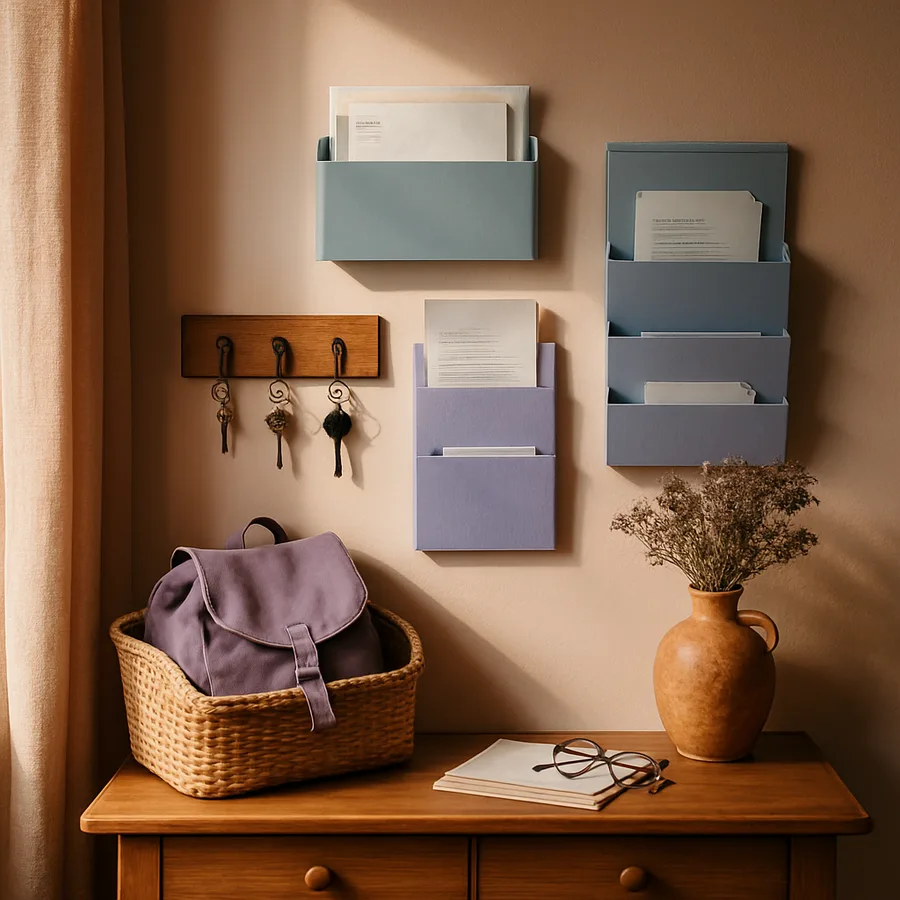
Why Every Home Needs a Dedicated Drop Zone
The moment family members walk through the front door, their hands are full and their attention is already shifting to whatever comes next: dinner preparation, homework, changing clothes, checking messages. This transition window of thirty to sixty seconds determines where keys, mail, school papers, and pocket contents land, and without a dedicated receiving station, those items disperse across kitchen counters, dining tables, stair treads, and couch cushions. A drop zone is the intentional interception point that captures these daily-carry items before they scatter, and its absence is the root cause of the perpetual surface clutter that frustrates millions of households.
The National Association of Professional Organizers reports that the average American spends twelve minutes per day searching for misplaced items, with keys, phones, and important papers ranking as the three most commonly lost categories. Across a year, that searching time totals more than seventy-three hours, nearly two full work weeks spent looking for things that a properly designed drop zone would have captured on arrival. The financial cost of missed bills, lost permission slips, and duplicated documents adds another layer of waste that a simple organizational station eliminates almost entirely.
What separates an effective drop zone from a surface that simply accumulates clutter is intentional design around the specific items it will receive. A bare console table in the foyer is not a drop zone. It is a horizontal surface that will fill with unrelated items until it overflows onto the floor. A true drop zone incorporates compartments, labels, and vertical sorting that channels each incoming item to a designated position from which it can be retrieved without searching. The distinction is between passive collection and active sorting, and only the latter delivers lasting organizational improvement.
Have you ever noticed how a hotel room maintains order effortlessly compared to your own entryway, despite accommodating a stranger's belongings? The secret is that hotels provide a specific place for every anticipated item: a luggage rack, a closet with defined hanging space, a desk with a clear work surface, a nightstand with a charging station. A home drop zone applies this same principle to the entry transition, designating a specific position for each category of incoming item so that the act of putting things away requires zero decision-making and minimal physical effort.
Designing the Mail Sorting Component
Mail arrives daily and accumulates relentlessly, making it the highest-volume paper category that a drop zone must manage. The most effective mail sorting systems use a three-stage process: immediate triage at the door, short-term action storage for items requiring response, and weekly processing that moves completed items to filing or recycling. The drop zone handles the first two stages, while the third occurs at a desk or filing location elsewhere in the home. Without this staged approach, mail piles grow until they become psychologically overwhelming, at which point critical items get buried beneath catalogs and advertisements.
Wall-mounted mail sorters with three to four labeled slots provide the most space-efficient triage station. Label the slots by action category rather than family member: Action Required for bills and forms that need response, To File for statements and records that need permanent storage, and Recycle for catalogs, advertisements, and envelopes that can be discarded after review. A fourth slot labeled Coupons and Events captures time-sensitive items that need visibility but not immediate action. This category-based sorting takes three to five seconds per piece of mail and prevents the undifferentiated pile that makes important items invisible.
The United States Postal Service delivers approximately 129.2 billion pieces of mail annually, according to their own operational statistics, and the average household receives roughly six pieces per day including packages. Managing this volume requires a physical system with enough capacity to hold one week of unsorted mail without overflowing, because even disciplined households skip daily sorting occasionally. A wall-mounted sorter with slots measuring at least ten inches wide and three inches deep accommodates this weekly buffer comfortably. Deeper slots encourage accumulation and should be avoided in favor of shallower compartments that create natural urgency to process before overflow.
Digital mail management complements but does not replace the physical drop zone. Services like USPS Informed Delivery provide daily email previews of incoming mail, which allows household members to anticipate important arrivals and prioritize sorting accordingly. Scanning important documents immediately upon receipt using a phone app like Adobe Scan or the built-in scanner in most smartphone cameras creates a digital backup that protects against physical loss. However, as noted by financial planning experts featured on Architectural Digest and similar publications, the American Institute of Certified Public Accountants recommends retaining physical copies of tax documents, legal correspondence, and financial statements for at least seven years, which means a filing system downstream of the drop zone remains necessary.
Key Management Systems That End the Daily Search
Keys are the single most time-sensitive item in any drop zone because they are needed urgently and exclusively during departure, which is typically the most rushed and stressful moment of the daily routine. A key management system must satisfy two requirements simultaneously: it must be effortless to use when arriving, which means requiring one-handed operation with zero precision, and it must be visually scannable when departing, which means keys must be visible and identifiable at a glance. Systems that fail either requirement will be abandoned within days regardless of how attractive or well-intentioned they are.
The three most reliable key management options are magnetic key strips, open hook boards, and small bowl-style trays, each with distinct advantages. Magnetic strips mounted at eye level allow keys to attach with a casual toss and detach with a quick grab, making them the lowest-friction option for busy households. Open hook boards with individual labeled hooks provide the most organized display and work well for families with many key sets that must be differentiated. Bowl trays placed on a shelf or console catch keys dropped from any angle but offer no organization, making them best suited for single-person or couple households with only one or two key sets.
Labeling key positions eliminates the visual scanning time that occurs when multiple similar key sets share a system. Color-coded key caps, available at any hardware store for under five dollars per set of twelve, provide instant visual identification that works even in poor lighting. Pair the color coding with a small label below each hook or zone that identifies the key set by function: "car," "front door," "office," "storage unit." This dual-identification system serves both the key owner who recognizes their color and any other household member who needs to locate a specific set in the owner's absence.
Smart locks and digital key systems are reducing household key volume but have not eliminated it. Most families still carry between three and six physical keys for vehicles, secondary properties, mailboxes, and storage. The Consumer Electronics Association projects that physical key use will decline by approximately thirty percent over the next decade as smart lock adoption increases, but the transition period requires systems that accommodate both physical keys and the devices, phones and key fobs, that are replacing them. A drop zone that includes both key hooks and a device charging station addresses this hybrid reality without requiring future redesign.
School Paper Management for Families With Children
School papers represent the most emotionally complex category in a family drop zone because they arrive in enormous volume, require varying levels of response urgency, and carry sentimental value that makes disposal feel wrong even when retention is impractical. The average school-age child brings home approximately five to ten papers per week including homework, notices, permission slips, artwork, and graded assignments. For a family with three children, that volume reaches fifteen to thirty papers weekly, or roughly sixty to one hundred twenty per month. Without a dedicated system, these papers occupy every available surface within days.
An effective school paper system mirrors the mail sorting approach with category-based slots rather than child-based ones. The critical categories are: Sign and Return for permission slips and forms with deadlines, Information Only for newsletters and schedules that need reading but not response, and Artwork and Keepers for items with sentimental value that will enter long-term storage or display. A fourth slot labeled Completed Homework provides a staging area for finished work that needs to return to school. This four-slot system processes the full spectrum of school paper types and prevents the single-pile accumulation that buries urgent items beneath informational ones.
The National PTA and many school districts have accelerated the transition toward digital communication, with approximately sixty percent of school notices now distributed electronically according to a survey by the National School Boards Association. This shift has reduced paper volume but created a new organizational challenge: families must now monitor both physical papers arriving in backpacks and digital notices arriving via email, app notifications, and school portals. A complete school paper system acknowledges this hybrid reality by including a visible reminder, such as a small whiteboard or a clip holding a printed weekly calendar, that surfaces digital deadlines alongside physical paperwork.
Sentimental paper management deserves its own strategy because it is the category where accumulation most quickly overwhelms the system. Rather than keeping every drawing, quiz, and creative writing assignment, establish a selection ritual at the end of each month or school term where each child chooses their three to five favorite pieces for a dedicated keepsake bin. Photograph the rest before recycling, creating a digital archive that preserves the memory without the physical storage burden. A single twelve-by-fifteen-inch archival box per child per school year provides generous physical storage for selected items and stacks efficiently on a closet shelf. This bounded approach prevents the unbounded accumulation that fills boxes, then closets, then entire rooms with papers no one will ever review.
Daily Reset Habits That Keep the Drop Zone Functional
The physical design of a drop zone determines its maximum organizational potential, but the daily habits practiced around it determine whether that potential is realized or wasted. Even the most thoughtfully designed system degrades without a consistent reset routine that returns displaced items to their designated positions and processes accumulated materials before they overflow. This reset is not a deep cleaning session. It is a focused three-to-five-minute daily practice that maintains the system's functionality at a sustainable effort level that does not create its own burden.
The optimal reset time varies by household schedule but should occur at a natural transition point when all family members are home and the next day's needs can be anticipated. For many families, this is the fifteen-minute window after dinner and before evening activities. During this window, each person returns their keys and personal items to their designated drop zone positions, school papers are sorted into their category slots, action-required mail is either processed or scheduled for tomorrow, and the physical surfaces of the drop zone are cleared of any items that do not belong there. The Better Homes and Gardens editorial team has recommended this post-dinner reset as one of the most impactful single habits for maintaining household organization.
Children can and should participate in the reset routine from a young age, handling their own papers, returning their own keys or ID cards, and clearing their own drop zone section. This participation builds organizational skills that extend far beyond the entryway and reduces the burden on the adults who would otherwise perform the entire reset alone. Start with one assigned task per child and add responsibilities gradually as competence and independence develop. By age eight, most children can manage their entire drop zone section without supervision, including paper sorting, backpack preparation for the next day, and surface clearing.
A weekly deeper processing session, approximately fifteen to twenty minutes, handles the accumulated items that daily resets defer: filing the "to file" mail, recycling processed paperwork, restocking supplies like stamps and envelopes, and evaluating whether the system's categories still match the household's actual incoming item types. This weekly session prevents the slow category drift that makes labeling inaccurate over time. If the "Action Required" slot consistently holds items that are actually informational, relabel it. If a new recurring item type appears that has no designated position, add a slot or basket before it establishes its own clutter pattern elsewhere. Are you ready to build your household's first dedicated drop zone? Start by identifying the surface closest to your front door where items currently accumulate, then install a three-slot mail sorter and a key hook panel at that exact location this weekend.
Choosing the Right Drop Zone Location and Layout
The single most important factor in drop zone success is proximity to the door through which family members enter most frequently, which is not always the front door. In many homes, the garage entry, side door, or mudroom entrance handles eighty percent or more of daily traffic while the formal front entry is used primarily by guests. Observing your family's actual traffic pattern over several days reveals the true primary entry point, and that is where the drop zone must live regardless of what architectural convention suggests. A beautifully designed drop zone at the front door will be ignored if the family enters through the kitchen every day.
Available wall space at the primary entry determines whether the drop zone takes a vertical wall-mounted form, a horizontal console-based form, or a hybrid of both. Wall-mounted systems work best in narrow hallways and tight entryways where floor space cannot be sacrificed. A twenty-four-inch-wide by thirty-six-inch-tall wall panel accommodating mail slots, key hooks, and a small shelf provides complete drop zone functionality in less than six square feet of wall space and zero square feet of floor space. The National Kitchen and Bath Association recommends wall-mounted solutions for any entry passage narrower than forty-two inches.
Console-based drop zones suit wider entries, foyers, and mudrooms where a piece of furniture can stand against the wall without impeding traffic flow. A console table thirty to thirty-six inches tall with at least two drawers and an open lower shelf provides surface area for active sorting, concealed storage for supplies and overflow, and visible storage for bags and bins. The console surface itself should remain sixty percent clear at all times to prevent the psychological overwhelm that full surfaces create. If the surface consistently fills beyond forty percent, the system needs either more sorting categories, more frequent processing, or an honest assessment of whether incoming volume has increased beyond the system's designed capacity.
Lighting at the drop zone is a frequently overlooked element that directly impacts usability during the dark-entry moments of early mornings and late evenings when most arrival and departure sorting occurs. A small battery-operated LED puck light or motion-activated strip light mounted above the mail sorter and key hooks ensures that labels are readable and items are identifiable without turning on overhead lighting that might disturb other household members. This ten-dollar addition eliminates the squinting, fumbling, and wrong-key-grabbing that occurs in under-lit entryways and reinforces the habit of using the drop zone even during the most rushed transitions of the day.
More Articles You May Like



Comments
Post a Comment