Laundry Room Folding Station Countertops at Standing Height
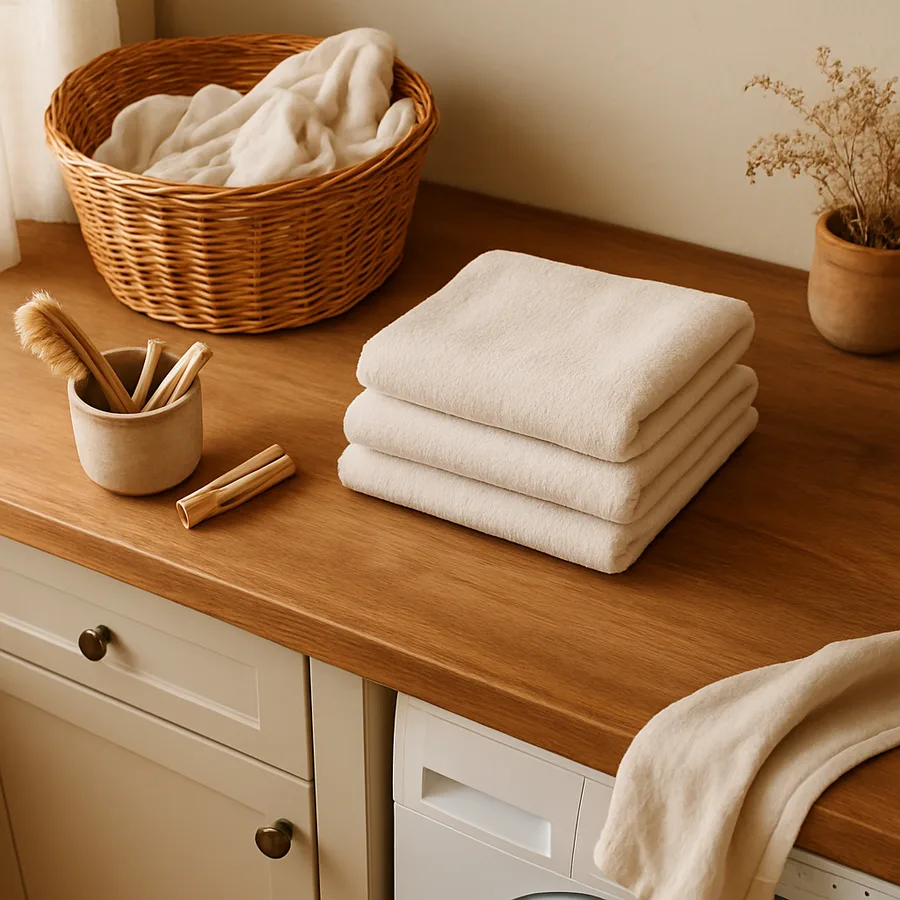
A standing-height folding station is one of those upgrades that quietly transforms how a laundry room actually feels to use. Instead of bending over a dryer, a wobbly table, or the edge of a dining room chair, you get a dedicated workspace engineered around the way real humans fold real clothes. Over the last decade, demand for purpose-built laundry spaces has climbed sharply: the National Association of Home Builders (NAHB) reports that 91% of new single-family homes delivered in the most recent survey year included a dedicated laundry room, and buyers consistently rank it among the most desirable interior spaces in the home. That popularity is changing how designers think about the countertop itself.
This guide walks through everything a homeowner, remodeler, or designer needs to specify a folding-station counter that works for the long haul. We will cover ideal dimensions, materials, lighting, storage integration, ergonomics, and common pitfalls. Whether you are retrofitting a narrow galley laundry or planning a large mudroom-and-laundry combo, the same principles apply: the counter has to be tall enough, deep enough, lit enough, and solid enough to handle a decade of steamy, bleach-splashed, detergent-dusted service without complaint.
Why Standing Height Matters More Than Any Other Dimension
Conventional base cabinets land the countertop at roughly 36 inches, which is comfortable for chopping onions but punishing for folding a basket of bath towels. Occupational therapists working with the American Occupational Therapy Association routinely recommend that repetitive standing tasks be performed at elbow height or slightly below, which for most adults between five-foot-four and six-foot-one means a work surface somewhere between 38 and 42 inches off the finished floor. That three-to-six-inch bump is small on paper and enormous in your lumbar spine.
A 42-inch counter puts the work surface at bar height, reducing forward flexion of the torso and cutting the load on the lower back. The U.S. Bureau of Labor Statistics has tracked nonfatal occupational back injuries from overexertion for decades; repetitive bending and lifting remains one of the leading causes of lost workdays. Laundry is not a jobsite, but the biomechanics are identical. If you fold three loads a week for twenty years, the cumulative benefit of a taller counter is measurable.
Have you noticed how much faster you fold when you can actually see the clothes? That is not psychology; it is geometry. A taller counter brings the garment closer to your line of sight without the hinge at your hip bones. That is why commercial laundries, hotels, and hospitals specify tall counters as standard. You can design a residential version that looks beautiful without sacrificing an ounce of that functional logic.
Choosing a Countertop Material That Survives Real Laundry
Laundry rooms serve up a rotating menu of hazards: bleach, liquid detergent, color-safe stain remover, oxygen brighteners, wet fabric, and the occasional dropped steam iron. The surface you choose has to tolerate all of it and still look presentable at year fifteen. Quartz is the current darling for good reason. Engineered from roughly 93% ground stone bound with resin, it is nonporous, resists staining, and does not require sealing. It is also the single most-specified countertop material in new U.S. kitchens and bathrooms, according to the National Kitchen and Bath Association (NKBA), which surveys designers annually.
Not everyone wants quartz, and several alternatives deserve serious consideration. Solid surface materials such as acrylic composites offer seamless integration with undermount sinks and can be sanded if scratched. Butcher block brings warmth and softens the acoustics of a hard-surfaced room, but it needs periodic oiling and should not sit directly below a steam-venting dryer. Laminate has made a quiet comeback with modern decors that convincingly mimic stone; it is also by far the most affordable option and completely sufficient for a low-traffic utility room. Stainless steel, once confined to professional kitchens, now shows up in high-end laundry rooms where a single continuous sheet spans washer, dryer, and folding zone.
A good rule of thumb: match the countertop to the abuse it will receive. If you pretreat stains on the counter, choose nonporous. If you iron directly on the surface, choose heat-tolerant. If you want a soft, warm aesthetic and do not mind maintenance, choose wood. The American Society of Interior Designers (ASID) frequently publishes case studies demonstrating how material selection in utility spaces affects long-term satisfaction scores, and laundry rooms consistently reward the homeowner who invested in a bulletproof surface.
Getting the Dimensions Right From Edge to Edge
A functional folding counter has three key measurements: height, depth, and continuous run. Height we already covered, but the details deserve attention. If the counter sits on top of a front-load washer and dryer, the appliance height is typically 38 to 39 inches before pedestals. Adding a pedestal raises it to roughly 53 to 55 inches, which is too high for folding. The cleanest approach is to skip pedestals and run the counter as a continuous plane across the appliances, supported on each end by base cabinetry at 38 inches.
Depth should be at least 22 inches to accommodate a standard bath towel folded in thirds. A 24-inch depth matches standard base cabinetry and gives you room to stage a laundry basket behind the fold zone. For continuous run, try to carve out at least 36 linear inches of clear counter space dedicated to folding. More is always better; the Whirlpool Institute of Fabric Science, the manufacturer-run research arm that publishes consumer laundry data, notes that folding speed improves significantly when the user can lay out two garments side by side without repositioning.
One frequently overlooked dimension is the distance from the front edge of the counter to the nearest wall or cabinet. You need at least 42 inches of floor clearance to comfortably pivot and walk with a basket. If you are combining the laundry room with a mudroom or hallway, plan a 48-inch aisle. That clearance is also consistent with International Residential Code (IRC) egress guidelines when a laundry room doubles as a circulation path.
Lighting the Folding Zone Like a Professional Workspace
Folding is a visual task. You are matching socks, inspecting for stains, checking that the kids' shirts are inside-out or right-side-out, reading care labels. None of that happens well under a single ceiling bulb. The Illuminating Engineering Society (IES) recommends 50 to 100 foot-candles at the work surface for detail-oriented domestic tasks, which is roughly double what the typical builder-grade laundry fixture delivers.
The easiest upgrade is under-cabinet LED strip lighting mounted to the bottom of an upper cabinet directly above the folding zone. A 24-inch LED bar rated at roughly 900 lumens will push the foot-candle count into the target range. Choose a color temperature between 3000K and 3500K for a warm-neutral light that renders fabric color accurately without feeling clinical. If the budget allows, add a dimmer; a laundry room also serves as a pass-through at night, and you do not want surgical lighting at two in the morning.
Supplement under-cabinet lights with a decorative overhead fixture such as a semi-flush mount or a pair of small pendants. Pendants are especially effective if the ceiling is nine feet or taller; they bring the visual weight of the room back down to human scale. Ever tried to fold laundry with an overhead light behind you that casts your own shadow across the counter? That is the exact scenario good lighting design is engineered to prevent.
Integrating Storage Without Stealing Counter Space
A folding counter earns its keep only if the things you need while folding are within arm's reach. That includes a stain stick, a lint brush, spare hangers, a basket for unmatched socks, and a place to park the clothes you need to hang rather than fold. The best designs integrate storage above and below the counter so the surface itself stays clear.
Above the counter, a run of shallow upper cabinets at 12 inches deep offers space for detergent, dryer sheets, and mesh bags. Some homeowners prefer open shelving with woven baskets for a softer look; the tradeoff is dust. Below the counter, consider a combination of drawer banks for folded linens, a pull-out hamper cabinet for sorting, and a narrow vertical cubby for an ironing board or drying rack. If you have space for only one below-counter feature, make it a pull-out rolling cart that tucks under the counter but comes out on casters when you need to move finished loads to another room.
Hanging space is the sleeper feature. A simple chrome rod mounted to the underside of an upper cabinet, running the length of the folding zone, gives you instant hanging storage for shirts and dresses that come out of the dryer on hangers. The American Cleaning Institute (ACI), a trade group that tracks residential laundry behavior, reports that an increasing share of households now air-dry or hang-dry a significant portion of their weekly laundry, which means hanging space inside the laundry room itself has become more valuable than ever.
Ergonomics, Safety, and the Details That Separate Good From Great
Every element of the folding station should reduce friction. Round the front edge of the counter with a small eased or bullnose profile; a sharp corner at standing height will find your hip bone repeatedly. Choose a stool with a footrest so you can occasionally sit without stooping to an ordinary chair. Install a GFCI outlet on the backsplash for a handheld steamer or garment shaver; the National Electrical Code (NEC) requires GFCI protection in laundry areas, so your electrician will handle this automatically on a new build but may need a reminder during a retrofit.
Flooring deserves a brief mention. A cushioned anti-fatigue mat in front of the folding counter changes the standing experience dramatically. The National Institute for Occupational Safety and Health (NIOSH) has documented that anti-fatigue matting reduces reported leg and back discomfort in standing workers by meaningful margins, and what works in a commercial kitchen works equally well in your laundry room. Choose a mat with a beveled edge and a nonslip backing so it does not become a trip hazard.
Pay attention to acoustics. A laundry room is a hard-surface environment: tile floor, painted drywall, glass front on the washer, stainless drum in the dryer. Sound bounces. A small area rug runner, a fabric Roman shade over the window, and a few woven baskets on open shelves will absorb enough high-frequency reflection to make the room feel quieter. If you have ever wondered why some laundry rooms feel serene while others feel like a boiler room, the answer is almost always soft goods. Did you know a simple fabric window treatment can reduce perceived noise levels noticeably in a small hard-surfaced room? It is one of the cheapest acoustic improvements available.
Conclusion: Design It Once, Enjoy It for a Generation
A well-executed standing-height folding counter is a rare home-improvement project that pays dividends every single week. The specific dimensions, materials, lighting, and storage details covered in this guide are not arbitrary preferences; they are drawn from decades of research in ergonomics, residential construction standards, and interior design practice. Get the height right, choose a surface that tolerates the environment, light it properly, and build storage around it, and you end up with a space that actually makes laundry day feel less like a chore and more like a satisfying fifteen minutes of tidying.
The biggest mistake homeowners make when planning a folding station is under-sizing it. A 36-inch counter tucked into a leftover corner will always feel cramped. A 60-inch counter at 40 inches high, lit from under-cabinet strips, with quartz on top and a pull-out hamper cabinet below, will feel generous forever. Measure twice, specify once, and resist the urge to shave two inches off the depth to squeeze in a broom closet.
As you plan, consult resources published by the NKBA, the NAHB, and the ASID, and talk with a local kitchen and bath designer who has actually specified laundry counters before. The difference between a laundry room that gets used as a drop zone and a laundry room that gets used as designed often comes down to whether the folding counter was planned first or squeezed in last.
Ready to rethink your laundry room? Start by measuring the floor-to-elbow height of every adult in your household, average the numbers, and use that figure as the target for your next countertop. Then browse the laundry-room projects on the NKBA, NAHB, and ASID websites for inspiration, and then bring those numbers to a designer or build-it-yourself plan. Your lower back will thank you.
More Articles You May Like



Comments
Post a Comment