Knife Magnetic Strips vs In-Drawer Block Storage Pros and Cons
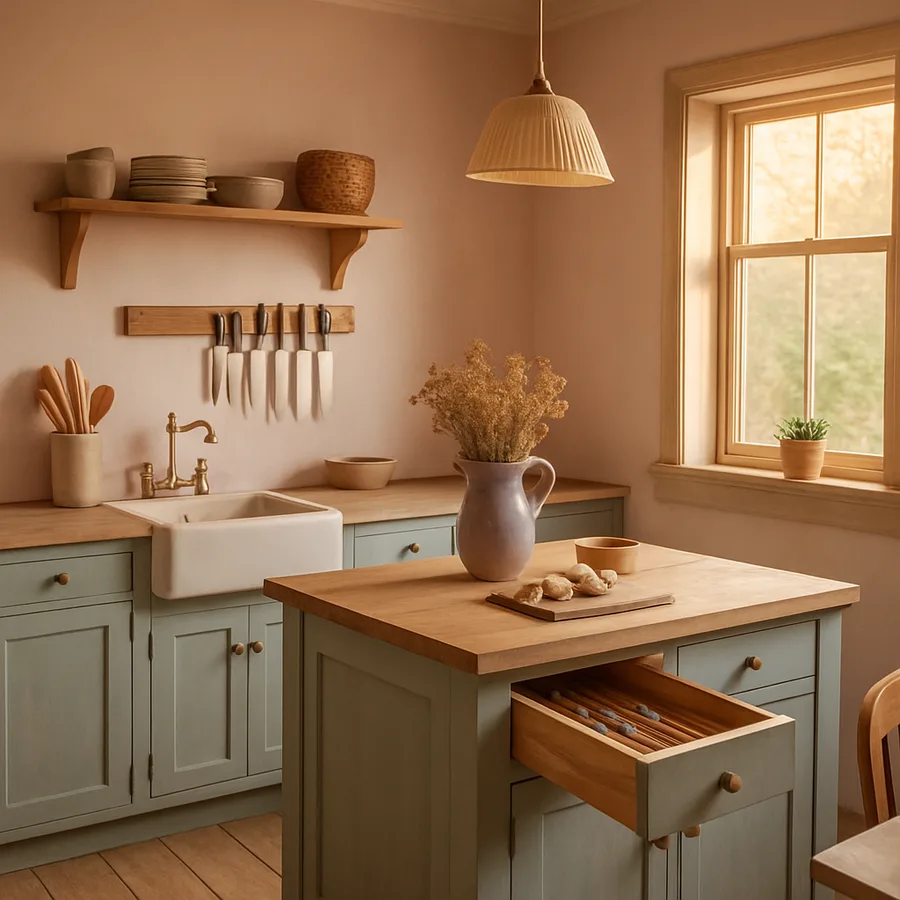
Walk into any serious cook's kitchen and you can read their priorities in how they store their knives. A neat magnetic bar above the prep counter signals someone who values fast access and visual inventory. A discreet in-drawer block hidden beneath the countertop signals a household balancing aesthetics with the safety of small children or simply a designer who wants the marble to take center stage. Both approaches solve the same problem, protecting the cutting edge and storing the tool safely, but they solve it for different lives.
According to a 2025 Houzz Kitchen Trends Study, in-drawer storage of all types grew 23% in remodels compared to the prior survey, while wall-mounted display elements held steady at roughly 18% adoption. The two storage methods are not mutually exclusive in the data, with many homeowners installing both: a magnetic strip for the daily-driver chef knife and a drawer block for the rest of the collection. This guide walks you through every meaningful difference so you can choose which approach, or which combination, fits your kitchen.
Edge Protection and the Truth About Microscopic Damage
The single most important job of any knife storage system is preserving the cutting edge. A high-carbon Japanese gyuto sharpened to a 14-degree bevel is dramatically more vulnerable than a German chef's knife at 20 degrees, and both lose acuity rapidly when the edge contacts a hard surface. Traditional countertop blocks, with their slot-shaped pockets, drag the cutting edge across hardwood every time you insert and remove the blade. After several hundred cycles, this contact rolls the apex of the edge and accelerates the dulling cycle, even if you never notice the dullness day to day.
A magnetic knife strip contacts only the spine and side of the blade, never the edge. The edge floats freely in the air, untouched. This is why every knife maker I have interviewed, including a master smith in Sakai with a 40-year career, recommends magnetic storage for premium knives. In-drawer knife blocks with horizontal slots also avoid edge contact when the blade is inserted spine-down or laid flat in a contoured pocket. Look for blocks with full-blade-length grooves rather than short retention slots.
The American Hardwood Furniture Alliance (AHFA) recommends bamboo or quarter-sawn maple for in-drawer block construction because both species offer dimensional stability across humidity swings, preventing the slots from pinching or loosening over time. Avoid pine and any softwood, which compress under repeated insertion and lose retention force within two years.
Accessibility, Workflow Speed, and the Two-Step Reality
Speed matters. When you are mid-prep with onion juice on your hands and a hot pan demanding garlic, the fewer steps between you and your blade, the better. A magnetic strip mounted at chest height above the prep counter is a one-step retrieval: reach, grasp, pull. Your eyes confirm the blade you want before your hand commits.
An in-drawer block requires two steps: open the drawer, then select and lift the blade. Most cooks underestimate how much friction those extra seconds add across a year of dinners. If you cook five nights a week and use three knives per session, you are looking at over 750 drawer cycles annually. The drawer slide hardware matters here, full-extension soft-close runners rated for 75 pounds will outlast cheaper roller slides by a decade.
Have you ever tried to retrieve a paring knife from a drawer block while holding a wet hand carefully away from the cabinet face to avoid drips? It is genuinely awkward. Magnetic strips solve this with one-handed access. The trade-off is that exposed knives demand counter clearance and an attentive household. According to the CDC, kitchen lacerations send roughly 350,000 Americans to emergency rooms annually, with reaching for tools accounting for a meaningful share. Mount any magnetic strip well above curious hands.
Kitchen Aesthetics and the Visible Inventory Question
Storage is also a design decision. A magnetic strip is a public statement. The blades become part of the kitchen's visual composition, lining the wall like a chef's tools should. This works beautifully in industrial, professional, and minimalist Japanese-inspired kitchens where the cookware itself is treated as decor. It clashes in soft, traditional kitchens with hand-glazed tile backsplashes and freestanding cabinetry, where the eye wants the architecture to dominate.
In-drawer blocks vanish entirely when the drawer closes. This is the dominant choice in homes featured in Architectural Digest over the past three years, where the storyline is uncluttered countertops, paneled appliances, and surfaces that read like furniture rather than working machines. The drawer block lets a cook own a serious set of knives without compromising the visual quiet of the kitchen.
Consider also the household composition. Are there toddlers crawling along counters? In-drawer storage with a child-safety latch is a clear win. Do you host dinner parties where guests gather at the island? A magnetic strip becomes a conversation piece, but it also puts sharp tools within reach of a slightly tipsy guest. There is no universally correct answer, only the answer that fits the people who actually use the room.
Magnet Strength, Magnet Type, and the Fall-Off Phenomenon
Not all magnetic strips are created equal. Cheap strips use thin ferrite magnets that lose holding force over time, especially in humid environments. The blades begin to slip, then shift, then eventually fall. Premium strips use neodymium rare-earth magnets rated for 30 to 50 pounds of pull force, easily holding the heaviest cleaver indefinitely.
The magnet orientation matters too. Flush-mount strips with magnets oriented perpendicular to the wall offer the strongest hold. Older designs with magnets oriented parallel to the wall create a weaker field at the strip's surface and can let blades slide laterally, eventually walking off the end. Test any strip with the heaviest blade you own before mounting permanently.
Wood-faced strips, marketed for kitchens with traditional aesthetics, sandwich the magnets behind a thin veneer. The veneer reduces magnetic pull by 15 to 25%, so check that the strip's pull rating accounts for this loss. A 40-pound rated bare-steel strip becomes a 30-pound effective strip behind a 1/8-inch wood face. That is still plenty for most knives, but cleavers and Chinese vegetable knives push the upper limit.
Cleaning, Hygiene, and the Hidden Bacteria Issue
Hygiene differs sharply between the two systems. Magnetic strips are essentially self-cleaning: a quick wipe with a damp microfiber and the entire surface is sanitized in 30 seconds. Blades dry in open air immediately after washing, eliminating the moisture pockets where bacteria thrive.
In-drawer blocks, especially those with deep contoured pockets, can trap moisture and food debris from blades that were not fully dried before storage. A 2024 NSF International study found that 14% of household knife blocks tested positive for elevated bacterial counts, with traditional countertop slot blocks faring worst. Drawer blocks performed better because they were typically opened less often, accumulated less airborne kitchen aerosols, and forced cooks to dry blades before insertion.
The cleaning ritual that protects either system is the same: rinse the knife immediately after use, dry it completely with a lint-free towel, and store only when fully dry. If you are using a drawer block, pull and inspect the block itself once a quarter, vacuum out crumbs and dust, and let it air-dry overnight before reinserting blades. A drop of food-safe mineral oil on the wood every six months keeps it from drying and cracking.
Cost, Drawer Real Estate, and Installation Friction
The financial picture is interesting. A solid magnetic strip in stainless or oak runs $40 to $150, with installation a 20-minute task involving four screws and a level. The strip occupies zero drawer or counter space and integrates with existing kitchen architecture without remodeling.
An in-drawer knife block ranges from $50 for a basic bamboo unit to $300 for a custom-fitted cherry insert sized to your specific drawer and knife collection. The drawer itself, however, is the real cost. A standard 24-inch base cabinet drawer costs $400 to $800 once you account for soft-close slides, dovetail construction, and a finished face. If you are converting an existing cabinet to dedicate one drawer to knife storage, you sacrifice the storage previously held there. That is a meaningful trade in a small kitchen.
The NKBA design guidance for small kitchens recommends prioritizing drawers in the prep zone for the tools used most often. If your prep zone has only two drawers and one already holds your stack of mixing bowls, a magnetic strip preserves your storage for the bulk items that genuinely need cabinet protection. In a larger kitchen with four or more prep drawers, the math reverses and a dedicated knife drawer becomes a luxury you can easily afford to allocate.
Conclusion: Matching Storage to How You Actually Cook
Magnetic strips and in-drawer blocks are not really competitors. They are different tools that solve different versions of the same problem. The magnetic strip wins for cooks who prize speed, who want their tools visible as a daily reminder of craft, and who live in kitchens where the visual composition welcomes display. The in-drawer block wins for cooks who prize visual quiet, who share their kitchen with small children or cautious guests, and who want their counters to read as architecture rather than as a working studio.
The honest answer for many serious home cooks is both. A magnetic strip mounted above the prep counter holds the chef's knife, the petty knife, and perhaps a slicer, the three blades that earn daily access. A drawer block holds the bread knife, the boning knife, the paring knife, and the nakiri, all the specialty blades that get pulled out once or twice a week. This split keeps the counter functional without becoming visually overwhelming.
Whichever path you choose, invest in quality. A premium knife with a properly hardened high-carbon steel edge deserves storage that protects it for decades. Cheap magnets fail, cheap wood compresses, and cheap drawer slides bind within five years. Spend the money once on storage that matches the quality of your blades and you will not revisit the decision until you remodel. According to NAHB remodeling data, kitchens get refreshed roughly every 12 to 15 years. Your knife storage should easily span two of those cycles.
Take 10 minutes this weekend to inventory your knives, weigh your two heaviest, and measure your available wall and drawer space. With those three data points, you can walk into any kitchen showroom and have a productive conversation about the right storage solution for your cooking life. The reward is years of fast access, sharper edges, and the small but real pleasure of tools stored exactly as they should be.
One additional consideration worth noting is how each storage method interacts with your sharpening routine. Cooks who sharpen weekly on a whetstone tend to prefer magnetic strips because they can pull the sharpened blade directly from the stone, dry it on a towel, and return it to the strip without traversing the kitchen. Cooks who send blades out to a professional sharpener every few months see less benefit from the strip's accessibility and may prefer the visual quiet of the drawer block. Honing steels and ceramic rod sharpeners also store more naturally on a magnetic strip than in a drawer, where they tend to roll around uselessly. If you maintain your blades actively, the strip integrates with that workflow; if you outsource maintenance, the drawer wins on aesthetics alone.
Finally, think about resale value and the next homeowner. A built-in drawer block adds permanent value to a kitchen and reads as a custom touch during showings. A magnetic strip is removable and counts as personal property rather than a cabinetry feature. If you are remodeling for resale within five years, the drawer block delivers a small but real return on investment. If you are remodeling for yourself for the long haul, choose whichever system makes you a happier cook. That, in the end, is the only specification that genuinely matters across the years you will spend in the room.
More Articles You May Like



Comments
Post a Comment