Downdraft Cooktop Ventilation vs Overhead Hood: Pros and Cons
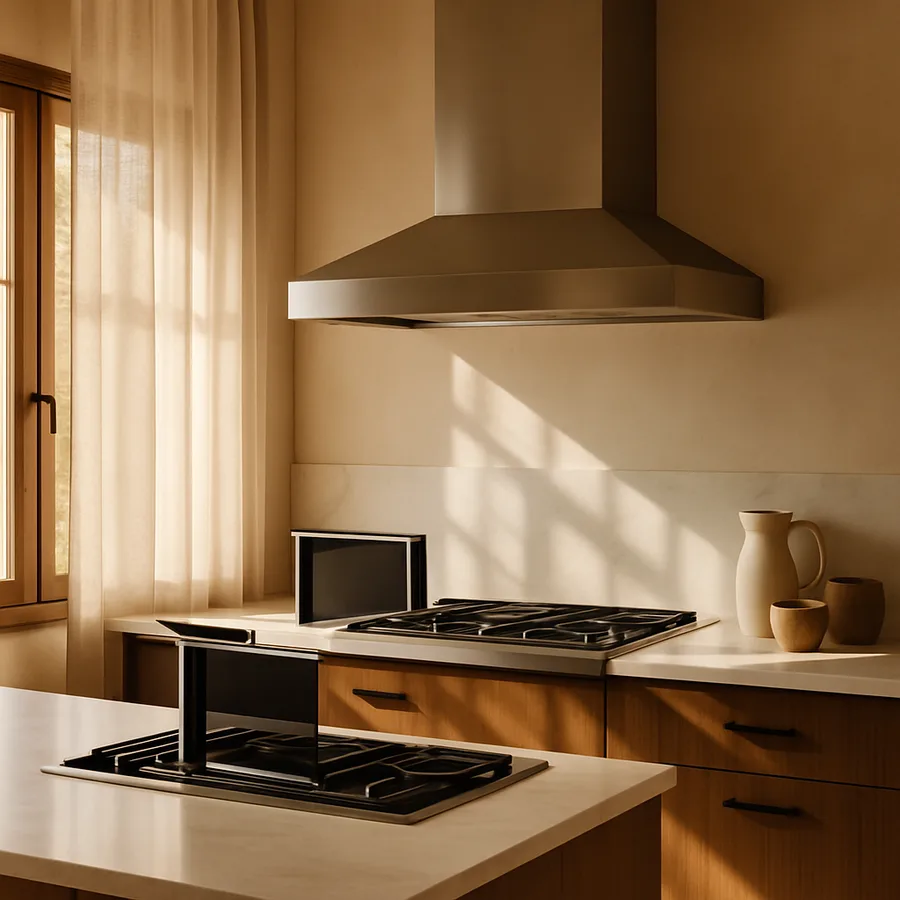
Every kitchen that involves cooking with heat, whether gas, electric, or induction, produces airborne contaminants that need to be removed from the living space. Grease particles, steam, smoke, odors, and in the case of gas cooking, combustion byproducts like nitrogen dioxide and carbon monoxide, all rise from the cooking surface and spread through the kitchen and into adjacent rooms if not captured and exhausted. The two primary approaches to managing these contaminants are the overhead range hood, which captures rising fumes from above the cooktop, and the downdraft ventilation system, which pulls fumes downward through vents built into or adjacent to the cooking surface. Each approach has genuine strengths and real limitations, and the right choice depends on your kitchen layout, cooking intensity, aesthetic priorities, and budget. The Home Ventilating Institute (HVI) certifies both types of systems and publishes performance data that allows direct comparison of airflow rates, sound levels, and energy consumption across product categories.
How Each System Works: Airflow Physics and Capture Mechanisms
An overhead range hood operates in alignment with the natural physics of heated air. When food is cooked on a burner or element, the heat creates a thermal plume, a column of rising air that carries grease particles, steam, and odors upward from the cooking surface. An overhead hood positioned 24 to 30 inches above the cooktop intercepts this rising plume before it disperses into the room, channels the contaminated air through grease filters that capture the larger particles, and exhausts the filtered air either to the outdoors through ductwork or back into the room through charcoal filters in a recirculating configuration. The physics are elegant and efficient: the system works with the natural direction of heat and airflow rather than against it.
Downdraft ventilation systems reverse this dynamic by pulling air downward, against the natural upward tendency of heated air. A typical downdraft system consists of a vent that rises from behind the cooktop surface, usually 8 to 10 inches tall when deployed, connected to a blower that draws air downward through ductwork routed beneath the floor or through the cabinet kick space to an exterior wall exhaust. Some models integrate the vent directly into the cooktop surface between the burner zones, eliminating the pop-up element entirely. The blower must be powerful enough to overcome the thermal buoyancy of the cooking plume and redirect it downward before it rises above the capture zone, which requires significantly more fan power per unit of effective capture compared to an overhead hood.
The fundamental performance difference between the two systems stems from this directional conflict. An overhead hood captures air that is already moving toward it, requiring relatively modest fan power to maintain effective capture. A 300 CFM overhead hood provides adequate ventilation for most residential cooktops. A downdraft system must fight the upward momentum of heated air, and a 500 to 600 CFM downdraft blower may provide capture performance comparable to a 300 CFM overhead hood. The American Society of Heating, Refrigerating and Air-Conditioning Engineers (ASHRAE) Standard 62.2 for residential ventilation acknowledges this efficiency gap and recommends higher airflow ratings for downdraft systems to achieve equivalent contaminant removal.
The height of the cooking vessel also affects performance differently for each system. An overhead hood captures fumes from both short pans like skillets and tall pots like stockpots with similar effectiveness because the thermal plume rises into the hood's capture zone regardless of the vessel height. A downdraft system, by contrast, struggles with tall cookware because the fumes from a 12-inch-tall stockpot must travel a considerable distance downward against their natural buoyancy to reach the intake vent. Steam and smoke from a tall pot tend to escape laterally into the room before the downdraft can capture them, a limitation that becomes apparent during pasta boiling, soup making, and any cooking that involves tall vessels with vigorous steam production.
Design and Aesthetic Considerations
The most frequently cited advantage of downdraft ventilation is its visual invisibility. When not in use, a pop-up downdraft vent retracts flush with the countertop, leaving the cooking surface completely unobstructed and the sightline across the kitchen clear. In open-concept kitchens where the cooktop is on an island or peninsula, this means uninterrupted views between the kitchen and the adjacent living or dining area, a design priority that many homeowners consider non-negotiable. The absence of overhead ductwork, hood enclosures, or ceiling-mounted fixtures preserves the clean ceiling plane and allows pendant lighting, skylights, or architectural details to serve as the focal point above the cooking area.
Overhead hoods, however, have undergone a significant design evolution that has transformed them from purely utilitarian appliances into statement pieces that enhance rather than detract from kitchen aesthetics. Custom hood enclosures wrapped in the same wood, plaster, or metal as the surrounding architecture create a focal point above the cooktop that anchors the kitchen's design composition. A hand-hammered copper hood in a farmhouse kitchen, a sleek stainless steel chimney hood in a modern kitchen, or a plaster hood that disappears into the ceiling soffit in a transitional kitchen each demonstrates how the overhead hood can serve as an architectural element rather than an industrial intrusion. The National Kitchen and Bath Association Design Trends Report identifies the decorative range hood as one of the top five kitchen design features that homeowners are investing in, reflecting a shift from hiding the hood to celebrating it.
The visual mass of an overhead hood varies dramatically by type. A under-cabinet hood mounted beneath an existing cabinet is nearly invisible, adding no visual bulk beyond what the cabinet already occupies. A wall-mount chimney hood projects 18 to 24 inches from the wall and extends from the backsplash to the ceiling, creating a substantial presence. An island hood suspended from the ceiling adds visual weight above the island and can make the space feel more enclosed, which may conflict with the open, airy feel that island configurations are designed to achieve. Selecting the hood type that matches both the ventilation requirements and the design intent of the kitchen is essential for a result that satisfies both functional and aesthetic criteria.
Do you prioritize an unobstructed view across your kitchen, or are you open to an overhead element that could serve as a design focal point? This preference often determines the direction of the ventilation decision more than any technical specification. If your kitchen design concept depends on clean, uninterrupted sightlines, especially across an island cooktop, downdraft ventilation supports that vision in a way that no overhead hood can. If the cooktop is on a perimeter wall where a decorative hood could enhance the kitchen's character, the aesthetic argument for downdraft weakens considerably.
Performance Under Real Cooking Conditions
Laboratory CFM ratings tell part of the performance story, but real-world kitchen conditions reveal the practical differences between the two systems more clearly. Overhead hoods excel at capturing the full spectrum of cooking byproducts because their position above the cooktop allows them to intercept fumes from all burners simultaneously, including the back burners that produce the most steam during simultaneous multi-pot cooking. A properly sized overhead hood with adequate CFM and correct mounting height, following the manufacturer's specified 24 to 30 inches above the cooking surface, captures 85 to 95 percent of cooking fumes under typical residential cooking conditions, according to testing by the Lawrence Berkeley National Laboratory.
Downdraft systems perform well for low-profile cooking: sauteing in a skillet, grilling on a flat griddle, and pan-frying in shallow pans. These cooking methods produce fumes close to the cooktop surface where the downdraft intake can capture them effectively. The challenge emerges with cooking that generates high-volume steam or smoke from elevated points: boiling large pots of water, deep frying in a tall Dutch oven, searing at high heat with significant smoke production, or flambeing. In these scenarios, the fumes rise quickly and escape laterally before the downdraft can redirect them, resulting in steam condensing on upper cabinets, grease depositing on nearby surfaces, and cooking odors spreading through the home.
Gas cooking presents a particular challenge for downdraft systems. The open flame of a gas burner generates a stronger thermal updraft than an electric or induction element, and the combustion byproducts, nitrogen dioxide and small amounts of carbon monoxide, need to be exhausted outdoors for health reasons rather than recirculated. A downdraft system paired with a gas cooktop must work harder to capture these byproducts, and the lower capture efficiency means more combustion gases remain in the kitchen air. The California Air Resources Board has cited inadequate kitchen ventilation as a significant contributor to indoor air pollution in homes with gas cooking, and their studies consistently show that overhead hoods provide more effective removal of gas combustion products than downdraft systems of equivalent rated CFM.
Noise levels differ substantially between the two systems at comparable effective capture rates. Because downdraft blowers must generate higher airflow to compensate for their directional disadvantage, they often run at higher fan speeds and produce more noise than an overhead hood achieving the same capture rate. A typical overhead hood operates at 3 to 6 sones at its medium speed setting, roughly the level of a normal conversation. A downdraft system providing equivalent capture may operate at 5 to 8 sones, noticeably louder and potentially disruptive in open-concept kitchens where the cooking area is adjacent to the living or dining space. Premium models of both types incorporate noise-dampening features that reduce operational sound, but at equivalent price points, the overhead hood typically runs quieter.
Installation Complexity and Cost Comparison
Overhead hood installation is straightforward when the cooktop is on a perimeter wall. The hood mounts to the wall or the cabinet above, and ductwork runs through the wall directly behind the hood or up through the cabinet and ceiling to a roof cap. A typical wall-mounted hood installation, including the hood, ductwork, and a roof or wall cap, costs $800 to $2,500 for materials and $300 to $800 for labor, totaling $1,100 to $3,300 for a complete installation. Premium and custom hoods with elaborate enclosures can increase the total significantly, but the ductwork and installation complexity remain similar.
Island hood installations are more complex because the ductwork must run through the ceiling, typically concealed within a soffit or chase, from the island location to an exterior wall or roof penetration. This ceiling ductwork adds $500 to $1,500 to the installation cost depending on the distance and the complexity of the routing. The structural mounting of an island hood must also support the weight of the hood from ceiling joists, which may require reinforcement. Total installed cost for an island overhead hood typically ranges from $2,000 to $5,000, including the hood, ductwork, ceiling reinforcement, and labor.
Downdraft ventilation installation involves routing ductwork downward and horizontally from the cooktop through the base cabinet and floor or through the cabinet kick space to an exterior wall exhaust. In a slab-on-grade foundation, where there is no basement or crawl space below the kitchen floor, the horizontal duct run through the base cabinet to the nearest exterior wall can be lengthy and may require multiple elbows, each of which reduces airflow efficiency. In homes with basements or crawl spaces, the duct can drop straight down through the floor and exit through the foundation wall, a more efficient routing. A complete downdraft system installation, including the integrated or pop-up vent unit, blower, ductwork, and exterior termination, typically costs $1,500 to $4,000, comparable to or slightly higher than a wall-mounted overhead hood but often less than a ceiling-mounted island hood.
The makeup air requirement is a factor that affects both systems but is more frequently triggered by high-CFM downdraft installations. Building codes in most jurisdictions require that any exhaust system rated above 400 CFM be accompanied by a makeup air system that replaces the exhausted air to prevent negative pressurization of the home. Negative pressure can backdraft gas water heaters and furnaces, drawing combustion gases into the living space, a serious safety hazard. A makeup air system adds $500 to $2,000 to the installation cost and requires coordination between the HVAC installer and the ventilation installer. Because downdraft systems often require higher CFM ratings to achieve adequate capture, they are more likely to trigger the makeup air requirement than an equally effective lower-CFM overhead hood.
Maintenance and Long-Term Reliability
Both ventilation systems require regular maintenance to perform effectively, but the nature and accessibility of that maintenance differs. Overhead hood maintenance primarily involves cleaning or replacing the grease filters, which trap airborne grease before it enters the ductwork and the fan. Baffle-style stainless steel or aluminum filters, standard on most mid-range and premium hoods, are dishwasher-safe and should be cleaned monthly under normal cooking conditions. The hood exterior requires periodic wiping to remove grease film, especially on stainless steel surfaces where grease residue is visible. The ductwork itself needs professional cleaning only infrequently, typically every three to five years for residential installations with regularly maintained filters.
Downdraft system maintenance is slightly more involved because the components are less accessible. The grease filters, located at the cooktop surface level, are typically removable and dishwasher-safe, similar to overhead hood filters. However, the pop-up vent mechanism, if present, includes a motorized lift that can accumulate grease on its tracks and moving parts, requiring periodic cleaning and lubrication to operate smoothly. The blower motor, often located beneath the floor or deep inside the base cabinet, is difficult to access for cleaning or replacement. The Home Ventilating Institute recommends annual inspection of downdraft blower components by a qualified technician, an ongoing maintenance cost that overhead hoods generally do not require.
Reliability over the typical 15-to-20-year lifespan of a kitchen ventilation system favors overhead hoods due to their mechanical simplicity. An overhead hood contains a fan motor, a light, and filters, with few moving parts and straightforward electrical connections. Downdraft systems add the complexity of motorized pop-up mechanisms, longer duct runs with more potential failure points, and blower motors that operate under higher load because of the increased airflow demands. Repair costs for downdraft systems tend to be higher as well, because the blower and motor are often located in positions that require disassembly of cabinetry or flooring to access. When a downdraft motor fails, the repair can cost $400 to $800 including labor, compared to $200 to $400 for a comparable overhead hood fan motor replacement.
Is your kitchen renovation designed for maximum longevity with minimal ongoing maintenance, or are you willing to accept slightly higher maintenance demands in exchange for the design benefits of downdraft ventilation? The honest answer to this question often reveals the true priority, and for many homeowners, the practical advantages of an overhead hood's simpler maintenance profile outweigh the aesthetic appeal of a downdraft system that requires more attention to keep performing well.
Making the Right Choice for Your Kitchen
The decision between downdraft and overhead ventilation should begin with an honest assessment of three factors: your cooking intensity, your kitchen layout constraints, and your design priorities. If you cook with high heat frequently, use gas burners, boil large pots of water regularly, or prepare cuisines that generate significant smoke and steam, an overhead hood provides meaningfully better capture performance and should be the default choice unless a compelling layout constraint prevents it. If your cooking is primarily light to moderate, using induction or electric heat with standard-height cookware, a downdraft system can provide adequate ventilation while preserving the clean sightlines and open design that motivated its consideration.
Layout constraints are the most legitimate reason to choose downdraft over overhead ventilation. When the cooktop is on an island with no practical path for ceiling-mounted ductwork, when the ceiling is a vaulted or cathedral design that cannot accommodate a suspended hood, or when the cooktop position is directly below a structural beam that prevents hood mounting, downdraft ventilation solves a genuine installation problem rather than serving as a purely aesthetic preference. In these scenarios, a well-specified downdraft system with adequate CFM rating and properly routed ductwork is the right engineering solution, and its performance limitations can be mitigated by choosing an appropriately sized unit and maintaining it diligently.
The budget comparison is not as clear-cut as it might appear. While a basic downdraft system costs less than a premium island hood, the total system cost including makeup air, professional ductwork routing, and ongoing maintenance can equalize or even exceed the overhead option over the system's lifetime. For perimeter wall installations where a wall-mounted hood is straightforward, the overhead option is almost always less expensive and more effective. For island installations, the cost comparison depends on the specific products chosen, the ductwork routing complexity, and whether makeup air is required, making a line-item comparison essential during the design phase.
Both systems deliver their best performance when properly sized, correctly installed, and regularly maintained. An undersized overhead hood that cannot keep up with a six-burner gas cooktop provides no better real-world performance than a downdraft system struggling with tall pots. The specifications must match the cooking load, the installation must follow manufacturer guidelines precisely, and the maintenance must be performed on the recommended schedule. Consult with a ventilation specialist or a certified kitchen designer who can evaluate your specific cooking patterns, kitchen layout, and aesthetic goals to recommend the system that delivers the best balance of performance, appearance, and long-term value for your kitchen.
Conclusion
Overhead hoods and downdraft cooktop ventilation systems are not interchangeable solutions to the same problem; they are fundamentally different approaches with distinct performance profiles, installation requirements, and aesthetic impacts. The overhead hood works with the physics of rising heat, captures fumes more efficiently, runs more quietly at equivalent capture rates, and requires less maintenance over its lifespan. The downdraft system works against thermal buoyancy but offers the compelling advantage of visual invisibility, preserving unobstructed sightlines and ceiling planes that are increasingly prized in open-concept kitchen design.
For the majority of residential kitchens with a perimeter-wall cooktop, the overhead hood is the superior choice on virtually every performance and practical metric, and the design options available for modern hoods allow them to enhance rather than compromise the kitchen's aesthetic. The decision becomes genuinely competitive only when the cooktop is on an island or peninsula where overhead ventilation is impractical or aesthetically unacceptable, and in these situations, a properly specified downdraft system is a legitimate and effective solution for cooks whose habits fall within the system's performance envelope.
The worst outcome is choosing neither system and relying on a recirculating fan or no ventilation at all. Cooking without effective ventilation degrades indoor air quality, deposits grease on kitchen surfaces and cabinetry, and allows moisture to accumulate in areas where it can promote mold growth. Whatever system you choose, ensuring that it is adequately rated, properly ducted to the exterior, and maintained regularly protects both the kitchen environment and the health of everyone in the home.
Take the time to compare both options within the context of your specific kitchen project. Visit showrooms where both systems are operational, observe the noise levels and capture performance firsthand, and discuss your cooking habits candidly with the kitchen designer or ventilation consultant. The right ventilation system is the one that you will actually use at full power every time you cook, and usability depends on a combination of performance, noise level, and ease of operation that only hands-on evaluation can fully reveal.
More Articles You May Like



Comments
Post a Comment