Built-In Knife Block in Drawer With Magnetic Inserts
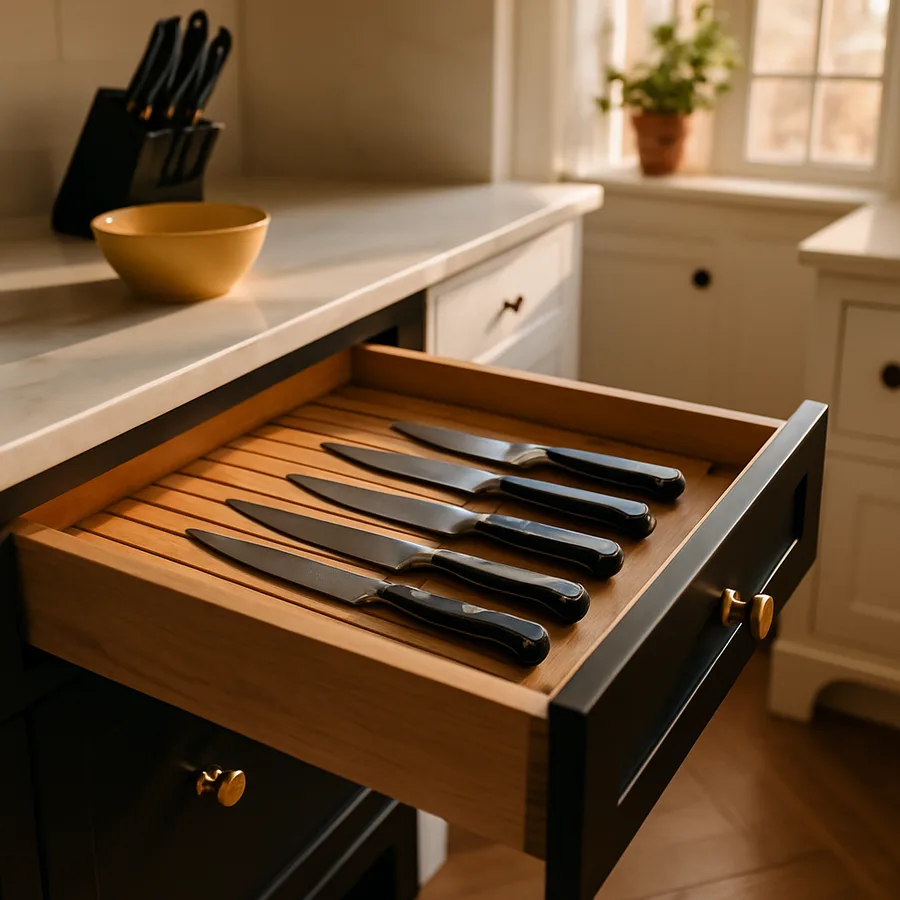
The traditional countertop knife block has been quietly losing favor in modern kitchen design, and for good reason. It collects dust along the slot interiors, it harbors moisture in slots that never fully dry, it occupies prime counter real estate that could be holding a stand mixer or a fruit bowl, and it forces the most expensive tools in your kitchen to live exposed to splashes, steam, and curious children. The integrated drawer-mounted knife storage system, especially one that uses neodymium magnetic inserts rather than wooden slots, addresses every one of those problems in a single move.
This guide covers the case for switching, the magnetic-insert geometry that holds knives without dulling the edges, the drawer construction that supports the load and prevents bowing, the safety features that matter when small children might be in the kitchen, and a step-by-step retrofit you can complete in a single Saturday with hand tools. The National Kitchen and Bath Association (NKBA) has reported that integrated cutlery drawers are now specified in roughly 35 percent of new custom kitchen installs, up from less than 8 percent a decade ago.
The Quiet Failures of the Countertop Block
Let me list the problems with the traditional block plainly. First, the slots are essentially impossible to clean without disassembling the block; food particles and moisture wick down into the slot interiors and create an environment friendly to mold. Second, knives stored point-down rest their tips against the bottom of the slot, dulling the very edge they were sharpened for. Third, the block occupies a permanent footprint on the counter, usually six inches by ten inches, that you can never repurpose. Fourth, the block is surprisingly easy for a curious toddler to pull a knife out of, with the handle right at face height for a standing two-year-old.
The drawer-based system, particularly with magnetic inserts, fixes each of those failures. The drawer interior is a flat, accessible surface that wipes clean with a single pass. Knives lie flat or stand on edge against the magnet, with no point contact and no slot pressure. The drawer closes flush with the cabinet face and reclaims the entire counter footprint. And the drawer can be fitted with a child-safety latch, which the American Society of Interior Designers (ASID) recommends in any kitchen where children under five spend significant time.
Have you ever opened the silverware drawer and realized you are also storing the chef's knife loose in there because the block is full? That improvisation is exactly the kind of small daily failure a dedicated knife drawer eliminates. Each knife has a specific magnetic position; nothing wanders.
Magnet Selection and Hold Strength
The heart of the system is the magnet itself, and not all magnets are created equal. Standard ferrite (ceramic) magnets are too weak to reliably hold a chef's knife under the vibration of a closing drawer. What you want is neodymium rare-earth magnets, grade N42 or higher, embedded in a wood or composite insert with the working face about 1/8 inch below the surface so the magnetic field reaches up through a thin layer of protective material.
The hold strength specification you want is roughly 8 to 12 pounds of pull force per knife slot. That is enough to hold the heaviest cleaver against a slamming drawer close, but not so much that you struggle to remove a paring knife with a flick of the wrist. Most premium kitchen-hardware manufacturers publish these specs; you can review the engineering data on magnetic kitchen storage systems through the Häfele functional hardware catalog for North American specifications.
Magnet placement is equally important. For a typical 21-inch deep drawer, plan on two parallel magnetic strips running front to back, spaced about 5 inches apart. That creates a "lane" where each knife rests with its blade against the rear strip and its handle near the front strip. The dual-strip approach holds even ungainly knives (filet knives with thin blades, oversized cleavers) far more securely than a single strip would.
The Drawer Itself: Build Quality That Matters
A loaded knife drawer is heavier than most homeowners expect. Eight to twelve quality knives, plus the magnetic insert, can total 12 to 18 pounds. That load is well within the capacity of a quality drawer slide system, but only if the drawer box itself is up to the task. Stapled MDF drawer boxes (common in builder-grade kitchens) will start to twist and bow within a year of holding magnetic inserts.
The right drawer box is dovetail-jointed solid maple or rabbeted 5/8-inch Baltic birch plywood. Both materials handle the load indefinitely, both resist moisture, and both can be repaired or refinished if damaged. Blum's Movento undermount slide system, with its 100-pound dynamic load rating, is overkill for a knife drawer in the best possible sense; the slides will outlast the kitchen. The full slide-system specification table is published at the Blum hardware portal for any DIYer who wants to verify load ratings before ordering.
Drawer width is a design choice. A 24-inch wide drawer accommodates 8 to 10 knives in a single bank. A 30-inch wide drawer can hold 12 knives plus a sharpening steel and a pair of kitchen shears. Wider drawers also make individual knife retrieval easier; tightly packed knives with handles touching are slightly harder to grab with one hand.
The Insert: Custom-Cut for Your Specific Knives
The magnetic insert is what takes the drawer from "knives loose against a magnet" to "designed cutlery storage." A great insert has shaped recesses for each specific knife in your set, with the magnet positioned exactly where the spine of the blade will rest. This eliminates any wobble during drawer travel and looks intentional rather than improvised.
You can buy generic inserts in 24-inch widths from kitchen-hardware suppliers, or commission a custom insert from a local woodworker for $150 to $300 depending on knife count and material. The custom approach is worth the cost if you have an unusual mix (a Japanese gyuto, a serrated bread knife, a cleaver) where the generic recess sizes do not fit well. A poorly fitted recess lets the knife rattle, which over time can chip the blade tip.
For DIYers, the insert is a satisfying weekend project. Start with a solid maple or walnut blank cut to the inside drawer dimensions. Lay your knives out on the blank, trace each one in pencil, and rout out a shallow recess (1/4 to 3/8 inch deep) for each blade. Drill a 3/4-inch hole through the bottom of each recess to accept a press-fit neodymium magnet, glue the magnet in with epoxy, and finish the entire blank with food-safe mineral oil and beeswax.
Drawer Location and Layout Logic
Where in the kitchen should the knife drawer live? The answer depends on your prep workflow, but the consensus from kitchen designers is the drawer immediately adjacent to your primary prep zone, ideally the drawer just below the counter where you cut. That puts the knife at most 18 inches from where it will be used, with a single drawer-pull motion to access.
Avoid putting knives in the upper drawer of a multi-drawer stack if children are in the household. Drawer height matters for access control: a knife drawer at toddler eye level is asking for trouble. The lowest drawer in a stack, especially one with a child-safety latch, is the safer location. The NAHB has published kitchen safety guidelines that specifically address dangerous-tool drawer placement.
One reader question that comes up: should you have one big knife drawer or two specialized drawers? For most home cooks, a single 24-inch drawer holding 8 to 10 knives is plenty. If you have a serious knife collection (say, a working set of 15 or more), splitting them into a "everyday" drawer near the prep zone and a "specialty" drawer farther away is a sensible upgrade. The everyday drawer holds your chef's knife, paring knife, utility, and bread knife; the specialty drawer holds the boning, filet, cleaver, and any specialty Japanese blades.
The Retrofit: Converting an Existing Drawer
If your existing drawer box is solid maple or Baltic birch and has high-quality slides, the retrofit is essentially a single weekend insert build. Measure the inside drawer dimensions, mill or order a maple blank to those dimensions minus 1/16 inch on each side for thermal expansion, lay out and rout the knife recesses, install the magnets, finish the wood, and drop the insert into the drawer.
If your existing drawer box is stapled MDF or has bowing slides, replace the drawer box first. Most cabinet manufacturers sell replacement boxes in standard widths, or a local cabinet shop will build one to your dimensions for $80 to $150. The replacement box drops into the existing slide rails (verify slide compatibility first) and provides the rigid foundation the magnetic insert deserves.
Before you commit, do a magnet test. Hold a small neodymium magnet against the underside of your current drawer bottom and try to lift the drawer. If you can feel the magnet pulling against itself through the drawer floor, you have plenty of magnetic field reaching up through the wood. If the pull feels weak, your drawer floor is too thick and you need either a thinner-bottomed drawer or larger magnets in the insert.
For households that include serious knife collectors with high-value Japanese blades or hand-forged carbon steel pieces, an additional consideration matters: humidity. Carbon steel rusts more readily than stainless, and a closed drawer can occasionally trap humidity from a damp dish-toweled blade put away too soon. Two solutions work well. First, a small silica gel desiccant pack tucked into the back of the drawer, replaced every six months, controls residual moisture. Second, a habit of fully towel-drying every blade before it returns to the drawer, which any owner of carbon steel knives has likely already adopted. The combination keeps the drawer environment as kind to expensive blades as a magnetic wall strip would be.
One more practical note on insert design: leave space for the items that always end up alongside the knives. A honing steel, a small pair of kitchen shears, a bench scraper, and perhaps a Y-peeler all benefit from the same magnetic storage approach as the knives themselves. Plan recesses for these accessories in the insert layout from the start; trying to add them later means reworking the magnet positions. A well-designed insert holds the entire prep-tool kit in a single drawer, which turns the drawer into the genuine command center for any cooking session.
Finally, think about how the drawer interacts with the rest of the cabinet stack. If your knife drawer is the lowest in a three-drawer base cabinet, the upper two drawers can hold complementary prep tools: measuring spoons and cups, prep bowls, kitchen towels. That turns the entire cabinet stack into a single integrated prep station, with the highest-frequency tools at the most ergonomic height. This kind of zoned thinking is exactly what kitchen designers mean when they talk about a "working triangle" reduced to a "working point" at the prep counter.
Conclusion
Switching from a countertop knife block to a magnetic in-drawer system is one of the highest-leverage kitchen upgrades I have seen homeowners make in the last five years. The benefits compound: counter space recovered, edge life extended, food-safety risk reduced, child-safety risk reduced, and the visual chaos of an oversized block on the counter quietly eliminated. Once you cook for a few weeks with the drawer, the block on the counter starts to look like a fax machine: an artifact of a previous era that you cannot quite believe you tolerated for so long.
The installation is well within reach for any homeowner who has done basic woodworking. Even commissioning a custom insert from a local maker plus replacing the drawer slides is a sub-$500 project at premium quality, and the daily payoff is constant. Resale appraisers and home buyers consistently respond to thoughtful kitchen storage details, and a clean, child-safe magnetic knife drawer is exactly the kind of detail that registers as "the previous owners cared about this kitchen."
If you have been telling yourself the block on your counter is fine, walk into the kitchen, look at it honestly, and ask whether it is the storage solution you would design from scratch today. If the answer is no, you have your next weekend project. Pull a knife out, look at the dust in the slot, and let that be your motivation. Measure your existing drawers, count your knives, and start sketching the insert layout this evening. The drawer is waiting to become the smartest cubic foot in your kitchen.
More Articles You May Like



Comments
Post a Comment