Kids Closet Double-Hanging Rod Heights for Self-Sufficient Dressing
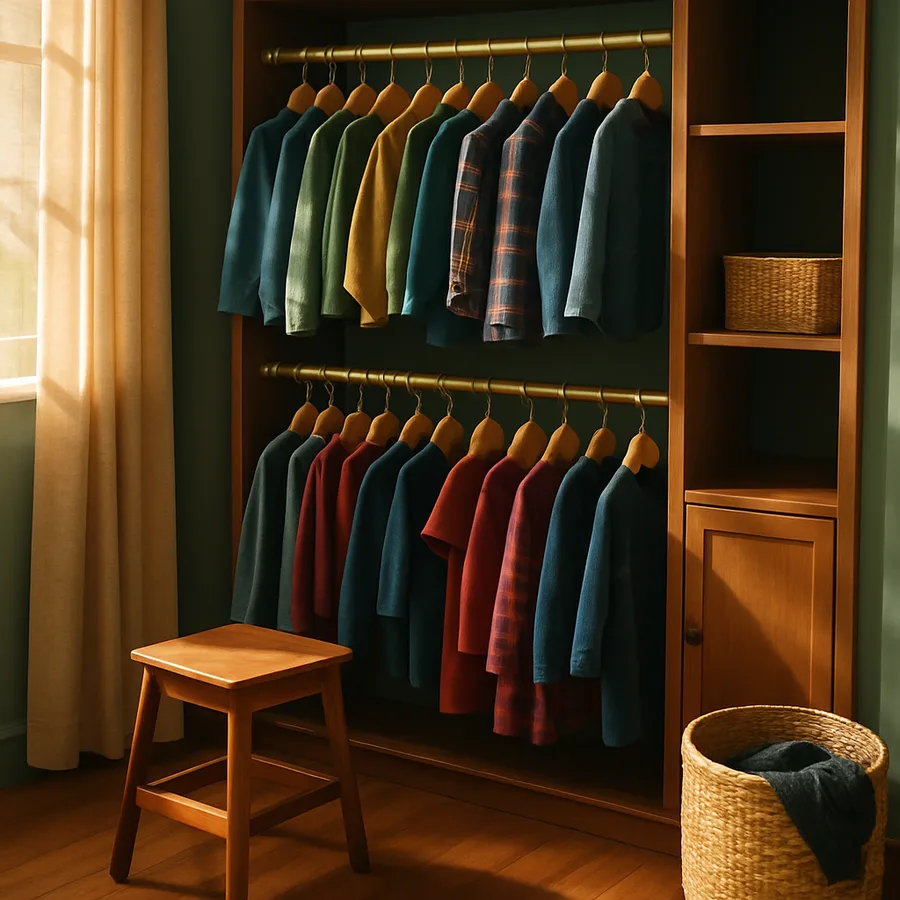
The closet is one of the most overlooked levers for raising independent, self-sufficient children. A closet sized for an adult forces a child to wait for help, surrender control over their daily routine, and absorb dozens of small competence losses every week. A closet sized for the child does the opposite: it puts every garment within reach, supports a real morning routine, and signals that the room belongs to the kid, not to the parent who hangs the clothes.
Double-hanging rods are the single most effective closet upgrade for children, particularly between ages three and twelve. By splitting the vertical space into two reachable rods rather than one impossibly high adult rod, you typically double usable hanging capacity while bringing every shirt, dress, and jacket into a child's grasp. This guide walks through the specific heights, depths, and configurations that produce a closet a child can run independently. According to a survey by the Better Homes and Gardens family-design team, parents who installed child-height double rods reported their kids dressed independently 30 to 60 minutes earlier in the morning routine, a meaningful daily recovery.
How Children's Reach Determines Rod Placement
Comfortable functional reach is the operative measurement, not maximum reach on tiptoe. Anthropometric data published by ergonomics researchers, including the dataset maintained by the National Institute for Occupational Safety and Health and adapted for pediatric populations, gives us a usable baseline. The functional reach height of a typical child is approximately their standing height minus 8 to 12 inches, depending on age and shoulder mobility.
For a 4-year-old (average height 40 inches), comfortable reach is roughly 48 inches. For a 6-year-old (average height 45 inches), comfortable reach is roughly 54 inches. For an 8-year-old (average height 50 inches), comfortable reach is roughly 60 inches. By age 12, children average 58 inches in height with a comfortable reach near 70 inches, approaching adult dimensions. These are averages; measure your specific child by having them stand against a wall and reach up comfortably without straining.
The upper rod in a double-hang configuration should sit at or just below the child's comfortable reach height. The lower rod should sit far enough below to allow garments on the upper rod to hang freely without dragging. A standard short garment (T-shirt, polo, blouse) needs about 28 to 32 inches of vertical clearance below the rod. A standard kid's dress or longer top needs 36 to 40 inches. This sets the gap between the two rods.
Recommended Double-Rod Heights by Age
Based on the reach data and standard garment lengths, the practical configurations are as follows. For ages 3 to 5, place the upper rod at 42 to 48 inches and the lower rod at 24 to 28 inches. This puts both rods well within reach and accommodates the very short garment lengths typical at this age. The bottom rod can be even lower (around 20 inches) for toddlers, since their tops and pants are tiny.
For ages 6 to 9, place the upper rod at 54 to 60 inches and the lower rod at 28 to 32 inches. By this age, garments are getting longer and the spacing needs to grow accordingly. This is also the age when a child begins choosing outfits independently, so the visual organization of the closet becomes as important as the reach. Group like with like; mix-ups happen when shirts and pants share the same rod.
For ages 10 to 13, place the upper rod at 64 to 70 inches and the lower rod at 32 to 36 inches. By this age, you are approaching adult dimensions and a single tall rod (one of the standard adult heights of 66 to 72 inches) becomes feasible. However, double hanging often remains preferable because it doubles capacity and accommodates the explosion of school activity gear, sports uniforms, and dress clothes that defines this age. Many designers recommend converting to a single-rod-plus-shelving configuration around age 14, when garment lengths approach adult standards.
Closet Depth, Hanger Choice, and Garment Spacing
Rod height is only half the equation. Closet depth determines whether garments hang freely or scrape the back wall, and hanger choice determines whether a child can actually use the rod independently. The standard closet depth is 24 inches from the back wall to the inside face of the door frame. This accommodates an adult hanger comfortably (typical 17-inch shoulder span) but it is overkill for kid garments.
Use child-sized hangers, not adult ones, on both rods. Adult hangers stretch the shoulders of small shirts, take up disproportionate rod space, and are difficult for small hands to manipulate. A 10 to 12-inch wood or velvet hanger is the right scale for clothes through age 8, and a 14-inch hanger covers ages 9 to 12. Velvet flocked hangers are particularly good for children because they grip the garment and prevent the slip-off problem that frustrates kids putting clothes back. The NAHB closet design guidelines recommend matching hanger scale to garment scale specifically to support independent dressing in family homes.
Garment spacing matters more than parents realize. Pack a closet rod tighter than 1.5 inches between hangers and a child cannot pull a garment down without snagging the neighbors. The right density is 1.5 to 2 inches per hanger, which means a 36-inch rod holds about 18 to 24 garments per side. If you need more capacity than that, add a second rod section rather than packing tighter. Better Homes and Gardens editors have consistently recommended the 1.5-inch rule as the threshold below which kids stop using their closets and start dropping clothes on the floor.
Visual Organization and Color Coding
A closet that is dimensionally perfect but visually chaotic still defeats the purpose. Children, particularly under age 8, rely heavily on visual pattern recognition to find clothes. Group garments by category first and by color second. The standard order, left to right on each rod, is short-sleeve shirts, long-sleeve shirts, light jackets, dresses (if applicable). Pants and skirts can hang on the lower rod or be folded in drawers; a hybrid approach often works well.
Color coding within each category dramatically improves a child's ability to find a specific garment. Within the short-sleeve shirt section, group by color family: whites, then yellows and oranges, then reds and pinks, then blues and greens, then grays and blacks. This is the same system used in retail apparel display because it works at a perceptual level. A child looking for "the blue striped shirt" finds it instantly when blues are grouped, and slowly when colors are scrambled.
Consider category labels on the rod or shelf for early readers. A small printed tag attached to the rod beneath each section ("school shirts," "play shirts," "dresses," "jackets") accelerates organization and supports kids in maintaining the system after a parent does the laundry. The American Academy of Pediatrics emphasizes in its guidance on building executive function that visual organizational systems in personal spaces (closets, desks, bookshelves) measurably support task initiation and self-direction in children ages 4 to 12.
Adjustability and Future-Proofing the System
Children grow. A rod that is perfectly placed at age 5 is awkwardly low at age 8 and useless at age 11. Build adjustability into the system from day one or you will be re-installing rods every two years.
The simplest adjustable system is a cleat-and-bracket approach: install vertical cleats on both side walls of the closet with mounting holes every 2 inches. Both rods sit on movable brackets that can be raised as the child grows. This costs slightly more upfront than a fixed installation but pays back many times over in flexibility. Major closet system manufacturers (Elfa, ClosetMaid, California Closets) offer modular adjustable rod systems specifically designed for growing kids; the principle is the same whether you DIY or buy a system.
A second approach is the removable lower rod. Install a permanent upper rod at adult height (66 to 70 inches) and a removable lower rod that sits on adjustable brackets. As the child grows, the lower rod rises until it eventually comes out entirely, leaving a single adult-height rod with a shelf above. This is a particularly clean solution for closets that will eventually serve a teen or adult occupant. The NAHB's family-housing guidelines specifically recommend this approach for new construction, since it future-proofs the closet for resale value while serving young children today.
Whatever system you choose, plan to revisit closet heights every 12 to 18 months. A 30-minute Saturday-morning session with a tape measure and a screwdriver is enough to keep the closet sized to the child. Many families schedule the adjustment alongside the back-to-school clothing transition, which provides a natural prompt and a logical moment to reorganize.
Step Stools, Lighting, and Door Configurations
Even a perfectly sized closet often benefits from a small step stool for retrieving items from the upper shelf or rear corner. Choose a two-step folding stool with a non-slip top and rubberized feet, sized to fold flat against the closet wall when not in use. The CPSC has noted that step-stool injuries in children most commonly involve plastic stools without anti-slip surfaces; a basic wood or steel stool with rubber treads is materially safer.
Lighting inside the closet is non-negotiable for a self-sufficient kid. A dark closet defeats every other design choice, because a child who cannot see their clothes will not use the closet. Install a battery-powered LED puck light or a hardwired motion-activated fixture inside the closet at the top center. Aim for 200 to 300 lux at the rod level, sufficient to distinguish colors and read tags. Battery LED options run for months on a single charge and require no electrician.
Door configuration also affects usability. Bifold doors open the full closet width but consume floor swing space. Sliding doors save floor space but only expose half the closet at a time, which fragments organization. For young children, an open closet (no door, perhaps a curtain) often works best because it removes a manipulation step and exposes the entire wardrobe at a glance. Many designers convert one closet door to open shelving and leave the other functional, splitting the closet into a "displayed" daily wardrobe and a "stored" off-season section.
Coordinating Drawers, Shelves, and Hanging Space
A double-hang rod system performs best when the rest of the closet is coordinated to match. The base of the closet should hold a small dresser or drawer unit at child height (24 to 30 inches tall), so socks, underwear, and pajamas live in the same room as the hanging clothes. Above the upper rod, install a single deep shelf for off-season storage, gift-bag stockpiles, or items that genuinely belong to the parent rather than the child.
If the closet has a back wall deeper than the rod brackets, add a shoe rack or low cubby for the four to six pairs of shoes a child actually rotates through. Storing shoes inside the closet rather than at the front door reduces morning friction and reinforces the closet as the dressing station. The NAHB closet guidelines specifically recommend integrated shoe storage in children's closets as part of supporting independent dressing routines.
Hooks are another underused element. A row of three or four low wall hooks inside the closet (or on the back of the closet door) holds robes, backpacks, hats, and the jacket-of-the-day. Hooks are forgiving where hangers are not; a child can use a hook with one hand and zero precision, while a hanger requires two hands and shoulder alignment that small kids often lack. The combination of a low hook for the daily jacket and a hangered rod for less-frequently-used outerwear typically resolves the persistent floor-pile-of-coats problem.
Conclusion: A Closet That Teaches Independence
The closet is rarely the room you walk into and admire, but it is the room that shapes your child's morning. A double-hang system sized to your child's actual reach, with appropriate hangers, garment spacing, color coding, and lighting, transforms dressing from a parent-led negotiation into a child-led routine. The investment is small. The daily payoff, in saved time, in built confidence, and in the slow accumulation of small competencies that produce capable kids, is significant.
The most common mistake we see is leaving the original adult-height rod and adding nothing else, then wondering why a 6-year-old will not get dressed independently. The second is over-installing: building a $4,000 custom closet for a child who will outgrow it in three years. The right approach is in the middle: a thoughtful but adjustable system, sized correctly today and easy to raise as the child grows. The principles in this guide work whether you are renovating a custom walk-in or just adding a tension rod and a few hooks to an apartment reach-in.
Have you measured your child's comfortable reach height today, or are you guessing? And does your child's closet have visible, color-grouped organization, or does it currently default to a shoved pile? Subscribe to our weekly kids' room newsletter for a downloadable closet measurement worksheet, age-by-age height charts, and the printable rod-position template we use with our own design clients. The closet you build today is the morning routine you give your child for years.
More Articles You May Like



Comments
Post a Comment