Horizontal Metal Rod Railings for Modern Farmhouse Staircases
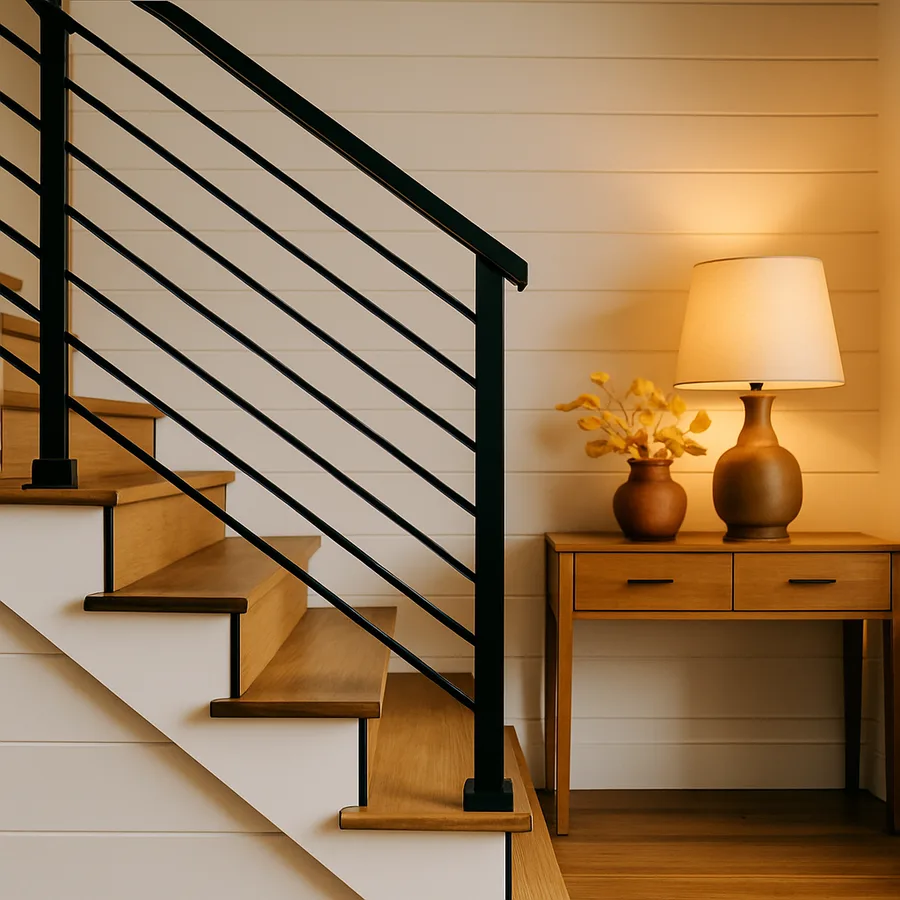
The modern farmhouse style has carried American interior design for nearly a decade, and the stair has been one of its most expressive features. Horizontal metal rod railings are increasingly the railing of choice in this style, because their crisp linear geometry plays naturally against shiplap, white oak treads, and exposed beam ceilings. They give a stair the workshop, foundry, or carriage-house quality that the modern farmhouse vocabulary references without falling into outright industrial pastiche. According to a 2025 Houzz Stair Style Report, horizontal rod systems were specified in 23 percent of farmhouse-style stair remodels last year, up from 6 percent five years earlier.
This guide is for homeowners and designers planning a horizontal rod railing on an interior stair. The format is deliberately practical: how to detail the system so it feels right in a farmhouse context, how to satisfy the building code, and how to anticipate the long-term performance of a system that puts most of its visible mass in slim horizontal members. Reader question to keep at the front of the conversation: how strict is your local jurisdiction on the climbability provisions of the IRC? Reader question two: do you want the rods exposed or partially concealed by a top and bottom flat bar?
Why Horizontal Rod Reads as Modern Farmhouse
The modern farmhouse style draws from three architectural references: the agrarian American farmhouse, the early industrial workshop, and the Scandinavian minimalist interior. Horizontal rod railings sit at the intersection of all three. The rod profile recalls the stretcher bars of a workshop fence. The visible bolted or welded terminations recall the plain joinery of a barn. The horizontality, which contrasts with the verticality of typical balusters, recalls the spare horizontal lines of a Scandinavian interior.
Designers who succeed with this style do so by treating the railing as one of three or four signature pieces in the room rather than as a background element. A horizontal rod railing wants to be photographed, and the rest of the architecture should support that intention. Pendant lighting at the landing, a heavy timber post at the bottom of the stair, and a continuous wood handrail along the top of the rod system all reinforce the desired reading.
The American Society of Interior Designers has noted in its style trend reports that the modern farmhouse stair tends to fail when too many materials compete for attention. A horizontal rod railing should be paired with restraint elsewhere: monochrome wall treatments, a single hardwood species, and lighting that reads as intentional rather than decorative. When the railing is the loudest object on the stair, the room reads as composed. When it competes with five other loud objects, the room reads as cluttered.
The Climbability Question: A Real Concern
Horizontal infills, including rods, cables, and slats, raise an immediate question in every plan review: can a child climb them? Earlier editions of the IRC included an explicit prohibition on guard infills that would form a ladder, but the current IRC has removed that prohibition while leaving the broader 4-inch-sphere rule in place. Many local jurisdictions, however, have retained the climbability prohibition through local amendments, and a few have added their own.
The International Code Council has acknowledged the inconsistency in its own commentary, recommending that designers consult the local building official before specifying any horizontal infill in a residential setting. In practice, most jurisdictions allow horizontal rod systems on residential stairs, but require either a continuous top cap that defeats the ladder reading or documentation that the rod assembly cannot be climbed by a child of typical size and dexterity.
Reader question: have you confirmed the rule in your jurisdiction? A phone call to the building department before drawing the railing is far cheaper than a redrawn permit set after a plan review comment. For published guidance on climbability and stair guards, see the open commentary published by the International Code Council.
Rod Material, Diameter, and Spacing
Most residential horizontal rod railings use 1/2 inch or 5/8 inch solid steel rod, finished with satin black powder coat or, less commonly, oil-rubbed bronze or raw mill finish sealed with clear coat. Aluminum rod is a lighter alternative that resists rust without finish and works well in coastal homes. Stainless rod is the most expensive option and is reserved for installations that emphasize a brighter, more contemporary edge to the farmhouse vocabulary.
Spacing is determined by the same 4-inch sphere rule that governs all guard infill. For a 36-inch tall guard with a 5-inch top rail and 4-inch bottom rail, the rod count typically lands at nine or ten horizontal members on roughly 3-inch centers, which provides a working safety margin against any deflection in the rods themselves. Some designers compress the spacing further to read as a denser pattern, which can be visually striking but adds material and labor cost.
The connection between rod and post matters more than the connection between rod and rod. Most systems thread each rod through a precision-drilled hole in each post, with the end posts terminating the rods either through a tensioned mechanical fitting or a welded plug. The American Welding Society publishes guidance on weld quality for guard assemblies, and any horizontal rod railing using welded terminations should be installed by a fabricator familiar with that guidance.
Posts, Anchorage, and Structural Loads
Horizontal rod railings, like all guards, must resist a 200-pound concentrated load applied in any direction at any point along the top, plus a 50-pound-per-foot uniform load. For rod systems, the load path runs through the top rail or top horizontal member, into the posts, and into the structural floor or stringer. Posts spaced more than 48 inches apart almost always require a custom anchorage detail, which on a remodel often means opening floor finishes to expose the rim joist or stringer.
According to NAHB-published cost data, the structural anchorage portion of a horizontal rod railing remodel typically runs 30 to 50 percent of the total project cost, with the rod system itself accounting for the balance. That ratio surprises homeowners who priced the railing from a manufacturer's catalog without adding the structural work. Designers who build the structural cost into the early project budget have far better client conversations than those who present it as an unexpected addition.
End posts, intermediate posts, and landing posts each behave differently. End posts carry the cumulative tension of any rods that terminate at them, intermediate posts carry the load transferred from rods passing through, and landing posts carry the top-of-stair turning load. The American Institute of Architects recommends that any horizontal rod railing longer than eight linear feet have its post anchorage reviewed by the structural engineer of record before fabrication.
Handrail Integration: The Required Second Member
The top of a horizontal rod railing is not a code-compliant handrail. The IRC requires a graspable handrail with a circular cross-section between 1.25 and 2.0 inches in diameter, or an equivalent profile, mounted between 34 and 38 inches above the nosing line. A flat-bar top of a rod railing does not satisfy this geometry, regardless of how the rest of the system is designed.
Designers detail this required second handrail in two common ways on a modern farmhouse stair. The first is a wood top cap that serves as both the visual termination of the rod system and the graspable handrail, sized and profiled to satisfy the IRC dimensions. The second is a separate metal grip-shape handrail mounted on the room-side of the posts, which leaves the rod system reading as pure horizontality and adds a continuous handrail at the proper height.
Architectural Digest has noted that the most successful modern farmhouse stairs treat the wood top cap as a primary feature, often in a contrasting species like walnut or fumed oak that creates a visual line above the black rods. Reader question: have you specified which approach you want, and confirmed that your local code official will accept it as a graspable handrail? Skipping that confirmation is the most common reason that horizontal rod railings get red-tagged at final inspection.
Finish, Care, and the Patina Decision
Horizontal rod railings live in a more demanding finish environment than most homeowners expect. Hands, shoes, vacuum hoses, and pet noses all contact the rods at various heights, and the powder-coat finish has to absorb that traffic for a decade or more. The Powder Coating Institute recommends a two-stage powder-coat process for any architectural metal railing, which adds modest cost at fabrication and significant longevity in service.
Some designers and homeowners deliberately choose a raw or lightly sealed steel finish that develops patina over time. This decision must be made at design stage, not in the field, because a patinated finish requires different maintenance than a powder-coated one and will react to humidity changes that an interior designer needs to anticipate. The patina look reads as authentically agrarian when done well, and as poorly maintained when done casually. The line between the two is finer than most homeowners expect.
Cleaning is straightforward. A soft cloth with a pH-neutral cleaner two to four times a year keeps powder-coated rods looking newly installed, and the same routine works for sealed raw steel with the addition of an annual application of a clear matte sealer. Damaged finishes can be touched up with manufacturer-supplied repair pens for small chips, but deeper damage usually requires removal and refinishing of the affected rod, which is more involved than a comparable touch-up on a wood spindle.
Conclusion
A horizontal metal rod railing is one of the most architecturally expressive choices available for a modern farmhouse stair, because it ties the railing to the broader visual vocabulary of the style without forcing the rest of the room to do the work. The system reads as crafted, intentional, and distinctly current, while still feeling rooted in the agrarian and industrial references that the modern farmhouse style draws from. When detailed well, it photographs beautifully and lives gracefully.
The cost of that result is detail discipline. Climbability needs to be confirmed with the local building official before the railing is drawn. Rod material, diameter, and spacing need to be selected with the load and code requirements in mind, not just the visual rhythm. Post anchorage needs to be coordinated with the structural framing, often before the floor finish is closed in. The required graspable handrail needs to be designed as part of the system, not added as a code afterthought. Each of these items rewards early attention and punishes late discovery.
Maintenance is real but manageable. Twice-a-year cleaning, attention to small finish chips, and a clear understanding of whether the system is meant to be powder-coated or patinated keep a horizontal rod railing looking newly installed for many years. Designers who walk the homeowner through the maintenance routine at design stage avoid the disappointed phone call three years later when the rods do not look the way they did on day one.
Want to plan one for your home? Pull together a stair elevation, photograph the surrounding architecture, and book a 30-minute consult with a metal fabricator who has installed at least three comparable systems. Ask to see installed photos with the same finish and the same lighting conditions as your stair. That sequence, more than any catalog browse, will tell you whether the horizontal rod railing belongs in your home and what it will take to install it correctly.
More Articles You May Like



Comments
Post a Comment