Kids Bunk Bed Safety Rails and Ladder Positioning Guidelines
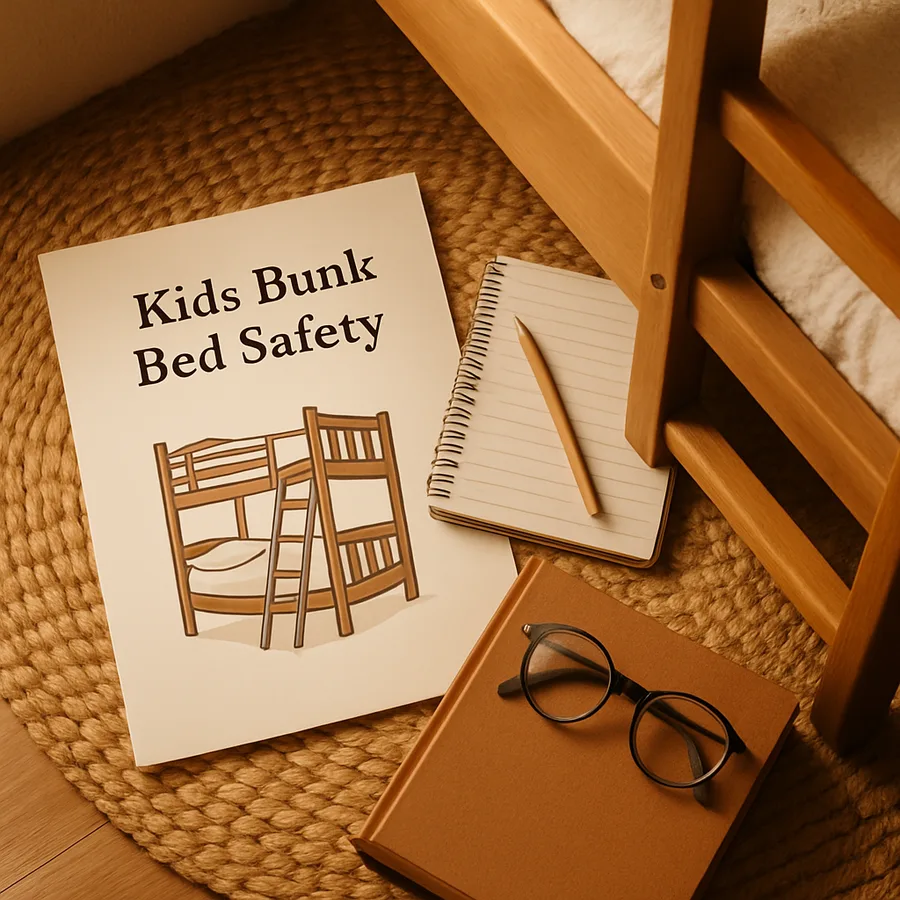
Few pieces of children's furniture combine practical brilliance and legitimate risk quite like the bunk bed. Done right, it doubles sleeping capacity in a single footprint and becomes the most beloved feature of a shared bedroom. Done wrong, it lands a child in the emergency room. According to data published by the U.S. Consumer Product Safety Commission, an estimated 36,000 bunk-related injuries are treated annually in U.S. hospitals, and the single biggest contributor is not the bed itself but the way the rails and ladder are set up and used.
This guide walks through the specific safety rail dimensions, ladder geometries, and placement decisions that separate a well-engineered bunk from a hazard. Every recommendation is grounded in ASTM F1427, the federal voluntary standard governing bunk bed construction, plus published guidance from the American Academy of Pediatrics and product-safety teams at major retailers. Whether you are buying new, inheriting a hand-me-down, or building a custom bunk, the same principles apply.
Why Bunk Bed Injuries Happen and What Drives Them
The injury data is clarifying because the patterns are remarkably consistent. The CPSC and several pediatric trauma centers have analyzed thousands of bunk-related ER visits, and the same root causes appear over and over. Falls during ascent or descent of the ladder account for roughly 30 to 35 percent of all incidents. Falls from the top bunk during sleep, almost always associated with inadequate guardrails or a too-thick mattress, account for another 35 to 40 percent. Head injuries, particularly to the lower bunk occupant, make up a meaningful share of the remainder.
The most affected age group is children five to nine. Younger children are more often involved in falls during play (jumping, climbing on the outside of the bed), while older children are more often injured during transitions between the bunks. Roughly 70 percent of fall injuries occur to children under 14, and the AAP has long recommended that children under six should not sleep on the upper bunk under any circumstances, a guideline that is repeatedly reaffirmed in pediatric injury-prevention research.
What this tells us as designers and parents is that the rails and the ladder are not afterthoughts. They are the safety system. A bunk frame that meets every dimensional requirement but pairs with a 9-inch-thick mattress, or a ladder that is angled too vertically, can still produce all the injury patterns above. The rest of this guide focuses on the dimensions and placements that prevent the most common failures.
Top Bunk Guardrail Standards and Real-World Dimensions
The governing standard is ASTM F1427, which requires guardrails on both sides of the upper bunk. On the wall side, the rail must run continuously from end to end. On the open side, the rail must extend the entire length of the bed except for an opening at the ladder, and that opening must be no more than 15 inches wide. Both rails must rise at least 5 inches above the top surface of the mattress when the mattress is in place.
The 5-inch minimum is just that, a minimum. In practice, child-safety researchers and pediatric occupational therapists routinely recommend 7 to 9 inches above the mattress for children under 12, particularly active sleepers. The reason is straightforward: a child rolling vigorously in deep sleep can develop enough lateral momentum to clear a 5-inch rail. Mattress thickness is the variable that quietly defeats most guardrails. If the bed was designed for a 6-inch mattress and you upgrade to an 8-inch mattress for comfort, you have just removed 2 inches of effective rail height. Always measure mattress-to-rail clearance after the mattress is installed, not from the frame.
End rails (head and foot) are also required by ASTM, and gaps in any guardrail system must be either smaller than 3.5 inches or larger than 9 inches to prevent head and limb entrapment. A 4-inch gap is the worst-case dimension; a child's torso can pass through but the head can become trapped, with potentially fatal results. This is why decorative guardrails with widely spaced spindles are dangerous unless they were specifically engineered to ASTM tolerances. When in doubt, fill the gap with a continuous rail rather than spindles.
Ladder Angle, Tread Depth, and Step Spacing
A correctly designed ladder is the single most cost-effective safety upgrade you can make to any bunk. ASTM F1427 specifies tread spacing of no more than 12 inches between rungs and a minimum tread depth of 1.5 inches. Those are minimums and, again, real-world recommendations push higher. A tread depth of 2.5 to 3 inches dramatically improves grip for small feet, particularly in socks, which is how most children climb at night.
Ladder angle is the variable most often overlooked. A vertical ladder (90 degrees) is the worst configuration; it forces a child to climb hand-over-hand and offers no margin if their grip slips. An angled ladder set at 70 to 75 degrees from the floor allows a child to lean their weight forward into the climb and recover from a stumble. The trade-off is floor space: an angled ladder consumes 12 to 18 inches of floor in front of the bed. In tight rooms this matters, but in most cases the safety gain is worth the footprint.
For maximum safety, particularly with younger children, a staircase ladder with full-depth treads (8 to 10 inches deep) is the gold standard. It costs more, often 30 to 50 percent above a basic ladder bunk, but it cuts ladder-fall injuries substantially in pediatric injury studies. Many staircase designs also incorporate drawer storage in the treads, recovering some of the lost floor space. Whatever style you choose, ensure the ladder is securely attached to the bed frame at top and bottom; a hooked-on ladder that lifts free is a known failure mode.
Wall Placement, Ceiling Clearance, and Room Layout
Where the bunk sits in the room affects safety more than most parents realize. Position the bunk against a long wall so the wall side handles half the fall-prevention burden naturally. Avoid placing the open side near a window, a radiator, a ceiling fan, or any wall-mounted hazard. The American Academy of Pediatrics specifically warns against placing bunks under ceiling fans because the upper bunk occupant can sit up and contact the blades.
Ceiling clearance above the top mattress should be at least 33 to 36 inches. This allows a child to sit up comfortably, move around to make the bed, and reduces the likelihood of head impact during play. With a typical 8-foot ceiling (96 inches), a standard bunk with the top deck at 60 inches and an 8-inch mattress leaves 28 inches of clearance, which is below the recommendation. Either choose a lower-profile bunk frame or a thinner mattress.
Floor surface matters too. A hardwood or tile floor under a bunk meaningfully increases injury severity in a fall. A medium-pile rug or a foam play mat with a low-profile area rug on top can significantly reduce fall injuries. The NAHB's 2024 family-housing guidelines specifically call for resilient flooring or rugs in shared children's bedrooms with bunks. If the room has hardwood, consider a 6-by-9 foot area rug centered under the open side of the bunk and the ladder approach.
Mattress Thickness, Bedding, and Hidden Hazards
Mattress selection is one of the most consequential and least discussed safety decisions. Every bunk bed manufactured to ASTM standards specifies a maximum mattress thickness, typically 6 to 8 inches for the top bunk. Exceeding that maximum directly reduces guardrail height. A 9 or 10-inch hybrid mattress on a frame designed for 6 inches removes 3 to 4 inches of effective rail. The bed still looks fine; it is just no longer compliant.
Bedding adds risk in less obvious ways. Heavy comforters and weighted blankets on the top bunk can drag a sleeping child toward the rail, particularly if they are restless. The American Academy of Pediatrics specifically warns against weighted blankets for children under five and against any weighted blanket on a top bunk for children under ten. Pillow placement also matters: a child who pushes pillows against the rail effectively reduces its height by the pillow thickness.
Hidden hazards include the gaps and projections that develop as a bunk ages. Loose bolts produce frame play and squeaks; the squeaks are often the early warning of a structural issue. Tighten all hardware quarterly and replace any rounded or stripped fasteners immediately. Check that no slats have shifted, that the foundation supports the mattress evenly, and that no clothing hooks, decorative posts, or finials project into a child's head-strike zone. A stuffed animal looped to a hook by its neck has caused at least one documented strangulation injury per CPSC reporting.
Daily Use Rules That Keep Bunks Safe Long-Term
Hardware and dimensions only do half the work. The rest is behavior, and the behavior rules need to be explicit, repeated, and modeled. The single most important rule is the youngest-on-bottom rule: children under six on the lower bunk, no exceptions. This is not a developmental judgment about your specific child; it is a statistical statement about reaction time, depth perception, and the risk of nighttime sleep falls in this age group.
The second rule is one-at-a-time on the ladder, and never on the outside of the bed. Children climbing the outside frame to reach the top bunk are a major source of head and arm injuries. The third rule is no jumping, ever, on either bunk. Beyond the obvious fall risk, repeated jumping accelerates frame loosening and slat failure. The fourth is a no-toys-on-the-top-bunk rule for hard or sharp items, since dropped toys present a head-strike hazard to the lower occupant.
Lighting affects safety more than parents realize. A child making a 2 a.m. trip to the bathroom is at materially higher fall risk than the same child during the day. Install a low-level pathway light at the base of the ladder, ideally motion-activated. Add a small reading light to the upper bunk so the child does not need to descend the ladder to turn on a room light. Better Homes and Gardens has consistently recommended battery-powered LED puck lights for this purpose; they install in seconds and run for months on a single charge.
Inspecting an Inherited or Used Bunk Bed
Many families acquire bunk beds secondhand from older siblings, relatives, or thrift sources. A used bunk can be perfectly safe, but it requires a more rigorous inspection than a new one straight from the box. The first check is the manufacturer's label and ASTM compliance statement, usually attached to the underside of a slat or the inside of a leg. If the label is missing or the bed predates 1999 (when ASTM F1427 was significantly updated), proceed with extra care.
Inspect every bolt and connection point. Disassemble the bed if possible, examine each joint for stress cracks, check that all hardware is original or properly matched, and replace any rounded or damaged fasteners. Look closely at the slat support system; bowed or cracked slats are a common failure point on older bunks and contribute to mattress sag and unexpected drops. Verify that the guardrails are full-length and meet the 5-inch-above-mattress minimum after the mattress you intend to use is in place.
Check for recalls. The CPSC maintains a searchable recall database, and bunk beds account for a meaningful share of children's furniture recalls each year. Search by manufacturer and model before installing any used bunk in your home. If a bunk has been recalled, do not use it; the issues are typically structural and not safely fixable. The same caution applies to homemade or custom-built bunks without verifiable engineering; the cost of professional inspection is small compared to the consequences of a structural failure during sleep.
Conclusion: Designing for Safety Without Killing the Magic
The bunk bed remains one of the most space-efficient and joy-inducing pieces of furniture you can give a child. None of the safety guidance above is meant to discourage you from buying one. The point is that the difference between a safe bunk and a hazardous one comes down to a handful of measurements, the right mattress, an angled or staircase ladder, and a few simple household rules. Get those right and the injury risk drops dramatically.
If you are evaluating an existing bunk in your home, walk through the safety checklist tonight: measure the guardrail above the actual mattress, check ladder angle and tread depth, inspect for loose hardware, confirm the floor under the bed has impact-absorbing material, and clear any wall-mounted hazards within the bunk's reach. If you are shopping, look for explicit ASTM F1427 compliance on the spec sheet, request the maximum mattress thickness in writing, and prefer staircase or angled ladders over vertical ones whenever the room allows.
Have you measured the actual guardrail clearance above your child's mattress, or are you relying on the manufacturer's spec? And does your child know the youngest-on-bottom rule and the one-at-a-time ladder rule? Download our printable bunk-bed safety checklist from the resources page and run through it together this weekend. A bunk bed that is correctly set up and respectfully used can serve a family safely for a decade or more, and the small upfront effort to verify the rails, the ladder, and the mattress will repay itself many times over.
More Articles You May Like



Comments
Post a Comment