Basement Playroom Safety Flooring for Kids and Toddlers
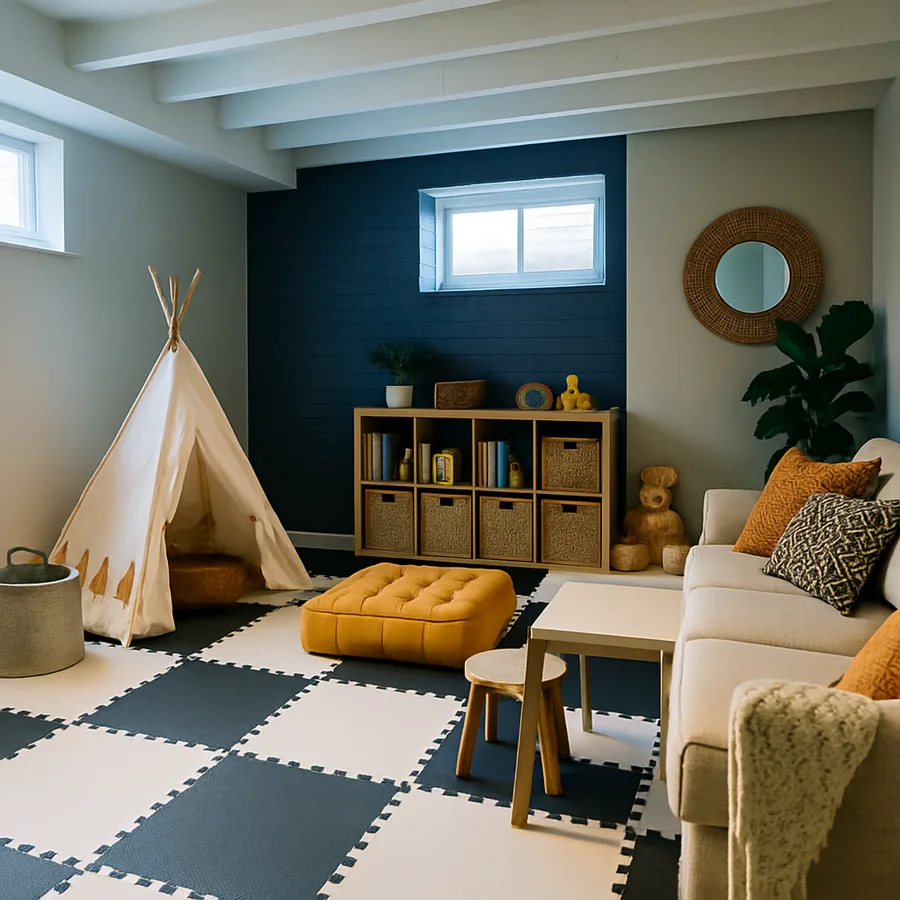
When parents convert a basement into a playroom, the single decision that shapes daily use more than any other is the floor. Basement floors are cold, they are hard, and they sit directly on concrete that offers no forgiveness when a toddler trips or a preschooler jumps from a couch. Getting the flooring right is not a cosmetic choice; it is a safety choice that affects injury risk, cleanability, comfort during long floor-play sessions, and whether the room actually gets used every day. The good news is that modern playroom flooring has moved well past the primary-colored foam tiles of the 1990s, and there are now four mainstream categories to evaluate: foam interlocking tiles, rubber rolls or tiles, cork, and low-pile carpet tiles over padding.
The U.S. Consumer Product Safety Commission (CPSC) tracks more than 200,000 playground-related injuries treated in U.S. emergency rooms each year, and while most occur on outdoor equipment, the underlying biomechanics apply to indoor play just as cleanly. Falls from standing height onto a concrete basement slab generate peak head impact forces that routinely exceed the injury thresholds defined in ASTM F1292, the standard for impact-attenuating surfacing under and around playground equipment. That same ASTM standard, together with ASTM F3101 for impact-attenuating playroom surfaces, gives you a quantitative framework for evaluating what is actually safe versus what just feels soft.
Understanding What Playroom Flooring Actually Needs to Do
Before comparing materials, it helps to separate the functions a playroom floor must perform. The first is impact attenuation, which is the ability to reduce the peak force and head acceleration during a fall. The second is thermal comfort, because concrete conducts heat away from a child's body faster than they can generate it, and a cold floor discourages floor play. The third is cleanability, because playrooms accumulate spilled juice, paint, craft glue, and the occasional diaper accident. The fourth is indoor air quality, because young children spend a large percentage of their day near the floor and inhale whatever off-gasses from it.
Each of the four mainstream materials scores differently across these four dimensions. No single material wins on every axis, which is why most well-designed playrooms combine two materials, typically a soft primary zone for active play and a firmer secondary zone for tables, easels, and wheeled toys. The American Academy of Pediatrics (AAP) recommends at least 60 minutes of active play per day for children ages 1 through 5, and a playroom that supports that level of activity needs both cushion and traction in appropriate zones.
Have you measured the room's temperature during the coldest week of winter? A basement slab can sit 10 to 15 degrees below the air temperature of the room above, and any flooring you choose should include an insulating barrier between the slab and the finish surface. This is both a safety consideration, because cold surfaces cause children to shift their stance and lose balance more often, and a comfort consideration that affects how much the room actually gets used.
Foam Interlocking Tiles: The Go-To First Choice
Foam interlocking tiles, also called EVA tiles after the ethylene-vinyl acetate polymer they are usually made from, have become the default playroom flooring for good reasons. They are inexpensive at $1 to $3 per square foot, they install without adhesives or tools, they cushion falls effectively, and they clean easily with a damp mop. A standard 5/8-inch thick EVA tile provides a critical fall height of roughly 2 to 3 feet under ASTM F1292 testing, which covers most toddler falls from a standing position.
The quality variation within the EVA tile market is significant. Premium tiles from manufacturers such as Greatmat, SoftTiles, and Rubber-Cal are tested for formaldehyde and phthalate content and carry certifications such as CertiPUR-US or Greenguard Gold for low VOC emissions. Inexpensive tiles from unnamed overseas sources frequently fail the same tests and can off-gas measurable amounts of formamide, which the European Chemicals Agency (ECHA) classified as a substance of very high concern in 2012. If you buy foam tiles, buy certified ones and avoid the lowest price tier.
The main downsides of foam tiles are durability and appearance. They dent under the legs of heavy furniture, they scuff when toys are dragged across them, and the interlocking seams collect dust and small crumbs. Most installations need replacement sections within three to five years in a high-use playroom. On the appearance front, modern foam tiles come in wood-grain and neutral patterns that read less "daycare" than the rainbow tiles of a decade ago, but they still do not compete with hardwood or cork at the adult-eye level.
Rubber Flooring: The Durable, Serious-Use Option
Rubber flooring, whether installed as rolls or as interlocking tiles, offers substantially higher durability and a higher critical fall height than foam at the same thickness. A 3/8-inch rubber tile typically rates for a critical fall height of 4 feet, and a 1-inch rubber tile can reach 6 feet or more under ASTM F1292. Rubber also provides better traction than foam, which matters for running and jumping games, and it is the default surface in commercial indoor play centers, gymnastics gyms, and daycare facilities.
The trade-off is cost and installation. Premium rubber playroom tiles run $4 to $10 per square foot, and rolled rubber for large continuous installations runs $3 to $7 per square foot plus the cost of seam adhesive. Installation is more involved than foam; rolled rubber requires a flat, clean, dry slab and often a moisture barrier, and it is heavy enough that most homeowners need a second set of hands for a 4-foot roll. Rubber also carries a distinct odor during the first weeks after installation, though certified low-VOC rubber from manufacturers such as Ecore, Regupol, and Mondo settles to imperceptible within about 30 days.
Is rubber right for a young child's primary play zone? For active, mobile toddlers and preschoolers who run, jump, and climb, rubber's combination of cushion and traction is hard to beat. For infants and early crawlers who spend their day on the floor, the firmer surface and the initial odor can make foam or cork a better starting point. Many families start with foam at the infant stage and transition to rubber around age 2, when mobility and impact forces both increase.
Cork: The Natural, Warm, Quiet Alternative
Cork is the most underrated playroom flooring material on the market. It is naturally insulating, so a cork floor over a basement slab feels noticeably warmer underfoot than any other hard-surface material. It is naturally resilient, giving roughly half the cushion of a foam tile at a third of the thickness. It is naturally antimicrobial because cork contains suberin, a waxy substance that resists mold and mildew, and it is harvested sustainably from the bark of the cork oak tree without harming the tree. The Forest Stewardship Council (FSC) certifies cork from well-managed forests, and certified product is widely available.
Modern cork flooring installs either as glue-down tiles, as click-lock floating planks, or as large sheet panels. The floating format is the most basement-friendly because it tolerates minor slab unevenness and can be lifted and reinstalled if the floor below ever needs attention. Cost runs $3 to $8 per square foot installed, placing cork between foam and rubber in the budget hierarchy. The Resilient Floor Covering Institute (RFCI) publishes installation and maintenance guidelines specific to cork, including moisture tolerance and recommended subfloor preparation.
Cork's main limitations for playrooms are denting and staining. Heavy furniture will leave permanent indentations, and spilled juice or paint can stain the surface if not wiped up promptly. A quality polyurethane or wax finish mitigates both, but requires periodic reapplication every 3 to 7 years in a high-use room. Cork also scores lower than rubber on critical fall height, typically rating around 2 feet for a 12mm floating floor, which makes it a better surface for table play and reading corners than for climbing and jumping zones.
Carpet Tiles and Modular Rugs
Low-pile carpet tiles combine softness, warmth, and the single most important playroom feature for many parents: easy replacement of stained or damaged sections. Instead of replacing a whole carpet after a paint accident, you lift and replace one 18-inch or 24-inch tile. Manufacturers such as FLOR, Shaw Contract, and Interface produce modular carpet tiles in hundreds of colors and patterns, many with post-consumer recycled content and third-party certifications such as Cradle to Cradle.
Carpet tiles installed over a dense foam or rubber underlayment deliver surprisingly strong impact attenuation. A combination of a 3/8-inch rubber underlayment and a 1/4-inch carpet tile can achieve a critical fall height in the 2-to-3-foot range while providing a soft, warm surface that reads more like a traditional living room than a play mat. This combination is common in high-end residential playrooms and in pediatric therapy rooms where the floor needs to be safe but also appear welcoming to anxious children.
The downsides are cleanability and dust mite management. Any carpeted surface accumulates allergens, and the Environmental Protection Agency (EPA) recommends weekly vacuuming with a HEPA-equipped vacuum for households with young children. Spills penetrate the pile and can wick into the underlayment if not addressed within minutes. For families with severe allergies or for children who spill frequently, carpet tiles may be the wrong choice regardless of their other strengths.
Subfloor Preparation, Moisture, and Code Considerations
No playroom flooring performs as advertised if the subfloor beneath it is wrong. Basement slabs routinely test at 4 to 6 pounds per 1,000 square feet per 24 hours on a calcium chloride test, and many flooring warranties require no more than 3 pounds. Before any finish floor goes down, conduct a moisture test per ASTM F1869 (calcium chloride) or ASTM F2170 (relative humidity probes) and address any elevated readings with either a sheet vapor barrier, a topical moisture-control primer, or both. Skipping this step is the most common cause of premature flooring failure in basements.
Radon is a separate but related consideration. The EPA estimates that 1 in 15 U.S. homes has indoor radon levels above the action level of 4 pCi/L, and basements are the most common entry point. If you have not tested for radon recently, test before you finish the floor, because any active mitigation system is easier to install or retrofit when the slab is still exposed. Short-term test kits are available for roughly $15 from most hardware stores or free in many states through state health department programs.
Building code requirements for playroom flooring are modest but real. Any finished basement room used as a playroom is a habitable space under the International Residential Code (IRC) and must meet ceiling height, egress, and smoke detection requirements. Floor materials themselves are not heavily regulated in residential settings, but flame spread ratings per ASTM E84 apply to any material in an exit corridor, and some jurisdictions require Class II or better for materials in basements with a bedroom egress. Check locally before committing.
Conclusion
The right playroom floor is the one that matches the age of the child, the intensity of the play, and the environmental conditions of the specific basement. Foam tiles are the correct starting point for infants and early toddlers in a moderate-humidity basement on a tight budget. Rubber is the correct choice for highly active preschoolers and school-age children who run, jump, and climb. Cork is the correct choice when warmth, indoor air quality, and aesthetics are the priorities. Carpet tiles are the correct choice when softness and easy replacement matter more than deep cushion. Most playrooms benefit from combining two materials, with soft cushion in the active zone and firmer surface under tables and easels.
Before you buy, run the actual fall calculation for your specific playroom. Identify the highest point a child will climb, whether that is a couch arm, a climbing ramp, or a bookshelf, and compare that height to the critical fall height rating of your chosen material. If your rated surface is too low, either add thicker material, add an underlayment, or relocate the climbing activity to a different zone. The ASTM F1292 rating printed on the product specification sheet is your single most useful number, and it is the number almost no homeowner reads before buying.
Plan for replacement from day one. Any playroom floor takes abuse, and the materials that last longest are the ones that can be replaced tile by tile rather than as a continuous installation. Buy a 10 percent overage at initial installation and store the extra tiles somewhere dry and labeled. When the inevitable paint spill or permanent stain appears in year three, you will be glad you have matching material sitting in a closet rather than discovering the product line has been discontinued.
Not sure which combination is right for your basement? Share the room dimensions, the age and number of children who will use it, and the activities you have planned, and we will help you match materials to the zones they will serve best. A thoughtful playroom floor is an investment in the daily life of your family, and getting it right is worth an hour of planning before the first tile goes down. For additional guidance, consult resources from the U.S. Consumer Product Safety Commission, the EPA Indoor Air Quality program, and the ASTM International F1292 and F3101 safety standards.
More Articles You May Like



Comments
Post a Comment