Key and Mail Drop Stations With Wall Hooks at Door
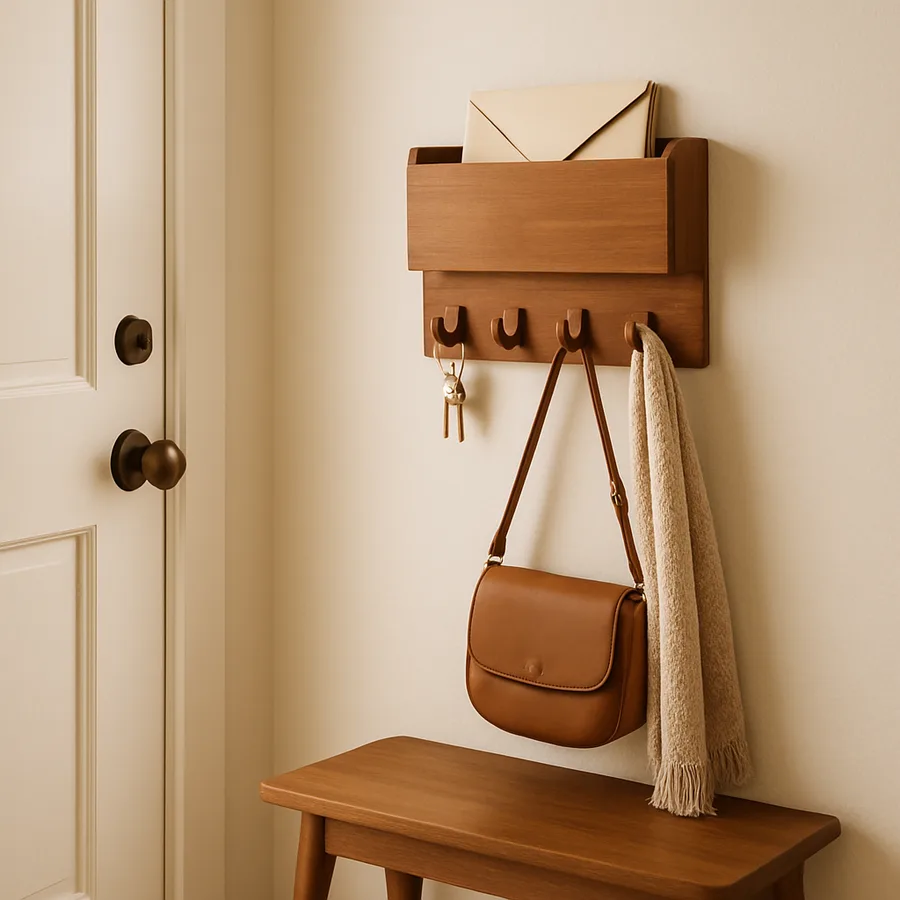
The first ten seconds inside your home should not involve a frantic search for car keys, a stack of envelopes balanced on the radiator, or a tangle of dog leashes draped over a doorknob. A purpose-built key and mail drop station turns the doorway into a quiet command center, and when paired with a row of wall hooks, it absorbs almost every small object that walks through with you. The trick lies in choosing the right wall, the right heights, and the right materials so the station works for adults, children, and guests without becoming visual clutter. This guide breaks down a real, buildable plan you can finish in a weekend.
Why a Dedicated Drop Zone Beats a Console Table
A traditional console table looks elegant in design magazines, but in a working household it accumulates flat-surface chaos within a week. A wall-mounted drop station forces vertical organization, which is the only kind that survives daily use. According to a 2024 National Association of Productivity and Organizing Professionals member survey, households that use vertical entry storage report spending an average of 4.6 fewer minutes per day searching for daily essentials. Multiply that by a year and the wall station has paid for itself in time alone.
There is also a behavioral component. When keys, sunglasses, and the dog leash each have a single named home, returning them becomes automatic rather than aspirational. The American Society of Interior Designers has long argued that spatial cues drive habit formation, and a wall-hook line provides exactly that cue: an empty hook is a visible prompt.
Console tables also waste square footage in narrow entries. A typical console occupies 14 to 18 inches of depth, which most apartment foyers and split-level entries simply cannot spare. A floating shelf paired with hooks reduces that depth to 5 to 8 inches and keeps the floor open for shoes, a runner, or a single accent chair.
The most beautifully built drop station fails if the household does not adopt it. The biggest behavioral mistake is treating the station as a passive surface rather than as part of an active routine. Build a thirty-second arrival ritual into your day: keys on the tray, mail in the slot, jacket on the hook, bag on the lower hook, and walk in. Do this for two weeks and it becomes muscle memory; skip it during the adoption period and the old chaos returns within days. Watch how the household actually moves through the entry for a week before assuming any problem is discipline rather than geometry.
Choosing the Right Wall
Not every wall near a door is a drop-station wall. The ideal candidate has three qualities. First, it sits within three steps of the door swing so you can deposit items before fully entering the home. Second, it offers at least 30 inches of horizontal clearance with no light switches, thermostats, or alarm panels that would compete for the same vertical band. Third, it has solid framing behind the drywall, because a row of hooks loaded with coats and bags applies meaningful pull-out force.
If your only candidate wall is shared with the door swing itself, mount the station on the hinge side rather than the latch side. The hinge side is partially shielded when the door opens, while the latch side becomes a collision zone for backpacks and elbows. In rentals where you cannot drill into shared walls, a floor-anchored leaner with hooks becomes a workable substitute, although it sacrifices the floating-shelf cleanliness.
Consider sightlines too. If you can see the drop station from the living room or kitchen, choose finishes that match those rooms rather than the door itself. The station will be in your peripheral vision far more often than the door is, and it should read as part of the home, not as a utility object.
Wall texture and existing trim also play in. A heavily textured wall (popcorn, knockdown, or skim-coat plaster with character) is harder to mount cleanly against than a smooth drywall surface. A floating shelf with a flat backplate exaggerates wall imperfections rather than hiding them. If your candidate wall is textured, plan to use a wood backplate sized 2 to 3 inches taller and wider than your hook spread, which lets the plate read intentionally rather than apologizing for the wall behind it. The plate also gives you something solid to drive screws into without hunting for studs.
Mounting Heights That Actually Work
Mounting height is where most DIY drop stations fail. Hooks placed too high force shorter members of the household to jump or stretch, and hooks placed too low let coat hems sweep the floor. The functional sweet spot for a primary coat hook row is 62 to 66 inches from the finished floor to the center of the hook. This range accommodates the average adult shoulder while keeping a winter parka clear of the baseboard.
Add a secondary kid-height hook row at 40 to 46 inches if children under twelve use the entry daily. Keeping the children's row visually distinct, perhaps with a different hook style or a contrasting wood plate, signals ownership without labels. The mail shelf should sit at 52 to 56 inches, low enough to drop letters with one hand and high enough that the surface stays out of casual sightlines.
For the key tray, the most ergonomic placement is on the same shelf as the mail, offset to one side. This consolidates all small daily objects into a single glance. If you prefer a separate key hook, mount it at 58 to 60 inches, slightly below the coat row so keys are not hidden behind a hanging jacket. Always verify final heights against the tallest and shortest household member before drilling. A piece of painter's tape mocked up on the wall for forty-eight hours catches problems no tape measure will.
Hook Spacing, Count, and Style
Spacing is the second most common failure point. Hooks crammed too close cause coats to overlap and pull on each other, while hooks spaced too far waste wall real estate. The reliable rule is 5 to 6 inches on center for hooks intended to hold thin items like hats, leashes, or tote handles, and 8 to 10 inches on center for hooks loaded with coats, backpacks, or bulky bags. A mixed-load wall, which is what most households actually have, splits the difference at 7 inches on center.
Count matters too. A useful rule of thumb is two hooks per household member plus one floating hook for guests. A family of four lands at nine hooks, which fits comfortably across a 60- to 72-inch wall plate. Going higher than ten hooks on a single rail begins to look like a gym locker room, and visual fatigue sets in quickly.
For style, match the hook material to one other metal already present in the entry, whether that is the doorknob, the threshold strip, or a nearby light fixture. Mixing brass with brushed nickel can work in a deliberately eclectic interior, but in a small entry the contrast tends to feel unresolved. Solid brass and matte black powder-coated steel are the two finishes that age most gracefully, and both forgive the inevitable scratches from zippers and key rings.
For larger households, consider color-coded hook caps or small wood disks that signal ownership without printed labels. A five-year-old and a thirteen-year-old will both internalize a colored hook in days, and adults can use simple positioning (always the leftmost two for parents, the next two for the eldest, and so on). The principle is the same as restaurant table seating: consistent assignment removes friction. Hook strength matters too; specify hooks rated to at least 20 pounds static load for general use and 35 pounds for hooks expected to carry winter coats or messenger bags.
Mail Sorting Without the Pile
A flat shelf collects mail; a sorted shelf processes it. Add a small three-slot vertical file or a pair of leaning bookends at one end of the shelf to create lanes for incoming, outgoing, and action-required envelopes. Some readers ask whether digital-only households still need a mail station, and the honest answer is yes. Even paperless homes still receive packages, jury summons, holiday cards, and the occasional misrouted bill. A small zone for these reduces kitchen-counter creep enormously.
Consider integrating a shallow drawer beneath the shelf if you want to hide items that should not greet guests, such as parking permits, returns waiting for a label, or a household checkbook. A drawer depth of 2 to 3 inches is enough for most paper goods and keeps the elevation thin. Brands like Architectural Digest's frequently featured organization specialists recommend processing the shelf weekly to prevent backlog, and a Sunday-evening five-minute sweep is realistic for most schedules.
Have you ever set down a package only to forget it for three days? A small chalk-painted strip or felt label area along the shelf edge solves this. Write the recipient's name and the day it arrived. The visual reminder, sitting where you naturally look, is dramatically more effective than a phone notification you swipe away.
Materials, Lighting, and Finishing Touches
The drop station is touched dozens of times each day by hands that may be wet, dirty, or carrying groceries. Choose materials that forgive that reality. White oak, walnut, and maple finished with a hardwax oil resist water rings and accept spot repair without refinishing the whole piece. Painted MDF looks crisp on day one but chips at the corners within a year of family use. If budget is the deciding factor, stained pine with a satin polyurethane is a respectable middle ground.
Lighting transforms the station from utility to architecture. A small wall sconce or a recessed puck light positioned above the shelf casts a warm pool that flatters the materials and makes finding keys at night effortless. Aim for a 2,700 to 3,000 Kelvin color temperature; cooler light reads as institutional in a residential entry. The Illuminating Engineering Society recommends task-level illuminance of roughly 150 to 200 lux at the shelf surface, which a single 4- to 6-watt LED achieves comfortably.
Finishing touches that pay disproportionate dividends include a small leather or stone catchall tray for loose change, a 2-inch wide felt strip behind the hook plate to soften coat impact on the wall, and a single framed piece of art mounted just above the hook line to anchor the composition. Skip the inspirational quote sign. The station is already saying everything it needs to say.
Conclusion
A great key and mail drop station with wall hooks is not a piece of furniture; it is a small architectural intervention that reorganizes how your household uses the first three feet of indoor space. By selecting the right wall, locking in the correct mounting heights, and spacing hooks to match real loads, you turn a chaotic transition zone into the calmest part of the day. Materials and lighting then do the second job of making the station feel like part of the home rather than a hardware-store afterthought.
The investment in time is modest. A confident DIYer can complete the full installation in a single Saturday, and a hired carpenter typically charges between two and four hours of labor for the job. The ongoing maintenance is even smaller, just the weekly Sunday sweep and an occasional wipe with a slightly damp cloth. Compared with the daily friction of a disorganized entry, this is one of the highest-return improvements a home can receive.
If you are weighing this project against a larger renovation, do the drop station first. The lessons learned about height, traffic flow, and material durability will inform every other built-in you ever commission, from a mudroom bench to a kitchen pantry wall. Begin by taping the layout on your wall this evening, lived with it for two days, and adjusted before drilling. That single step is the difference between a station that lasts a decade and one that gets repainted in six months.
Ready to start? Measure your candidate wall tonight, photograph it, and sketch the hook spacing on tracing paper laid over the photo. Take that sketch to your hardware store this weekend, choose your hooks and shelf in person where you can feel the weight, and commit to the install before the next round of holiday coats arrives. Your mornings will feel different by the end of the month.
More Articles You May Like



Comments
Post a Comment