Tri-View Medicine Cabinets for Three-Mirror Bathroom Vanity Wall
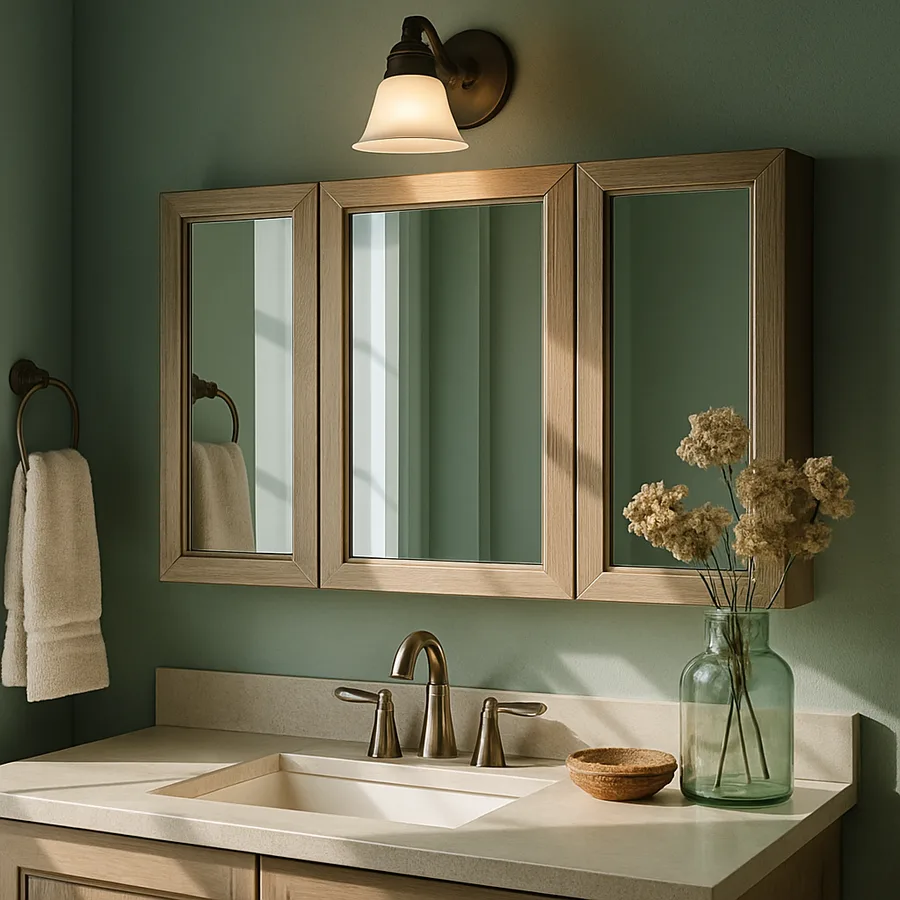
The three-mirror vanity wall is one of the most photographed silhouettes in residential bathroom design, owing its current popularity to a generation of hospitality interiors that paired clean millwork below with a triptych of mirrored cabinet doors above. When that triptych is engineered as a single tri-view medicine cabinet, the wall becomes both a storage powerhouse and an architectural moment. Done well, it functions like a carefully composed photograph. Done poorly, it reads as three mismatched cabinets bolted next to each other in service of an idea that was never resolved.
The difference between the two outcomes is mostly invisible during the showroom selection phase, which is why so many homeowners arrive at this layout with a vanity dimension and a vague aspiration rather than a coordinated specification. This guide walks through the framing, lighting, sightline, and proportion decisions that turn three doors into a single composition, and it covers the practical questions about hinge geometry and door reveal that typically only get asked once the cabinet is hung and the regret has set in.
What a Tri-View Cabinet Actually Is
A tri-view medicine cabinet is a single recessed or surface-mount cabinet box engineered with three doors instead of one or two. The three doors are usually identical in width and height and are arranged across a continuous mirror plane, each opening to a separate vertical compartment within the cabinet body. From the room, the wall reads as three matched mirrors. From inside the cabinet, you have three storage bays, typically with adjustable shelving in each bay.
The defining feature is the door alignment. In a well-designed tri-view, the three doors share a single hinge axis at the top or side, the door reveals are perfectly even, and the gaps between doors are calculated to be uniform and small, usually one-eighth to three-sixteenths of an inch. This visual discipline is what separates a tri-view from three side-by-side single-door cabinets. The physical hardware is similar but the manufacturing tolerance is tighter, which is why a quality tri-view costs noticeably more per linear foot than three single-door cabinets of the same total width.
Tri-view cabinets are most often specified for primary bathrooms with a wide single vanity or a double vanity with a single trough sink. The sweet spot is a vanity in the 60 to 84-inch range, where the geometry yields three doors of 18 to 24 inches each. Below 54 inches the doors become narrow enough to feel cramped, and above 90 inches the proportions start to favor a four-door layout instead. According to National Kitchen and Bath Association design surveys, double-vanity bathrooms have grown to roughly 41 percent of new primary baths, and the tri-view form factor has tracked that growth almost in lockstep.
Framing for the Recessed Tri-View
Recessed tri-view cabinets present a framing challenge that single-door recessed cabinets do not. A 60-inch tri-view cabinet wants a continuous wall opening of roughly 58 inches wide, which crosses three to four standard 16-inch on-center stud bays. Framing that opening requires removing the intermediate studs and supporting the wall with a continuous header above the opening, plus king studs at each end, plus appropriate sill blocking below. This is identical to the framing logic for a window, just inverted in usage.
The header sizing depends on whether the wall is load-bearing. Most interior bathroom walls in single-story construction are non-bearing, which means a doubled two-by-four header is sufficient for openings up to 60 inches. Walls that carry roof or upper-floor load require an engineered header sized by a structural engineer based on the span and the load above. Have you confirmed whether your bathroom wall is bearing? If the bathroom sits below a roof framed with conventional rafters and the wall runs perpendicular to the rafters, the wall is likely non-bearing. If the wall runs parallel to the rafters and supports a ridge beam or a ceiling beam, it likely is. IAPMO's residential construction resources include framing reference details that help non-engineers decode the framing logic of their own homes.
The other framing concern is what lives inside the wall. A tri-view opening is wide enough that it almost always crosses some piece of plumbing or electrical that was happy to live in a single stud bay but cannot survive being directly behind the cabinet box. Rerouting a vent stack or a supply line is a real expense, and the discovery typically happens after the drywall is opened. Build that risk into the project budget at roughly 8 to 12 percent contingency, because the assumption that the wall is empty fails about a third of the time in real renovations.
Door Geometry and Hinge Hardware
The doors on a tri-view cabinet must clear each other when opened simultaneously, which is a hardware question more than a design question. Most tri-views use European concealed hinges with a 110 to 120-degree opening angle, allowing each door to swing fully without interfering with its neighbor when one is open and the others are closed. The interesting case is what happens when two adjacent doors open at the same time, which is the configuration most users actually adopt when reaching for items in adjacent bays.
If the hinge axis allows two adjacent doors to open simultaneously to 90 degrees without contact, the cabinet is fully usable. If the doors collide before reaching 90 degrees, daily use becomes a one-door-at-a-time exercise that quickly registers as cheap. Premium tri-views solve this by specifying soft-close hinges with a slightly recessed hinge cup, which gains the few millimeters of door-edge clearance needed for simultaneous operation. Mid-tier products often skip this detail and ship with hinges that visibly bind when both doors are open.
The other hardware variable is which way the doors swing. The most flexible configuration is left-left-right or right-right-left, where the center door swings the same direction as the door it is most commonly accessed alongside. Symmetric tri-views, where the left door swings left, the right door swings right, and the center door swings either direction, are visually balanced but produce a daily friction in shared-vanity scenarios where both users reach for the center bay. The best designers ask about household behavior before specifying hinge direction, because no manufacturer publishes a rule for this.
Lighting the Triptych
The three-mirror wall presents a lighting question that does not arise with a single mirror: where do the sconces go? Two flanking sconces, one at each end of the triptych, light the outer mirrors well but cast oblique shadow across the center mirror. Three sconces, one between each pair of mirrors, light the center mirror evenly but require electrical home runs to two interior locations within the cabinet body. Top-mounted vanity bars or LED strips integrated above the cabinet face provide even wash but eliminate the cross-light that flatters facial features for tasks like shaving or applying makeup.
The rule of thumb derived from the cosmetics industry is that good vanity lighting wants at least one fixture at face height to either side of the user's reflection, with a color temperature between 2700K and 3500K and a color rendering index above 90. ENERGY STAR's lighting guidance details the CRI and color temperature thresholds that distinguish task-quality light from accent-quality light. With a tri-view, achieving cross-light at every mirror typically requires either four fixtures across the wall or a top-mounted bar paired with two flanking sconces.
The integrated solution that has gained ground in the past five years is a tri-view cabinet with vertical LED strips embedded along each side of each door, producing built-in cross-light at every mirror without any external fixture. The visual effect is striking, the light is even, and the entire wall reads as a composed unit. The trade-off is electrical complexity, because the cabinet now contains three to six individual lighting zones that must be wired to a single circuit and ideally a dimmer compatible with the LED driver specified by the manufacturer.
Storage Strategy Across Three Bays
Three bays is a luxury that invites disorganization. Without a deliberate storage strategy, each bay becomes a generic dumping ground and the practical advantage of the tri-view layout collapses into the same chaos as a single oversized cabinet. The strategy that works best in shared bathrooms is zoning by user. The left bay belongs to one occupant, the right bay to the other, and the center bay holds shared items like a thermometer, prescription medications, or first-aid supplies.
The strategy that works best in single-user bathrooms is zoning by frequency. The center bay holds daily items at face height, the left and right bays hold weekly and monthly items respectively, and the top shelves of all three bays hold rarely-used backups. This logic treats the cabinet like a kitchen pantry rather than a junk drawer and dramatically improves the experience of finding what you need with wet hands.
Whatever zoning rule you adopt, write it down somewhere visible during the first month of use and resist the temptation to shove items into the nearest open bay. The discipline of the storage strategy is what makes the tri-view feel like an upgrade over a single oversized cabinet rather than just a wider one. Are you willing to maintain that discipline? If the answer is honestly no, a single-door cabinet with internal organizers may serve you better than a tri-view.
Proportion and Visual Coordination
The single most overlooked variable in tri-view specification is how the cabinet proportions relate to everything else on the wall. The cabinet width should align with either the vanity width, the visual centerline of the room, or a deliberate proportion of the wall, but it should not float as a random measurement chosen because the catalog offered it. The most polished installations use a cabinet that matches the vanity width within an inch or two, producing a vertical column of cabinetry from floor to top of cabinet that the eye reads as architecturally coherent.
Door height is the other proportion lever. A short tri-view, perhaps 28 inches tall, reads as horizontal and emphasizes the width of the wall. A tall tri-view, 36 to 40 inches tall, reads as architectural and emphasizes the verticality of the bathroom. The right answer depends on ceiling height. In a bathroom with eight-foot ceilings, the shorter cabinet usually feels right because it leaves visual breathing room above. In a bathroom with nine or ten-foot ceilings, the taller cabinet earns its scale.
The trim and finish of the cabinet matter as much as the dimensions. A tri-view with a brushed brass trim and matching brass hardware on the vanity below reads as a coordinated millwork program. A tri-view with a polished chrome trim against bronze vanity hardware reads as two competing finishes that did not negotiate. Designers working in this scale routinely specify the cabinet, vanity, sconces, and faucet from a coordinated finish family rather than mixing brands, because the cost of consistency is small and the visual benefit is enormous.
Conclusion
The tri-view medicine cabinet rewards careful specification more generously than almost any other bathroom storage decision. When the framing is right, the doors clear each other, the lighting cross-illuminates each mirror, and the proportions match the vanity below, the wall becomes a permanent visual asset that elevates the entire bathroom. When any of those factors is wrong, the cabinet reads as a missed opportunity, and the cost of the missed opportunity is paid in daily use for the life of the installation.
The decisions that matter most are the framing scope, the door swing direction, the lighting strategy, and the proportional relationship to the vanity. Each of those decisions is best made in conversation with a designer or contractor who has installed at least a few tri-views before, because the failure modes are not obvious from a catalog photograph. Almost every disappointed homeowner I have seen with a tri-view installation made a sensible-seeming choice in isolation that compounded badly with another sensible-seeming choice elsewhere. The tri-view rewards systems thinking and punishes piecemeal selection.
If you are planning a primary bathroom remodel and the wall is wide enough to accommodate it, the tri-view is worth the additional specification effort. Walk through the four decisions above with your designer or contractor, build a small contingency for in-wall surprises, and confirm hinge clearance with a physical mockup if you can. The bathroom that emerges will photograph beautifully, function thoughtfully, and continue to feel like a luxury upgrade for the next decade. That is the durable kind of value renovations rarely deliver, and the tri-view, specified well, is one of the surer paths to it.
More Articles You May Like



Comments
Post a Comment