Modern Farmhouse vs Actual Farmhouse: Spotting the Difference
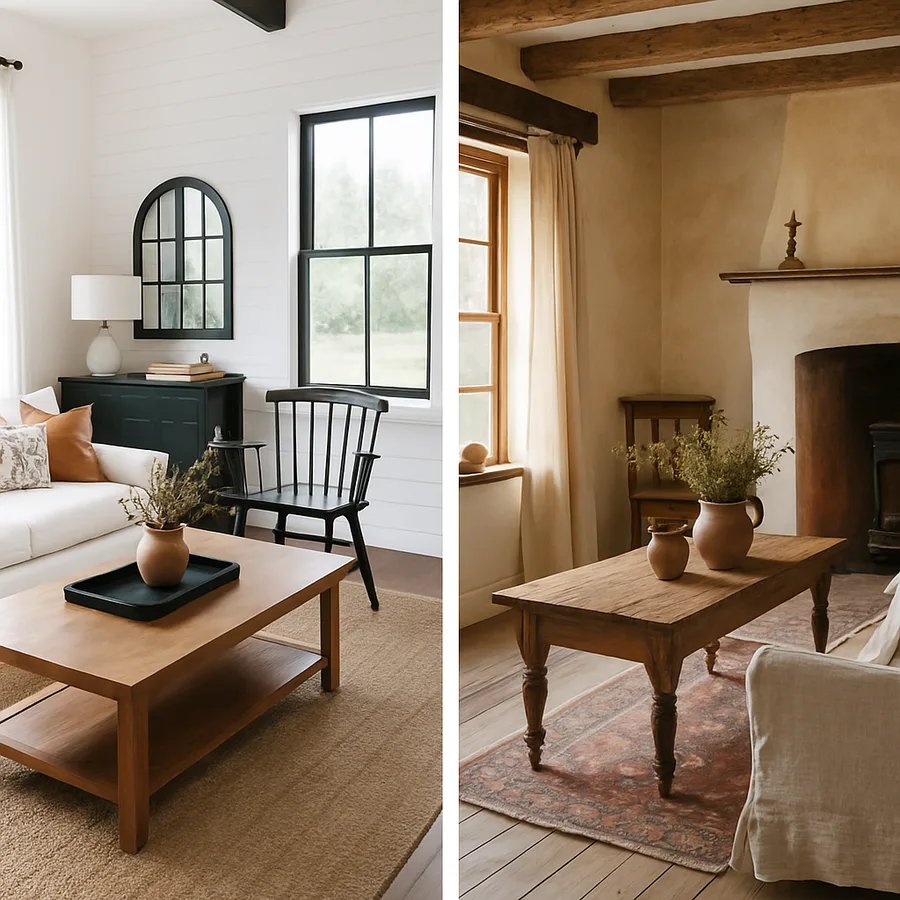
The Problem: Two Styles, One Confusing Name
Walk into any home furnishings store and you will encounter products labeled "farmhouse style" that bear little resemblance to the actual homes where generations of farming families lived and worked. The modern farmhouse aesthetic, popularized through television renovation shows and social media, has created a visual language that borrows selectively from agricultural architecture while leaving behind the practical, often rough-hewn reality of genuine rural homes. This confusion has real consequences for homeowners who may invest heavily in a look they believe is authentic, only to discover they have purchased a curated fantasy.
The distinction matters because understanding the roots of a style helps you make more intentional design decisions. When you know why a true farmhouse has wide-plank pine floors, you can decide whether that choice serves your home or whether the engineered hardwood alternative makes more practical sense. When you understand that shiplap was originally an inexpensive wall covering for utilitarian spaces, you can use it with purpose rather than applying it as a decorative afterthought across every vertical surface. The National Trust for Historic Preservation has emphasized the importance of understanding architectural vernacular, noting that preservation-conscious homeowners report greater long-term satisfaction with their design choices.
According to the Houzz Kitchen Trends Study, farmhouse-style kitchens have consistently ranked among the top three most-requested styles for renovations, with approximately 30 percent of surveyed homeowners expressing interest in farmhouse elements. However, the study also found that most respondents could not clearly articulate the differences between modern farmhouse and traditional rural design, suggesting that the terms have become interchangeable in popular usage despite representing very different approaches.
This article breaks down the concrete differences between the two styles across six key categories so you can identify which elements genuinely appeal to you and assemble a home that reflects informed taste rather than trend-following. Whether you end up choosing a modern farmhouse approach, an authentic rural aesthetic, or a thoughtful blend of both, the goal is a space that feels honest and personally meaningful.
Materials and Construction: Engineered vs Inherited
The most fundamental difference between modern farmhouse and actual farmhouse interiors lies in material authenticity. A genuine farmhouse was built with whatever materials were locally available and affordable: rough-sawn lumber from nearby sawmills, locally quarried stone for foundations and fireplaces, hand-forged iron hardware from the town blacksmith, and plaster walls mixed from lime and sand. These materials carry an inherent irregularity that comes from handwork and regional variation, and that irregularity is precisely what gives true farmhouse interiors their warmth and character.
Modern farmhouse design, by contrast, relies heavily on manufactured materials that simulate the appearance of age and handcraft without the actual provenance. Shiplap is perhaps the best example: in genuine agricultural buildings, shiplap was a utilitarian cladding chosen for its overlapping joint that resisted water infiltration, and it was typically left unpainted in barns and outbuildings. The modern farmhouse version is a decorative wall treatment, often made from thin MDF or pine boards, painted bright white, and applied to interior walls purely for visual effect. The difference is one of substance versus surface.
Flooring tells a similar story. Authentic farmhouse floors were typically wide-plank softwood, usually pine or fir, that developed a rich patina over decades of foot traffic, dropped cookware, and seasonal expansion and contraction. The boards were often irregular in width, and the nails that held them down created visible patterns across the surface. Modern farmhouse floors tend to be engineered hardwood or luxury vinyl plank in uniform widths with factory-applied distressing meant to suggest age. The National Wood Flooring Association has observed that reclaimed wood flooring sales have grown steadily as consumers seek authentic materials, yet reclaimed wood still represents a small fraction of the overall market compared to factory-made alternatives.
Does the distinction between genuine and simulated materials matter if the visual result is similar? That question is worth sitting with. Many homeowners find that rooms furnished with authentic materials develop a sense of presence and depth that manufactured alternatives cannot quite replicate. Others prioritize the consistency, affordability, and ease of maintenance that modern materials provide. Neither position is wrong, but making the choice consciously rather than by default produces a more satisfying outcome.
Color and Finish: Crisp White vs Weathered Patina
If you have seen a modern farmhouse interior on social media, you have almost certainly noticed the dominance of white. White shiplap walls, white kitchen cabinets, white subway tile backsplashes, white slipcovered sofas, and white beadboard ceilings are the backbone of the modern farmhouse palette. This all-white approach creates a bright, clean, photogenic look that performs exceptionally well in digital images, which is a significant part of its widespread adoption. The result is spaces that feel fresh and contemporary despite incorporating historically inspired architectural details.
Actual farmhouse interiors tell a very different chromatic story. Walls were often painted in muted, earthy tones determined by the pigments available to rural households: ochre yellows, barn reds, deep greens, slate blues, and cream (but rarely a stark, bright white, which would have been impractical to maintain). Wood surfaces were frequently left unfinished or coated with linseed oil, beeswax, or milk paint that aged to a soft, chalky finish. The overall effect was substantially warmer and more varied than the monochromatic modern interpretation. Architectural Digest has documented numerous historic farmhouse restorations where designers deliberately preserved or recreated these original color schemes rather than defaulting to the all-white treatment.
Hardware and metal finishes also diverge significantly. Modern farmhouse interiors favor matte black hardware, which has become so ubiquitous that it now reads as a signature of the style. Cabinet pulls, light fixtures, faucets, and curtain rods in flat black finishes create graphic contrast against white surfaces. In genuine farmhouses, hardware was typically wrought iron or cast iron that developed a dark, uneven patina over time, or simple brass and copper pieces that mellowed to a warm brown. The modern matte-black finish is factory-applied and uniform, lacking the depth and variation of naturally aged metal.
The finish on furniture follows the same pattern of divergence. Modern farmhouse pieces often feature factory distressing: perfectly imperfect paint chips, uniform sanding at edges, and applied glaze designed to suggest decades of use. Genuine farmhouse furniture shows wear patterns that correspond to actual use. Drawer pulls are worn smooth where hands gripped them daily, chair legs are scuffed where feet rested, and table surfaces carry the specific marks of the activities that took place on them. The difference is subtle but cumulative, and rooms filled with genuinely aged furniture possess a narrative quality that manufactured distressing cannot achieve.
Floor Plans and Spatial Logic
The spatial organization of a genuine farmhouse is driven entirely by practical necessity, and it looks nothing like the open-concept layouts that define modern farmhouse design. Traditional farmhouses were built with clearly defined, often small rooms, each serving a specific function. The kitchen was a workroom centered on a large cooking hearth or wood-burning stove, separated from the parlor where guests were received. A mudroom or back entry provided a transition zone between the outdoors and the interior, serving as a place to remove dirty boots and hang work coats. Bedrooms were compact, often tucked under sloped eaves on the second floor, with minimal closet space because freestanding wardrobes were the norm.
Modern farmhouse homes, conversely, almost universally feature open-concept living that merges the kitchen, dining area, and living room into a single expansive space. This layout reflects contemporary preferences for visual connectivity and social cooking, but it has no historical precedent in actual agricultural homes. The National Association of Home Builders (NAHB) reported that 84 percent of new single-family homes built in recent years feature an open or partially open floor plan, a figure that encompasses modern farmhouse construction as well as other styles. The open concept is a modern convenience dressed in historical clothing.
Ceiling treatments highlight the contrast as well. Modern farmhouse interiors frequently feature exposed beams, but these are often decorative box beams, hollow structures wrapped in stained or whitewashed wood, that serve no structural purpose. In genuine farmhouses, exposed ceiling beams are load-bearing elements, usually hewn from single timbers with visible adze marks, and they carry the weight of the floor above. The scale, spacing, and surface texture of structural beams are distinctly different from their decorative counterparts, and the discerning eye can spot the difference immediately.
Understanding these spatial differences helps you make smarter decisions about which farmhouse elements to incorporate into your home. If you love the idea of a mudroom, consider that the original version was a purely functional space with hooks, a bench, and durable flooring, not a styled entryway with matching storage cubbies and a decorative chalkboard. If exposed beams appeal to you, research whether genuine reclaimed beams or structural timber framing might be feasible for your project rather than defaulting to the hollow decorative versions.
Furniture and Decor: Curated vs Accumulated
The furniture in a modern farmhouse interior is typically purchased as a coordinated collection, often from a single retailer or product line. Matching sets of dining chairs, coordinated bedroom suites, and living room groupings selected for visual harmony are common. The pieces reference historical forms, such as spindle-back chairs, trestle tables, and ladder-back stools, but they are manufactured with contemporary precision and sold at scale. This approach produces rooms that are visually cohesive and immediately complete.
Actual farmhouse interiors, by contrast, were furnished through decades of accumulation. A dining table might have been built by a family member in the nineteenth century, surrounded by chairs acquired one or two at a time from different sources and eras. Dressers, sideboards, and storage cabinets were often hand-built to fit specific alcoves or purposes, and they bore the marks of their makers in their joinery, proportions, and finish. The resulting interiors were eclectic by necessity, and their visual interest came from the variety and history of individual pieces rather than from deliberate coordination.
Decorative objects follow the same pattern. Modern farmhouse decor leans heavily on a recognizable vocabulary of styled vignettes: galvanized metal containers, cotton stems in glass jars, wooden bead garlands, enamelware pitchers, and signage with inspirational phrases. These objects are produced specifically for the decor market and carry no functional purpose. In a genuine farmhouse, decorative moments emerged organically from functional objects: a collection of crockery on open shelves, a quilt rack holding hand-stitched blankets, cast-iron cookware hanging from a pot rack, or a row of preserving jars lined up in the pantry.
The Better Homes and Gardens design team has noted the growing consumer interest in what they term "meaningful objects," items chosen for personal significance rather than trend alignment. This shift suggests that the market is gradually moving toward the authentic farmhouse approach to furnishing, where each piece carries a story, even if the broader modern farmhouse trend continues to dominate retail shelves. Have you considered what objects in your home carry genuine personal meaning versus those you purchased purely for their aesthetic contribution?
Lifestyle and Philosophy Behind Each Style
At the deepest level, the difference between modern farmhouse and actual farmhouse design reflects two fundamentally different relationships with domestic life. Modern farmhouse is an aspirational aesthetic that borrows the visual language of rural simplicity while maintaining all the comforts and conveniences of contemporary living. It offers the romance of country life without the early mornings, the manual labor, or the genuine constraints of rural budgets. There is nothing inherently wrong with this aspiration, but recognizing it for what it is helps you engage with it more honestly.
Actual farmhouse living was governed by principles of utility, economy, and self-sufficiency. Every design choice served a practical purpose. Wide porches provided shade in summer and sheltered the entrance from rain. Root cellars kept produce cool before refrigeration. Summer kitchens separated cooking heat from living spaces during warm months. These features were not decorative choices but engineered solutions to daily problems, and they carry an integrity that is difficult to replicate when the underlying problems no longer exist.
The ASID has published research on the psychological benefits of living in spaces that feel authentic and intentional, noting that homeowners who understand the historical context of their design choices report higher satisfaction with their environments. This finding suggests that the most rewarding approach may be a hybrid one: selecting modern farmhouse elements that genuinely improve your daily life while incorporating authentic materials and objects that connect you to the history and craftsmanship behind the style.
The growing preservation and reclaimed materials movement offers a practical bridge between the two approaches. Salvage yards, architectural antique dealers, and reclaimed lumber suppliers can provide authentic farmhouse materials, from hand-forged door latches to century-old barn boards, that can be integrated into contemporary construction. Organizations like the Preservation Alliance and local historical societies often maintain directories of these suppliers. The result is a home that carries genuine history in its bones while accommodating the spatial and technological expectations of modern living.
Conclusion: Making an Informed Choice
The distinction between modern farmhouse and actual farmhouse interiors is not a matter of one being better than the other. It is a matter of understanding what you are choosing and why. Modern farmhouse offers consistency, accessibility, and a photogenic aesthetic that works well in contemporary open-plan homes. Authentic farmhouse design offers depth, narrative, and a connection to material history that accumulates over time. Many of the most compelling homes blend elements of both, using modern layouts and systems while incorporating genuine antiques, reclaimed materials, and traditional craftsmanship.
The next time you see a product or a room labeled "farmhouse," pause and ask yourself which tradition it actually represents. Is it drawing from the genuine material culture of rural American homes, or is it offering a contemporary reinterpretation that prioritizes visual impact over historical accuracy? Neither answer disqualifies the piece, but the question itself will sharpen your eye and strengthen your design instincts over time.
Start by visiting a local architectural salvage yard or antique shop and handling genuine farmhouse-era materials and furniture. Feel the weight of a hand-forged iron latch, run your hand across a century-old tabletop, and compare those sensory experiences with their modern reproductions. That direct comparison will tell you more about your personal preferences than any article or photograph ever could, and it will set you on a path toward a home that feels truly and specifically yours.
For guided support in blending historic and modern elements, reach out to a design professional certified by ASID who specializes in historic or transitional interiors to help you develop a plan that honors both comfort and authenticity.
More Articles You May Like



Comments
Post a Comment