Metal and Glass Open Shelving for Modern Industrial Kitchens
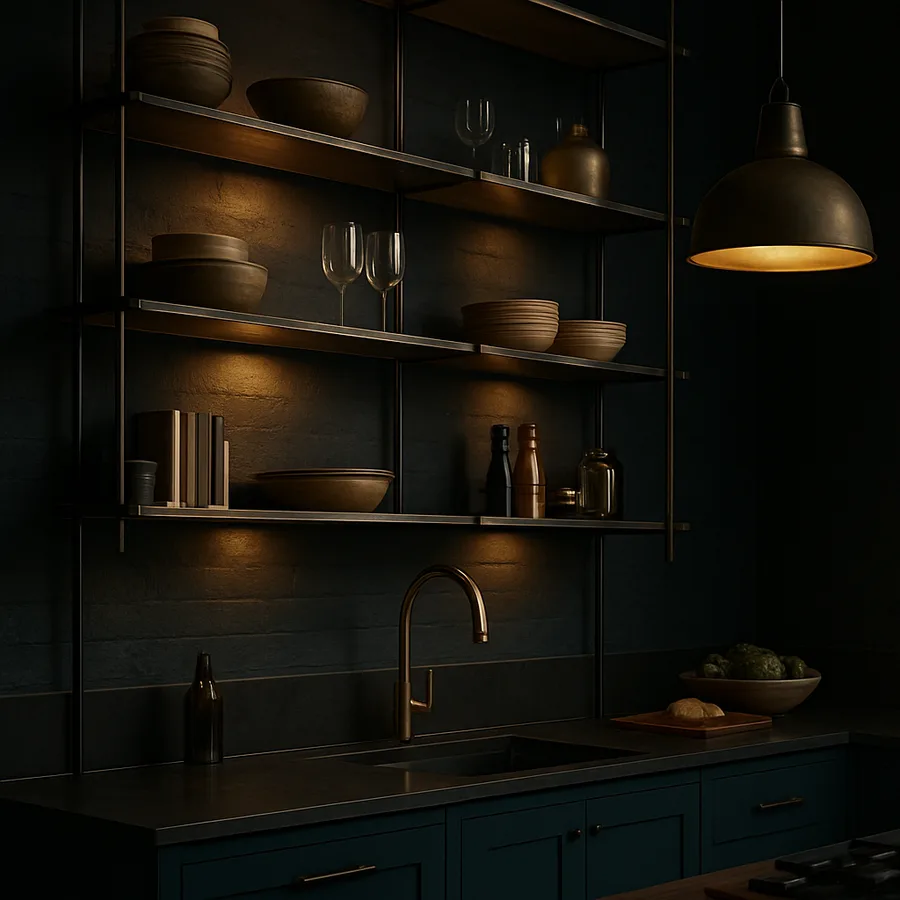
Wood shelves get most of the attention in kitchen design coverage, but the modern industrial kitchen has its own native language: blackened steel, raw brass, brushed stainless, and tempered glass. These materials read differently from wood, behave differently under load, and reward a completely different set of design and styling choices. They are also having a serious moment, with the National Kitchen and Bath Association (NKBA) reporting that metal-framed open shelving installations grew 34 percent year-over-year in their 2026 trends report.
This guide covers the material science, the install considerations, the styling logic, and the maintenance reality of metal and glass open shelving. If you are drawn to the warehouse-loft aesthetic - exposed structure, honest materials, deliberate roughness - these are the systems that will let you build it without compromising on function.
Why Metal and Glass Belong in the Industrial Kitchen
The industrial design vocabulary descends from late-19th and early-20th century factory and commercial kitchen architecture, where structural steel and tempered glass were the dominant materials precisely because they were durable, fire-resistant, and easy to clean. A modern residential kitchen that adopts this language is borrowing both the look and a meaningful chunk of the underlying performance.
Metal shelves have three structural advantages over wood. They are dimensionally stable, meaning they do not sag under sustained load the way even thick hardwood eventually will. They are thinner for the same load capacity, which produces a sharper visual line. And they are non-porous, which means they do not absorb cooking grease or kitchen humidity over years of use. Architectural Digest has documented this in its industrial kitchen retrospectives, noting that 12-year-old steel shelves in working kitchens routinely look identical to their install-day photos with only routine cleaning.
Glass shelves play a different role. They are visually almost weightless, which makes them ideal for small kitchens where any visible mass would feel oppressive. They reflect light rather than absorbing it, which amplifies whatever ambient lighting the kitchen already has. And they pair beautifully with under-shelf LED strips, creating a glow effect that is impossible to achieve with any solid material.
Steel Grades and Finishes That Hold Up
Not all metal shelving is created equal. The cheap end of the market - usually sold as "industrial style" decor - is typically thin gauge cold-rolled steel with a powder coat finish. It looks the part for the first year, but the finish chips at any point of contact, and the underlying steel begins to oxidize visibly within two to three years in a normal kitchen environment.
The honest, durable end of the market uses one of three approaches. Hot-rolled steel with a hand-applied wax or oil finish develops a genuine patina over time, deepens in color, and is repairable indefinitely with steel wool and re-waxing. Blackened steel uses a chemical conversion coating that is integral to the metal itself rather than a surface paint, so it cannot chip in the conventional sense. Marine-grade stainless steel in a brushed finish is the highest-performing option, especially within four feet of a cooktop where airborne salts and acids accelerate corrosion of lesser materials.
Brass and copper deserve their own paragraph. Both materials patina dramatically in a kitchen environment unless they are clear-coat lacquered, and even lacquered finishes typically fail within five to seven years. The honest move with brass and copper is to embrace the patina as a feature. The American Society of Interior Designers (ASID) trend reports have noted for several years that "living finishes" - brass and copper allowed to age naturally - are a defining feature of high-end industrial residential design. Have you decided whether you want a finish that stays static or one that actively changes over time?
Tempered Glass: Specifications That Actually Matter
Glass shelving in a kitchen must be tempered. This is non-negotiable, both for safety and in many jurisdictions for code compliance. Tempered glass is heat-treated to roughly four times the strength of standard annealed glass, and when it does fail, it crumbles into small blunt pieces rather than long sharp shards. The American National Standards Institute (ANSI) Z97.1 standard governs safety glazing requirements, and any reputable fabricator will provide certification documentation.
Thickness drives both the visual weight and the load capacity. The minimum useful thickness for a kitchen shelf application is 3/8 inch. At this thickness, a 30-inch shelf supported on both ends comfortably holds 40 to 50 pounds of dishes. For longer spans or heavier loads, step up to 1/2 inch or 5/8 inch. Glass thicker than 5/8 inch reads as visually heavy and somewhat defeats the purpose of using glass in the first place.
Edge treatment is a small detail with large visual consequences. Polished pencil edges are the cleanest, most contemporary look. Beveled edges read as more traditional, almost mid-century. Flat polished edges are the most industrial, especially when paired with exposed bracket hardware. Specify edge treatment explicitly when ordering - many fabricators default to a basic seamed edge that looks unfinished in a residential application.
Bracket Systems for Industrial Aesthetics
Where wood shelving conventionally hides its hardware, industrial shelving celebrates it. The bracket itself becomes part of the design language. There are four bracket families that dominate industrial kitchen installations.
The first is pipe and flange, the original Brooklyn-loft signature. Black iron pipe in 3/4 or 1 inch diameter, threaded into floor flanges that lag-bolt into wall studs. Pipe shelving has the highest load capacity of any consumer-grade industrial system, routinely supporting 80 to 100 pounds per linear foot when properly anchored. The visual is unmistakable, but it is also genuinely heavy and dominates any room it appears in.
The second is the welded steel L-bracket, typically 1/4 inch thick mild steel with a hot-rolled or blackened finish. These read more refined than pipe while still announcing their industrial intent. The third is the cable suspension system, where shelves hang from steel cables anchored to ceiling joists. Cable systems work beautifully for glass shelves and are common in cafe-influenced residential kitchens.
The fourth is the fully welded steel frame, essentially a custom steel skeleton that holds multiple shelves in a single fabricated unit. These are usually shop-built to spec, more expensive, and produce the most cohesive single statement piece. The National Association of Home Builders (NAHB) Remodelers Council has noted that custom steel fabrication for residential kitchens has grown into a dedicated subspecialty, with regional fabricators now serving most major metro areas. Have you considered which bracket family matches your overall kitchen vocabulary, or are you risking a mismatch by selecting hardware in isolation?
Lighting Integration That Transforms the Look
Metal and glass shelves come alive under intentional lighting in a way wood shelves rarely do. The reflective surfaces catch and bounce light, creating depth and drama that flat materials cannot match. Conversely, metal and glass shelves under flat overhead lighting can look sterile and cold, which is the most common failure mode in amateur installations.
The single most effective lighting move is under-shelf LED strip lighting. A continuous strip of warm-white LEDs (2700K to 3000K, never cooler) mounted to the underside of each shelf creates a soft glow that washes down across the contents and the countertop below. The American Lighting Association recommends roughly 200 to 300 lumens per linear foot of shelf for general task lighting, scaled higher if the shelf is the primary light source for the workspace.
For glass shelves specifically, edge-lit LED puck lights mounted at the bracket connection points create the impression that the glass itself is glowing, which is a striking visual at night. For metal shelves, directional spot lights mounted in the ceiling and aimed at specific styled objects create a gallery effect that elevates ordinary dishes into displayed objects. Have you mocked up your lighting plan with even simple stick-on LED test strips before committing to permanent fixtures?
Maintenance, Patina, and the Long View
Metal and glass shelves are easier to maintain than wood in most respects, but they have their own quirks. Glass shows water spots, fingerprints, and dust simultaneously, which means it needs more frequent wiping than wood for the same visual cleanliness. Use a microfiber cloth dampened with a mix of distilled water and a small amount of vinegar, never paper towels which leave lint, and never glass cleaners with ammonia which can attack adjacent metal finishes over time.
Stainless steel and powder-coated steel wipe clean with the same microfiber and a drop of dish soap. The honest mistake to avoid is using abrasive sponges or steel wool on stainless, which scratches the brushed grain pattern visibly and permanently. Hot-rolled and blackened steel benefit from a light wipe with steel-conditioning oil every six to twelve months, which deepens the color and refreshes any scuffs that accumulate from daily contact.
Patina on brass, copper, and uncoated steel is the long-game decision. Some homeowners love the way these materials evolve, with the surface deepening, mottling, and developing character. Others find the changes unsettling. There is no right answer, but the choice is essentially permanent - once a brass surface has patinated for two or three years, restoring it to factory-bright condition is a multi-hour project of polishing and sealing that most homeowners will not undertake. Architectural Digest's industrial kitchen features almost universally celebrate patina as a feature, but that aesthetic preference is not universal.
Conclusion: An Honest Material Vocabulary for an Honest Style
The industrial aesthetic at its best is a celebration of structural honesty - materials doing visible, legible work. Metal and glass open shelving fits this vocabulary natively in a way that wood, with all its softer associations, sometimes cannot. When the bracket is supposed to look like a bracket, when the steel is supposed to age into something darker than it started, when the glass is supposed to glow rather than disappear, you have the makings of a kitchen that will read as intentional and timeless rather than as a passing trend.
Start with material decisions, not styling decisions. Pick your bracket family, your metal finish, and your glass thickness before you think about which dishes you will display. The hardware will outlast the dishes by decades, and the harmony between the structural materials and the surrounding kitchen architecture is what separates an industrial kitchen that ages beautifully from one that reads as a costume.
The NKBA, NAHB, and ASID all converge on the same fundamental advice for industrial residential work: source from real fabricators rather than decor retailers, specify materials with the same precision you would apply to structural members, and budget for proper lighting from the beginning rather than as an afterthought. For inspiration and to find regional fabricators, the searchable directories at NKBA Find a Pro, Houzz's industrial kitchen archive, and Architectural Digest's design directory are the most reliable starting points.
One last consideration that often goes unmentioned: industrial kitchens age in a particular way that is worth previewing before you commit. Wood-and-stone kitchens tend to soften over time as finishes mellow and the space accumulates the patina of use. Metal-and-glass kitchens hold their original sharpness much longer, which can be either a feature or a problem depending on your aesthetic preferences. If you want a kitchen that visibly records the years your family lives in it, the industrial vocabulary will require more deliberate styling layers - textiles, plants, art - to soften what the structural materials themselves resist softening. Have you thought about how you want your kitchen to age, not just how you want it to look on day one?
For the right household and the right architectural context, that aesthetic stability is exactly the appeal. The kitchens that drew you to industrial design in the first place were almost certainly photographed in their tenth or fifteenth year, with materials that look essentially identical to their install date. Borrowing that durability is part of what makes the style attractive. Just go in with clear eyes about which trade-offs you are accepting, and the result will reward you for decades.
Browse the Interior Bliss Industrial Kitchen Lookbook in our resource library for two dozen photographed installations covering pipe-and-flange, welded steel, cable-suspended, and full-frame fabricated systems, each with a detailed material specification and lighting plan you can use as a reference for your own project.
More Articles You May Like



Comments
Post a Comment