Hidden Pocket Doors That Disappear Into the Wall Completely
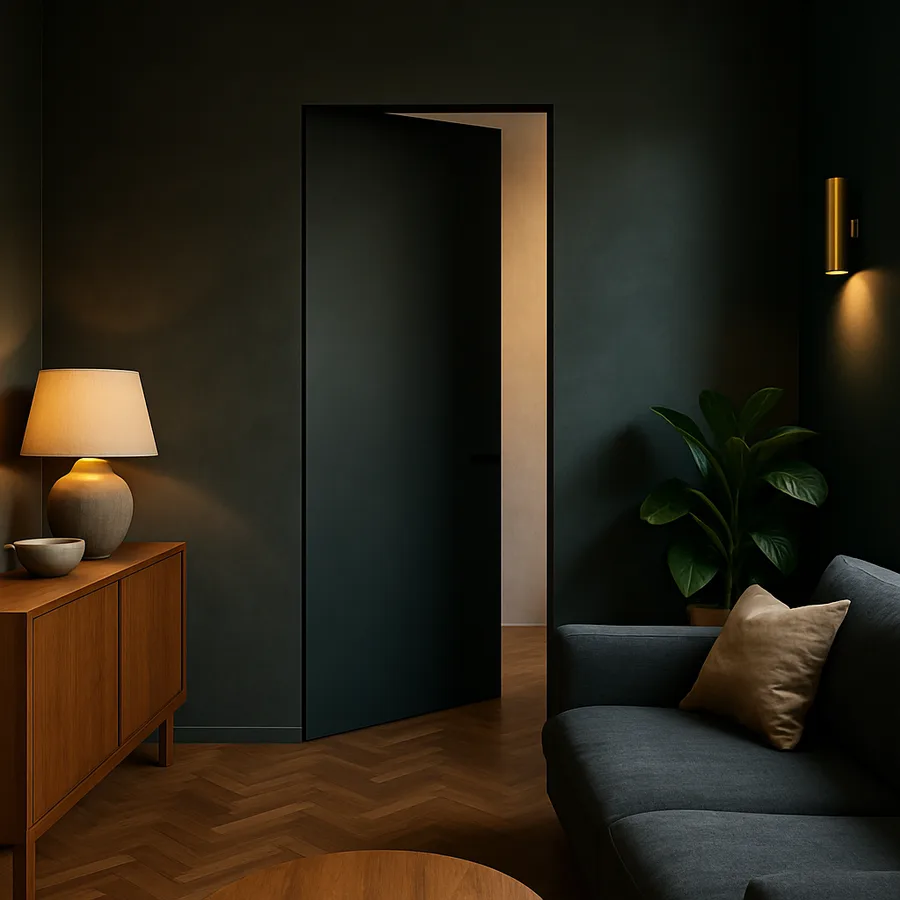
The dream of a door that is genuinely invisible until you need it has driven high-end residential design for at least a decade. A standard pocket door already disappears into the wall when open, but the head jamb, the casing, and the visible slab face when closed all keep it firmly in the category of "door that hides" rather than "door that vanishes." A truly hidden pocket door, sometimes called a flush pocket door or a jib pocket door, takes the concealment one step further: when closed, the slab face is flush with the surrounding drywall, painted the same color, with no visible casing or hardware. The wall reads as a continuous surface, and the door is invisible until someone touches it.
This article walks through the design and construction details that make a hidden pocket door actually work, drawing on the specifications used by high-end residential designers in projects that have to hold up to professional photography and decades of daily use. The level of detail required is much higher than a standard pocket door, but every element is achievable with off-the-shelf parts assembled with care. The reward is a feature that consistently provokes the strongest reactions of any element in the homes that include it.
What Hidden Means in Practice
"Hidden" can mean different things at different price points, and clarifying the spec at the start of a project saves enormous frustration later. Three levels of concealment are commonly specified, each progressively more difficult and expensive than the last.
Level 1: Casing-free pocket door. The head jamb and side jambs are still present, but flat with the drywall instead of standing proud as casing. The slab face is recessed slightly behind the wall plane, and a 1/4 inch reveal is visible around the slab perimeter. Cost premium over a standard pocket: about 30 percent. This is the most common interpretation of a "hidden" pocket door and is achievable with most premium frame kits.
Level 2: Flush pocket door with reveal. The slab face is exactly flush with the surrounding drywall, and a precise 1/8 inch reveal runs around the slab perimeter. The reveal is intentional and reads as a clean shadow line. Casing is eliminated entirely, replaced by a reveal jamb that brings the drywall right up to the door edge. Cost premium: about 60 percent over a standard pocket. This is the spec used in most high-end residential applications and is the sweet spot for hidden pocket doors.
Level 3: Jib pocket door. The slab face is flush with the wall and there is no visible reveal at all. The slab edge meets the surrounding drywall with a tight butt joint, sealed with caulk and painted over so the joint is invisible from any normal viewing angle. Cost premium: 100 percent or more over a standard pocket. This is the spec for the most demanding installations, including projects published in design magazines and homes built for professional photography. Jib doors require a level of finish discipline that many remodelers cannot deliver, and they should be specified only when the design intent justifies the cost.
The American Society of Interior Designers has been tracking the rise of jib doors and other hidden architectural elements as a marker of high-end residential design, and member surveys consistently rank them among the most-requested specifications in projects above $1 million in renovation budget. Have you ever walked into a home and not realized a wall contained a door until the homeowner pushed on it? That experience is what hidden pocket doors are designed to create.
The Reveal Jamb System
The technical foundation of a hidden pocket door is the reveal jamb, sometimes called a drywall-return jamb or a flush jamb. Instead of the traditional jamb-plus-casing assembly, the wall material (drywall) wraps around the edge of the rough opening and butts directly against an L-shaped metal channel that defines the door opening. The L-channel sits flush with the drywall surface on one leg and provides a precise stop edge on the other leg, against which the door slab closes.
The L-channel is typically extruded aluminum, anodized matte black or clear, available from architectural specialty suppliers like Trim-Tex, Fry Reglet, and Gordon. Some pocket door frame manufacturers (Eclisse, FritsJurgens, Cavity Sliders) integrate the reveal jamb directly into their premium frame kits, which simplifies coordination significantly. The channel installs before the drywall, the drywall is cut to fit precisely against the channel's wall-side leg, and the joint is taped, mudded, and finished smooth.
For Level 2 reveal-style installations, a 1/8 inch reveal channel sits between the drywall edge and the door slab. The reveal is the single most important visual element of a hidden pocket door because it controls the sharpness of the shadow line and the perceived precision of the installation. A consistent 1/8 inch reveal reads as crisp and intentional; a varying reveal that drifts between 1/16 inch and 3/16 inch reads as sloppy carpentry. The American Institute of Architects details for hidden door installations specify reveal tolerances of plus or minus 1/32 inch, and meeting that tolerance requires careful coordination between the door supplier and the drywall finisher.
Slab Construction for Flush Doors
The door slab itself has to be designed for flush installation. A standard hollow-core or solid-core door is typically 1-3/8 inch or 1-3/4 inch thick, and its face has a slight crown or hollow that is invisible when surrounded by casing but becomes obvious when the door is flush with a flat wall. Hidden pocket door slabs are built to a tighter face flatness tolerance, typically 1/16 inch or less across the full slab face, which requires either a high-quality solid-core door or a custom-built slab from a millwork shop that specializes in flush doors.
Slab edges have to be precisely square and clean. A standard door has slightly eased edges to prevent splintering during installation; a flush pocket door slab has perfectly square edges to maintain the consistent reveal width. The slab is typically pre-finished by the manufacturer to match the wall paint exactly, because field finishing rarely achieves the precision required. The National Association of the Remodeling Industry reports that most failed hidden pocket installations they have inspected involved field-finished slabs that did not match the wall sheen perfectly, creating a visible difference that defeated the entire concealment effort.
Door weight increases with slab quality. A flush-tolerance solid-core slab typically weighs 60 to 100 percent more than a comparable hollow-core door, which means hardware selection has to step up accordingly. A 32-inch flush pocket door usually weighs 80 to 120 pounds and requires at minimum a 200-pound rated track. This is the part of the spec that most often gets undersized when the slab choice is made later than the hardware order.
Hardware That Stays Hidden
Visible hardware would defeat the entire concept of a hidden door. Hidden pocket doors substitute concealed alternatives for every standard hardware element. The edge pull, normally a spring-loaded handle on the leading edge, is replaced with either a magnetic pull activated by a small handheld magnet kept nearby, or a push-to-open mechanism that releases the door from a magnetic catch and pushes it open about an inch when you press on the slab face.
The face pull on each side of the slab is replaced with a finger-touch operation: the door is opened by simply pushing on the slab face from one side, and pulled closed using a recessed finger pull cut into the slab edge. Some designs eliminate even the recessed finger pull by extending the slab past the strike jamb on one side, creating a slim grip surface that is invisible from straight-on viewing but accessible from the side.
The privacy lock, when needed, is the hardest element to hide. The current state of the art is a magnetic lock activated by an RFID card or a smartphone (used in some high-end installations by brands like Salto and ASSA ABLOY), which leaves the door surface completely clean. Mechanical privacy locks for hidden doors do exist (using a tiny coin-slot operator on the slab face) but they are visually obvious at close range and most designers prefer to either accept the visible operator or specify a non-locking door for purely aesthetic openings.
Coordination Across Trades
A hidden pocket door is the project that most demands coordinated execution across trades. The drywaller has to finish the wall around the door opening to a perfectly flat plane that will not telegraph through the slab when closed. The painter has to apply paint of identical color and sheen to both the wall and the slab face, and the slab needs to be finished off-site in a controlled environment because field finishing introduces texture variations that ruin the flush effect.
The carpenter has to set the frame kit and the reveal jambs to precise tolerances that exceed normal residential carpentry standards. The hardware installer has to fit the soft-close, the magnetic pulls, and any locking mechanism with attention to actuation feel that matches the visual precision of the door. And the lighting designer (if one is involved) has to plan ambient and accent lighting to either flatter the door surface or carefully avoid raking light that would expose any imperfections.
This level of coordination is the reason hidden pocket doors cost so much more than standard pocket doors and the reason they are most often built by specialty millwork shops and architectural-grade builders. This Old House has documented hidden door installations in their renovation series, and the pattern across projects is consistent: the homes that achieve truly invisible doors are the ones where the design team coordinated the work from the schematic phase forward, not the ones that tried to add the feature late in the construction process.
Maintenance and Long-Term Performance
Hidden pocket doors require slightly more maintenance than standard pocket doors because the precision tolerances that make them invisible also leave less room for the small variations that develop as a house settles. The reveal width can shift by 1/16 inch over a few years as the framing dries and the foundation settles, and what started as a crisp 1/8 inch shadow line can become an uneven 3/32 to 5/32 inch reveal that no longer reads as intentional.
The fix for reveal drift is usually adjustment of the strike jamb, which most premium frame kits allow through accessible adjustment screws. Plan for a one-hour service visit every five to seven years to re-tune the reveal, and budget for the occasional repaint of the slab face when the wall is repainted (because color and sheen drift over time and the slab needs to track the wall exactly to stay invisible).
Hardware service life is the same as standard pocket doors: residential-grade hardware lasts 10 to 15 years, commercial-grade lasts 25 years or more. Magnetic pulls and push-to-open mechanisms have fewer moving parts than spring-loaded edge pulls and tend to last longer. The International Code Council notes that hidden door installations should still meet all applicable egress and emergency-access codes, which means privacy locks must have emergency release accessible from outside even when the slab face is otherwise clean. Plan for that release in the spec, even if it is the only visible element on the slab face.
Conclusion
Truly hidden pocket doors are the high end of the pocket door spectrum, demanding precision in every dimension of the installation from frame setting to slab construction to finish painting. The reward is an architectural element that consistently provokes the strongest reactions of any feature in the homes that include them, and a design vocabulary that makes possible spatial transformations that no other door type can match.
The path to a successful installation runs through clear specification at the schematic stage, careful coordination among the trades, and selection of materials and hardware designed for flush installation rather than adapted from standard products. None of these requirements is exotic, but all of them have to be in place from the start, and trying to add them late in construction almost always produces compromised results that fall short of the design intent.
Cost is real and should be acknowledged honestly. A hidden pocket door at the Level 2 reveal spec costs 60 percent more than a standard pocket door of equivalent size, and a Level 3 jib door costs 100 percent more or more. For most residential projects, the appropriate choice is Level 2: the visual impact is dramatic, the cost premium is significant but manageable, and the long-term maintenance is bounded. Level 3 jib doors should be reserved for the projects where every visible joint matters and the budget supports the additional craftsmanship required.
Considering a hidden pocket door for your home or project? Start by visiting a home or showroom that has one installed, because no photograph or specification sheet captures the experience of a door that genuinely disappears into the wall. Spend ten minutes operating the door, observing the reveal in different light conditions, and feeling the way the magnetic catch releases when you push the slab. That experience will tell you immediately whether the design impact justifies the cost premium for your specific project, and it will help you communicate the spec accurately to your design and construction team.
More Articles You May Like


Comments
Post a Comment