Pocket Door Frame Installation in Existing Walls Without Tearing Out
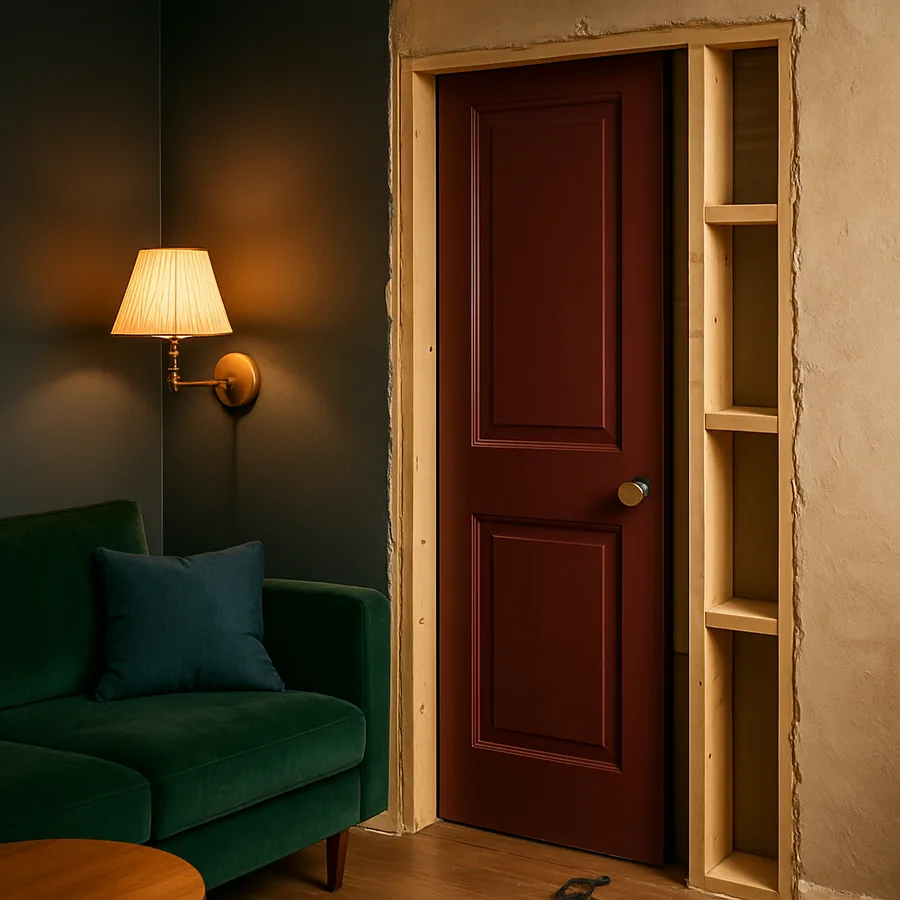
Adding a pocket door to an existing wall sounds like a project that requires gutting the room. For decades it largely did, because pocket frame kits were designed for new construction, where the studs were not yet in place and the drywall had not been hung. Today, a combination of slim-profile frame kits, careful drywall removal techniques, and load-transferring temporary headers makes it possible to install a pocket door in an existing partition wall with surprisingly little disruption to surrounding finishes. This article walks through the actual sequence a working remodeler uses to do this job in a single weekend.
The promise of "without tearing out" deserves an honest qualification up front. You are not going to do this with no demolition. You will, however, be able to limit drywall removal to one face of the wall, preserve the opposite face entirely, and leave flooring, baseboards, and ceiling intact. The trade-off is that the work is fussier, slower per square foot, and more dependent on careful planning than a new-build install. If you are comfortable with that trade, the results are worth it.
Assessing Whether Your Wall Is a Candidate
Not every wall can host a pocket door, and the assessment phase is where most retrofit projects succeed or fail. Start with the obvious: is the wall load-bearing? A non-bearing partition is a straightforward project. A load-bearing wall is still possible but requires a structural engineer to design a header that can both carry the floor loads above and accommodate the pocket cavity below. The American Institute of Architects publishes guidance for residential load redistribution that any qualifying engineer will follow, and the cost of the engineering review (typically $400 to $1,200) is money well spent.
Next, map what is inside the wall. Electrical wiring, plumbing supply and drain lines, HVAC ductwork, low-voltage runs, and gas piping all live somewhere in your existing partitions. A borescope camera through a small inspection hole, combined with a stud finder that detects metal and live wires, will reveal most of what you need to know. Electrical can almost always be rerouted; plumbing supply lines can be rerouted with effort; drain lines, gas, and HVAC trunk lines usually cannot, and any of those in the planned pocket cavity will end the project.
Finally, measure the wall length available for the pocket. The pocket cavity needs to be at least as wide as the door slab plus 1 inch of clearance, plus the wall depth for the receiving jamb. For a 32-inch door, that means a clear pocket of at least 67 inches from the leading-jamb stud to the far end of the cavity, with no obstructions. The National Association of the Remodeling Industry reports that roughly 70 percent of homeowners requesting pocket-door retrofits have a usable wall location, but that the remaining 30 percent are blocked by structural or mechanical conflicts that only a thorough assessment will reveal.
The Keystone-Cut Drywall Removal Method
The breakthrough technique that makes single-face retrofits possible is what carpenters call the keystone cut. Instead of removing the drywall in a rectangle that you have to patch with butt joints all around, you cut the drywall in a tapered trapezoid, wider at the top than at the bottom. When you reinstall the original piece, gravity holds it in place against the studs while you tape and mud, and the angled edges create a longer joint that hides better under skim coat.
To execute the cut, snap chalk lines on one face of the wall defining the pocket area plus 6 inches above and below for working room. Score the lines with a sharp utility knife, then make the cuts with an oscillating multi-tool set to a depth just past the drywall thickness. The multi-tool is critical because it will not damage wiring or pipes hidden behind the drywall the way a reciprocating saw will. Pry the drywall panel off the studs, label its top edge with a marker, and set it aside in a safe spot. You will reinstall this exact piece at the end.
The opposite wall face stays untouched throughout the project, which means whatever paint, wallpaper, tile, or wainscoting is on that side is preserved. This is the entire point of the retrofit method. Crews who have done this work for years can keep the disturbance to a single 8-by-4-foot drywall panel on one side of the wall, with no impact on the adjacent room at all.
Removing the Existing Studs and Bottom Plate
With the drywall off, the studs in the planned pocket area come out next. A reciprocating saw with a long bi-metal blade will cut through 2x4 studs at the top and bottom plates in seconds, but before any cuts happen you need to install temporary support. Even non-bearing partition walls carry some lateral load and stabilize the framing above, and pulling studs without temporary support invites the wall above to sag or crack.
Temporary support is typically a 2x6 strongback screwed horizontally across the wall above the pocket area, with adjustable steel posts (sometimes called Acrow props or jack posts) tightened up under each end. For load-bearing walls, the temporary support is far more elaborate and is the part where the structural engineer's drawings come into play. Never improvise on a load-bearing wall; the consequences of a failed temporary shore range from cracked drywall to a collapsed ceiling, and the savings of avoiding professional engineering are not worth that risk.
Once support is in, cut the studs with the reciprocating saw, taking care to leave the bottom plate intact at floor level. The bottom plate is what keeps your flooring transition clean. You will notch the bottom plate to receive the floor-mounted track guide, but you will not remove it entirely unless your flooring contractor is on standby to refinish or replace the affected boards. This Old House demonstrates this notch-and-leave approach in their pocket-door retrofit episodes, and the finished results show that the saved baseboard and flooring make a meaningful aesthetic difference.
Installing the Slim-Profile Pocket Frame Kit
Pocket frame kits intended for retrofit work are slimmer and more flexible than new-construction kits. Brands like Johnson 1500HD, Cavity Sliders CS Cavity Slider, and Eclisse Classic Single all offer retrofit-friendly versions with split frames that can be assembled inside an existing wall without removing the second face of drywall. The frame components are a head jamb with the pre-installed track, two vertical split studs that form the cavity sides, a strike jamb at the receiving end, and a floor guide channel that sits at the bottom.
Installation begins with the head jamb. Set it level using a 4-foot spirit level and shim it to the existing top plate, then secure with structural screws. The split studs install next, plumbing them with the level and securing them top and bottom. The strike jamb completes the cavity at the far end, and the floor guide is the last piece. Crucially, every step needs to be measured and re-measured: a pocket cavity that is even 1/4 inch out of plumb will cause the door to bind or skew, and that error compounds over the door's lifetime.
Header reinforcement comes next. The original wall header (if it had one) is usually inadequate for the new wider opening. Most retrofit kits include or require a steel header tube that spans the full opening and ties into the existing top plate. The International Code Council residential code requires that any opening wider than the existing rough opening have its header re-engineered, and even on non-bearing walls the new header transfers the moment loads from the door swing into the surrounding framing. Skipping this step is the most common cause of retrofit pocket doors that develop binding or rubbing within the first year.
Hanging the Door and Fine-Tuning the Operation
With the frame in place, the door slab gets prepped before hanging. Mortise the leading edge for the lock and edge pull, drill for the flush pulls on each face, and apply finish if the slab is not already pre-finished. Hardware should be fully installed before hanging, because the door cannot easily be removed once it is on the track and inside the pocket.
Hanging the door is a two-person job for any slab over 50 pounds. Tip the door into the cavity at an angle, slip the hanger trucks onto the track from the leading-jamb side, and let the door come to rest hanging from the track. Adjust the hanger bolts to set the slab height precisely, leaving a 1/4 inch gap at the floor and a 1/8 inch reveal at the head jamb. Operate the door through its full travel several times, watching for any binding, rubbing, or skewing. Adjustments at this stage are easy; adjustments after the drywall goes back on are not.
Have you considered what happens if the door drags after you close the wall up? Most retrofit kits include access panels above the head jamb specifically to allow future hanger adjustment without re-opening the drywall. If your kit does not, design a small access panel into the patched drywall area, painted to match the wall and held in with magnetic catches. Future you will be enormously grateful, even if it is only used twice in twenty years.
Reinstalling Drywall and Finishing the Patch
The final phase is reinstalling the original drywall panel and finishing the joints invisibly. Lift the keystone-cut panel back into position and screw it to the new framing and to the surrounding studs. The angled edges should mate with the existing drywall along their full length. Apply mesh tape to all joints, then bed-coat with setting-type joint compound (typically 20-minute or 45-minute hot mud), feathering the edges 6 to 8 inches beyond the joint.
Two more coats of regular all-purpose joint compound follow, each feathered wider than the last. The final coat should extend 12 to 18 inches beyond the joint to fully blend the patch into the surrounding wall. Sand between coats with a 220-grit screen, taking care not to feather the existing wall finish. Prime the entire patched area with a high-build drywall primer, and paint with two coats of the original wall color.
Lighting is the test that exposes a poor patch. Before declaring the job done, shut off all the room lights and shine a strong work light at a sharp angle across the patched area. Any ridges, divots, or feathering errors will jump out, and they should be skim-coated and re-sanded until the wall is flat under raking light. The American Society of Interior Designers often points out that paint and finish quality is what separates a craftsman renovation from a homeowner project, and this final lighting test is the single best discipline for catching the difference before the client sees it.
Conclusion
Retrofitting a pocket door into an existing wall is no longer a project that requires gutting half a room. With careful assessment, the keystone-cut drywall method, a slim-profile retrofit frame kit, and disciplined finishing, the entire job can fit inside a long weekend and disturb only one face of the wall. The savings in drywall, paint, baseboards, and flooring on the preserved face routinely cover the modest premium for a retrofit-rated frame kit several times over.
The decision tree starts with structural and mechanical assessment, runs through frame selection and installation, and ends with finish work that determines whether anyone can ever tell the wall was opened up. At each stage, the temptation to cut corners exists, and at each stage the cost of cutting corners shows up either immediately as a binding door or eventually as a cracked drywall joint that telegraphs the patch. Slow down at the right moments and the project rewards you with a feature that looks original to the home.
One piece of advice that experienced remodelers will repeat without prompting: photograph everything. Take pictures of the wall before opening it, after demolition, after framing, after the door is hung, and after each coat of mud. The photos help with troubleshooting if anything goes wrong, they document the work for resale disclosures, and they create a personal reference library for the next pocket door retrofit you tackle. Every project teaches something, and the photos are how you carry the lesson forward.
Ready to plan your own pocket door retrofit? Walk your home this weekend with a flashlight, a stud finder, and a measuring tape. Identify the candidate walls, sketch the dimensions, note any visible electrical outlets or plumbing fixtures that hint at hidden runs, and build a preliminary scope before you call any contractors. Coming to a contractor meeting with a clear scope drops the bid range significantly and makes the entire project more predictable from quote to completion.
More Articles You May Like



Comments
Post a Comment