Garage Tool Chest Selection Roll-Around vs Fixed Cabinet Compared
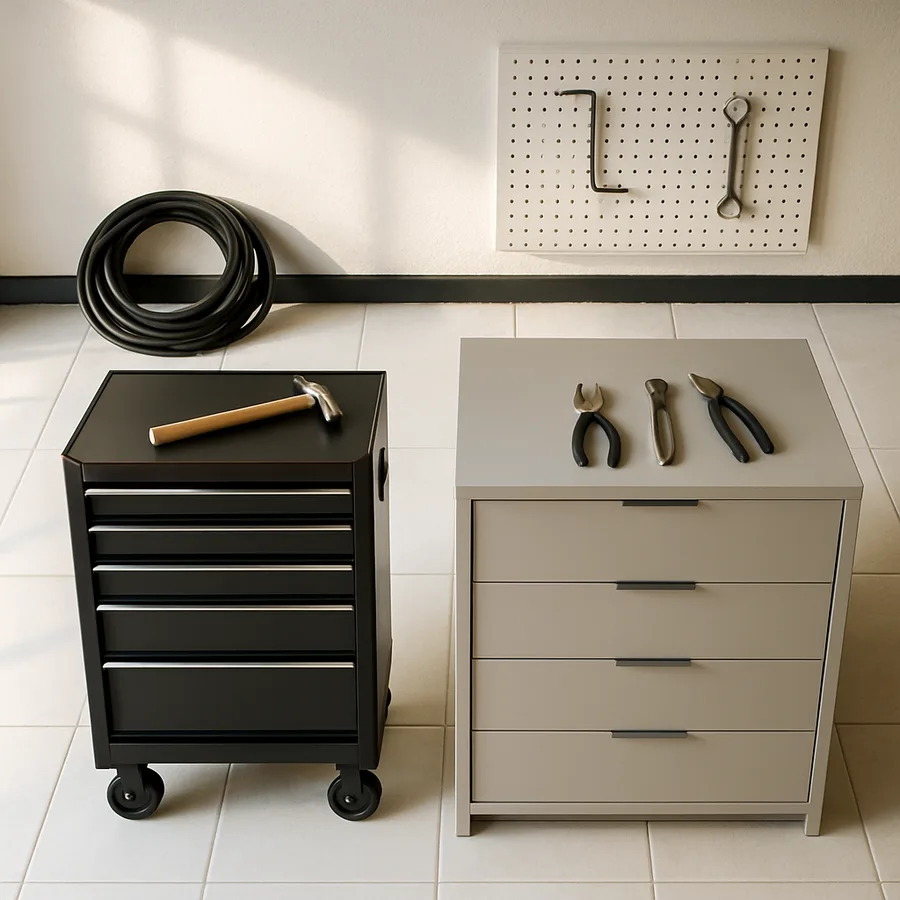
The decision between a roll-around tool chest and a fixed cabinet looks like an aesthetic choice and turns out to be a workflow choice. Roll-arounds bring the tools to the work, glide between vehicles, and follow you around a project. Fixed cabinets anchor a workshop, hold dramatically more weight, and integrate with bench tops, dust collection, and electrical runs in ways a wheeled box cannot match. Picking the wrong format costs you either daily friction or a chunk of garage real estate.
Most garages benefit from a hybrid layout, but the right hybrid depends on the work you actually do. A weekend mechanic working under multiple cars needs mobility above almost everything else. A woodworker stationed at a table saw needs density and dust resistance. This guide compares the two formats across the dimensions that matter and gives you a framework to decide which combination fits your real workflow.
Capacity and Density Per Square Foot
A roll-around chest packs an enormous amount of storage into a small footprint, but the format imposes structural limits. The wheels and frame must support the entire load, which means roll-arounds top out around fifteen hundred to two thousand pounds of total capacity in serious commercial-grade units, and around four hundred to seven hundred in mid-tier home units. Fixed cabinets, by contrast, can be specified to virtually any load rating because the wall or floor anchoring carries the weight.
Per square foot of garage floor, roll-arounds win on density when the chest is parked, because the entire vertical column is storage. Fixed cabinets often include a workbench top, an apron, and a back panel that consume some of the volume for non-storage purposes. The math flips when you consider the path of operation: a roll-around needs an aisle to move, while a fixed cabinet only needs the swing radius of its drawers and doors. In a tight one-car garage, the aisle requirement of a roll-around can cost more square footage than the cabinet itself uses.
According to the Hearth, Patio and Barbecue Association and adjacent home-improvement industry surveys, the average American garage has roughly four hundred fifty square feet of usable floor area, and storage equipment competes directly with vehicle parking and project space. Industry data published at HPBA.org reflects how shrinking suburban garages are pushing more buyers toward vertical storage. The capacity question is rarely about how much you could store; it is about how much you can store while still parking and working.
Mobility, Workflow, and Project Type
The case for a roll-around starts with the work pattern. Automotive repair, outboard engine maintenance, and large-equipment service all benefit from rolling the tool source to the work. A four-thousand-pound vehicle does not move easily; a two-hundred-pound roll-around chest does. The reduced trips between bench and project can save thirty minutes on a brake job and an hour on a transmission service.
Have you ever counted how many times you walked to your tools during a single repair? Most home mechanics make twenty to forty trips on a typical project, and a roll-around eliminates almost all of them. Family Handyman has documented workflow studies in shop environments at FamilyHandyman.com showing time savings of fifteen to twenty-five percent when tools live within arm's reach of the active work area.
Fixed cabinets win when the work happens in one location consistently. Woodworking, electronics repair, leather craft, and gunsmithing all benefit from a stationary bench with deep storage and reliable surface area. Mobility offers no advantage when the project itself does not move. In those workflows, a fixed cabinet system delivers more storage, better organization, and fewer moving parts that can fail over time.
Build Quality, Drawer Slides, and Long-Term Reliability
Both formats live or die by their drawer slides. Cheap roll-arounds use friction slides that bind under heavy loads and develop play within a year of regular use. Cheap fixed cabinets use the same friction slides and fail just as fast. The difference between a tool storage system that lasts ten years and one that lasts thirty is almost always in the slide hardware.
Look for ball-bearing slides rated at one hundred pounds per pair minimum, with full extension on every drawer. Roll-arounds carry the additional requirement that the slides resist motion-induced wear; the constant rolling stresses slide rails differently than a stationary cabinet. Industrial-grade ball slides with hardened steel races are worth specifying on the lower drawers of a heavy roll-around, because those drawers carry the most weight and see the most cycle stress.
Frame construction matters more on roll-arounds than on fixed cabinets. The wheels concentrate load at four points, which means the frame must transfer drawer load through a weld pattern that does not flex. Look for fully welded steel frames rather than bolted assemblies, and inspect the corners for visible weld penetration rather than spot welds alone. Fixed cabinets can rely on the wall anchoring to absorb shear loads, so frame welding is less critical.
Caster quality is the third long-term reliability factor and the one most often overlooked at purchase. Stock casters on mid-tier roll-arounds are sized for showroom appearance rather than working life, and they wear quickly under heavy load on rough garage floors. Upgraded polyurethane casters with sealed bearings cost around eighty to one hundred fifty dollars for a set of four and dramatically extend the rolling life of the chest. Two of the four casters should be locking, positioned diagonally for stability when the chest is parked.
Drawer dividers and small-parts organizers belong in the build-quality conversation as well. A premium chest often includes molded drawer liners and adjustable dividers that integrate with the drawer geometry. A budget chest leaves you to source aftermarket organizers, which rarely match the drawer dimensions cleanly and waste a noticeable percentage of the available volume. Factor accessory cost into the comparison when shopping the lower tier of the market.
Security, Locking, and Theft Considerations
A garage tool collection is a targeted theft category, especially for premium hand tools and power tools. Both roll-arounds and fixed cabinets offer locking mechanisms, but the security model is quite different. A locked roll-around chest weighing four hundred pounds can be wheeled out of an open garage in under ninety seconds by two people. A fixed cabinet bolted to a stud wall cannot leave without significant time, noise, and tools.
For premium tool collections, a fixed cabinet anchored into a structural wall offers materially better theft protection than a roll-around, regardless of how good the lock on the chest is. Add a separate detached-garage alarm, motion lighting outside the garage door, and a habit of closing the door whenever no one is actively working in the space. The Federal Bureau of Investigation tracks property crime statistics annually, and detached garages remain one of the more frequently targeted residential outbuildings.
If you choose a roll-around, look for a chest with a ground-anchor option, often a steel cable or floor-mount bracket that secures the chest when parked. The anchor adds twenty seconds to a moving operation but defeats most opportunistic theft. Some owners pair a roll-around with a small steel-mesh enclosure or a security-curtain that slides across the front of the storage area when the garage is closed for the day.
Cost, Depreciation, and Resale Value
Roll-around tool chests hold their value better than fixed cabinets, partly because they are easier to resell when an owner downsizes or moves. A premium roll-around purchased for three thousand dollars typically sells for sixty to seventy percent of original price after five years if it has been maintained. Fixed cabinet systems, especially those with custom modifications, often sell for thirty to forty percent of original cost because the buyer must dismantle, transport, and reinstall the system.
From a cost-per-cubic-foot of storage standpoint, fixed cabinet systems usually deliver better value at the time of purchase. Modular fixed cabinets from major manufacturers run twenty to thirty percent less per drawer than equivalent roll-around storage, and they often include workbench tops as part of the package. The depreciation hit at resale partially offsets that initial savings, so the lifetime cost can be similar.
According to industry pricing data referenced by This Old House in their workshop comparisons at ThisOldHouse.com, a typical premium roll-around in the seventy-two-inch class costs between two thousand and five thousand dollars new, with the price-quality curve flattening sharply above three thousand. The mid-tier sweet spot for most home shops is two thousand to thirty-five hundred dollars, where slide quality and frame construction reach durable specifications without paying for industrial overkill.
Hybrid Configurations That Get the Best of Both
The most common high-performing layout in serious home shops is a fixed cabinet system anchored to one wall, paired with a roll-around chest for active project work. The fixed cabinets hold the bulk of the collection, including infrequent specialty tools, fasteners in bulk, and consumables. The roll-around carries the daily tools to wherever the active project lives, and returns to a parking spot at the end of the work session.
This hybrid resolves most of the format-vs-format tradeoffs. Capacity is high because the fixed cabinets carry the long tail of the tool collection. Mobility is preserved because the roll-around handles active work. Security is reasonable because the most valuable specialty tools live in the locked, anchored fixed cabinets, while the roll-around carries lower-value daily tools that are also easier to replace.
The challenge of a hybrid is keeping the inventory split sensible. Tools migrate. The two-thirds of your collection that lives in fixed cabinets today will drift toward the roll-around if you let it, until the roll-around is overloaded and the fixed cabinets are half empty. A quarterly review, taking thirty minutes to redistribute tools back to their planned homes, keeps the system functioning. NIOSH resources at CDC.gov/NIOSH include workplace organization guidance that translates directly to home shop discipline.
Power and lighting integration favor the fixed cabinet half of any hybrid. Outlet strips, under-cabinet LED lighting, and the data drops for connected tools all install cleanly along a fixed run and far less cleanly along a moving roll-around. Plan the electrical and lighting around the fixed cabinets first, treat the roll-around parking spot as a second priority for power, and use cordless tools or short extension cords for any work that happens away from the wall.
Floor protection is another small but consequential detail. Heavy roll-arounds concentrate point loads at the four casters, which can dimple softer epoxy coatings or crack thinner concrete sealers over years of repeated parking. A simple rubber mat under the parking spot distributes the load, prevents cosmetic damage to the floor, and dampens the rolling noise during repositioning. The mat costs around forty dollars and saves a complete floor refinish over the life of the chest.
Conclusion
The roll-around versus fixed cabinet decision is not a head-to-head comparison; it is a workflow audit. Mobility is a real competitive advantage when the work moves, and a real cost when the work stays still. Capacity scales differently in each format, security profiles diverge sharply, and resale value follows a different curve. Your best choice depends on what you actually do in the garage and how the space competes with vehicles and project areas.
If your work centers on automotive repair, marine engines, or any project where the workpiece outweighs you, lean toward a roll-around as the primary tool home. The thirty trips per project that mobility eliminates compound into hours of saved time per year, and the slide quality on a premium roll-around makes daily use a pleasure rather than a chore.
If your work centers on a workbench, a table saw, a soldering station, or any fixed-position activity, a wall of cabinets delivers more storage, better security, and lower depreciation than rolling alternatives. The cabinets integrate with dust collection, electrical runs, and bench-top tools in ways no wheeled box can replicate, and the system pays back the higher install effort over decades of use.
For most home garages, the right answer is both, with a clear policy on what lives where and a quarterly habit of pulling the system back into its planned configuration. Plan the system around the work, not around the catalog photo, and the storage will quietly support every project you take on. Walk into the garage tomorrow morning, count the trips you make on the next repair, and let the data choose your next chest.
More Articles You May Like



Comments
Post a Comment