Dutch Doors for Pet Containment in Kitchens and Mudrooms
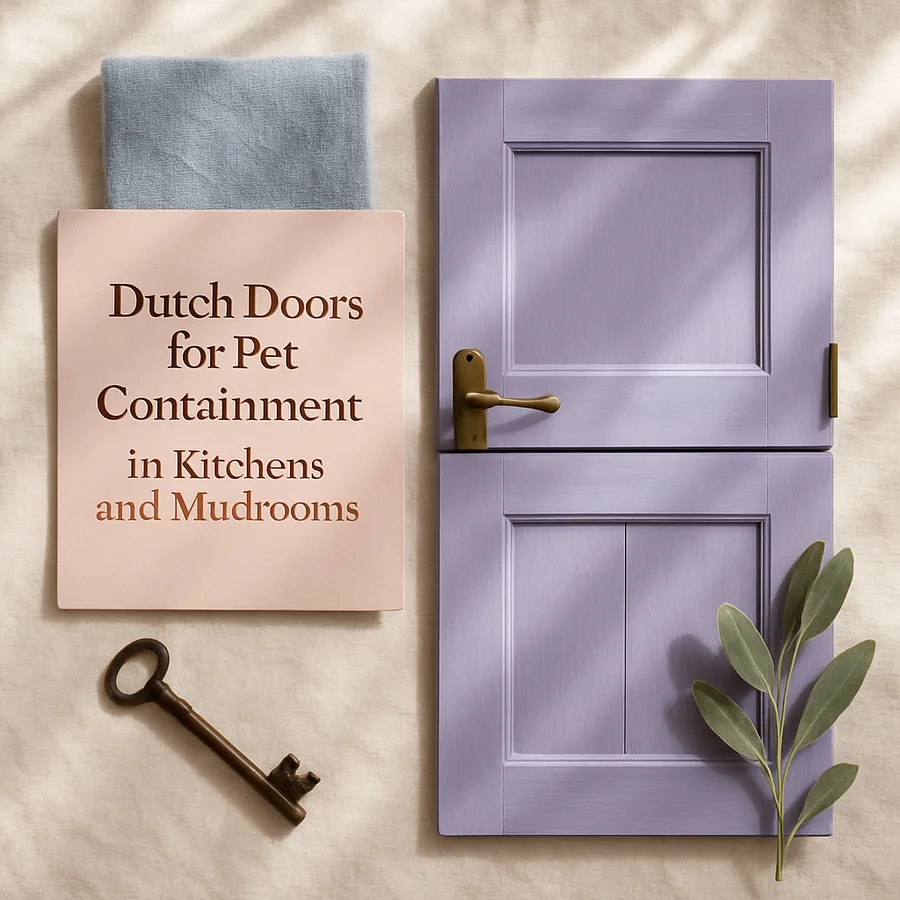
If you have ever tried to cook dinner with a curious retriever weaving between your ankles, or wrangled a muddy terrier through a back-entry corridor in winter, the appeal of a Dutch door becomes obvious within minutes. By splitting a single doorway into independent upper and lower leaves, this centuries-old design lets households contain pets without fully closing off a room. Owners gain visual contact, ventilation, and conversational access while a determined dog or wandering cat is held safely behind a half-height barrier. In renovation circles, Dutch doors have evolved from a quaint farmhouse motif into a serious functional tool, particularly in kitchens and mudrooms where pet traffic intersects with cooking, cleaning, and laundry.
The renewed interest is not anecdotal. According to the American Pet Products Association's National Pet Owners Survey, roughly 66 percent of U.S. households own a pet, and the American Kennel Club has repeatedly noted that home design queries from owners of large breeds spike during late-fall months when shedding and tracked-in debris peak. Pair that with a generation of remote workers who now witness their pets' indoor habits all day long, and the demand for thoughtful pet containment built into the architecture rather than bolted on as plastic gates is easy to understand. Dutch doors answer that demand with a permanence and dignity that pressure-mounted barriers cannot.
Why the Kitchen Threshold Deserves a Half Door
Kitchens are arguably the most dangerous everyday room in the house for animals. Hot pans on the stovetop, dropped chocolate, knives left on a counter edge, and slippery tile during meal prep all carry meaningful risk. The American Society for the Prevention of Cruelty to Animals maintains an extensive list of toxic foods and chemicals routinely found in kitchens, and pet emergency veterinarians frequently cite kitchen ingestion incidents as a top reason for off-hours visits. A Dutch door at the kitchen entry creates a soft barrier that allows family conversation and supervision while preventing a foraging nose from reaching the prep zone.
Practically, the half-door geometry shines because it preserves the social character of the kitchen. Open-concept layouts have dominated U.S. residential design for two decades, and homeowners are reluctant to undo that openness with a solid slab. The lower leaf, typically 36 to 42 inches tall, blocks dogs up to medium-large size while letting parents and guests still chat across the threshold. The upper leaf can stay open through a long Sunday brunch, then close at bedtime to muffle dishwasher cycles. Have you considered how often you actually need a kitchen fully sealed off versus partially partitioned? For most homeowners, the answer points squarely at a Dutch door rather than a traditional swing door.
Acoustic performance matters too. Hard kitchen surfaces like quartz, stainless steel, and tile reflect sound aggressively, and even a half-closed lower leaf reduces the perceived noise spilling into adjacent rooms. Builders affiliated with the National Association of Home Builders often recommend pairing Dutch doors with felt-backed sweeps and self-closing magnets for a cleaner acoustic seal without sacrificing the open-top aesthetic.
Mudrooms as the Real Pet Command Center
Mudrooms have transitioned from utility afterthought to a primary architectural feature in higher-end remodels, and pet logistics now drive much of that brief. A well-planned mudroom absorbs muddy paws, wet leashes, kibble bins, and grooming chaos before any of it reaches living areas. Installing a Dutch door at the kitchen-facing wall of the mudroom lets you keep a freshly bathed dog confined while floors dry, or hold a delivery-skeptical herding breed back during package handoffs. The closed lower leaf creates an unmistakable visual cue to the pet that this side is theirs while training routines reinforce the boundary.
Storage planning compounds the value. Many mudroom Dutch doors swing into rooms with built-in benches, cubbies, and a small dog-washing station. Designers often size the lower leaf taller than typical, around 44 inches, to defeat counter-surfing larger breeds. Ventilation through the open upper leaf prevents the damp-towel funk that plagues sealed mudrooms, and a transom above the door amplifies daylight transfer into otherwise windowless interior spaces. How big is the breed you are planning around, and how high can it actually jump from a flat-footed start? That single question reshapes the door dimensions more than any style preference.
Sizing, Material, and Hinge Considerations
The default Dutch door split places the meeting rail at roughly the midpoint of a standard 80-inch door, giving two leaves of about 40 inches each. For pet containment, this is rarely the right ratio. Most renovators raise the lower leaf to between 42 and 48 inches so a Labrador or shepherd cannot place its forepaws on the top edge and vault. Smaller homes with toy and miniature breeds can drop the lower leaf to 32 inches, which keeps the door visually lighter while still enclosing the animal. The National Association of the Remodeling Industry publishes member guidance suggesting any custom split be verified against breed-specific jump heights before milling.
Material matters as much as proportion. Solid hardwood doors resist scratching and the inevitable shoulder-bumps from enthusiastic greetings, while engineered wood saves cost in lower-traffic homes. Pet households that include claw-clippers and chewers should specify a 1.75-inch thick stile and a non-glued tongue-and-groove panel construction so individual panels can be replaced without scrapping the entire door. Hinge selection is critical because half doors carry asymmetric loads. Three ball-bearing hinges per leaf is standard, with a stainless option for mudrooms exposed to humidity. The National Association of the Remodeling Industry recommends specifying hinges rated to at least 1.5 times the weight of the leaf to prevent sag over time.
Don't overlook the meeting rail itself. A T-astragal with a rabbeted overlap blocks drafts when both leaves are closed and gives a satisfying mechanical click that signals to the dog that the door is fully shut. Some owners add a discreet shelf on top of the lower leaf for keys, leashes, or treats, turning the meeting rail into a functional landing strip. Be careful not to make this shelf wide enough to tempt a jumping cat, however, or the entire containment logic breaks down.
Hardware That Survives Daily Pet Traffic
Hardware is where pet-focused Dutch doors live or die. The shootbolt that locks the two leaves together for normal swing operation is the single most failure-prone component because it cycles every time the lower leaf opens independently. Specify a forged brass or stainless shootbolt, never zinc, and lubricate it on the same schedule as your garage-door springs. A magnetic catch on the lower leaf holds it shut against a curious nose without requiring a latch every time you walk through. For homes with multiple pets, a thumb-operated paddle latch mounted high enough that no dog can nose it open adds a fail-safe.
Self-closing hinges deserve a careful look. They prevent the lower leaf from drifting open in air-handler drafts, but cheap units slam loud enough to startle anxious animals. Soft-close dampers solve the problem at modest cost. If your household includes a dog that has ever chewed a baseboard, expect the door bottom to receive similar treatment. A stainless kick plate on the mudroom side adds visual order and prevents the slow crescent of teeth marks that otherwise accumulates over years.
Training and Behavioral Integration
A Dutch door is a tool, not a magic spell. The most beautiful half door in the world will not contain a determined herding breed if the household has never trained the animal to respect thresholds. Introduce the door gradually: start by leaving the lower leaf open for a week so the pet associates the frame with normal passage, then close it during low-stress moments and reward calm behavior on the correct side. Trainers credentialed through the Association of Professional Dog Trainers consistently emphasize that physical barriers paired with reinforcement schedules produce far better long-term outcomes than barriers alone.
For multi-pet homes, observe interspecies dynamics through the open upper leaf. Cats often appreciate Dutch doors because they can perch on the meeting rail and survey the kitchen without engaging. Dogs typically learn within two weeks that the lower leaf signals quiet observation rather than active participation. Households with senior pets benefit from a lower-leaf height that the older animal could theoretically clear so the architecture never traps a confused dog on the wrong side during a panic event. Discuss any mobility-impaired pet with your veterinarian before finalizing dimensions.
Children change the calculation. A toddler can pull the lower leaf open if the latch is reachable, so install handles at adult height and consider a child-safe magnetic key for the shootbolt. The American Veterinary Medical Association publishes home-safety guidance suggesting that any pet barrier in a home with children under age six be operable only by adults to prevent accidental release of an aggressive or fearful animal during chaotic moments.
Cost, Permits, and Resale Considerations
Budget transparency helps. A custom interior Dutch door installed by a licensed carpenter typically lands between 1,800 and 4,500 dollars including hardware, paint, and trim adjustments. Pre-hung Dutch doors from millwork catalogs run lower, often 800 to 1,500 dollars before installation, but require careful jamb verification. Permits are rarely needed for an interior door swap, although homeowners associations in some neighborhoods regulate visible exterior glazing if the door sits at a sightline from the street. Always check with your local building department before assuming a permit-free path.
Resale data is encouraging. The National Association of Realtors Remodeling Impact Report consistently shows that thoughtful pet-friendly upgrades, particularly in mudrooms, return between 50 and 70 percent of cost at sale, and qualitative feedback from listing agents suggests Dutch doors photograph well in marketing materials. The half-open hero shot of a kitchen-mudroom transition has become a recognizable trope in real-estate listings for a reason: it telegraphs lifestyle, charm, and considered planning all at once.
Insurance is a quieter consideration. Some carriers offer modest discounts for documented pet-containment features when the household includes a breed flagged on standard underwriting tables. Ask your agent whether installation receipts and photographs would qualify before you commit to specific hardware, since some discounts require certified components. A American Institute of Architects member can also weigh in on whether a Dutch door integrates cleanly with your home's existing trim profile and historical character.
Lead times deserve advance planning. Custom millwork shops report typical Dutch door production windows of 8 to 14 weeks, and supply chain disruptions over the past several years have stretched some species and hardware finishes well beyond those norms. Order well before your renovation week, especially if the door must coordinate with cabinetry, flooring, or paint deliveries. Pre-hung catalog Dutch doors ship faster but rarely match the proportions and trim of high-end remodels, so use them only when budget or schedule forces the issue. Keep a small inventory of replacement weatherstripping, magnetic catch plates, and shootbolt strikes so the door stays adjustable for the life of the home.
Conclusion
Dutch doors solve a problem that pressure-mounted gates and folding plastic barriers can only paper over. By turning a single threshold into two coordinated halves, they preserve the visual openness that modern homes prize while reliably containing pets in the rooms where containment actually matters. Kitchens become safer, mudrooms become more functional, and the entire household gains a calm, consistent boundary that pets learn to respect within weeks rather than months.
The detailing is what separates a charming farmhouse vignette from a workhorse that survives a decade of paws and shoulders. Specify thicker stiles, ball-bearing hinges, a forged shootbolt, and a meeting rail that closes with a confident thunk. Size the lower leaf to defeat your specific breed's jumping ability, not the breed in a magazine photograph. Layer in soft-close dampers, kick plates, and adult-height latches if children share the home, and pair the architecture with consistent training so the door becomes a cue rather than a contest.
If your daily routine involves cooking around a curious nose or wrangling muddy paws through a back hallway, schedule a consultation with a credentialed remodeler this month and ask specifically about Dutch door options sized for your animals. Bring measurements of your largest pet's standing reach and a photograph of the existing trim so the conversation moves quickly from concept to drawings. The investment is modest compared with the daily friction it removes, and the resulting threshold is one of those rare upgrades that pays back in calm every single morning.
More Articles You May Like



Comments
Post a Comment