Dining Chair Slipcover Versus Reupholstery Cost Comparison
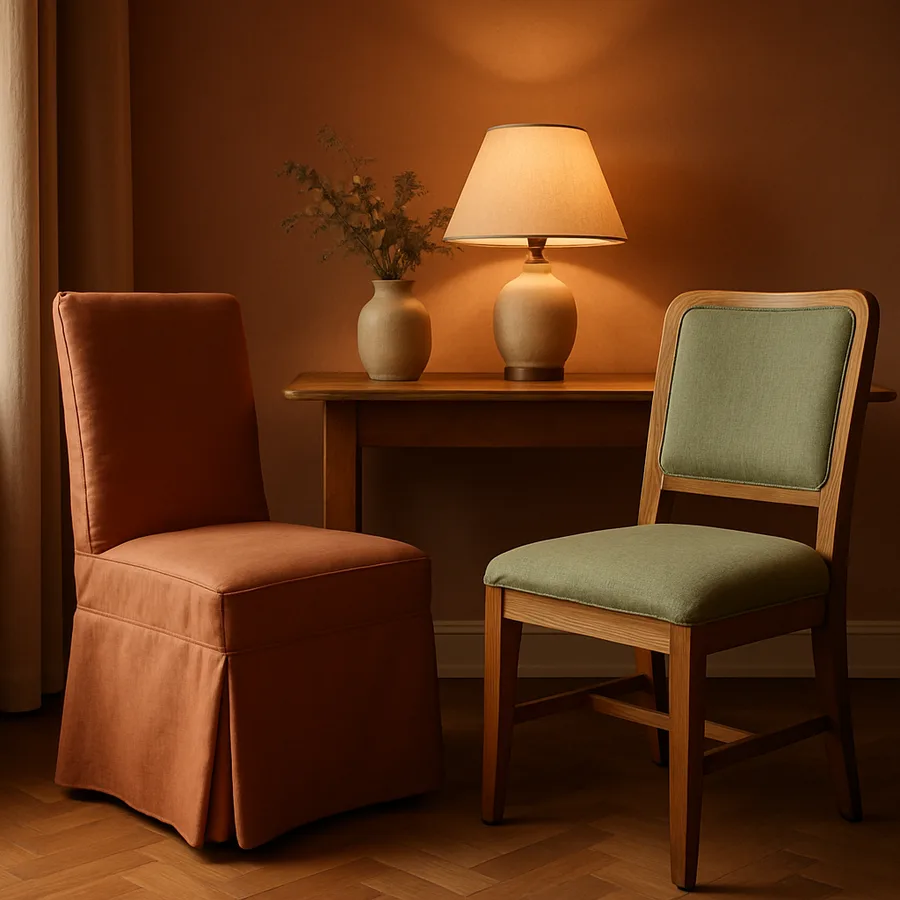
A worn dining chair seat is one of the most common and most ignored problems in American homes. The fabric thins, a wine stain sets, the foam compresses, and the chair that once anchored holiday meals starts to feel embarrassing rather than welcoming. Two paths exist to revive it: a dining chair slipcover or full reupholstery. The two solutions look similar in a finished photograph but represent very different investments of time, money, and craftsmanship.
This guide breaks down the real cost ranges, the durability tradeoffs, and the design implications of each route. The numbers below are drawn from interviews with upholstery shops, manufacturer pricing data, and consumer surveys conducted by the American Home Furnishings Alliance (AHFA). By the end you should be able to estimate, within a reasonable range, what either approach will cost for a set of six or eight chairs and which is the better fit for your situation.
What A Slipcover Actually Is And How It Fits
The slipcover style itself carries design weight. A tailored slipcover with sharp corners and minimal gathering reads as deliberate and contemporary, while a relaxed slipcover with soft draping and skirted hems reads as cottage or French country. Pottery Barn and Restoration Hardware have made the relaxed style something of a default in American casual dining, but custom shops can produce either style on the same chair frame. The decision affects the entire visual character of the room and should be made with the surrounding decor in mind rather than the chair alone.
A slipcover is a removable, washable fabric cover that wraps over the existing chair seat and, in some designs, the chair back. It is sewn to a pattern that fits a specific chair model and held in place by ties, elastic, hook-and-loop closures, or a tailored seam that grips by friction. A good slipcover looks intentional rather than improvised. A bad one bunches at the corners and slides off when anyone leans back.
The slipcover universe splits into two categories: ready-made and custom. Ready-made slipcovers from retailers like Pottery Barn, Sure Fit, or Bemz typically run between $40 and $120 per chair depending on fabric. They fit common chair shapes and assume some standardization in dimensions. Custom slipcovers from a local seamstress or upholstery shop usually start around $150 per chair and run to $300 or more for complex shapes or premium fabrics like Belgian linen or performance velvet.
What Reupholstery Involves And Why It Costs More
The skilled labor required for quality reupholstery has become harder to find. The number of full-time upholsterers in the United States declined by roughly 35 percent between 2010 and 2024 according to Bureau of Labor Statistics trade data, which has driven labor rates upward and lengthened wait times at reputable shops. Many shops now book three to six months out, particularly during the fall and winter when holiday entertaining drives demand for refurbished dining sets. Plan accordingly if you intend to have chairs ready for a specific gathering.
Reupholstery is a structural process. The upholsterer removes the existing fabric, evaluates and often replaces the foam, retightens or replaces webbing or springs, and then stretches and staples new fabric over the rebuilt seat. On a chair with a tight upholstered back, the process is repeated for the back panel. Done well, the result is indistinguishable from a new chair, with the added benefit that you keep the frame you already trust.
According to a 2024 survey by the Professional Upholsterers Association, the average cost to reupholster a single dining chair seat in the United States runs $90 to $180 for labor plus $30 to $200 for fabric, depending on grade. A fully upholstered chair with both seat and back can run $250 to $600 per chair. A set of eight chairs can therefore land anywhere from $720 for simple seats in a basic fabric to $4,800 for fully upholstered chairs in premium textiles. The wide range reflects huge variation in chair complexity and fabric choice.
Side By Side Cost Comparison For Six And Eight Chair Sets
Regional pricing variation is significant and worth investigating before assuming national average figures apply. Major metropolitan markets like New York, San Francisco, and Boston typically run 20 to 40 percent above national averages for both slipcover and reupholstery work, while smaller cities and rural areas often run 15 to 25 percent below. Getting two or three quotes within your local market is more reliable than any published average, and the spread between high and low quotes within a single zip code can easily exceed 50 percent for the same work specification.
Let us run the math for two common scenarios. Scenario one: a household with six dining chairs that have plain drop-in seats. Custom slipcovers in a midweight cotton-linen blend would run roughly $900 to $1,500 for the set. Reupholstery of the same six seats in equivalent fabric would run roughly $720 to $1,200. In this scenario, reupholstery is actually cheaper because the slipcover requires more fabric and more sewing complexity than the upholstered alternative.
Scenario two: a household with eight chairs that have fully upholstered seats and backs in a worn pattern. Slipcovers covering both seat and back, custom-fit, would run roughly $2,000 to $3,200. Full reupholstery would run $2,400 to $4,800. Here the slipcover is meaningfully cheaper, but it also delivers a different result: removable, washable, but slightly less crisp at the edges than a stretched and stapled finish.
The simple rule that emerges from these scenarios: slipcovers tend to win on cost when the chair has complex curves or fully upholstered backs, while reupholstery tends to win on cost when the chair has simple drop-in seats. Better Homes and Gardens publishes useful homeowner cost guides that confirm this pattern across multiple regional markets.
Durability Lifespan And Cleaning Considerations
Beyond fabric durability, the underlying foam matters enormously. Quality reupholstery includes a foam evaluation and replacement when needed, typically with a high-density polyurethane rated for at least 1.8 pounds per cubic foot. Lower-density foam sags within a year or two and creates the visible compression that makes a chair feel old. Slipcovers do not address foam at all; if your chairs feel like they have lost their structure, no slipcover will solve that problem because the underlying foam continues to fail beneath the new fabric.
Reupholstery, properly done, lasts as long as the original fabric did. A high-grade Crypton performance fabric or a Sunbrella indoor-outdoor fabric on a dining chair can survive a decade or more of family meals. The downside is that when it stains or tears, the only fix is another reupholstery cycle. Stains on stretched fabric rarely come out completely because the fabric cannot be removed for washing.
Slipcovers are the opposite. The fabric will not last as long under abrasion because it is not pulled tight against the foam. A typical custom slipcover in a midweight fabric shows visible wear in three to five years of daily use. The compensating advantage is that the slipcover comes off, goes in the washing machine, and goes back on. Red wine, a small child with a juice cup, or a casual barbecue all become solvable rather than catastrophic. For households with young kids or pets, that washability often outweighs the shorter useful life.
Have you ever tried to spot-clean a stretched dining chair seat after a memorable spill? If so, the slipcover argument probably needs no further selling. If you eat formally and rarely spill, the durability of stretched fabric becomes more compelling.
Fabric Selection And The Hidden Costs
Both routes are sensitive to fabric choice. The most common mistake homeowners make is choosing a beautiful upholstery-grade fabric that fails the dining-chair test. A fabric needs to meet roughly 30,000 double rubs on the Wyzenbeek abrasion scale to qualify as residential heavy-duty per ACT (Association for Contract Textiles) guidelines. Many gorgeous decorative fabrics test at 9,000 to 15,000 double rubs and will pill, fuzz, or thin out within a year on a dining chair.
Performance fabrics like Crypton, Sunbrella, and Revolution have transformed the category over the past decade. They resist stains, repel liquids, and survive abrasion that would destroy a traditional fabric. They also cost roughly 20 to 50 percent more per yard than non-performance equivalents, but the lifetime cost is almost always lower. A reupholstery shop can recommend specific fabrics that have performed well in dining applications, and many maintain a curated swatch library precisely for this purpose.
For slipcovers, the fabric weight matters as much as durability. Lightweight cottons drape beautifully but slide around. Heavier linens and cotton-canvas blends hold their shape but require more aggressive washing care. Pre-washing the fabric before sewing prevents the dramatic shrinkage that often surprises first-time slipcover owners after the inaugural laundry cycle.
When Reupholstery Is Worth It And When To Replace Instead
One additional factor in the replace-versus-restore decision is the frame quality of the original chair. Look at the joinery: chairs assembled with mortise-and-tenon joints, dowels, and corner blocks are built to be restored. Chairs assembled with staples, glue alone, or particle-board components rarely survive the disassembly required for reupholstery. A skilled upholsterer can usually tell within the first inspection whether a chair is worth restoring, and a reputable shop will turn down work on chairs that cannot be done well.
There is a third option neither slipcover nor reupholstery solves: replacement. If your dining chairs are mass-produced from soft hardwoods with stapled-on aprons, the labor cost of reupholstery may approach the cost of a new chair set. The math changes when the chair is a vintage piece, a designer original, or a solid-hardwood frame from a manufacturer like Stickley or Ethan Allen. In those cases, reupholstery preserves a frame that cannot be cheaply replaced and is almost always the right call.
A reasonable rule of thumb from the NAHB (National Association of Home Builders) Remodeling Council is that reupholstery is justified when the cost of refurbishment is less than 50 percent of the cost of an equivalent new chair. If the new chair would cost $400 and reupholstery is $250, restore. If the new chair would cost $200 and reupholstery is $250, replace. Sentimental value, frame quality, and environmental footprint can all push the math toward restoration even when pure dollars suggest otherwise. Authoritative cost guides at NAHB and design context at Better Homes and Gardens are worth reviewing before you commit.
The environmental argument is increasingly mainstream. Reupholstering a chair generates roughly one-tenth the embodied carbon of building a new equivalent chair, according to a 2023 lifecycle analysis cited by the Sustainable Furnishings Council. For households committed to lower-impact living, restoration is not just a financial choice but an ecological one.
Conclusion And Making The Right Choice For Your Chairs
The slipcover-versus-reupholstery decision rarely has a single correct answer. Slipcovers win for households with active kids, pets, or messy entertaining habits, where washability matters more than perfect fit. Reupholstery wins for households with treasured frames, formal dining patterns, or a desire for the crisp tailored look that only stretched fabric delivers. Cost is rarely the deciding factor because the two methods land within a few hundred dollars of each other for most six-to-eight-chair sets.
Before you commit, get two written quotes: one from a custom slipcover maker and one from a reupholstery shop. Bring the chair in person if possible, or send detailed photos and dimensions. Ask each shop about fabric recommendations for your specific use case, expected lifespan with your usage patterns, and the warranty they stand behind. A reputable shop should warrant labor for at least one year and should be willing to walk you through fabric grades on the Wyzenbeek scale.
If you cannot decide, do one chair first as a test. A single reupholstered or slipcovered chair will tell you everything the showroom cannot: how it feels to sit in, how it cleans, how it ages over a season of meals. Many shops will offer a small discount on the remaining chairs if you commit after the test piece is delivered. This single-chair experiment is the cheapest insurance against an expensive whole-set mistake.
Take the next step. Pull one of your dining chairs into the brightest light in your home, photograph it from three angles, and send those photos to two local upholstery shops this week. The quotes you receive will give you the concrete numbers you need to choose with confidence and bring your dining chairs back to looking as good as the meals you serve on them.
More Articles You May Like



Comments
Post a Comment