Acoustic Panels as Wall Art in Home Theaters and Podcasting Rooms
When Sound Treatment Meets Visual Design
Acoustic panels have long carried a reputation as purely functional objects: rectangular slabs of foam or fiberglass wrapped in utilitarian fabric and mounted on walls to tame echoes and reverb. In professional recording studios and corporate conference rooms, this no-frills approach makes sense because aesthetics are secondary to acoustic performance. But in a home theater or a podcasting room built inside a living space, the visual impact of wall treatments matters enormously because these rooms are part of your home, not a commercial facility. The good news is that the acoustic panel industry has responded to this demand with products that perform as well as traditional panels while looking like deliberate, intentional art.
The convergence of acoustics and aesthetics is not a compromise; it is a legitimate design discipline. The Acoustical Society of America (ASA) has published research demonstrating that panel shape, surface texture, and mounting configuration all influence acoustic performance, meaning that creative visual designs are not merely cosmetic overlays but can actually enhance how the panel interacts with sound waves. A panel with an irregular, sculpted surface scatters sound in complex patterns that a flat panel cannot replicate, providing diffusion rather than pure absorption. This means that some of the most visually interesting designs are also acoustically superior to the basic flat rectangle.
The market for decorative acoustic panels has grown substantially, driven by the parallel booms in home theater construction and podcasting. According to the Custom Electronic Design and Installation Association (CEDIA), dedicated home theater rooms have increased by roughly 25 percent in new custom home construction over the past five years. Meanwhile, podcast listenership continues to climb, and a growing number of creators are building permanent recording spaces at home. Both applications demand serious acoustic treatment, and both exist within residential interiors where visual coherence with the rest of the home is expected.
The result is a thriving category of products that range from fabric-wrapped panels printed with custom artwork to three-dimensional wood slat diffusers that function as sculptural wall installations. Companies like Vicoustic, Artnovion, GIK Acoustics, and Primacoustic now offer product lines specifically designed for residential spaces where appearance and performance carry equal weight. This article explores how to select, place, and combine these products to create rooms that sound outstanding and look even better.
Types of Decorative Acoustic Panels and What They Do
Fabric-wrapped absorber panels are the most versatile category and the starting point for most home theater and podcasting setups. These panels consist of a rigid fiberglass or mineral wool core wrapped in acoustically transparent fabric. The fabric can be any color, pattern, or even a custom-printed image, because the sound passes through the fabric to reach the absorptive core behind it. Standard sizes range from two-by-two feet to two-by-four feet, though custom dimensions are available from most manufacturers. Absorption performance is determined by the core material and thickness, with two-inch cores handling mid and high frequencies well and four-inch cores extending absorption down into the lower midrange.
Wood slat diffuser panels have become enormously popular in recent years, appearing in interior design magazines and social media feeds as a modern wall treatment. These panels feature parallel wood slats with gaps between them, behind which sits an absorptive material. The slats scatter incoming sound waves in multiple directions, providing diffusion that prevents flutter echoes and standing waves without making the room feel dead or over-damped. From a visual standpoint, the natural wood grain and rhythmic pattern of the slats create a warm, textured feature wall that works in contemporary, Scandinavian, and mid-century modern aesthetics. The Architectural Digest has featured wood slat acoustic walls in multiple residential project profiles, recognizing them as both a functional and decorative element.
Shaped and sculpted panels push the art dimension further by using three-dimensional forms to create visual interest on the wall. Hexagonal tiles, undulating wave patterns, geometric mountain scapes, and organic curved forms all serve acoustic purposes by scattering sound at varying angles, preventing the focused reflections that cause acoustic problems. These panels are typically made from polyester fiber, recycled PET plastic, or dense foam, and they are available in a wide range of colors. Arranging them in custom configurations allows you to create a unique wall composition that is genuinely artistic while providing measured acoustic improvement. Many podcasters use these panels as a visible backdrop in their video recordings, where the panels serve triple duty as sound treatment, visual branding, and set design.
Bass traps are a specialized category that addresses low-frequency sound accumulation in room corners. While not traditionally considered decorative, modern bass traps are available in column and corner-mount designs that integrate smoothly with the room's appearance. A cylindrical bass trap wrapped in matching fabric and placed in a corner reads as a design column rather than acoustic equipment. In a home theater, where deep bass from a subwoofer can cause boomy, muddy sound, properly placed bass traps make a dramatic difference in clarity. In a podcasting room, they reduce the low-frequency resonance that makes voice recordings sound boxy and unprofessional.
Panel Placement Strategy for Home Theaters
Home theater acoustic treatment follows a well-established methodology based on the positions of the speakers and the listeners. The first reflection points are the highest priority for panel placement. These are the spots on the side walls, ceiling, and rear wall where sound from the front speakers bounces once before reaching the listener's ears. The reflected sound arrives a few milliseconds after the direct sound, causing comb filtering that smears the stereo image and reduces dialogue clarity. Placing absorber panels at these reflection points eliminates the interference and dramatically improves the perceived quality of the audio system. Finding these points is as simple as having someone slide a mirror along the wall while you sit in the primary viewing position; wherever you can see a speaker's reflection in the mirror, that is a first reflection point.
The rear wall behind the seating position is the second priority. Sound from the front speakers reaches the rear wall and bounces back toward the listener, creating a delayed reflection that muddles spatial cues and makes the room sound echoey. A combination of absorption and diffusion on the rear wall works best: absorber panels to reduce the energy of the reflection and diffuser panels to scatter the remaining energy so it arrives at the listener from many directions at low levels rather than as a single coherent bounce. This is an excellent location for a feature wall of wood slat diffusers flanked by fabric-wrapped absorber panels, creating a visually striking arrangement that also represents best-practice acoustic treatment.
The ceiling is often neglected in home theater treatments because mounting panels overhead feels less intuitive than treating walls. However, the ceiling is a major reflection surface, particularly for the center channel speaker that carries dialogue. A row of absorber panels on the ceiling between the front speakers and the seating position prevents ceiling reflections from degrading vocal clarity. These panels can be mounted in a decorative arrangement, such as a staggered pattern or a coffered-style grid, that appears intentional and architectural rather than afterthought. Cloud-mounted panels suspended slightly below the ceiling on wire hangers are another option that provides both acoustic benefit and a floating visual element.
How much treatment is enough? Over-treating a home theater is a real risk that makes the room sound unnaturally dead, which is uncomfortable for both movie watching and conversation. A common guideline is to cover approximately 30 to 50 percent of the wall surface area with a combination of absorbers and diffusers, leaving some reflective wall and ceiling space to maintain a sense of liveliness. The precise balance depends on room size, shape, and personal preference. Starting with the first reflection points and the rear wall, then adding treatment incrementally while listening critically, allows you to dial in the right amount without overshooting.
Optimizing a Podcasting Room for Voice Clarity
Podcasting rooms have different acoustic requirements than home theaters because the primary sound source is the human voice at close range rather than a multi-speaker surround system. The goal in a podcasting room is to capture a clean, dry vocal signal with minimal room reflections, reverberation, and background noise. This means the treatment strategy emphasizes heavy absorption, particularly at mid and high frequencies where vocal resonances occur, with less emphasis on the diffusion and spatial balance that a home theater needs. A well-treated podcasting room should sound noticeably quieter and more controlled than a normal room when you clap your hands or speak out loud.
The wall directly behind the microphone is the most critical surface to treat, because sound from the speaker's mouth radiates forward past the microphone, hits the facing wall, and bounces back into the microphone as a delayed reflection. This reflection is the primary cause of the hollow, roomy quality that distinguishes amateur podcasts from professional productions. A large absorber panel or a cluster of panels covering most of this wall eliminates the reflection and immediately improves vocal clarity. The Audio Engineering Society (AES) recommends treating at minimum the wall facing the speaker and the two side walls within a few feet of the microphone position for spoken-word recording.
Because podcasters often record video simultaneously, the visual appearance of the wall behind the speaker, which is the on-camera background, is especially important. This is where decorative acoustic panels truly shine as dual-purpose elements. A grid of hexagonal panels in branded colors, a wood slat feature wall, or a gallery arrangement of fabric-wrapped panels with custom prints all create a visually professional backdrop that viewers associate with quality content. Many successful podcasters have made their acoustic panel wall a signature visual element of their show, recognizable at a glance in thumbnails and social media clips.
Corners and the ceiling in a podcasting room benefit from treatment as well. Corner bass traps reduce the low-frequency buildup that can make a small room sound boxy and give voices an unnatural boomy quality. Ceiling panels directly above the recording position prevent reflections from the overhead surface. In small rooms, which most home podcasting spaces are, the surfaces are close enough that reflections arrive very quickly after the direct sound, making them harder to distinguish but still audible as coloration. Treating at least four surfaces (the facing wall, the two side walls, and the ceiling above the microphone) brings the room to a standard that produces broadcast-quality vocal recordings. Is your current recording space treated on multiple surfaces, or are you working with panels on a single wall?
Selecting Panels That Match Your Room's Aesthetic
Choosing panels that complement the room's existing design language is what separates a space that looks intentionally designed from one that looks like a studio was jammed into a spare bedroom. Start by identifying the room's dominant visual characteristics: color palette, material textures, geometric style (angular versus curved), and overall formality. A modern home theater with dark walls, recessed lighting, and clean lines calls for panels in dark fabrics with minimal pattern, or black wood slat diffusers that continue the room's linear vocabulary. A warmer, more eclectic podcasting room might welcome colorful hexagonal panels arranged in an asymmetric mosaic.
Custom fabric printing on acoustic panels opens an enormous range of possibilities for personalizing a space. Manufacturers like GIK Acoustics and Acoustimac offer services where you upload an image and they print it on acoustically transparent fabric stretched over an absorber core. This means you can have family photographs, abstract art, movie posters, or brand graphics on your walls that are simultaneously functional acoustic panels. The print quality on modern acoustic fabric rivals that of canvas art prints, making it difficult for visitors to distinguish the panels from conventional framed artwork. The Houzz ideabook galleries include numerous examples of custom-printed acoustic panels integrated into residential media rooms.
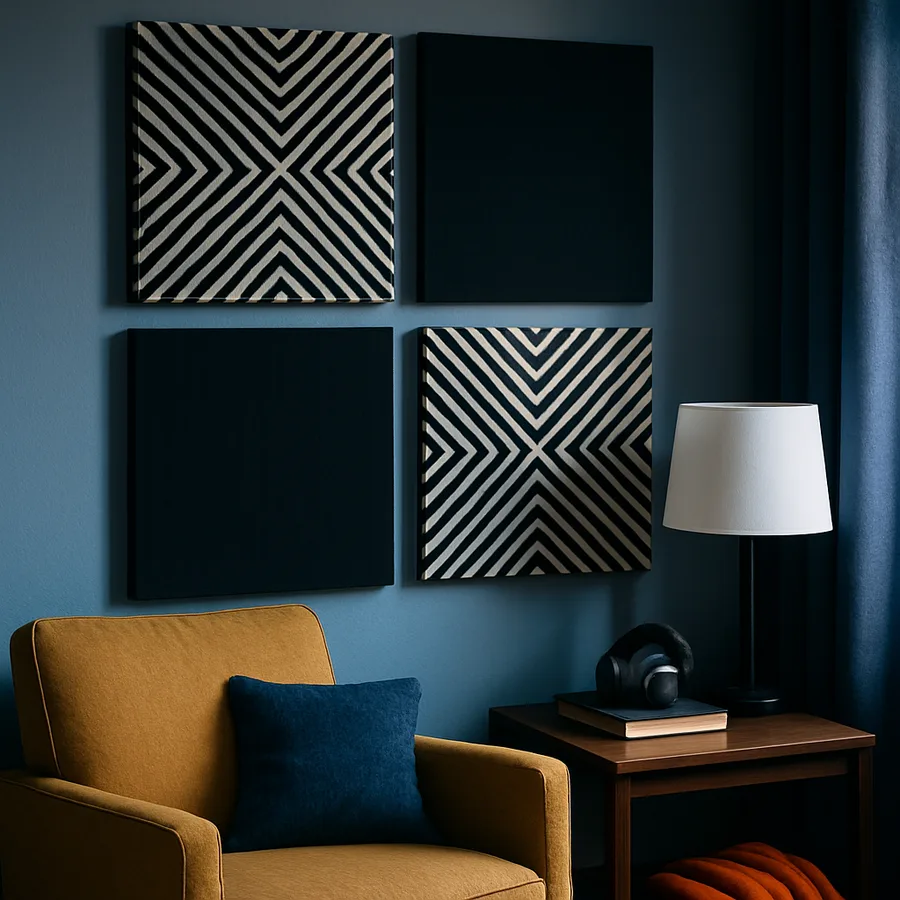
Arranging panels as a gallery wall rather than a uniform grid adds visual sophistication. Mixing panel sizes, incorporating some rectangular and some square formats, and varying the spacing creates the curated look of an art collection rather than the institutional look of a recording studio. Leaving intentional gaps between panels where the wall color shows through breaks up the visual mass and prevents the treatment from feeling oppressive. Some designers alternate absorber panels with diffuser panels of matching dimensions, creating a rhythm of smooth fabric and textured wood that is both acoustically diverse and visually dynamic.
Color coordination between panels, wall paint, furnishings, and lighting ties the room together. Monochromatic schemes where the panels are a shade or two lighter or darker than the wall create a subtle, sophisticated effect. Complementary color schemes where the panels introduce an accent color that appears elsewhere in the room's soft furnishings make the panels feel like part of the decorating rather than an addition to it. Avoid the common mistake of choosing panels in a color that exists nowhere else in the room, which makes them visually isolated and draws attention to them as foreign objects rather than integrated elements.
Installation Methods and Practical Considerations
Most decorative acoustic panels are designed for simple wall mounting using Z-clips, French cleats, or adhesive strips, depending on the panel's weight and the wall surface. Z-clips are the most secure method, using interlocking metal brackets that hold heavy panels firmly while allowing easy removal for repositioning. French cleats work similarly and are preferred for very heavy panels like thick wood slat diffusers. Adhesive strips (such as Command strips rated for the panel's weight) work for lighter foam and polyester fiber panels and leave no wall damage, making them ideal for rental spaces. Always verify the weight rating of your chosen mounting method against the actual weight of the panel, as acoustic panels are denser and heavier than they appear.
Leaving an air gap between the panel and the wall improves acoustic performance, particularly for low-frequency absorption. A gap of two to four inches effectively doubles the panel's absorptive depth without adding material, because the air space behind the panel extends the distance over which sound energy is converted to heat. Spacer blocks, standoff brackets, or deep Z-clips can create this gap while keeping the panel securely mounted. In a home theater, this technique is especially valuable because it improves bass absorption without requiring thicker, more expensive panels. The trade-off is that the panels protrude further from the wall, which may affect the room's proportions in a small space.
For ceiling-mounted panels, safety is the primary concern. Panels must be anchored into ceiling joists or structural members, not just drywall, to prevent them from falling. Wire suspension systems that hang panels below the ceiling as floating clouds are popular in both home theaters and podcasting rooms, but the wire anchors must support the panel weight with a significant safety margin. In a home theater with a large screen and projector, ceiling panel placement must also account for the projector's throw path and any ceiling-mounted speakers. Measure and plan the ceiling treatment on paper before drilling any holes.
Maintenance of decorative acoustic panels is minimal but worth mentioning. Fabric-wrapped panels accumulate dust over time and benefit from periodic vacuuming with a brush attachment on low suction. Wood slat panels can be dusted with a microfiber cloth or compressed air to clean the gaps between slats. Printed fabric panels should not be cleaned with liquid cleaners, which can cause the print to bleed or the fabric to stain. Keeping the room reasonably dust-free through regular cleaning and good HVAC filtration extends the visual life of the panels and prevents dust from reducing their acoustic performance. The National Air Duct Cleaners Association (NADCA) recommends regular HVAC maintenance in rooms with significant fabric surfaces, which includes acoustically treated rooms.
Conclusion: Rooms That Sound as Good as They Look
The old dichotomy between acoustic performance and visual appeal has been thoroughly dissolved by the current generation of decorative acoustic panels. Whether you are building a home theater that needs precise reflection control or a podcasting room that demands clean vocal capture, the products available allow you to meet professional acoustic standards while creating a space that is genuinely beautiful. The key is understanding the acoustic requirements of your specific application, selecting products that address those requirements, and integrating the panels into the room's design language so they read as intentional decor rather than functional equipment.
For home theaters, the combination of fabric-wrapped absorbers at first reflection points, wood slat or shaped diffusers on the rear wall, and carefully placed ceiling clouds delivers measurable sound quality improvements that make your audio system perform closer to its potential. For podcasting rooms, heavy absorption on the walls surrounding the microphone position, supported by corner bass traps and ceiling treatment, produces vocal recordings with the clarity and professionalism that listeners expect from established shows.
The investment in quality decorative panels is modest relative to the equipment they support. A home theater system costing thousands of dollars will always underperform in an untreated room, and a professional microphone in an echoey spare bedroom will never produce clean audio. The panels are what allow your equipment to deliver its full capability. Start by treating the single most critical surface in your room, whether that is the first reflection point in a theater or the facing wall in a podcast studio, and experience the difference before expanding the treatment to additional surfaces.
As the categories of home entertainment and content creation continue to merge with residential interior design, acoustic panels will increasingly be specified alongside paint colors, furniture, and lighting as a standard element of room design. Approaching them with the same aesthetic intentionality you bring to every other design decision in your home ensures that the result is a space you are proud to show, use, and spend time in.
More Articles You May Like



Comments
Post a Comment