Craft Room Pegboard Storage Walls for Tools and Supplies
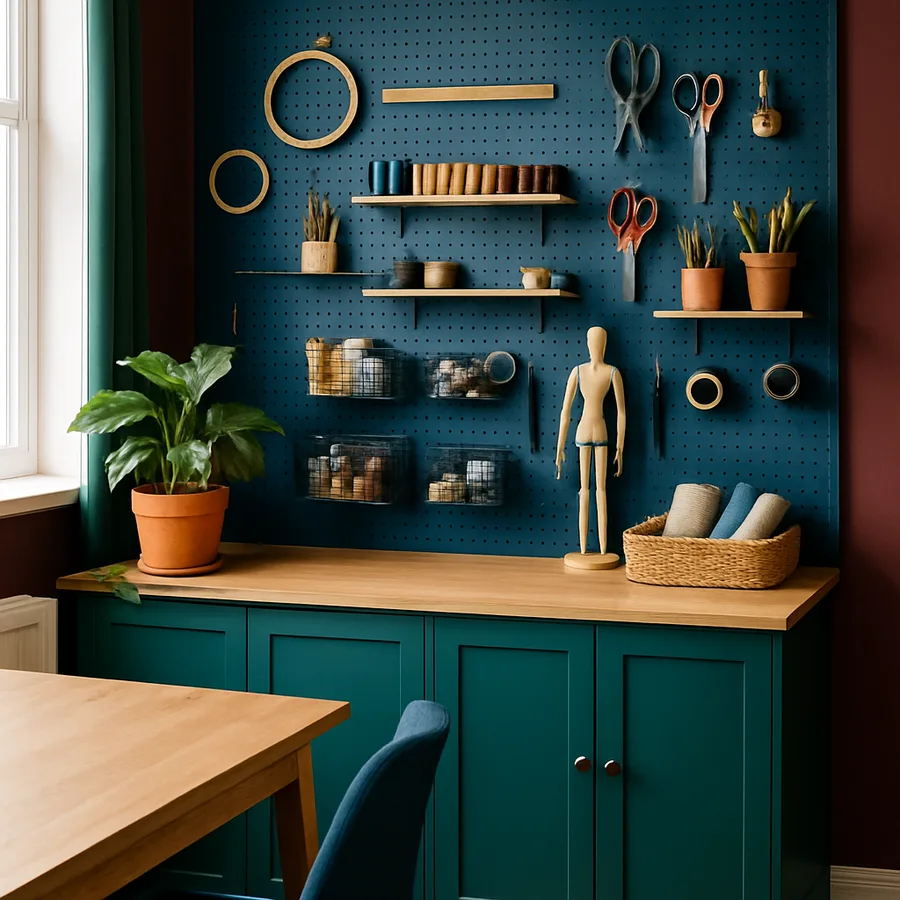
A pegboard wall is the fastest, cheapest, and most flexible storage upgrade any craft room can receive, and it consistently outperforms purpose-built drawers and cabinets across every craft discipline. The reason is simple: pegboard converts dead vertical wall space into a fully visible, reconfigurable storage surface where every tool lives in plain sight, hangs at exactly the right height, and gets returned to its dedicated spot in two seconds rather than buried in a drawer. The system was originally a workshop staple for woodworkers and mechanics, but it has slowly conquered sewing rooms, paper crafting studios, jewelry workshops, scrapbooking spaces, and mixed-media studios because the underlying principle - visible, accessible, reconfigurable storage - solves the universal problem of craft supply chaos.
This guide walks through material selection, mounting and structural reinforcement, hook systems and accessories, zoning strategies for different craft types, lighting and styling considerations, and the maintenance routine that keeps the wall functioning rather than degenerating into a cluttered shrine. Whether you are outfitting a dedicated craft room or carving storage out of a shared spare bedroom, the principles below scale to any size and budget. Have you ever stood in your craft space, surrounded by supplies you own, and still spent ten minutes hunting for a glue stick? The next sections eliminate that exact moment.
Choosing the Right Pegboard Material
Pegboard comes in three primary materials, and each has dramatically different durability, weight capacity, and aesthetic characteristics. Standard tempered hardboard pegboard, the brown sheets sold at every home improvement store, is the cheapest option at roughly fifteen to twenty-five dollars for a 4-by-8-foot panel. It works perfectly well for light-to-medium tools and small bins, but it sags noticeably over time under heavy loads and is prone to splintering at the hole edges if hooks are removed and reinserted frequently. For a typical craft room, hardboard is entirely adequate and costs a fraction of the alternatives.
Metal pegboard, often sold as steel pegboard or "wall control" panel, runs roughly six to ten times the cost but holds dramatically heavier loads, never sags, and looks far more polished in a styled craft room. The hooks lock into place with a positive engagement that prevents accidental dislodging when removing tools, which is the single most annoying failure mode of cheap hardboard. A 24-by-48-inch metal panel typically supports two hundred pounds of distributed load, compared with roughly fifty pounds for hardboard of similar size. For sewing rooms with heavy rotary cutters and rulers, or jewelry studios with metalworking pliers, the upgrade is worth the cost.
Custom pegboards in birch plywood or MDF, often used in design-forward craft studios and increasingly featured in Architectural Digest studio profiles, deliver a warm aesthetic that disappears into the room rather than reading as utilitarian. They cost more, require drilling your own hole pattern, and work best with specialized wooden pegs, but they convert the storage wall into a design element rather than a workshop appliance. The hole pattern is typically one inch on center, which provides finer hook positioning than the standard quarter-inch hardboard pattern. For high-end residential craft spaces, a wood pegboard reads as styled rather than industrial.
Wall Construction and Mounting Strategy
Pegboard cannot mount flush to the wall because the hooks need clearance behind the panel to engage. Furring strips installed behind the pegboard create a half-inch to one-inch gap that allows hook insertion and provides the structural strength to hold loaded panels stable. The strips can be ordinary 1-by-2 lumber or 1-by-3 lumber, screwed into wall studs at sixteen-inch intervals, then the pegboard screws into the strips. This sandwich construction transfers the entire load from the pegboard into the framing rather than relying on drywall anchors, which is critical for any panel carrying meaningful weight.
Stud spacing matters more than people initially expect. Most residential framing places studs at sixteen inches on center, which means a 4-by-8-foot pegboard panel will cross five studs across its width. Mark every stud before you cut your furring strips, and use a stud finder with deep-scan mode to verify no plumbing or electrical runs behind the chosen wall. A 2020 survey by the Drywall Finishing Council found that the most common DIY pegboard failure mode was inadequate fastener engagement with framing, resulting in panels gradually pulling away from the wall under load. Use 2.5-inch wood screws minimum, sunk through both the pegboard and the furring strip into the stud center, with a screw approximately every twelve to sixteen inches along each strip.
For large installations covering an entire wall, treat the project as a series of joined panels rather than a single oversized sheet. Three 4-by-4-foot panels are easier to handle, easier to align, and easier to replace individually if one section ever needs work. Use a chalk line or laser level to establish the reference line for the bottom edge before mounting any panel; small alignment errors compound visually across a long wall and can make even high-quality work look amateurish. Painting the pegboard before installation, with two coats of latex semi-gloss, dramatically improves the finished aesthetic and seals the hardboard against humidity-driven warping over time.
Hook Systems and Specialized Accessories
The hooks transform a panel of pegboard into actual functional storage, and the quality difference between cheap and good hooks is enormous. Bargain-bin hooks slide out of the holes every time you lift a tool, a failure mode that quickly becomes infuriating. Quality hooks include a positive locking feature - either a spring clip, a screw-tightened collar, or a precisely tooled bend - that holds the hook firmly in place even when tools are repeatedly removed and reinserted. Buy hooks once at higher quality rather than three times at bargain prices.
Beyond simple J-hooks, the accessory ecosystem for pegboard is extensive and worth knowing. Small parts bins clip onto the pegboard and store loose items like bobbins, beads, eyelets, brads, and small hardware. Tool holders shaped specifically for pliers, scissors, or screwdrivers cradle the tool by its handle so it sits ready to grab. Magnetic strips designed for pegboard hold metal tools without hooks. Roll holders manage spools of ribbon, tape, twine, and trim, with the spool spinning freely as you pull the desired length. Shelf brackets convert sections of the pegboard into open shelving for items that do not hang well.
For maximum flexibility, mix hook types deliberately rather than buying a single starter pack. A typical craft pegboard wall benefits from roughly twenty long J-hooks for general tools, twenty short pegs for small items, ten clip-style holders for marking pens and brushes, six small parts bins, and four roll holders. Plan the hook inventory based on the tool inventory, not the other way around. Walk through your existing supplies, count the categories, and order hooks to match. A 2024 retail study by the Craft and Hobby Association reported that craft-room organization remained the single fastest-growing category in the home storage segment, with pegboard accessories leading the growth.
Zoning the Wall by Craft Activity
A pegboard wall used for everything ends up organized for nothing. The room works dramatically better when the wall is zoned by activity, with each zone holding the supplies needed for one type of task and arranged in the order you actually use them. For a mixed craft space, the typical zones are cutting and measuring, adhesives and binding, painting and inking, sewing and fabric handling, and finishing tools. Keeping each zone contained to a defined area lets your hands learn the geography of the wall, so you reach for tools without consciously searching.
Within each zone, position tools according to frequency of use and weight. The most-used tools live at chest height, ideally between forty-eight and sixty inches above the floor, where they require no bending or stretching. Heavy tools belong at lower positions where the load is closer to the wall mounts and the framing carries the weight directly. Lightweight, less-frequently-used items can live higher on the wall, above the comfortable reach zone, because the cost of the occasional stretch is lower than the cost of cluttering prime real estate. Trace each tool's outline on the pegboard with a permanent marker after the layout is finalized: empty silhouettes make missing tools obvious and dramatically increase the rate at which tools get returned to their dedicated home.
Leave at least ten percent of the pegboard empty as flex space for future supplies and for temporarily parking tools during active projects. A wall packed to one hundred percent immediately becomes inflexible the moment you buy a new tool, and the temptation to cram becomes irresistible. Empty space is part of a working storage system, not wasted real estate. The same principle applies to the small parts bins: filled to ninety percent leaves room for restocking, while filled to one hundred percent guarantees that the next purchase has nowhere to go.
Lighting, Color, and Visual Styling
A pegboard wall can read as workshop-utilitarian or as styled craft-room centerpiece, and the difference comes down to color choice and lighting. White or light gray pegboard, with carefully selected paint, blends into modern interior schemes and lets the tools become the visible accent. Saturated colors - coral, teal, mustard, or deep navy - turn the pegboard itself into a design feature, which works beautifully for a dedicated craft room but reads as overwhelming in a multipurpose space. Sample-test the color on a small section before committing to a full wall.
Lighting transforms the wall's daily usability. A linear LED fixture mounted under a top shelf or above the pegboard throws even, shadow-free light across every hook, making it instantly obvious where empty hooks are and which tools need to come back home. Strip lighting concealed behind a small wood trim above the panel adds warmth and elevates the wall from utility to design feature. The Illuminating Engineering Society recommends task lighting of around 500 lux at any organized storage surface, which a single under-shelf LED fixture comfortably delivers across a 4-foot panel.
Add small design touches that signal "styled craft room" rather than "garage workshop." A single framed print mounted in a clear gap on the pegboard breaks the visual rhythm. A small plant in a clip-on pot adds life. Labeled wood bins in matched wood tones unify mismatched container collections. The wall is part of the room's design, not an exempt utility zone, and treating it that way pays back in pride-of-place every time you walk into the space. Have you ever invited a friend into your craft room and felt the urge to apologize for the mess? A styled pegboard wall reverses that reflex permanently.
Maintenance Routines That Keep the System Working
A pegboard wall is only as functional as the discipline you bring to maintaining it. Without regular resets, the wall slowly drifts: tools end up in adjacent zones, bins fill with unrelated items, and the empty silhouettes become invisible to your daily eye. The solution is a low-effort maintenance rhythm built into the way you finish each project. Spend the last five minutes of every craft session returning every tool to its dedicated hook, and the wall stays organized indefinitely. Skip that ritual, and the wall degrades within weeks.
Every two or three months, do a deeper reset. Pull every tool off the wall, wipe the pegboard with a damp cloth, sort the supplies in each bin, and toss anything that has expired or dried out. Markers, glue sticks, paint pens, and adhesives all have working lives, and a wall full of dried-out supplies is technically full but functionally empty. A 2023 study by the American Cleaning Institute estimated that the average household discards roughly thirty percent of craft supplies during routine deep-cleanings, primarily because the supplies were forgotten and aged out unnoticed in deep storage. Visible storage on a pegboard fights that waste pattern by keeping every supply in active sight.
Reconfigure the zones whenever your craft mix shifts. If you take up jewelry making and stop quilting, the wall should reflect that change within a season, not five years later. Pegboard's reconfigurability is its single biggest advantage over built-in cabinetry, and using that flexibility regularly is what justifies the pegboard choice in the first place. The wall is a living system, designed to evolve as your interests evolve. Walk into your craft room this weekend, pick the most chaotic corner, and start the pegboard install there. The transformation begins with one panel and grows from there.
Conclusion
A pegboard storage wall is one of the rare home upgrades that delivers immediate, daily, ongoing returns from a small investment of money and a single weekend of installation. The wall converts dead vertical space into a fully visible, reconfigurable storage system that keeps every tool reachable, every supply visible, and the entire room dramatically more inviting to work in. The cost - typically under two hundred dollars for a high-quality 4-by-8-foot installation - is a fraction of the cost of cabinetry and delivers superior organization for almost every craft discipline.
The biggest mistake people make is buying a pegboard, screwing it directly to drywall without furring strips, hanging hooks at random, and then wondering why the system feels sloppy. A working pegboard wall is engineered: structural mounting that transfers load to studs, a thoughtful zoning plan, quality locking hooks, deliberately matched lighting, and a small set of maintenance rituals. Each element compounds with the others, and the same set of supplies that felt overwhelming in a closet feels manageable on the wall.
If you are starting from scratch, measure your wall, count your tool categories, sketch the zones on graph paper, and order materials this week. Paint the pegboard before installation. Mount it on furring strips with screws into studs. Buy quality hooks. Trace tool outlines once the layout is finalized. Walk into your craft space tonight, look at the wall behind your work table, and imagine it covered in clearly organized tools rather than blank drywall. The wall is the cheapest upgrade your craft room will ever receive, and the daily payoff continues for as long as you keep crafting.
More Articles You May Like


Comments
Post a Comment