Raised Panel Wainscoting vs Flat Panel for Dining Room Walls
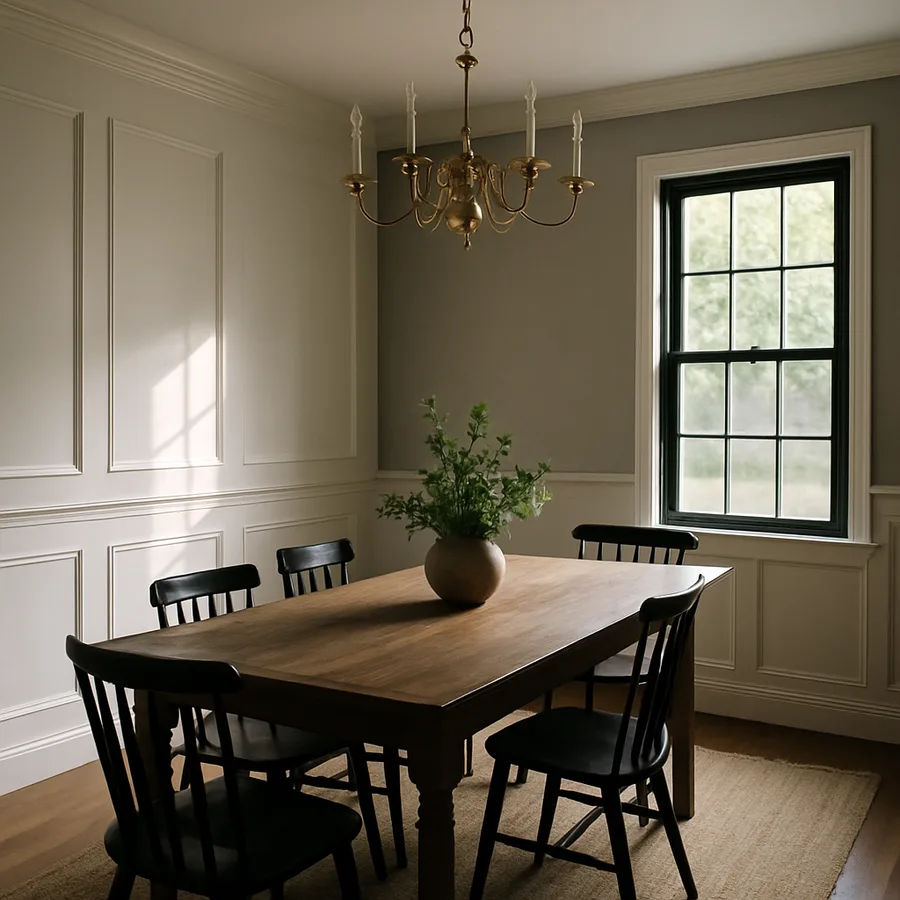
Wainscoting transforms a flat plaster dining room into an architectural composition. The decision that homeowners agonize over, often for weeks, is which kind: raised panel with its three-dimensional carved field, or flat panel (sometimes called recessed panel or Shaker panel) with its serene rectangular planes. Both have legitimate historical pedigrees. Both can be installed beautifully or poorly. And the right choice depends entirely on the era, formality, and budget of the home in question.
Houzz remodeling research has consistently shown wainscoting as one of the top three most-searched dining room upgrades, and the National Association of Home Builders Cost vs. Value report indicates that paneled walls return roughly 60 to 75 percent of their installed cost at resale in mid-range markets. That financial argument is strong, but the aesthetic argument matters more, and choosing the wrong panel type can date a room or make it feel costume-y rather than considered. This guide walks through the tradeoffs in detail.
Defining Each Panel Type
A raised panel is a center field that has been milled, carved, or routed so that its surface stands proud of the surrounding stiles and rails. The classic profile features a flat raised center surrounded by a beveled or ogee shoulder that transitions down to the frame. The visual effect is sculptural, reading three-dimensional even from across the room because of the shadow lines cast by the bevel. Historically these panels were carved from solid wood and represented serious craftsmanship, which is why they appear in the most formal Georgian, Federal, and Greek Revival rooms.
A flat panel (also called recessed panel or Shaker panel) places the center field flush with or slightly recessed from the surrounding frame. There is no bevel, no carved shoulder, no central rise. The composition reads quiet and rectangular, defined by the proportions of the stiles and rails rather than by sculptural relief. Shaker craftsmen made this style famous because their religious commitment to plain dignity rejected ornament, and Arts and Crafts and Mission designers inherited the language for similar philosophical reasons. The American Institute of Architects has documented the persistence of flat-panel work in vernacular American architecture from the Shaker villages of New York forward.
The difference matters because the same room with raised panels and flat panels will read entirely differently: the first formal and historic, the second clean and architectural. Neither is better in the abstract. Each suits particular contexts.
A small but important variant worth knowing: the recessed bead panel, which is essentially a flat panel with a small bead routed around the inside edge of the frame opening. The bead introduces a single small shadow line that sits between the pure rectilinear flat panel and the fully sculptural raised panel in formal register. Many transitional dining rooms use this hybrid because it satisfies homeowners who want a touch of ornament without committing to full Georgian formality. Stock millwork suppliers carry pre-routed flat panels with bead detail in standard sizes, making this hybrid one of the easier semi-custom options for DIY-friendly installations.
Era and House Style Compatibility
House style is the first filter. Georgian colonials built before 1830 and high-style Federal townhouses belong to the raised-panel tradition. Installing flat panels in these houses is not wrong, but it loses an opportunity to honor the home's actual heritage. Greek Revival and Italianate Victorians similarly read better with raised panels because the broader architectural vocabulary of those styles assumes ornament and depth.
Craftsman bungalows, Prairie-style houses, American Foursquares, and most farmhouses belong to the flat-panel tradition. Raised panels in these houses look anachronistic and effortful. Architectural Digest historic-house features often note this distinction explicitly, treating panel choice as a marker of whether the renovators understood the house. Mid-century modern homes generally avoid wainscoting entirely, but when used, flat panels with crisp Shaker proportions are the only defensible choice.
Reader question: what about new construction or homes whose style is genuinely mixed? Default to flat panels. They read modern enough to fit contemporary builds, traditional enough to satisfy buyers who want detail, and forgiving enough that profile mismatches with existing trim do not become glaring. The This Old House design archive has highlighted this default repeatedly in transitional new-build features.
Cost, Installation Time, and Complexity
Cost differences are significant. Flat panels can be installed using flat MDF or plywood sheets cut to size with stiles and rails applied directly to the wall surface, a technique sometimes called applied-frame wainscoting. Material cost for an average dining room runs $300 to $800 in trim and panels, plus a weekend of labor for a moderately skilled DIY-er. Professional installation typically runs $8 to $14 per linear foot.
Raised panels are substantially more expensive because the panels themselves must be milled with a specialty router bit, often using solid wood or paint-grade poplar. Pre-fabricated raised panels exist but cost three to five times what flat MDF panels do. Material cost for a comparable dining room runs $1,200 to $3,000, and professional installation typically runs $20 to $35 per linear foot. The National Association of the Remodeling Industry (NARI) reports raised-panel installations averaging two to three times the labor hours of flat-panel jobs of equivalent square footage.
Complexity also matters for DIY decisions. Flat panels forgive imperfect cuts because the frame components hide most discrepancies. Raised panels require precise milling, careful joinery, and often shop-built construction. A first-time DIYer can produce a respectable flat-panel installation; raised-panel work is best left to experienced finish carpenters or pre-fabricated kits.
Time-to-complete is another underappreciated variable. A motivated DIY-er working alone can complete a flat-panel dining room installation across two long weekends: one for layout, cutting, and rough installation, the second for caulk, paint, and detailing. The same DIY-er attempting a raised-panel installation should budget at least three weekends and accept that several panels will need to be re-cut or re-fit before the final result reads clean. Hiring a professional carpenter for the raised-panel work compresses the schedule to roughly five to seven working days, including paint, but at the labor rates noted above. Both approaches produce excellent results when the planning is solid.
Height, Proportion, and Layout
Both panel types share the same proportional concerns. The standard wainscoting height in a dining room is 32 to 36 inches (one-third of an eight- to nine-foot ceiling), though dramatic three-quarter wainscoting at 54 to 60 inches has become popular in contemporary traditional rooms. Full-height paneling that runs to the ceiling is rare in dining rooms but appropriate in libraries and studies.
Panel proportions inside the wainscoting frame should be slightly taller than wide for a formal feel, or roughly square for a casual feel. Long horizontal panels read informal and can make a small room feel cramped. The American Society of Interior Designers (ASID) recommends planning panel layout from the room's focal points outward (typically the fireplace, the buffet wall, or the principal window) so that no awkward partial panel lands in a visually prominent location.
Reader question: what if your wall length does not divide evenly into proportional panels? Adjust the stile widths slightly so each panel comes out the same dimension, even if the stiles vary by half an inch from one end of the wall to the other. The eye reads consistent panels and forgives slightly uneven framing; it does not forgive a runt panel at one end.
Paint, Stain, and Color Strategy
Color treatment dramatically affects how the panels read. Raised panels painted in light cream or off-white emphasize the carved relief because shadow lines do the visual work; the same panels in a dark color flatten the relief and can make the carving disappear. If you choose raised panels, lean toward classical light tones (Benjamin Moore White Dove, Sherwin Williams Alabaster, or comparable) unless you want the panels to read as a moody architectural background rather than ornamented surface.
Flat panels tolerate any color beautifully because the visual interest comes from the rectangular frame composition rather than from sculptural relief. Saturated colors (deep navy, hunter green, oxblood, charcoal) on flat panels have become a defining trick of contemporary traditional design over the past five years. Architectural Digest editorial features this saturated-flat-panel approach almost monthly. The strategy works because the geometric rigor of the framing reads modern even when the paint color reads traditional.
Stained installations almost always favor flat panels in oak, walnut, or cherry, finished with a clear satin coat that lets the wood grain dominate. Stained raised panels are technically possible but rare today because the carved profiles reveal end-grain and short-grain that absorb stain unevenly. If you want the depth of stained wood, choose flat panels with a beautiful species and let the material speak.
Choosing for Your Specific Dining Room
To synthesize: choose raised panel wainscoting if your home is genuinely Georgian, Federal, Greek Revival, Italianate, or otherwise pre-1900 high-style; if your budget supports the higher material and labor cost; if you want a formal, serious, almost ceremonial dining room; and if you are comfortable hiring a finish carpenter rather than doing the work yourself. The raised panel rewards investment with a depth and presence that flat panels cannot replicate.
Choose flat panel wainscoting if your home is Craftsman, farmhouse, Shaker, Mission, mid-century, or contemporary; if you prefer a clean, geometric, paint-color-driven aesthetic; if budget is a meaningful constraint; if you want to attempt the installation yourself; or if you plan to use a saturated paint color that would be wasted on raised panels. Flat panels also age well in resale because their geometric language reads neither dated nor trendy.
Reader question: can you mix the two within one home? Yes, but only when the rooms have distinct functions. A formal dining room with raised panels can coexist with a casual breakfast nook in flat panels because the rooms are programmatically different. Mixing the two in adjoining rooms with similar functions reads inconsistent.
One more consideration that frequently gets overlooked: the dining room's relationship to adjacent spaces. If the dining room opens directly into a kitchen with simple Shaker cabinetry and no traditional millwork, raised-panel wainscoting in the dining room can read as a costume change rather than a continuation. The eye crosses the threshold and registers the abrupt formality shift as artificial. In open-plan or sightline-connected layouts, lean toward flat panels in the dining room so the architectural language stays consistent across the connected spaces. Reserve raised panels for dining rooms that are genuinely separate (closed off by doors or accessed through a clear architectural transition) where the formality contrast reads as intentional rather than discordant.
Conclusion: Match the Panel to the House and the Life
Both raised panel and flat panel wainscoting are legitimate, beautiful, and historically grounded. The wrong choice is rarely the panel itself but rather a panel that fights the home's architecture, the room's actual use, or the homeowner's budget reality. Spend the first hour of planning identifying which category your house belongs to, and the rest of the decisions follow naturally.
Treat the installation as a long-term commitment. Wainscoting installed today will outlast paint colors, furniture, and probably the current homeowner. Choosing materials and joinery that age gracefully (kiln-dried hardwoods, properly back-primed MDF, coped inside corners) protects that investment for decades. Skimping on the prep work to save a few hundred dollars almost always becomes visible within three to five years.
Whichever panel type you choose, the dining room becomes the most photographed room in the house once the work is done. Friends notice, guests comment, and family meals acquire a slight ceremonial edge that they did not have before. That elevation is what wainscoting really delivers, and it is worth getting right.
Ready to commit to a direction? Order a sample of each panel type from a millwork supplier, hold them against your dining room wall in both morning and evening light, and live with the comparison for a week before deciding. For more guidance on historic and contemporary wall panel work, consult resources from the American Institute of Architects, This Old House, and the National Association of the Remodeling Industry, then book the carpenter and start the project.
More Articles You May Like



Comments
Post a Comment