Laundry Room Drying Rack Systems Mounted on Walls or Ceilings
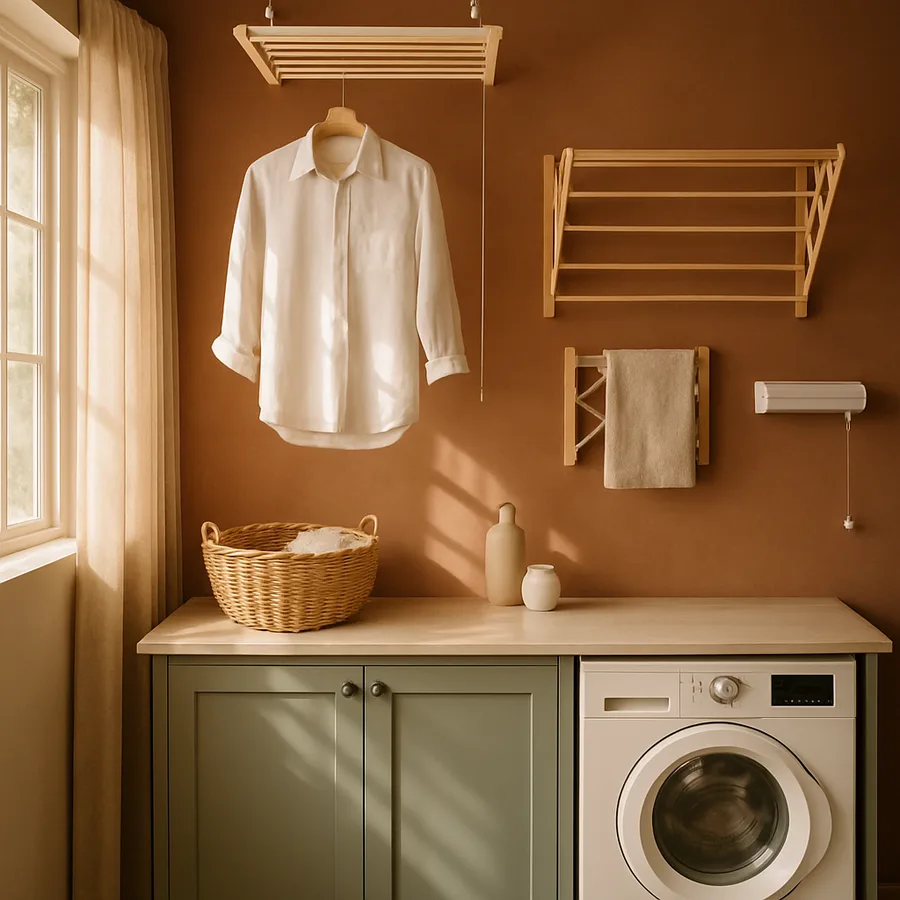
Air-drying clothes used to be something grandparents did in a backyard. Today it is a design-forward, energy-conscious choice that is increasingly central to how homeowners plan a laundry room. A well-specified wall-mounted or ceiling-mounted drying rack system can handle multiple loads per week, disappear when not in use, and save meaningful money on utility bills, all without sacrificing floor space. The trick is choosing the right system, mounting it to the right substrate, and sizing it to the amount of laundry you actually air-dry.
The energy case is genuinely compelling. According to the U.S. Department of Energy (DOE), clothes dryers are among the most energy-intensive appliances in a typical household, and the agency has repeatedly identified the dryer as one of the top electricity-consuming appliances in the home. Shifting even a third of your weekly laundry from the dryer to an air-drying rack can translate into a meaningful annual reduction in electricity use, especially if your local utility charges time-of-use rates. That same shift also extends the lifespan of your clothes by reducing heat exposure and mechanical tumbling.
The Main Categories of Air-Drying Hardware
Drying racks mounted off the floor come in several distinct styles, each with different capacity, ergonomics, and visual presence. Understanding the categories is the first step to matching the right product to your room.
Accordion wall racks mount flat against a wall and expand outward like a folding fan. When closed, they project about three inches from the wall; when open, they extend 18 to 24 inches and deploy between five and ten horizontal rods. They are inexpensive, easy to install with wall anchors or stud screws, and almost invisible when closed. The tradeoff is limited capacity: a typical unit handles one light load of small garments. They work best in small laundry rooms where an occasional air-dry is the norm rather than the routine.
Retractable clothesline systems mount a spring-loaded reel of clothesline to one wall and a cleat to the opposite wall. You pull the line across the room when you need it, clip it to the cleat, and hang clothes on the line. When you are done, the line retracts into the reel and disappears. These units are terrific in small laundry rooms and, notably, in bathrooms that double as hand-wash-drying spaces. Some models offer five to seven parallel lines, multiplying capacity dramatically.
Ceiling-mounted pulley racks, sometimes called clothes airers or sheila maids, are the classic Victorian solution revived with modern materials. A wooden or steel frame with four to eight parallel rods is suspended from the ceiling by cords running over pulleys; the frame lowers when you want to load it, then hoists back up to ceiling height where warm air naturally accelerates drying. These systems have the highest capacity of any wall or ceiling rack, handling two or three loads at once, and they are genuinely beautiful in the right room.
Wall-mounted folding racks are a hybrid: a metal frame that folds flat against the wall but swings out horizontally when deployed, similar to a Murphy bed mechanism. Capacity falls between accordion and pulley systems, and visual presence is moderate.
Load Ratings, Mounting, and Why Substrate Matters
This is the part that goes wrong most often. A drying rack loaded with wet laundry is surprisingly heavy. Wet cotton absorbs 1.5 to 2 times its dry weight in water, which means a load of wet bath towels that weighs eight pounds dry can weigh 20 pounds or more when fresh out of the washer. A fully loaded ceiling pulley rack can easily carry 25 to 40 pounds, and that weight is concentrated at the mounting points on the ceiling.
The American Wood Council publishes fastener withdrawal values for residential framing lumber; a single wood screw into a structural joist holds dramatically more weight than the same screw into drywall alone. A drywall anchor, even a high-quality toggle bolt, is rarely rated for the dynamic load of a swinging, lowering, fully loaded clothes airer. The universal rule: mount the hardware to a stud or a ceiling joist, period. If the system has two or four mounting points and only one aligns with a joist, add a piece of 1x4 hardwood backing across the joists and mount the hardware to the backing board, not directly to the drywall.
For pulley racks, the pulleys should be mounted through the ceiling into a joist or a blocking board between joists; never into drywall alone. For wall-mounted accordion racks, the top mounting screws should hit a stud; additional screws can use wall anchors as long as at least two screws engage solid wood. The International Code Council (ICC), which publishes the residential code referenced in most U.S. jurisdictions, does not specifically regulate drying-rack installation, but the underlying fastener requirements are the same as for any other hardware mounted to framing.
Where in the Room to Put the Rack
Location affects drying speed more than most homeowners expect. Air-drying is fundamentally a moisture-transport problem: water evaporates from wet fabric into the surrounding air, and the speed depends on air temperature, air movement, and how saturated the surrounding air already is. A rack installed in a stagnant corner of a cold basement will dry clothes slowly. The same rack installed near a supply register or in a sunlit room will dry clothes remarkably fast.
The ideal location has three attributes: it is near a source of warm moving air, it is high enough in the room that warm air has risen to it, and it is not directly over a trafficked walkway. Ceiling pulley racks shine here because they hoist laundry up into the warmest stratum of the room, where drying is fastest. If you have a forced-air HVAC system, positioning the rack in the path of a supply register can cut drying time nearly in half for lightweight garments.
Avoid placing racks directly over the washer and dryer. Condensation and lint from the dryer vent can redeposit on clean wet garments, and the acoustic noise of the appliances interferes with the quiet of the room. A dedicated air-dry zone a few feet away from the appliances is a better design. Have you ever hung a shirt to dry and found it smelled faintly of dryer sheets the next morning? That is the cross-contamination problem, and distance solves it.
Humidity, Ventilation, and Indoor Air Quality
A fully loaded drying rack is essentially a whole-house humidifier. In the dry winter months of a cold climate, that can actually be a benefit; in the humid summer months of a warm climate, it can push indoor humidity past the point where dust mites and mold thrive. The Environmental Protection Agency (EPA) recommends maintaining indoor relative humidity between 30% and 50% to balance comfort, health, and material preservation. A single load of wet laundry in a small closed laundry room can push local humidity well above that range within an hour.
Ventilation is the answer. A laundry room with an exhaust fan ducted to the exterior will move the excess moisture outside before it can settle into drywall or adjacent rooms. The Home Ventilating Institute (HVI) certifies residential exhaust fans and publishes sizing guidelines; a typical laundry room of 50 to 80 square feet is well-served by a fan rated between 80 and 120 cubic feet per minute. Run the fan during the first hour of air-drying and during any subsequent washing or drying activity to keep room humidity in the comfort zone.
In homes with mechanical ventilation recovery systems, including energy recovery ventilators (ERVs) and heat recovery ventilators (HRVs), laundry-room exhaust is often integrated into the whole-house scheme rather than handled by a dedicated fan. The American Society of Heating, Refrigerating and Air-Conditioning Engineers (ASHRAE) publishes standard 62.2, which governs residential ventilation rates, and certified installers will have configured the laundry-room pickup to handle the added moisture load from wet laundry.
Ergonomics, Loading, and Reaching What You Hung
The rack that looks great in a product photo is sometimes a daily frustration to use. Key ergonomic considerations: can you reach the rods without a step stool, can you load a heavy wet garment without twisting awkwardly, and can you see the garments you are hanging?
Pulley racks solve the reach problem completely because you lower them to a comfortable loading height, usually four to five feet off the floor, then hoist them up to dry. Accordion and folding racks do not have that flexibility; the top rod is fixed at whatever height you mounted the unit. For an average-height adult, mounting the top of the unit at roughly 60 to 66 inches places the highest rod at a reachable height.
Consider the weight of wet laundry when sizing mounting height. Lifting a wet bath sheet to shoulder height is more fatiguing than lifting a dry one. If your primary use case is drying heavy towels and bedding, a pulley rack is genuinely the right answer. For light garments only, a lower-mounted accordion or folding rack is fine. Have you ever shopped for a rack based on looks and then regretted it after the first load? That is the miss most homeowners make; function really does have to lead.
Spacing between rods matters too. A good rack provides at least three to four inches between rods so that draped garments can hang without touching their neighbors. Touching garments dry more slowly and can transfer dye in rare cases. Measure the rack carefully; some budget units cheat on rod spacing to advertise more rod length in a smaller footprint, and you pay for that cheat in drying time.
Style, Materials, and Integrating the Rack Into the Room
Drying hardware does not have to look industrial. Victorian-era wooden pulley racks with brass fittings bring genuine architectural character to a traditional or cottage-style laundry room. Modern stainless-steel accordion racks read as minimalist and disappear into a contemporary space. Retractable clotheslines are almost invisible when retracted, leaving just a small chrome or brass reel on one wall.
Wood species matters if you are choosing a pulley rack. Pine and beech are economical but can warp in the humidity fluctuations of a laundry room; oak, maple, and ash hold up better long-term. Metal hardware should be corrosion-resistant, ideally stainless steel or powder-coated aluminum; plain steel pulleys and cleats will rust within a few years in a humid environment. The American Cleaning Institute (ACI) has noted a steady increase in consumer interest in line-drying and air-drying equipment, and the product category has responded with genuinely beautiful options at the middle and upper price ranges.
Coordinate the finish of the rack with nearby laundry-room hardware: cabinet pulls, faucet, light fixtures. A laundry room with brushed-nickel hardware should have a brushed-nickel retractable line, not a chrome one. These small details separate a thoughtfully designed space from a catalog assembly, and they cost essentially nothing at the specification stage.
Conclusion: An Underrated Upgrade With Real Energy Savings
A well-chosen wall or ceiling drying rack system is one of the best-value upgrades available to a laundry-room renovator. The hardware itself rarely costs more than a few hundred dollars, the installation is within reach of a confident DIY homeowner with a stud finder and a drill, and the ongoing benefits in energy savings and garment longevity are measurable year over year. Add in the square footage you reclaim by getting the ironing board, drying rack, and hamper off the floor, and the case for a comprehensive air-drying strategy is hard to argue with.
As you plan, match the rack category to the way you actually dry clothes. If you air-dry one or two delicate items per week, a simple accordion wall rack is plenty. If you are committed to line-drying the majority of your laundry, invest in a ceiling pulley system with real hardwood rods and solid brass hardware. If you live in a compact condo where every inch of visible wall matters, a retractable clothesline is the elegant answer. Match hardware to use case, and the system will pay for itself in lowered utility bills within a few years.
Do not forget the supporting details. A well-performing air-drying setup depends on adequate ventilation, appropriate mounting into structural framing, and thoughtful placement in the warmest and best-ventilated part of the room. Resources published by the DOE, the EPA, and the HVI will help you think through the energy and ventilation side of the equation, while design publications from NKBA and ASID will help you integrate the hardware beautifully.
Ready to dry smarter, not hotter? Start by tracking how many loads of laundry you dry in a typical week and identifying which of those could reasonably line-dry. Then browse detailed guidance from the U.S. Department of Energy, the EPA, and the Home Ventilating Institute before you buy. An hour of planning will prevent a decade of buyer's remorse.
More Articles You May Like



Comments
Post a Comment