Comfort Height vs Standard Toilet for Aging Bathrooms
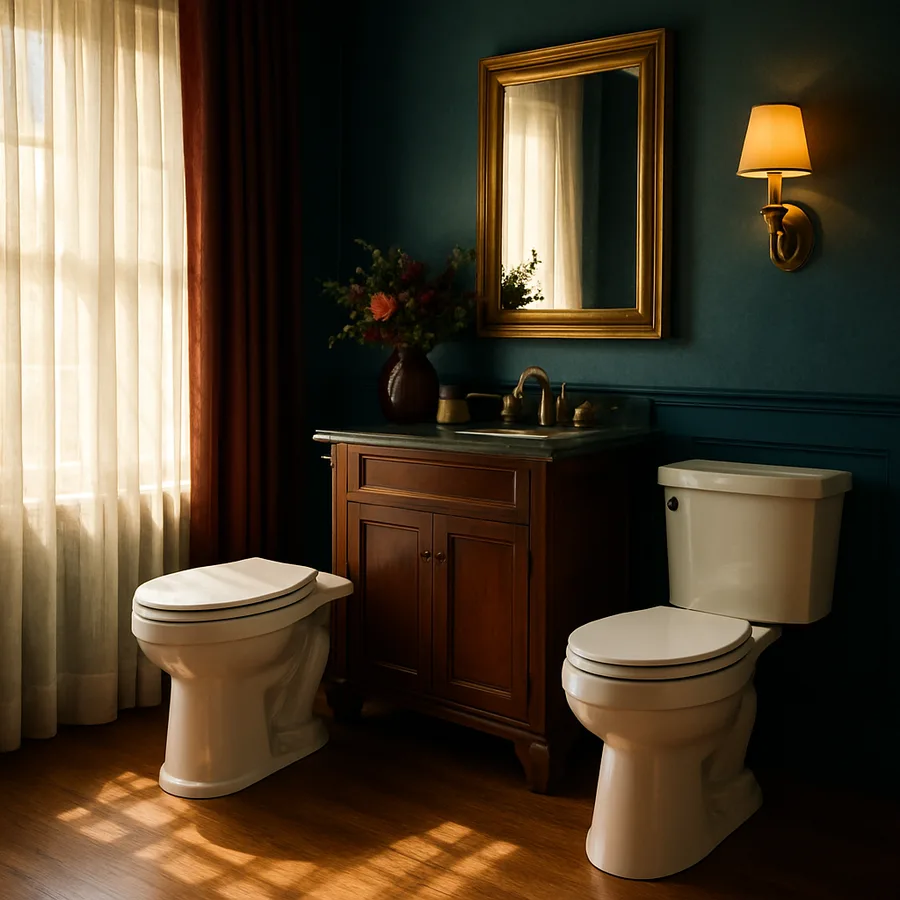
The single most consequential dimension on a toilet is one that most homeowners never measure: the height of the bowl rim above the finished floor. For decades, the American standard sat at roughly fourteen to fifteen inches, a height that pairs comfortably with average adult anatomy in midlife. Sometime in the 1990s, manufacturers began offering a taller alternative, marketed under various brand names but standardized in the industry as comfort height. The new dimension, typically sixteen and a half to seventeen and a half inches, lines up almost exactly with the seating height of a typical dining chair. The change sounds modest. The lived difference, especially for users dealing with knee, hip, or back limitations, is anything but.
That subtle two-inch shift is the entire reason comfort-height toilets are now the default specification in most aging-in-place bathroom designs. It is also the reason many universal-design new builds quietly install comfort-height units across every bathroom in the home, regardless of who currently lives there. Knees age, hips age, and recovery from a single injury can change the calculus quickly. Choosing the right bowl height is one of the few bathroom decisions that genuinely intersects with long-term health and independence, and it deserves more thought than it usually gets.
The Two Dimensions That Define Each Format
Standard-height toilets, sometimes called regular-height or traditional-height in product literature, place the bowl rim approximately fourteen to fifteen inches above the floor. With a typical seat thickness of roughly half an inch, the seated surface lands around fifteen inches from the floor. This dimension was established when American homes had smaller average occupants and shorter average lifespans, and it remained the default well into the late twentieth century.
Comfort-height toilets place the bowl rim at roughly sixteen and a half to seventeen and a half inches above the floor. With a standard seat, the seated surface lands at seventeen to eighteen inches. This range is not arbitrary. It corresponds to the seat-height range specified by the U.S. Access Board in the federal accessibility standards that underpin the Americans with Disabilities Act design guidance, which calls for water closet seats between seventeen and nineteen inches above the finished floor in accessible facilities. Comfort-height toilets are, in effect, residential implementations of the accessible-fixture range that public buildings have used for decades.
The third dimension worth mentioning is the wall-hung toilet, which can be set at any height the framing allows. While a wall-hung is not technically a comfort-height toilet, it can be installed at any chosen height between roughly fifteen and nineteen inches. For households planning around specific user heights, the wall-hung is the most flexible choice. For most other households, the comfort-height floor-mounted toilet is the practical default.
Why Two Inches Changes Everything for Aging Knees
The biomechanics of standing up from a low seat are surprisingly demanding. To rise from a fifteen-inch seat, an adult must hinge forward at the hip, transfer weight onto the toes, and then extend the knees against the load of the entire upper body. The peak knee torque required during this motion is meaningfully higher at fifteen inches than at seventeen inches, because the geometry forces a deeper knee bend and a longer extension arc. For a healthy adult in midlife, neither motion is challenging. For an adult with osteoarthritis, a recovering knee replacement, or a lower-body injury, the difference can be the line between independence and a request for help.
Geriatric care literature has measured this difference for decades. According to materials shared by the AARP Livable Communities initiative, sit-to-stand transitions are among the most common moments of falls in the home, and bathroom transitions specifically rank in the top three locations for fall-related injuries among adults over 65. Raising the seat height by two inches reduces the required muscular effort, shortens the transition time, and lowers the risk of loss of balance during the rise. Pair the higher seat with a properly mounted grab bar, and the bathroom becomes measurably safer without sacrificing visual cohesion.
For shorter users, the calculus inverts. An adult under roughly five-foot-three may find that a comfort-height seat causes their feet to dangle slightly, which can be uncomfortable for extended sitting and which can complicate certain bowel-evacuation positions. A small footstool placed in front of the toilet resolves both issues, restoring the squat-like geometry that the user's body prefers. For households with users at very different heights, the comfort-height toilet plus a small footstool is the compromise that serves both ends of the range. Have you measured the heights of the people who will use this bathroom most?
The Case for Standard Height in Specific Households
Standard-height toilets are not obsolete, and the rush to declare them so misses some real cases where the lower bowl is the right choice. The most obvious is a household with young children. A toddler learning to use the toilet has a much easier time on a fifteen-inch seat, and the lower height reduces the fall distance if the child loses balance during the climb. Many families with young children install a standard-height toilet in a primary children's bathroom and a comfort-height toilet in an adult-primary bathroom.
The second case is shorter adults. A user under five-foot-three may genuinely prefer the geometry of a fifteen-inch seat, especially if they spend extended time on the toilet. A footstool can compensate on a comfort-height fixture, but for users who do not want to manage a stool, the standard height is more comfortable from day one. Listen to the actual users rather than assuming everyone prefers the taller option.
The third case is users with specific bowel-health concerns. The traditional squat position, with knees raised above the hips, is associated with more efficient evacuation in some clinical literature, and a lower seat plus a footstool approximates that position more naturally than a higher seat. For users who have been advised by a healthcare provider to maintain a deeper squat geometry, a standard-height toilet plus a stool may be the better long-term choice.
Layering In Other Aging-Friendly Features
Bowl height is the foundational decision, but it is most effective when paired with a few complementary features. Grab bars are the obvious partner. A vertical grab bar mounted beside the toilet, anchored into solid framing, gives the user a stable handhold during the sit-to-stand transition. According to the ADA Standards for Accessible Design, grab bars in accessible toilet compartments must support a downward and lateral load of 250 pounds, and the same load rating is a sensible target for residential grab bars regardless of strict code compliance. Avoid suction-cup grab bars; they are not load-rated for the kind of loads that matter most.
Lighting is the second underrated feature. Bathroom falls are concentrated at night, and a well-lit path from the bedroom to the toilet eliminates one of the most common causes of misstep. A motion-activated night light inside the toilet bowl, a low-glow toe-kick light along the vanity, and a path of low-glare LED strips along the floor are all simple upgrades that reduce nighttime risk. The features are inexpensive individually and have an outsized cumulative effect on safety.
Flooring choices matter too. Glossy porcelain tile that is beautiful when dry can be dangerously slick when wet. The National Floor Safety Institute publishes a Dynamic Coefficient of Friction rating that quantifies wet-surface slip resistance, and bathroom floors should target a wet DCOF of 0.42 or higher. Textured porcelain, slip-resistant vinyl, and certain stone finishes meet this threshold; smooth marble and high-gloss porcelain often do not. Pair the right toilet height with the right floor and the safety benefits compound.
What to Specify on the Order Sheet
When ordering a comfort-height toilet, four numbers and two features matter most. The first number is the rough-in distance, the horizontal distance from the finished wall to the center of the floor flange. Most American toilets are designed for a 12-inch rough-in, but 10-inch and 14-inch variants exist and are common in older homes. Measure carefully before ordering; a mismatch is a frustrating return.
The second and third numbers are bowl height and overall height. Confirm that the bowl height is in the comfort-height range of 16.5 to 17.5 inches, and check that the overall height clears any window sill or wainscoting line behind the toilet. The fourth number is the seat thickness, which can add a half-inch to a full inch to the seated surface height. If the goal is to land at exactly eighteen inches seated, do the arithmetic up front.
The two features are flush volume and bowl shape. EPA WaterSense certification at 1.28 gallons per flush or below is a sensible minimum, with dual-flush configurations offering further water savings. Bowl shape, either round-front or elongated, affects both seated comfort and footprint depth. Elongated bowls, typical of comfort-height models, are roughly two inches longer front-to-back than round-front bowls, and they are more comfortable for most adults but require more floor space. In a tight bathroom, the round-front comfort-height bowl is a useful compromise.
Cost, Availability, and the Real-World Decision
For most product lines, comfort-height and standard-height versions of the same toilet model are priced within a few dollars of each other, sometimes identically. The increase in cost is essentially an increase in the size of the porcelain casting, and at production scale the difference is negligible. Where a price difference does appear, it is usually around twenty to fifty dollars, an amount that is dwarfed by the labor cost of a future fixture replacement if the wrong height is chosen up front.
Availability favors comfort-height in most retail channels. As of recent product surveys cited by the National Kitchen and Bath Association, comfort-height toilets account for roughly seventy percent of new residential toilet sales in the United States, and the share is rising. Standard-height toilets remain widely available, but the depth of the catalog, especially for premium features like dual-flush and integrated bidets, is now skewed toward comfort-height as the default.
The practical decision for most homeowners is therefore simple. If the bathroom serves adult primary users, choose comfort-height. If the bathroom serves a household with young children as the primary users, consider standard-height for that specific bathroom. If the household includes adults of significantly different heights, choose comfort-height and add a small footstool for shorter users. If the bathroom is a long-term aging-in-place project, choose comfort-height paired with grab bars, slip-resistant flooring, and good nighttime lighting. Which of those scenarios best describes the bathroom you are planning?
Conclusion: Designing for the Body You Will Have, Not Just the One You Have Now
The toilet height decision is one of the few bathroom choices that quietly compounds over a lifetime. A fifteen-inch standard-height seat works fine for a healthy thirty-five-year-old. The same seat, in the same bathroom, can become a daily struggle for the same person at age seventy-two recovering from a knee replacement. Choosing comfort-height up front is, in effect, choosing to make a future version of yourself less reliant on help in a private and important moment. The cost is negligible. The benefit is genuinely meaningful.
Universal design principles, championed by the National Kitchen and Bath Association and the AARP Livable Communities framework, push exactly this kind of forward-looking choice. The same design that makes a bathroom usable for a recovering injury or an aging parent visiting for the holidays is the design that quietly works better for everyone, every day, for decades. Comfort-height toilets are the canonical example: a small dimensional change that ages with the household instead of against it.
For renovations that are not specifically aging-focused, the comfort-height choice still tends to be the right one for an additional reason. Resale data consistently shows that buyers in the mid-to-upper price range read comfort-height toilets as a signal of a thoughtfully renovated bathroom, even when they cannot articulate why. Bathrooms with comfort-height fixtures simply feel current, while bathrooms with low standard-height bowls can feel dated even when other elements have been updated.
Before finalizing the order, walk into the bathroom and stand where the toilet will sit. Visualize the daily users of that toilet at three life stages: today, ten years from now, and twenty years from now. Choose the fixture that serves all three of those moments well, and pair it with grab-bar blocking inside the wall framing even if the bars themselves are not installed yet. Future-you, or a future household member, will be quietly grateful for the foresight. For a deeper guide to aging-friendly bathroom design, the AARP HomeFit and ADA Standards for Accessible Design publications are both excellent starting points and worth reading before any major bathroom decision is finalized.
More Articles You May Like



Comments
Post a Comment