Quartz vs Granite Vanity Tops: Which Lasts Longer in Bathrooms
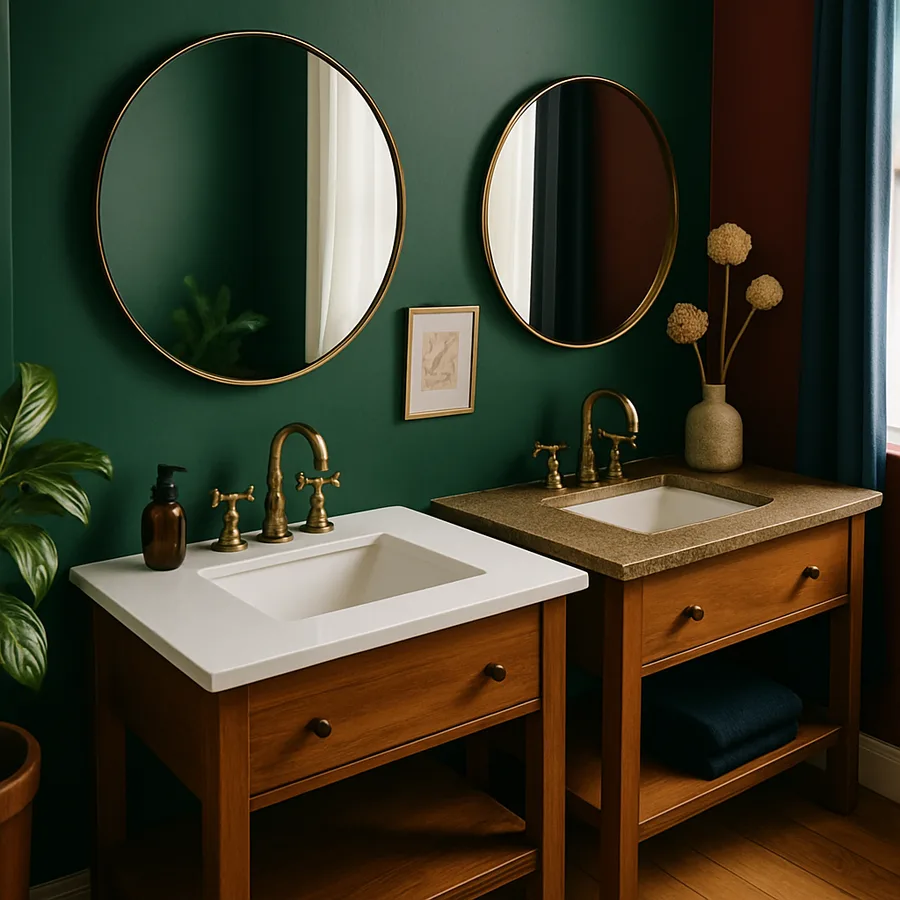
Ask ten homeowners which surface lasts longer in a bathroom and you will get roughly five votes for quartz, four for granite and one honest shrug. Both materials sit at the premium end of the vanity-top market, both are marketed as essentially bulletproof and both show up in nearly every kitchen-and-bath showroom in North America. The marketing is loud, but the longevity story is more nuanced than either camp admits. This head-to-head is organized around the actual questions homeowners should be asking: What fails first? How does each surface age? And for a bathroom specifically, which one stays looking new longer?
The short answer is that both materials, when properly selected and installed, routinely last 20 to 30 years in a bathroom. The longer answer is that the failure modes differ dramatically, the maintenance commitment is not equivalent, and your household's habits often matter more than the material you choose. Industry data from the NAHB remodeling surveys consistently shows stone vanity tops in the top-returning categories for resale value, but the surveys do not tell you whether your particular top will still look great at year fifteen.
Understanding What You Are Actually Buying
Granite is a natural igneous stone, quarried in large blocks and cut into slabs. It is crystalline, visibly heterogeneous, and every slab is unique. The Natural Stone Institute (NSI), which absorbed the former Marble Institute of America, grades commercial granite slabs on a multi-tier system accounting for soundness, color consistency and the presence of natural fissures. A higher grade means fewer resin-filled fractures and better long-term performance, not just a better appearance.
Engineered quartz is a composite material built from roughly 90 to 94 percent ground natural quartz bound with 6 to 10 percent polymer resin and pigment. Brand names dominate the category: Caesarstone, Silestone, Cambria, MSI and Corian Quartz are among the most widely specified. The resin content is what makes quartz nonporous, uniform and sensitive to UV light and high heat in ways that natural granite is not. ASTM International standard C1528 covers selection and use of natural stone in architecture, and ASTM C1527 covers engineered stone; fabricators with both standards on file signal a serious shop.
Staining and Porosity
In a bathroom, staining means toothpaste, makeup, hair dye, perfume and occasionally stronger chemicals. Engineered quartz wins the raw stain test by a comfortable margin because the resin binder renders the surface effectively nonporous. A Kohl Center for Materials Research comparison and multiple independent trade publications report quartz absorption rates near zero percent by weight, compared with 0.2 to 0.5 percent for unsealed granite. In practical terms, that means quartz tolerates a careless moment with hair color dramatically better than unsealed stone.
Granite can close most of the gap with proper sealing. A quality penetrating sealer reduces absorption into the range where normal bathroom spills are not an issue, provided you wipe within a reasonable time and reseal on schedule. How often is on schedule? NSI guidance suggests testing annually by dropping water on the surface; if the droplet darkens the stone within 10 minutes, it is time to reseal. In a bathroom this typically means every two to four years, versus never for quartz. If you hate maintenance chores and frequently use intense pigments at the vanity, quartz is the safer choice.
Heat Resistance and Hot Tools
This is the category where granite wins decisively. Natural granite formed at volcanic temperatures and handles a hot curling iron, flat iron or dropped hot water bottle with no meaningful damage. Placing hot objects directly on the surface is not recommended as a daily practice, but occasional contact causes no staining, discoloration or cracking.
Engineered quartz, because of its polymer content, is genuinely sensitive to high heat. Direct contact between a hot styling tool and the surface can leave a white or yellowish mark that is difficult or impossible to remove. The damage pattern is usually localized, so a single incident does not destroy the top, but it is a permanent reminder. Quartz manufacturers typically specify a maximum continuous surface temperature of roughly 150 to 180 degrees Fahrenheit; hair styling tools routinely operate at 300 to 450 degrees. If your household includes heavy styling routines, do you want to manage that risk with a heat-resistant mat every single time?
Chip, Crack and Edge Durability
Edge durability is the most underreported failure mode in stone vanities. Both materials are hard and brittle, and a dropped glass bottle on the front edge can chip either one. The repair story differs, though. A chipped granite edge often accepts an epoxy fill that is nearly invisible when executed by a skilled fabricator, because the surrounding stone has natural color variation that hides the repair. A chipped quartz edge is harder to disguise because the pattern repeats uniformly, and a poorly color-matched repair stands out.
Cracks are rare in thicker slabs, more common in thinner tops and especially common around sink cutouts where stress concentrates. This is why quality fabricators reinforce the corners of cutouts with a small radius rather than a sharp angle. The ISSFA and NSI both publish fabrication best practices covering exactly this detail, and any fabricator worth hiring will be able to discuss cutout radius, seam placement and substrate support in detail before the job begins. Ask those questions; the answers tell you whether you are hiring a craftsperson or a saw operator.
Edge profile choice interacts meaningfully with durability, and this is a conversation worth having with your fabricator before the slab is cut. A square eased edge is the most contemporary look but exposes a 90-degree corner that chips more easily than softer profiles. A bullnose or half-bullnose rounds the corner and substantially reduces chip risk; ogee and waterfall profiles fall in between. For bathrooms with kids or pets, or for anyone who occasionally drops glass bottles, a softer profile is simple insurance. The Natural Stone Institute publishes illustrated guidance on edge profiles for different use cases, and it is a worthwhile half-hour read before finalizing your order.
Substrate support under the top also influences crack risk, and the rules are slightly different for quartz versus granite. Quartz manufacturers typically specify a fully supported cabinet top with no overhang greater than six inches without additional bracketing, because the resin-and-aggregate matrix has less flex than cement-bound systems. Granite tolerates slightly longer unsupported spans but still benefits from a full plywood deck. The ISSFA and NAHB both maintain reference documents on cabinet preparation for stone tops, and any fabricator who cannot reference those documents in a conversation is signaling limited depth. A good installer arrives with a pre-printed checklist of cabinet conditions to verify, and if something is out of tolerance, they pause rather than improvising.
Appearance Over Time
Aging is where bathroom conditions expose a quiet weakness in engineered quartz. The polymer resin that makes quartz nonporous also makes it sensitive to ultraviolet light, and bathrooms with a south-facing window can see color shift on lighter quartz tops over five to ten years. Manufacturers have improved UV stability significantly, but the ASID material specifications for naturally lit bathrooms often flag this as a planning consideration, especially for brilliant whites and bright pigments.
Granite is essentially UV-immune. A natural stone installed in direct sunlight looks the same after two decades as on installation day. The flip side is that natural variation within a slab can lean unpredictably; the piece you approved from a warehouse inspection is what you get, and any regret about pattern intensity sticks with you for the life of the top. For quartz, the slab you chose is effectively what every slab of that SKU will look like, so there are fewer surprises once it is installed.
Cost, Installation and the Long-Term Math
Pricing overlaps substantially. Installed granite runs roughly 60 to 200 dollars per square foot depending on grade, origin and edge profile. Installed engineered quartz lands in a similar 70 to 180 dollar range, with premium brands pushing above 200. According to NAHB Cost vs Value data, both materials recover roughly 60 to 70 percent of their cost at resale in a midrange bathroom remodel, making them economically similar at the moment of sale.
The long-term math favors whichever material matches your behavior. A diligent sealer gets another decade of like-new performance from granite at a material cost advantage. A household that hates maintenance will be happier with quartz and accept the heat-sensitivity trade-off. Both materials, if abandoned to rough use with no care, will show their age within a decade. The NKBA member survey shows that designer specifications split almost evenly between the two materials across residential projects recently, which is the strongest signal that neither is universally better; both are excellent when matched to the right client.
Conclusion
Quartz and granite both deserve their reputations as premium vanity-top materials, and neither is automatically the better choice for your bathroom. The honest answer to "which lasts longer" is a tie in raw structural life, with meaningful differences in the failure modes along the way. Granite ages elegantly with proper sealing but requires that sealing. Quartz skips the sealing entirely but punishes hot tools and can shift in color under direct sunlight. Your decision should weigh which trade-off you are genuinely willing to live with for two decades.
Household style matters more than buyers admit. A minimalist household that uses the bathroom for routine grooming and expects the surface to behave invisibly will usually prefer quartz. A household that already cares for a wood cutting board, a leather jacket or a natural stone patio and understands that fine materials reward attention will often prefer granite. There is no wrong answer; there is only the answer that matches how you actually live.
Whichever material you choose, source it carefully. Visit the slab yard for granite and approve the specific slab before fabrication begins. For quartz, request a full-size sample in the exact lighting of your bathroom rather than trusting a small chip. Hire a fabricator who references both ASTM standards and NSI best practices without prompting. And once the top is installed, follow the manufacturer care guide for a full year; the habits you build early are the habits that determine how the surface looks at year fifteen.
Still undecided between quartz and granite for your bathroom? Book a side-by-side showroom appointment this week, bring your tile and fixture selections, and put a sample of each in your actual bathroom lighting for 48 hours before deciding. The right surface is the one that still makes you smile a decade from now.
More Articles You May Like



Comments
Post a Comment