Bird Cage Placement Considerations for Light Drafts and Family Areas
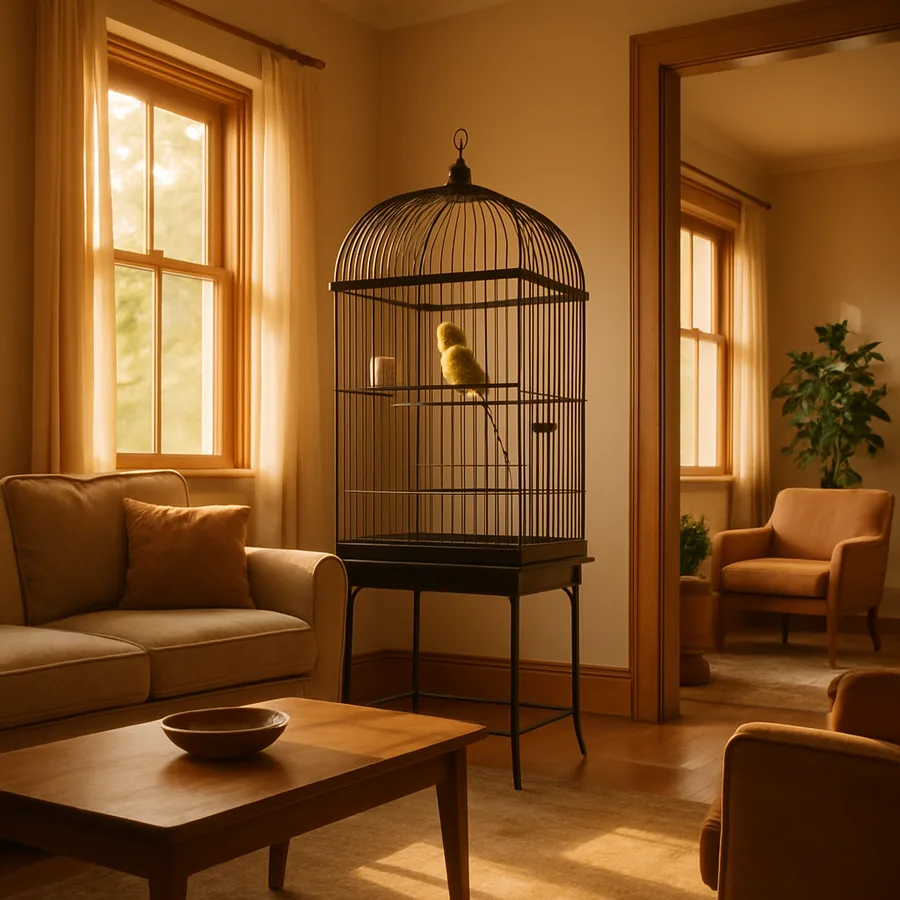
The decision about where to put a bird cage in a home is treated as a furniture problem and is actually a husbandry problem. Companion birds are sensitive to drafts, sudden temperature swings, ultraviolet light availability, social isolation, and airborne contaminants, and every one of those variables changes with the position of the cage in the room. Most pet owners locate the cage on the basis of where there is empty floor space and discover months or years later that the bird's stress behaviors, feather quality, or laying problems trace back to the placement. The good news is that the right placement is not difficult, it just has to be deliberate, and the same logic applies to budgies, cockatiels, and the larger parrots that increasingly share American living rooms.
The Three Variables That Determine Cage Position
Three considerations dominate the placement decision, and the rest of the analysis flows from them. The first is access to natural light, which the bird needs for both circadian rhythm and vitamin D synthesis. The second is protection from drafts, which include obvious sources like open windows and exterior doors and less obvious sources like air-conditioning vents and ceiling fans. The third is social proximity, which means the cage should sit in a room where the family actually spends time, because companion birds form pair-bonds with their humans and isolated birds develop behavioral problems that are difficult to reverse.
Those three variables interact, and the interaction is where placement gets interesting. The sunniest spot in the house is often the spot with the worst drafts, because windows leak air around the perimeter and large windows leak more than small ones. The most social room is often the kitchen, which contains airborne hazards (nonstick cookware fumes, smoke from burnt food) that can kill smaller bird species in minutes. The right placement therefore balances the three variables rather than maximizing any one of them, and the balance differs from house to house.
The American Veterinary Medical Association publishes general guidance on companion bird welfare, and the AVMA companion bird resources are a useful authoritative reference for the medical implications of housing decisions. The placement choices that an experienced avian veterinarian recommends are all rooted in the same three-variable framework, and the framework predicts which placements work and which create problems.
Natural Light and the Vitamin D Question
Birds evolved in environments with full-spectrum sunlight, and the indoor environment of a typical American home delivers a tiny fraction of that light intensity even near a sunny window. Glass blocks the ultraviolet B wavelengths that birds need to synthesize vitamin D, which means a cage placed against a closed window receives plenty of visible light but very little of the biologically active UVB. The ASPCA notes that vitamin D deficiency is one of the most common nutritional problems in companion birds, and the ASPCA bird care resources recommend either supplementation, full-spectrum avian lighting, or supervised outdoor time to address the deficiency.
The practical implication is that "near a window" is the right placement for circadian rhythm but not a complete solution for UVB needs. Most experienced bird owners pair window placement with a full-spectrum bird lamp mounted above or beside the cage, and the lamp is left on for 8 to 12 hours per day on the same schedule as the natural daylight. The fixture and bulb together cost roughly 100 dollars and last several years, which is a small investment compared to the medical cost of treating a calcium-deficient laying hen or a feather-plucking parrot.
The other light-related issue is duration. Birds need a clear distinction between day and night, and rooms with bright artificial lighting that runs late into the evening confuse the circadian system. Cockatiels and budgies are particularly sensitive; chronic late-night light exposure has been linked to chronic egg-laying in females and aggression in males. The fix is either a covered cage at a fixed time each evening or a separate sleep cage in a quiet room, and either solution works as long as the bird gets approximately 10 to 12 hours of darkness per night.
Drafts, HVAC, and the Invisible Threats
A draft is any moving column of air that strikes the bird repeatedly, and drafts are far more common in American homes than most owners realize. The obvious sources are open windows, gaps under exterior doors, and unsealed dryer vents, but the more frequent culprits are forced-air heating and cooling registers. A cage placed within five feet of an active register, especially one mounted in the floor or low on the wall, exposes the bird to a continuous stream of conditioned air at temperatures significantly different from the ambient room temperature. The bird's response is to fluff its feathers and reduce activity, both of which look like contentment but actually indicate thermal stress.
Ceiling fans are the second most common indoor draft source. The fan does not move air at high enough velocity to cool the bird directly, but the constant air motion disrupts the still microclimate that the bird relies on to regulate its body temperature. A cage directly under a ceiling fan running on any setting other than off is in a draft, even if the human occupants of the room cannot feel the airflow at standing height. Move the cage to a wall away from the fan, or turn the fan off when the bird is in the room, and the problem disappears.
The kitchen presents a different category of airborne threat that is not technically a draft but is far more dangerous. Polytetrafluoroethylene cookware, the nonstick coating sold under various brand names, releases fumes when overheated that are lethal to birds at concentrations far below the level humans can detect. Self-cleaning ovens release similar fumes during the cleaning cycle. A cage in or adjacent to a kitchen with nonstick cookware is at chronic risk, and the safe response is to either remove the cookware from the home or place the cage in a room not connected to the kitchen by open air. There is no middle path; the toxicity is acute and rapid.
Social Placement and the Family Room Question
Companion birds are flock animals, and they treat the human family as their flock. Isolation is therefore a welfare issue, not just a behavioral preference. A cage in a back bedroom that the family enters only for sleep produces a bird that is socially deprived for 16 to 18 hours per day, and the cumulative effect is feather plucking, food refusal, screaming, and other stress behaviors that are difficult to reverse once they become established. The cage belongs in the room where the family actually congregates.
For most homes that room is the family room or the open kitchen-living area, and the kitchen-living combination raises the airborne-toxin question discussed above. The clean answer is a family room separated from the kitchen by some barrier (a wall, a partial wall, or even just sufficient distance) and ventilated independently. A cage placed against the back wall of a family room, six to eight feet from the nearest exterior window, with a clear line of sight to the typical family seating, hits the social requirement without compromising the draft or light requirements.
How much human interaction does the bird actually need? The answer depends on the species. Budgies and cockatiels do well with one to two hours of direct interaction per day plus passive presence the rest of the time; African Greys, Amazons, and macaws need three to four hours of direct interaction or they decline. The cage placement should reflect the anticipated interaction level. A bird that will receive an hour of direct attention per day from a busy family does not need to be in the most-used room in the house; a bird that will receive four hours of attention per day from a retiree who reads in the living room every evening absolutely should be in that living room.
Cage Height, Sight Lines, and Predator Anxiety
The height of the cage above the floor is a placement decision that interacts with bird psychology in non-obvious ways. Birds in the wild perch high and view the ground as the territory of predators, and the same instinct operates in companion birds. A cage placed at floor level produces an anxious bird that flinches every time a human walks past, because the human looms overhead in the same threat geometry as a hawk. A cage placed at human eye level (roughly five feet above the floor) produces a bird that engages with the family at parity and shows fewer startle behaviors.
The sight lines from the cage matter as much as the height. A bird that can see the entrance to the room sees humans approaching well before they arrive at the cage, and that warning eliminates the startle response that drives many cage-aggression problems. A bird that faces a blank wall, conversely, is constantly surprised by humans appearing at the cage edge from outside its visual field, and the cumulative startle exposure produces stress and defensive behaviors. Orient the cage so the bird's primary perch faces the room entry, and the behavioral problems most owners attribute to "personality" largely disappear.
The cage should also have one solid side. A cage exposed on all four sides leaves the bird with no place to retreat from perceived threats, and birds that cannot retreat develop generalized anxiety. A cage placed against a wall, with the wall behind the primary perch, gives the bird the option of facing the room when curious and turning away when overwhelmed. That single placement detail is the difference between a relaxed companion and a perpetually nervous one, and it costs nothing.
Practical Room-by-Room Evaluation
The living room is the most common cage location and usually the right one, with three caveats. First, no fireplace. Wood smoke and gas fireplace combustion both produce airborne contaminants that birds tolerate poorly. Second, no exterior wall during winter in cold climates without supplemental insulation; the cold radiating off a single-pane window can stress a tropical species. Third, no media wall with a large television; the sudden loud sounds and rapid screen changes startle birds and produce chronic stress.
The home office can work for owners who spend most of their workday at home and want the bird's company during work hours. The advantages are constant human presence, controlled lighting, and protection from kitchen hazards. The disadvantages are typically the same exterior-wall-and-window concerns as the living room, plus the noise of the bird during phone calls, which is a serious issue for some species and a non-issue for others. A budgie or cockatiel in a home office is usually fine; a cockatoo in a home office is usually a career-ending decision.
The bedroom should not be the primary cage location for any bird, but a separate sleep cage in a bedroom can be an excellent supplement to a primary cage in the family room. The sleep cage is smaller, simpler, and used only for nighttime, and the practice of moving the bird to the sleep cage at a fixed evening hour establishes the day-night rhythm that the species depends on. The American Veterinary Medical Association's guidance on companion bird welfare explicitly endorses dedicated sleep arrangements as an evidence-based welfare improvement, and the practice has become standard among committed bird owners over the past decade.
Seasonal Adjustments and Long-Term Stability
Cage placement is not a one-time decision. The right spot in summer can be the wrong spot in winter, because the same window that delivered ideal morning light in July becomes a cold draft source in January. Owners who track their birds attentively often have a "summer placement" and a "winter placement" within the same room, and the seasonal move takes ten minutes once a year. The disturbance to the bird is brief and the welfare benefit is significant.
The other long-term consideration is renovation. Any planned remodeling that involves the cage room (paint, refinishing floors, new flooring installation) should be timed so the bird is housed elsewhere during the work. Construction dust, paint fumes, and floor-finish solvents are all toxic to birds at concentrations that are unremarkable to humans, and the temporary relocation to a friend's home or a quiet utility room for the duration of the work is the safe choice. Plan the relocation as part of the renovation timeline rather than as an afterthought.
Have you established a baseline for normal behavior in the current placement? Most owners cannot answer that question precisely, but a five-minute observation log kept once a week (preening, vocalizing, food intake, droppings appearance) creates the baseline that lets owners detect placement-related stress before it becomes a clinical problem. The same log catches medical issues earlier than visual inspection alone, and the discipline is small enough to maintain indefinitely. An owner who has logged six months of normal behavior recognizes abnormal behavior within a day; an owner who has not logged any behavior at all may not recognize abnormality for weeks.
Conclusion
Bird cage placement is the most consequential ongoing welfare decision an owner makes after the species selection itself, and the framework for getting it right is straightforward. Light from a real window with full-spectrum supplementation, protection from forced-air registers and ceiling fans and kitchen hazards, social proximity to the room the family actually uses, eye-level height with one solid wall behind the primary perch, and a separate sleep arrangement to enforce the day-night cycle. Each element is independently verifiable, and the total package can be assembled in any conventional American home with modest planning. The placement does not require an expensive renovation; it requires a deliberate choice.
The cost of getting placement wrong is paid by the bird in stress, feather damage, and shortened life expectancy, and by the owner in behavioral problems that are progressively harder to reverse. The cost of getting placement right is the half hour it takes to walk through the home with the framework in mind and identify the room, the wall, and the height that satisfy all three variables. That half hour is the highest-leverage time investment most bird owners can make, and it pays compound returns across the bird's entire 10-to-50-year lifespan.
If you have an existing bird in a placement that does not match the framework, the move can usually be made gradually rather than abruptly. Position the new cage location in advance, transfer the bird's familiar perches and toys to the new cage, and leave both cages available for a transition period of one to two weeks. Most birds adjust well to a thoughtfully planned move, and the welfare improvements show up within the first month. Schedule a placement review this weekend by walking through your home with this article in hand and tagging each room against the three-variable framework, then make the changes that the analysis identifies.
The companion bird relationship is one of the longest commitments a household pet involves, and the cage is the bird's primary environment for the duration of that commitment. Treat the placement as the architectural decision it actually is, and the bird will reward the attention with the calm, social, and engaged behavior that drew the family to the species in the first place. The right spot in the right room is not a luxury; it is the foundation of the relationship.
More Articles You May Like



Comments
Post a Comment