Swing-Arm Sconce Installation Beside Beds for Reading Light
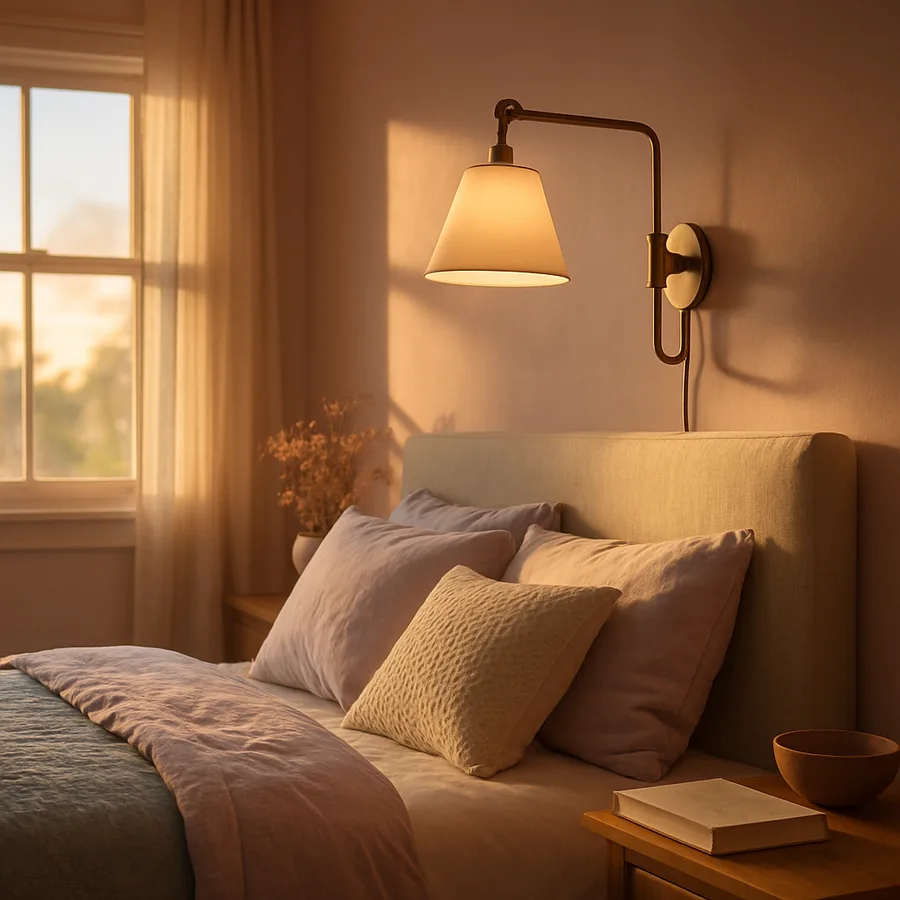
The right reading light over a bed is one of those quiet upgrades that completely changes how a bedroom is used. A bedside table lamp eats nightstand space, casts shadows when you change positions, and almost never points at the page where you actually need it. A wall-mounted swing-arm sconce solves all three problems at once: it frees the nightstand for water, books, and a charging cable; it pivots to follow the page; and it points light directly at task level without bouncing across the room. The challenge is choosing the right model, mounting it at the right height, and wiring it without ending up with a switch in an awkward location. This guide walks through the install end to end.
Why Swing-Arm Sconces Win for Bedside Reading
Three properties make swing-arm sconces particularly well suited to bedside use. First, the arm pivots, which lets a single fixture serve a range of postures (reading propped up against the headboard, reading lying on one side, or pushing the arm flush against the wall when not in use). Second, they are wall-anchored, which keeps the nightstand clear and reads as architectural rather than fussy. Third, they accept a focused shade or hood, which puts the lamp output exactly where it is needed and keeps light off your partner's face.
According to a 2024 sleep-environment survey by the National Sleep Foundation, 61 percent of adults who read in bed report some form of dissatisfaction with their current bedside lighting, with the most common complaints being inadequate brightness, glare, and the need to disturb a partner to reach a switch. A properly chosen swing-arm sconce addresses all three.
The product category has matured significantly in the last decade. Where older designs relied on stiff metal arms that would not stay in position, modern fixtures use tensioned swivel joints that hold any position indefinitely without sagging. Quality residential models cost between $140 and $480 per fixture, with the premium tier offering integrated dimmable LEDs and high-CRI color rendering.
Mounting Height Above the Mattress
Mounting height is the number-one variable that decides whether a sconce reads as professional or amateur. The reliable target is 30 to 36 inches above the top of the mattress, measured to the center of the wall-mount backplate. This range puts the swing-arm joint roughly at chest height when sitting upright against a headboard, which is the position most readers actually use.
If your bed has a tall headboard (over 48 inches above the mattress), shift the sconce up to 4 to 8 inches above the top of the headboard so the fixture is not visually fighting the headboard's profile. If the headboard is low or absent (a platform bed, for example), keep the sconce in the 30-to-36-inch range above the mattress and let the wall plane carry the visual composition.
One subtlety: the arm pivot point is what matters for ergonomics, not the backplate. If you choose a fixture with a long upper arm (say, 14 inches from backplate to shoulder), mount the backplate slightly higher to keep the elbow joint at chest height when the arm is extended. Always test the geometry by holding the fixture against the wall (or taping a paper template at full size) before drilling. Two or three minutes of mockup saves rework.
The other subtlety is horizontal offset from the bed centerline. The backplate should sit roughly 6 to 10 inches outside the edge of the mattress, not flush with it, so the arm has natural room to swing inward without colliding with the headboard. A backplate aligned exactly with the mattress edge forces the arm to extend perpendicular to the wall before pivoting, which looks awkward and fights the natural reading posture. Treat the offset as part of the bed's overall composition, the way you would treat a nightstand placement.
Projection and Reach Considerations
Swing-arm sconces vary widely in maximum extension, from compact 14-inch arms suitable for narrow rooms to generous 28-inch arms that reach across an entire pillow. The right reach depends on bed size and your typical reading position. For a queen bed where you sit roughly centered on your side of the mattress, a 22- to 26-inch maximum extension gives you full coverage across the pillow without forcing the fixture to live constantly in its fully extended position.
For a king bed, a single per-side fixture in the same range works as long as both partners are accustomed to reading in their own zones. Couples who like to share a single light source should look at a longer 28-inch arm or, more reasonably, install matched pairs on each side. Pairs are also the more common solution; the symmetry reads beautifully against a headboard, and each reader controls their own switch and dimmer.
For twin beds and guest rooms, a compact 14- to 18-inch arm is plenty. The smaller scale also reads better against the smaller bed footprint; an oversized arm above a twin can look like the fixture is borrowed from a larger room. Many readers ask whether to mix swing-arm sconces with bedside table lamps. The honest answer is no; pick one or the other per side, because the two solutions visually compete.
The arm tension also deserves attention. Lower-quality fixtures use friction joints that loosen over time, leaving the arm to droop progressively until it sits permanently extended. Better fixtures use spring-tensioned or detent joints that hold any chosen position with consistent resistance for years. Test the arm in the showroom or read fixture reviews carefully before committing; this is the single mechanical detail that decides whether a swing-arm sconce ages gracefully or becomes a daily annoyance after eighteen months of use.
Wiring Path and Switch Placement
The cleanest install of a hardwired swing-arm sconce runs 14/2 cable from a switch leg at the wall directly to the sconce's junction box, with no visible cord. The switch can be a dedicated wall switch at the entrance to the bedroom, a local pull-chain at the sconce itself, or (best of all) a switch integrated into the sconce backplate for one-hand operation from bed.
The integrated-backplate switch is the configuration most readers prefer once they have lived with both options. It puts control within easy reach without requiring you to sit up or feel for a remote. A small rotary dimmer integrated into the backplate is even better; LED-compatible rotary dimmers in this category typically cost $30 to $60 and add immeasurable usability. If wiring constraints prevent backplate switching, a wireless smart switch on the wall beside the bed is the next-best option.
Plug-in versions exist and are a legitimate choice, especially in rentals or in walls where opening drywall is not feasible. The visible cord is the trade-off; some manufacturers ship matching fabric cord covers that route the cord neatly down the wall and into a baseboard outlet. The American Lighting Association notes that plug-in swing-arms now account for roughly 35 percent of the residential market, up from under 10 percent a decade ago, driven largely by renter demand.
Lamps, Shades, and Light Quality
The light source itself matters as much as the fixture geometry. For bedside reading, target a 5- to 9-watt LED lamp producing roughly 500 to 800 lumens. This is enough to comfortably read printed text without eye strain and dim enough at lower settings for late-evening use. The Illuminating Engineering Society recommends 30 to 50 footcandles at the page for sustained reading, which a properly aimed swing-arm easily delivers.
Color temperature should sit at 2,700 Kelvin or, for readers who find themselves slightly drowsy, the warmer 2,200 Kelvin range. Avoid anything 3,500 Kelvin or higher in a bedroom; the cooler tones suppress melatonin and make falling asleep noticeably harder. Color rendering index of 90 or higher is preferable, especially for art books, illustrated covers, and any color work.
Shade choice is the often-neglected variable. A tapered drum shade with a 4- to 6-inch lower diameter directs light cleanly downward toward the page while shielding your partner from glare. A bare-bulb fixture, no matter how attractive in product photography, will broadcast light across the whole room and disturb anyone sleeping beside you. Avoid them in shared bedrooms. For solo bedrooms, an articulated reflector hood can replace the fabric shade and offer slightly tighter control over beam direction.
Matching, Symmetry, and Style Choices
Two final variables decide whether the sconces feel like architecture or accessories: matching and symmetry. Matched pairs on either side of the bed almost always read better than mismatched fixtures, even when the rest of the room embraces eclecticism. The bed is the visual anchor, and symmetry there reinforces the rest of the composition. If you genuinely want asymmetry, treat it as a deliberate design move and pair it with deliberate asymmetry elsewhere in the room (different art on each wall, different chairs, etc.).
Style matching to existing room metals and finishes is the second consideration. Brass and aged bronze read traditional and warm; matte black and brushed nickel read contemporary and cool; polished chrome reads slightly more formal. Pick the metal already dominant in the room (door hardware, light fixtures, picture frames) rather than introducing a new metal at the sconce.
The shade fabric or material is the final touch. Off-white linen shades diffuse warmly and flatter both the fixture and the room. Pleated paper shades read more traditional. Metal hood shades read more industrial or modern. Avoid pure white plastic shades; they yellow over time and tend to read as builder-grade no matter the surrounding fixture quality. Most quality swing-arm fixtures ship with replaceable shades, which means you can refresh the look without replacing the whole fixture.
Have you ever inherited a bedroom with sconces that almost worked but somehow felt off? The cause is usually a small mismatch between the sconce style and the rest of the room's vocabulary. A polished brass swing-arm above a bed flanked by walnut nightstands and matte black hardware feels like an outlier rather than an accent. Resolve these conflicts by picking the sconce metal first, since it is the visually loudest element above the bed, and then tuning the rest of the room's hardware to match. The fixture should feel like the natural conclusion of choices already made, not a foreign object dropped into a finished room.
Conclusion
A pair of well-installed swing-arm sconces beside the bed is one of the highest-impact bedroom upgrades a homeowner can make. The combination of clear nightstand surfaces, ergonomic light positioning, and a clean architectural profile transforms the bed area from a functional zone into a composed, layered space. The fixtures earn their keep every single evening they are used.
The three rules to internalize are height, reach, and switching. Mount the backplate 30 to 36 inches above the mattress, choose an arm long enough to reach the page from a relaxed seated position, and prioritize either a backplate-integrated switch or a wireless smart switch within easy reach. These three decisions decide more about the daily experience than any other variable, including fixture style.
Finish quality is the final layer. Pick lamps in the 2,700 Kelvin warm range with high color rendering, choose shades that direct light downward toward the page rather than broadcasting it across the room, and match the fixture metal to existing hardware to keep the room visually unified. The total fixture-and-install cost for a well-chosen pair lands between $420 and $1,100 in most residential markets, including hardwired electrician labor, which is modest given the daily benefit.
If your current bedside setup involves clip-on lamps, a clutter-prone nightstand, or an overhead light that disturbs everyone in the room, plan a swing-arm install this season. Measure your headboard, sketch the location of each sconce backplate, and book an electrician for the wiring before you order the fixtures. A clean, considered install lasts a decade or more, and you will notice the difference every single night you reach for a book or settle in for a quiet evening of reading before sleep.
More Articles You May Like



Comments
Post a Comment