Bed Risers For Storage Underneath Bed Frame Heights Compared
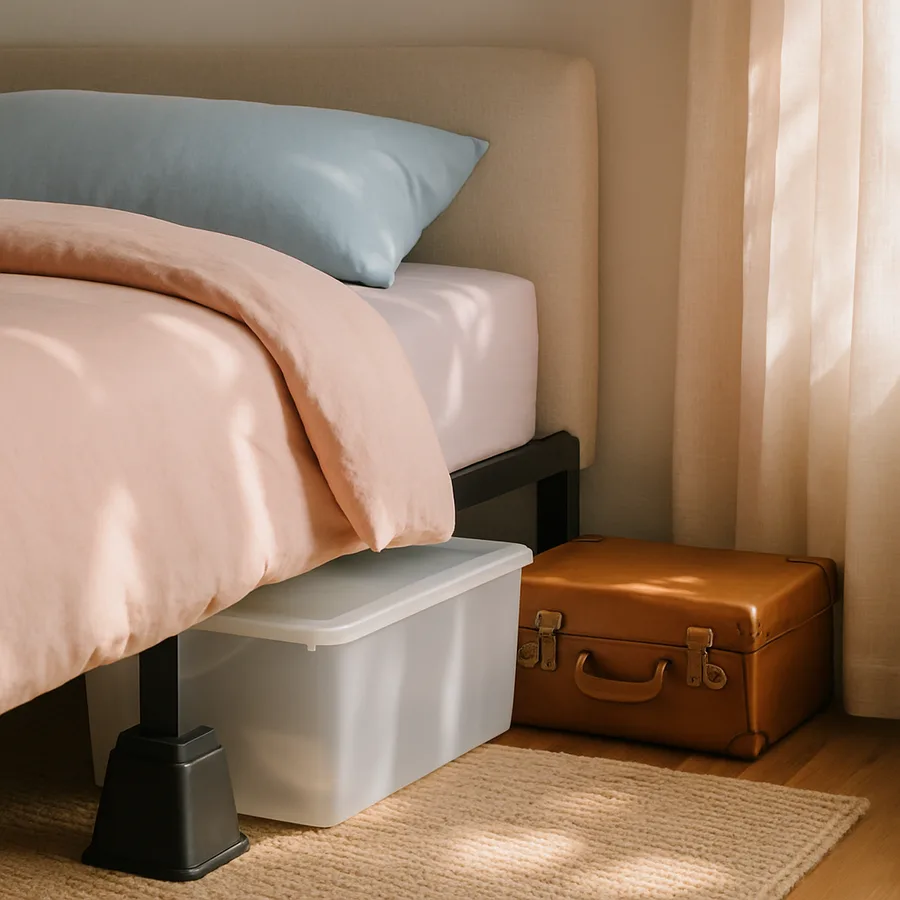
Under-bed storage is the cheapest square footage in any bedroom, and bed risers are the cheapest tool for unlocking it. A typical platform bed sits between 12 and 18 inches off the floor, which leaves only 4 to 8 inches of usable storage clearance after the frame and slats. Lift the same bed by six inches with a set of risers and you double or triple the available cubic capacity without changing a single piece of furniture. The National Association of Productivity and Organizing Professionals reports that under-bed storage is among the top three highest-yield organization interventions in residential bedrooms, second only to closet rod doubling and ahead of dresser-drawer systems.
The tradeoff is not all upside. Risers change the visual proportions of a bed, they affect mattress-top height in ways that can throw off existing nightstands, and they introduce a stability variable that depends entirely on the riser design and the frame they support. This guide compares the major riser categories by lift height, weight rating, and frame compatibility, then walks through the clearance math for the most common under-bed storage solutions. The goal is to help you choose risers that deliver the storage gain you want without compromising the bed itself.
Why Riser Height Drives Every Other Decision
The first decision is how much lift you actually need. Riser heights cluster around 3 inches, 5 inches, and 8 inches as the dominant retail options, with some specialty risers at 12 inches for very tall storage applications. Each step up unlocks different storage formats, but each step also raises the mattress top by exactly the same amount, which has cascading effects on bedding fit, nightstand selection, and how easy the bed is to climb into.
A 3-inch riser is the safe baseline. It adds enough clearance to fit most flat under-bed bins and shallow rolling drawers without changing the bed's visual proportions much. A 5-inch riser unlocks taller bins, plastic shoeboxes, and most folded-luggage formats, and it starts to read visibly as a lifted bed rather than a standard bed. An 8-inch riser is the threshold for accommodating wheeled vacuums, off-season blanket storage, and full-depth pull-out bins, but it also pushes mattress-top height past the comfort zone for many sleepers, especially shorter adults and older readers.
The honest framing is that the tallest riser that still works for your access ergonomics is usually the right answer. Have you measured how high your mattress top sits with bedding on, and added the riser height to that number? If the resulting total exceeds 30 inches, sitting on the edge of the bed becomes uncomfortable for adults under 5'7", and getting in and out at night becomes a measurable inconvenience. Style guides from Better Homes & Gardens often recommend a target seated mattress-top height of 24 to 27 inches for this reason.
Plastic Stacker Risers Versus Solid Block Risers
Riser construction breaks into two main categories. Plastic stacker risers are hollow, lightweight, and inexpensive, typically made from injection-molded ABS or polypropylene. They are sold in sets of four, with each unit accepting a standard bed leg in a recessed cup. Solid block risers, by contrast, are made from hardwood, dense rubber, or solid molded plastic, and they tend to weigh significantly more per unit while supporting much higher load ratings.
The pricing spread is substantial. Plastic stacker risers run $15 to $30 for a set of four, while solid hardwood or rubber risers run $40 to $120 for a comparable set. The weight rating spread is even larger: plastic risers typically rate between 250 and 500 pounds per leg, while solid risers can rate 1,000 to 1,500 pounds per leg. For a queen bed with two adults plus mattress and frame, total load distributed across four legs usually falls between 600 and 900 pounds, which sits comfortably inside the plastic riser range but offers far more margin with solid risers.
The reliability difference shows up over time. Plastic risers can fatigue at the recessed cup walls under sustained load, especially in warm rooms or when the bed sees aggressive movement. Solid risers do not fatigue, do not flex, and do not show visible compression even after years of use. According to general durability guidance from the American Home Furnishings Alliance, sleep-system reliability correlates with overall structural redundancy, and risers are part of that structure when they are installed.
Frame Compatibility And Leg-Type Considerations
Not every bed accepts every riser. The compatibility variable is the leg type at the foot of each bed leg. The most common leg types are flat-bottom rectangular legs, round-bottom legs, casters with locking wheels, and integrated metal feet. Plastic stacker risers usually accommodate rectangular and small round legs but cannot handle casters or wide flat feet beyond about 4 inches square. Solid block risers with custom drilled cups can handle nearly any leg type but require matching the cup size to the leg dimensions.
Caster-equipped frames present a particular challenge. Casters are designed to roll, and stacking them on top of a riser introduces a tipping risk that no riser manufacturer recommends. The right move with caster frames is to remove the casters entirely (most are bolt-on or screw-in) and install the risers directly under the threaded leg socket, which is what the caster was attached to in the first place. This restores the structural geometry the bed was designed for and adds the riser lift cleanly.
Metal-frame beds with integrated feet are the most riser-compatible because the feet are flat, defined, and load-rated. Wood frames with turned legs require attention to the leg taper at the bottom: a leg that narrows from 2 inches at the floor to 1 inch at the cup base may not seat correctly in a generic riser cup. Resources from Apartment Therapy include compatibility checklists with photos of common leg-and-riser pairings, which is worth reviewing if your bed has unusual leg geometry.
Clearance Math For Common Under-Bed Storage Formats
The point of risers is the storage they unlock, so the clearance math matters more than any other variable. Start with your bed's existing under-bed clearance, which is the floor-to-frame-bottom dimension. Most platform beds have between 4 and 8 inches of existing clearance. Most traditional frames with box springs have between 8 and 12 inches of existing clearance. Add your riser height to that number to get total available clearance, and subtract one inch as a buffer for sagging slats, dust ruffles, and the inevitable creep of mattress weight over time.
For under-bed storage formats, the dominant categories are flat fabric bins (3 to 4 inches tall), rigid plastic bins (5 to 7 inches tall), low rolling carts (5 to 8 inches tall), shoe-organizer rolling drawers (7 to 9 inches tall), and full-depth wheeled luggage (9 to 13 inches tall). Each of these has a typical lift requirement: flat bins need 4 to 5 inches of clearance, rigid bins need 6 to 8 inches, rolling carts need 7 to 9 inches, and luggage needs 11 to 14 inches.
Doing the math on a real example: a platform bed with 5 inches of existing clearance, lifted by 5-inch risers, ends up with 10 inches of total clearance, minus 1 inch buffer, equals 9 inches usable. That fits rigid plastic bins comfortably, fits a low rolling cart, and just barely fits a thin shoe-drawer rolling unit. The same platform bed with 8-inch risers would deliver 12 inches usable, which opens up the full luggage and seasonal-bedding category. Have you measured your existing clearance, picked the bin format you want, and worked backward to the riser height required? Working forward from "I want 5-inch risers" rarely produces the right answer for the storage you actually need.
Stability, Safety, And Long-Term Performance
Risers add height, and height adds tipping risk if the bed is loaded asymmetrically or pushed laterally. The main stability variables are riser footprint width, leg-to-cup fit, and floor surface. Wide-footprint risers (4 inches square or larger at the base) resist tipping much better than narrow risers, even at the same lift height. A snug leg-to-cup fit prevents the leg from rocking inside the cup, which is the most common failure mode for inexpensive plastic risers.
Floor surface matters more than most buyers expect. Hardwood floors let risers slide under lateral force, which is a problem if the bed gets pushed during cleaning or use. The fix is either a non-slip pad under each riser or a riser with a rubber bottom designed for hard surfaces. Carpeted floors create a different issue: the carpet pile compresses unevenly under the riser footprint, which can introduce a slight tilt over time. A thin plywood square (8 inches square, half-inch thick) under each riser distributes the load and prevents progressive tilting.
Long-term performance also depends on weight cycling. The bed sees load applied and released every time someone gets in or out, and each cycle stresses the riser. Solid risers handle millions of cycles without measurable change. Plastic risers under high load can show micro-cracks at stress points after a few years. According to general structural guidance referenced by groups like the National Association of Home Builders in residential durability publications, redundancy and overrating are the cheapest path to long-term reliability, which suggests buying risers rated for at least 50 percent above your expected load.
Aesthetic Integration And Hiding The Lift
The functional case for risers is strong, but the aesthetic case is mixed. A bed sitting on visible black plastic risers reads as a college dorm regardless of how nice the bedding is. Hiding the risers is straightforward and worth the small extra effort.
The most common solution is a bed skirt long enough to reach the floor at the new lifted height. Standard bed skirts come in 14, 15, and 18-inch drops; with risers, you may need a 21-inch or longer drop, which is sometimes labeled as a "tall riser" or "lifted" bed skirt. A second solution is to choose risers that visually match the bed legs, which is straightforward with hardwood risers in a stain that matches the frame.
A third option, increasingly popular in modern bedrooms, is to embrace the lifted look with intentional under-bed lighting. LED strip lighting mounted to the underside of the frame casts a soft glow that reads as designer-intentional rather than as a hidden gap. This works particularly well in primary bedrooms with platform beds and minimalist aesthetics, and it doubles as a low-output night light for navigating the room without overhead lighting. Resources from the American Society of Interior Designers have featured lifted-bed lighting installations as part of broader trend coverage on warm minimalism in residential design.
Choosing The Right Riser For Your Specific Bed
The right riser depends on three variables: how much storage clearance you need, how much weight your bed assembly will impose, and what aesthetic outcome you want. For storage gain alone, taller is better, capped by the comfortable mattress-top height for getting in and out of bed. For weight support, solid risers are almost always worth the price difference over plastic, especially for queen and king beds with two adults. For aesthetics, hardwood risers and tall bed skirts together hide the lift entirely and read as built-in furniture.
Budget-wise, the premium end of the riser market tops out around $150 for a high-end solid wood or rubber set, while the entry level lands around $20 for plastic stackers. The middle of that range, roughly $50 to $80 for a quality solid set, is the right target for most buyers. The under-$30 segment is fine for guest rooms and short-term setups but not ideal for primary bedrooms where the bed will see daily heavy use over many years.
Finally, consider whether risers are the right tool at all. If you need substantial under-bed storage and you are buying a new bed anyway, a storage-platform bed with built-in drawers or a lift-up mattress mechanism delivers more capacity, better organization, and a cleaner aesthetic than risers retrofitted to a standard frame. Risers shine when you have an existing bed you love and you want to add capacity without replacing furniture. They are a tactical solution to a specific problem, not a general substitute for a designed-in storage bed.
Conclusion
Bed risers solve a real problem cheaply and quickly: they unlock under-bed cubic capacity that would otherwise sit unused. The decision-making process is simple if you do it in order: measure existing clearance, pick the storage format you want to fit, calculate the required total clearance, and choose riser height accordingly. Skip that sequence and you end up with risers that either underdeliver on storage or push your mattress top so high that the bed becomes uncomfortable to use.
The construction-quality decision matters more than buyers usually assume. Plastic stacker risers work for guest rooms, short-term setups, and beds with light loads, but solid hardwood or dense rubber risers are the right answer for primary bedrooms with daily heavy use. The price difference of a few tens of dollars is trivial across the multi-year lifespan of a bed, and the structural margin pays off in stability and longevity. Buying once, well, almost always beats buying twice when the first set fails.
If you have an existing bed and good underlying clearance is something you can imagine using productively, take this checklist into your bedroom: measure floor-to-frame clearance, weigh or estimate total bed-plus-occupant load, identify your bed's leg type, and decide which storage format you want to enable. Make those four measurements this weekend, then shop with the numbers in hand. The set you buy with that preparation will be the right one the first time, and the under-bed storage you unlock will pay back the cost of the risers within the first season of organized seasonal storage.
More Articles You May Like


Comments
Post a Comment