Beaded Curtain Door Treatment as Soft Privacy Without Wall
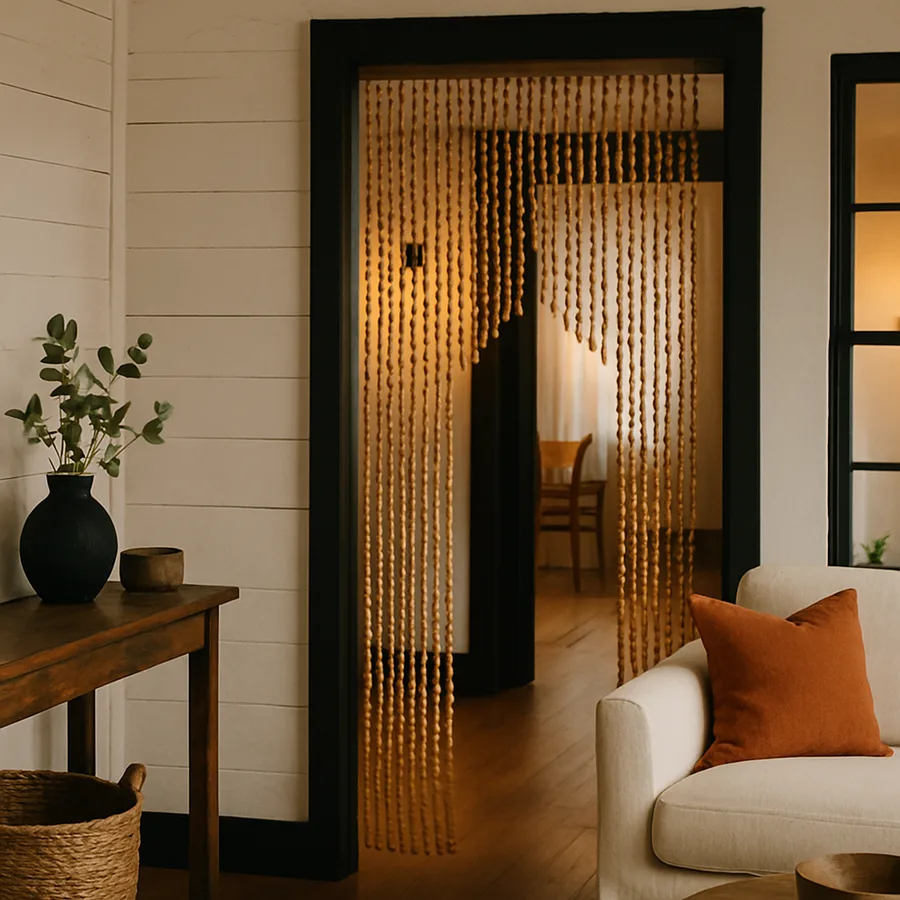
Beaded curtains carry a strong association with the 1960s and 1970s, but the contemporary versions hanging in design-forward apartments today bear only a passing resemblance to those nostalgic strands of plastic. Modern beaded door treatments use natural materials like bamboo, wood, ceramic, brass, and even hand-cut crystal to create dividers that filter light, soften sound, and suggest privacy without ever fully closing off a space. For renters, small-space dwellers, and anyone working in a studio or open-plan home, a beaded curtain in a doorway is one of the most affordable and visually rich ways to mark a transition between two functional zones without committing to a solid door.
The renewed interest in beaded curtains tracks alongside broader design movements toward textural materials, hand-craft aesthetics, and the warm bohemian sensibility that has dominated residential interiors over the past several years. According to trend reports referenced by Architectural Digest and other shelter publications, sales of natural-material beaded curtains have grown notably as homeowners look for ways to add tactile interest to neutral interiors. The combination of low cost, easy installation, and high visual impact explains much of the appeal, but the functional benefits are real as well, and they are the focus of this guide.
What a Beaded Curtain Actually Does in a Doorway
A beaded curtain creates what designers call soft enclosure, a partial visual and acoustic barrier that defines a space without sealing it. From a distance the strands read as a continuous textured surface, blurring the view through the doorway and obscuring details of the room beyond. Up close and in motion, the individual beads separate and allow easy passage, with the whole curtain swaying briefly before settling back into stillness. This dual character, opaque from afar and permeable up close, is exactly what makes beaded curtains useful in situations where a solid door would feel too final and an open doorway too exposed.
The acoustic effect is subtle but real. A dense curtain of wooden or ceramic beads breaks up direct sound transmission and reduces the perceived loudness of conversations passing through the doorway. Studies in architectural acoustics, including work referenced by the Acoustical Society of America, suggest that even modest soft barriers can reduce speech intelligibility through an opening by 15 to 25 percent, which is enough to make a sleeping area feel more separated from a living room or to keep kitchen noise from overwhelming a quiet reading nook. The curtain does not block sound the way a solid door would, but it diffuses it in a way that the brain registers as more distance.
The light effect is equally important. A beaded curtain in a sunlit doorway throws scattered patterns of shadow and reflection onto the floor and walls of the adjacent room, an effect that changes throughout the day as the sun moves. This is one of the most overlooked aesthetic dividends of the format, and it cannot be replicated by any solid material. Have you stood in a room and watched the light play through a textured surface and felt that something about the space was suddenly more alive? That is the contribution a beaded curtain makes every sunny morning.
Bamboo and Wood Bead Options for Natural Interiors
Bamboo strand curtains are the most widely available and least expensive natural option, typically priced between 30 and 80 dollars for a standard 35-by-72 inch panel. The strands are usually three to four feet long and are joined at the top by a wooden header strip with eyelets for hanging. The bamboo segments are often printed or stained with patterns ranging from simple horizontal bands to detailed scenic compositions. Quality varies widely, with the better products using kiln-dried bamboo that resists warping and lower-end versions sometimes splitting or fading within a year.
Wooden bead curtains, made from spheres or oblongs of olive wood, walnut, or birch, sit at a higher price point but feel substantially more luxurious. The beads have weight that bamboo lacks, which means the strands hang straighter, swing more deliberately, and produce a soft clattering sound when moved that many people find pleasant. Expect to spend 80 to 250 dollars for a quality wooden bead curtain in a standard doorway size, with handcrafted versions from artisan workshops reaching higher figures still. The American Hardwood Export Council notes that domestic hardwoods have grown in popularity for craft applications, and many wooden bead curtains are now made in the United States from sustainably harvested wood.
The choice between bamboo and wood comes down to the formality of the surrounding space and the wear it will receive. Bamboo reads casual, coastal, and slightly bohemian. Wood reads warmer, more crafted, and slightly more substantial. For high-traffic doorways with adults and children passing through dozens of times per day, wood holds up better and looks better longer. For decorative doorways that are passed through occasionally, bamboo is hard to beat on cost and visual impact.
Ceramic, Glass, and Crystal Bead Options for Luxe Interiors
For interiors that lean more refined or more dramatic, ceramic, glass, and crystal bead curtains move the format into genuinely luxurious territory. Hand-strung crystal curtains can cost several hundred to several thousand dollars and produce a sparkling, prismatic effect when sunlight passes through them. The most theatrical versions use multiple strands of varying bead sizes to create a depth and density that approaches the effect of a chandelier draped across an entire doorway.
Ceramic bead curtains, often handmade in small-batch potteries, offer a quieter version of the same idea. The beads have weight and texture that synthetic versions cannot match, and the slight color variation from one bead to the next gives the whole curtain a lived-in, collected quality. These are the curtains you see in high-end boutique hotels and in the homes of designers who collect ceramics. Pricing typically falls between 200 and 800 dollars for a standard doorway size, with custom commissions running considerably higher.
The maintenance requirements differ as well. Crystal and glass curtains need occasional dusting and periodic deeper cleaning to maintain their sparkle. Ceramic curtains are essentially maintenance-free aside from gentle dusting. Both types are heavier than bamboo or wood and require sturdier hardware, which we will cover in the installation section below.
Installation Methods That Actually Work
The simplest installation uses a tension rod inside the door frame, supporting a beaded curtain that has eyelets along its top header. This works for lightweight bamboo and wood curtains in standard interior doorways, typically 30 to 36 inches wide. For heavier curtains or wider openings, a tension rod will sag or slip, and you need a more substantial mounting solution.
The next tier of installation uses a curtain rod mounted to the inside of the door frame with two L-brackets. This requires drilling into the frame itself rather than the wall, which is permissible in most rentals because door frames are considered fixtures and small screw holes are easily filled before move-out. A 1-inch diameter wooden or metal rod can support up to 30 pounds of beaded curtain, which covers nearly all residential applications. Architectural Digest has documented numerous beaded curtain installations using this approach in their interior tour features, and the method is widely considered the most reliable.
For the heaviest crystal or ceramic installations, a French cleat mounted across the top of the door frame distributes the load across multiple anchor points and prevents the rod from twisting or sagging. This is overkill for most residential situations but worth the effort for premium curtains that you intend to keep for many years. The International Code Council publishes general guidance on residential anchor capacity that can help you size hardware appropriately for unusually heavy installations.
Where Beaded Curtains Work Best in the Home
The most successful beaded curtain installations are in doorways between rooms that need partial separation but full air and light flow. The opening between a kitchen and a dining room is a classic example; the curtain softens the visual transition and screens kitchen mess from view during meals without blocking the cook from conversation. The opening between a bedroom and a private bathroom is another strong candidate, particularly in older homes where the bathroom door has been removed for accessibility or aesthetic reasons.
Closet openings benefit dramatically from beaded curtain treatments, particularly in vintage homes where the original closet doors have been removed. The curtain hides the contents while still allowing easy access, and the textural quality is far more interesting than a flat fabric panel. Have you ever opened a closet covered by a fabric curtain and felt the experience was a little lifeless? A beaded curtain solves that problem completely.
Studio apartments use beaded curtains to define sleeping zones, walk-in closets, or work nooks within a single open volume. The curtain does not need to span a doorway at all; it can hang from a ceiling-mounted rod in the middle of the room to suggest a transition between functional areas. This approach works particularly well in lofts with high ceilings, where the curtain falls long enough to create real visual presence without dominating the room.
Common Mistakes and How to Avoid Them
The most common mistake with beaded curtains is choosing a curtain that is too short for the doorway. A curtain that ends six or eight inches above the floor reads as cheap and unfinished, regardless of the bead quality. Standard curtain lengths run 72 inches, but interior doorways are typically 80 inches tall, leaving an awkward gap. The fix is either to choose a longer custom-length curtain or to mount the rod lower, recessed into the doorway, so that the curtain sweeps the floor properly. The visual difference between a well-proportioned and a poorly proportioned beaded curtain is enormous.
The second common mistake is hanging too few strands. A sparse curtain looks like a sample rather than a finished product, and the privacy and light-filtering effects depend heavily on density. Aim for at least 50 strands per linear foot of door width, and ideally closer to 80 or 100 for a proper full effect. Manufacturers often advertise the total bead count rather than the strand density, so calculate carefully before purchasing.
The third common mistake is overlooking the sound. Beaded curtains, particularly those made of wood or ceramic, produce a soft clatter every time they are moved. Most people find this pleasant, but it can become a distraction in a home office or near a sleeping area. If quiet operation matters to you, choose smooth glass or polished wooden beads that slide against each other more silently than rough ceramic or bamboo.
Conclusion
Beaded curtains have evolved far beyond their dorm-room reputation into a genuinely sophisticated category of residential textiles. Modern materials, careful craftsmanship, and a renewed appreciation for textural interiors have placed the beaded curtain back into the design conversation as a legitimate alternative to solid doors, fabric panels, and architectural partitions. The format offers a unique combination of soft privacy, light filtration, acoustic diffusion, and tactile presence that no other product can match at a comparable price.
The decision to install a beaded curtain comes down to whether you want a partial separation that preserves the connection between two spaces. If you want full privacy and full sound isolation, a solid door is the right answer. If you want a little of each, with the visual interest and movement that only a beaded format can provide, the beaded curtain is the more thoughtful choice. The format is particularly powerful in transitional doorways where neither full enclosure nor full openness feels right.
For renters and small-space dwellers, the cost-to-impact ratio is exceptional. A quality beaded curtain installation can be completed in a single afternoon for under two hundred dollars and can transform the way a doorway reads in a single hour. For homeowners with more substantial budgets, custom crystal and ceramic installations move into genuinely luxurious territory while still being installable in any standard doorway.
If you have a doorway in your home that has been bothering you for years, whether because the door is missing, the room beyond is a visual mess, or the transition just feels too abrupt, this is the moment to consider a beaded curtain. Measure your opening, browse a few of the natural-material options from reputable suppliers, and order one that fits your space properly. The textural and atmospheric difference will surprise you, and the installation will take less time than you expect.
More Articles You May Like


Comments
Post a Comment