Built-In Pet Bowl Drawers in Kitchen Toe Kicks Hidden Away
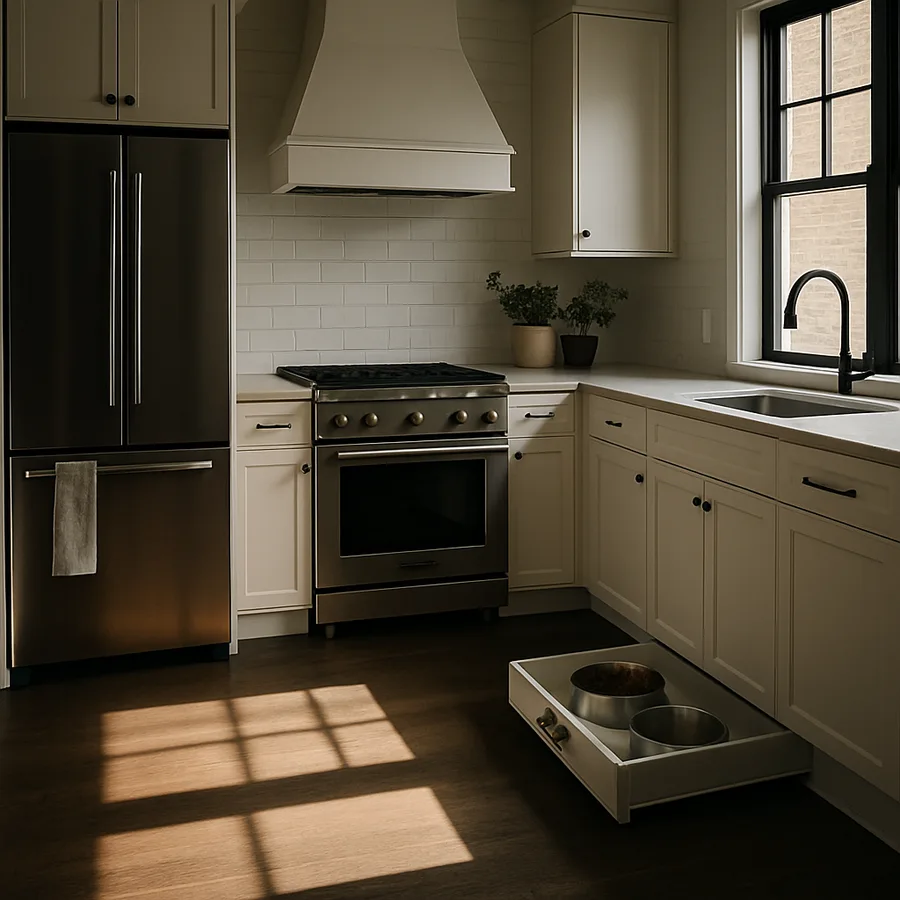
The food and water bowls that sit on most kitchen floors are a quiet design compromise. They collect dust, get kicked, and break the visual line of an otherwise considered space. Yet pets need to eat and drink in the room where the household spends most of its time, which puts the bowls and the kitchen in a permanent low-grade conflict. The toe-kick drawer solves the problem with a touch of millwork that turns a wasted four-inch zone into elegant hidden infrastructure.
This guide covers the planning, fabrication, and integration of pet bowl drawers built into kitchen toe kicks, the recessed band of cabinetry between the floor and the bottom of the lower cabinets. The technique works in new kitchens and in retrofits, suits dogs and cats of nearly any size, and brings a small but real upgrade to the everyday function of the kitchen. Done thoughtfully, the drawer disappears entirely when closed and produces meals at the touch of a foot or hand.
Why the Toe Kick Is the Right Place
The toe kick is one of the few zones in a kitchen that exists primarily for ergonomic clearance rather than storage. Standard cabinetry includes a recessed area approximately four inches tall and three inches deep at the base of every lower cabinet, which gives feet a place to go when working at the counter. The space is functionally invisible because nothing happens in it visually, which makes it ideal for hiding infrastructure that needs to be accessible but not on display.
From the pet's perspective, a toe-kick drawer at floor level is exactly the right height to eat from. Veterinary nutrition guidance from the American Veterinary Medical Association indicates that floor-height feeding is appropriate for most dogs and cats, with elevated bowls being a more specialized choice tied to specific health considerations. The toe-kick drawer keeps food at natural eating height without requiring the bowls to be permanent floor obstacles. When the meal ends, the drawer slides shut and the kitchen returns to a clean, uncluttered state.
Logistical advantages multiply the design appeal. A toe-kick drawer near the food storage cabinet shortens the daily feeding routine to a single sequence: open the cabinet above for kibble, slide out the drawer below, fill, and close. Spills are easier to manage because the drawer can be removed and rinsed in a sink. According to surveys collected by the National Kitchen and Bath Association, integrated pet features rank among the top requested customizations in pet-owning households, with the toe-kick drawer being one of the most common implementations.
Sizing the Drawer for Real Pets
Drawer dimensions need to accommodate the bowls themselves plus the clearance for paws and snouts during eating. A typical large-dog stainless bowl measures about eight inches in diameter, while smaller bowls run five to six inches. A two-bowl drawer for a medium-to-large dog needs internal width of at least eighteen inches and depth of at least ten inches to fit two bowls comfortably with a little space between. For multiple pets or larger breeds, scale up proportionally.
Vertical clearance is the hidden constraint. The standard toe-kick height of four inches is adequate for shallow bowls but cramped for deeper ones. Many designers extend the toe-kick height to five or six inches in pet-feeding zones, which accommodates standard bowl depths and allows the drawer to use a bowl-recessing cutout for stability. The slight visual change from increased toe-kick height is virtually undetectable in a finished kitchen but makes a significant practical difference.
The bowl-recessing cutout is the small detail that elevates the design. Rather than placing free-standing bowls in the drawer, the drawer top has circular cutouts sized to hold the bowls in place by their rim. This prevents sliding when the drawer opens and closes and creates the clean, integrated look that makes the feature read as built-in rather than improvised. Cutouts should match the bowl's outer diameter at the rim, with the bowl resting on a small lip that holds it at the correct height.
Hardware and Mechanism Selection
The mechanism that opens the drawer determines the daily user experience. Three approaches dominate, each with distinct trade-offs. Standard ball-bearing drawer slides operated by a recessed pull or finger groove are the most familiar option, reliable and inexpensive. The pull mechanism is functional but introduces a visual element to the toe kick that some homeowners want to avoid.
Push-to-open hardware eliminates the pull entirely. A gentle press with the toe or knee releases the latch, and the drawer slides forward on full-extension slides. This is the most elegant solution and the one that achieves the truly invisible toe-kick look, but it requires precise installation and the latches occasionally need adjustment. Premium German-engineered push-to-open systems from manufacturers like Blum and Hettich are the gold standard for kitchen applications because they tolerate years of daily use without losing their action.
Soft-close functionality is essential regardless of the opening mechanism. A drawer slammed shut by a curious dog can spill food across the kitchen and over time damage the slides. Soft-close hardware adds modest cost and prevents both noise and damage. Pair this with full-extension slides rated to at least seventy-five pounds, because the combined weight of the drawer, bowl cutouts, and full bowls of food and water adds up faster than expected.
Material Choices for Drawer Construction
Pet-bowl drawers live in a wet, occasionally messy environment that punishes inappropriate materials. The drawer box itself should be constructed from moisture-resistant materials, with marine-grade plywood being the durable benchmark. Standard kitchen-grade plywood works for the structure but should be sealed thoroughly with a water-resistant finish. Avoid particle board and standard MDF because both expand and crumble when wet, and a pet-bowl drawer will get wet repeatedly over years of use.
The drawer top, where the bowl cutouts live, takes the most abuse and benefits from a wipeable, water-resistant surface. Solid surface materials like Corian or quartz composite work beautifully because they are non-porous and easy to clean, and the cutouts can be CNC-machined to precise dimensions. Stone or quartz tops produce a similar effect at higher cost. For a more economical approach, use a high-pressure laminate or a thick polyurethane-finished hardwood, accepting that the surface will need refinishing or replacement after a decade of use.
The bowls themselves matter for the same reasons. Stainless steel is the veterinary-recommended default because it resists bacterial growth, does not leach chemicals, and stands up to dishwasher cleaning. The American Animal Hospital Association notes that ceramic bowls can also work well if certified lead-free, while plastic bowls are generally discouraged because of micro-scratch accumulation and potential allergic reactions in some pets. Choose bowls that match the cutout dimensions exactly, ideally purchased at the same time as the drawer is fabricated to ensure perfect fit.
Optional Plumbing Integration
The most ambitious version of the toe-kick drawer adds plumbed water supply, eliminating the need to refill the water bowl manually. This is a niche feature but a useful one for households that travel frequently or that simply want one less daily task. Implementation requires a small water line tapped from the nearby kitchen supply, a low-voltage valve, and a level sensor in the bowl that triggers refill as water is consumed.
The plumbing complexity is real but not extreme. A licensed plumber can install the water line and shut-off valve during a kitchen renovation, and the level-sensor and valve hardware is available from companies that specialize in livestock watering systems and pet-product manufacturers. Always include a manual shut-off valve accessible from outside the drawer so the system can be disabled for cleaning, repair, or extended absence. A small drip pan beneath the bowl catches any overflow, with a drain to the under-sink area for safety.
Is automatic plumbing worth the added cost and complexity? For most households, a manual fill from the nearby tap is simple enough that the added engineering does not pay off. For multi-pet households, households where the primary pet caregiver travels often, or homes with mobility-limited residents who find bending to fill bowls difficult, automatic plumbing makes a meaningful daily difference. The decision should be guided by the actual feeding routine in the household, not the appeal of the technology in the abstract.
Integration With Existing Cabinetry
Retrofitting a toe-kick drawer into existing cabinetry is more common than building one into a new kitchen, and the process is approachable for skilled DIY homeowners or any competent finish carpenter. The first step is verifying that the cabinetry has continuous toe-kick space rather than individual cabinets each with their own short toe-kick segment. Continuous toe-kick across multiple cabinets allows a longer drawer; segmented toe-kick limits drawer width to a single cabinet bay.
The drawer face must match the existing cabinetry exactly to disappear when closed. Match the door style, the wood species, the stain, and the reveals around the drawer face. For painted cabinetry, this is straightforward; for stained wood, securing matching material may require working with the original cabinet maker or accepting a slight tonal difference that will be most visible immediately after installation. Over time, exposure to light and use brings the new piece into closer alignment with the surrounding finish.
Hardware coordination matters too. If the rest of the kitchen uses visible pulls, the pet drawer can match by adding a discreet pull. If the kitchen has gone fully integrated with no visible hardware on lower cabinets, push-to-open is the right choice for the pet drawer to maintain consistency. According to design guidance published by the National Kitchen and Bath Association, the most successful kitchen integrations of specialty features prioritize visual continuity over showcasing the feature itself, which means the best toe-kick drawer is the one nobody notices until it opens.
Conclusion
The toe-kick pet bowl drawer is a small intervention with a measurable daily impact on how a kitchen functions in a pet household. It removes a permanent visual interruption, simplifies the feeding routine, and adds a thoughtful detail that signals real attention to how the house actually works. The cost is modest, the installation is approachable, and the result tends to delight both the people and the pets who use it.
The decisions that determine success are concrete and well understood. Size the drawer to the pets that actually live in the home, with appropriate room for bowls and clearance. Choose hardware rated for daily use and waterproof construction materials throughout the drawer box. Match the drawer face precisely to surrounding cabinetry so the feature disappears when closed and reads as part of the original design rather than a retrofit afterthought. Optional plumbing makes sense for specific households but is not necessary for most.
Where does the project fit in a broader kitchen renovation? It is among the simplest and most universally appreciated additions to plan during a remodel, slotting into the cabinetry phase with minimal disruption. For homeowners not actively renovating, a standalone toe-kick drawer install can be completed in a long weekend by a competent finish carpenter, with materials cost typically running between three hundred and eight hundred dollars depending on the level of finish. The cost rises with premium hardware, plumbed water supply, or stone surface tops, but stays well within the range that produces a high return in daily satisfaction.
The drawer also tends to spark conversations about other small pet-integration features that the household may not have considered. A shallow utensil drawer dedicated to pet feeding accessories, a pull-out trash bin sized to hold a thirty-pound bag of kibble, or a tucked-away water bowl warming pad for senior cats are all natural companions to the toe-kick drawer concept. None of these features individually transforms a kitchen, but together they create a space that genuinely supports the way the household lives, which is the deeper goal that drives most kitchen renovation budgets in the first place.
Ready to plan one for the home? Begin by measuring the existing toe-kick height and width across the planned drawer location, photographing the cabinet face for finish matching, and listing the bowl sizes the household actually uses. Bring this information to a cabinet maker or finish carpenter for a fixed-price quote, and request samples of the proposed top material before committing.
For broader guidance on pet nutrition, feeding ergonomics, and kitchen design for pet households, consult the resources published by the American Veterinary Medical Association, the American Animal Hospital Association, and the National Kitchen and Bath Association, which together cover both the practical and design considerations that shape a successful installation.
More Articles You May Like


Comments
Post a Comment