Spice Drawer Inserts With Angled Slots for Easy Label Reading
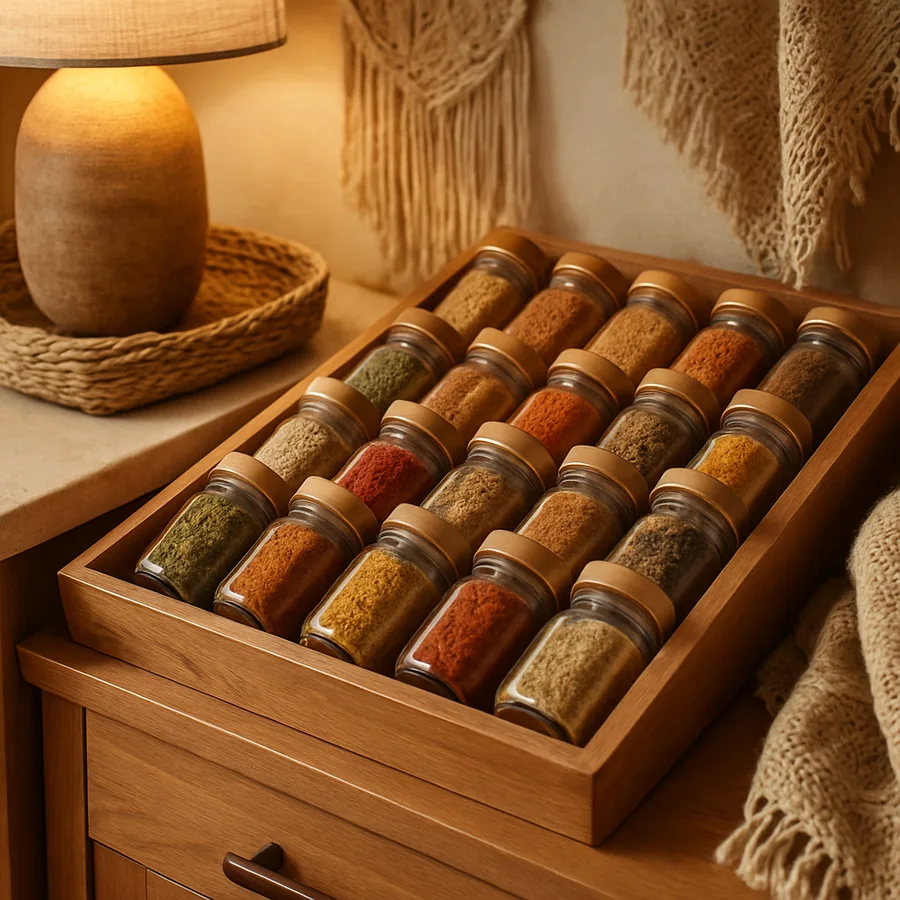
Why Angled Slots Change Everything About Spice Storage
Traditional spice storage forces a compromise that no cook should have to make. Spice racks mounted on the wall display labels facing outward but consume valuable backsplash or cabinet door space. Turntables inside cabinets hide labels behind other jars and require spinning and searching to find what you need. Drawer inserts with flat horizontal slots stack jars on their sides, which makes labels visible only if you happen to have positioned each jar with the label facing up, a condition that lasts about one day before someone puts a jar back rotated the wrong way. Angled spice drawer inserts eliminate all of these compromises by tilting each jar at a consistent angle, typically between 15 and 30 degrees, so that every label faces upward and toward the front of the drawer simultaneously.
The angled position works because of simple geometry. When a spice jar rests in an angled slot, the label printed on the lid or the side of the jar is naturally oriented toward the person looking down into the open drawer. You do not need to pick up jars, rotate them, or lean sideways to read them. Every jar in the drawer presents its label to you the moment you pull the drawer open. The National Kitchen and Bath Association (NKBA) includes angled spice drawers in their list of high-impact kitchen upgrades that improve daily cooking efficiency, citing feedback from professional chefs and home cooks who switched from cabinet storage to angled drawer systems.
Speed is the practical benefit that matters most during active cooking. When a recipe calls for cumin and you are stirring a pan with one hand, you need to locate, grab, and open the cumin jar with your free hand in a matter of seconds. Searching through a cluttered spice cabinet or spinning a turntable while holding a spatula is a recipe for burned food and spilled spices. An angled drawer insert lets you glance down, spot the label instantly, and grab the jar without breaking your cooking rhythm. Professional kitchen designers estimate that angled spice storage reduces the average spice retrieval time from eight to twelve seconds down to two to three seconds, a seemingly small improvement that compounds significantly over the dozens of spice accesses that occur during a complex meal preparation.
The visual impact of an open spice drawer with angled inserts is also worth noting. There is something genuinely satisfying about pulling open a drawer and seeing thirty or forty spice jars arranged in neat diagonal rows, every label visible, every color on display. It transforms a utilitarian storage task into a visual experience that makes the kitchen feel professional and well-considered. Interior designers frequently photograph open spice drawers for portfolio presentations because they communicate organizational sophistication in a single glance. That aesthetic quality is a bonus rather than the primary purpose, but it contributes to the overall sense of a kitchen that works as well as it looks.
Selecting the Right Insert Dimensions for Your Jar Collection
Spice jar collections are remarkably inconsistent in size and shape. The typical kitchen contains a mix of narrow cylindrical jars from specialty spice shops, wide rectangular tins from bulk purchases, tall grinder bottles for peppercorns and sea salt, and squat round containers from supermarket spice aisles. An angled insert that works beautifully with one jar style may not accommodate another, which is why measuring your actual collection before purchasing is essential. Start by identifying the three or four jar formats you use most frequently and measure their diameter, height, and any protruding features like flip-top lids or grinder mechanisms.
Most commercial angled spice inserts are designed around the standard 4-ounce round jar, which has a diameter of approximately two inches and a height of approximately four inches. If the majority of your collection uses this format, a standard insert will serve you well. However, if you have invested in a uniform jar set from a brand like Simply Organic or a custom labeled set, verify that the specific jar dimensions match the slot width and depth of the insert you are considering. A jar that is even a quarter-inch too wide will not sit properly in the angled slot, causing it to rest on top of the insert rather than nestling into its designated position.
Drawer depth is the dimension most likely to cause problems. An angled spice insert requires more front-to-back depth than a flat organizer because the angle projects the jar diagonally across the drawer. A jar that sits four inches tall in a flat orientation may require five to six inches of horizontal depth when angled at 20 degrees. Standard kitchen drawers are typically 18 to 22 inches deep, which accommodates three to four rows of angled jars with room for the insert frame structure. Shallower drawers may only fit two rows, which limits the total jar capacity. Measure the interior depth of your drawer and compare it against the insert specifications before ordering, and do not forget to subtract an inch for clearance between the back of the insert and the rear wall of the drawer.
Height clearance matters for taller jars and grinder bottles. When a jar is placed in an angled slot, its effective height (measured from the drawer bottom to the highest point of the jar) is greater than when it lies flat. A five-inch-tall grinder bottle in a 20-degree slot protrudes approximately 5.3 inches above the drawer bottom, measured vertically. If your drawer has only five inches of clearance beneath the countertop, that grinder bottle will prevent the drawer from closing. The solution is either to store tall items in a separate drawer or to select an insert with a shallower angle that keeps tall jars within the available height envelope. Some inserts offer variable angles across different rows, with steeper angles for short jars in the front and shallower angles for tall items in the back.
Material Choices and Their Impact on Durability
Bamboo is the dominant material for spice drawer inserts, and for good reason. Its natural antimicrobial properties are particularly valuable in a spice storage context, where small amounts of ground spice inevitably dust the surface of the insert over time. Bamboo resists the growth of bacteria and mold that can develop on surfaces exposed to organic powders, making it a hygienically sound choice for food-adjacent storage. The warm golden tone of bamboo also complements the rich earth tones of most spice collections, creating a visually cohesive drawer interior. A quality bamboo angled insert costs between twenty-five and fifty-five dollars depending on size and the number of jar slots.
Acrylic inserts offer a modern alternative that provides full visibility of the drawer contents, including the spaces beneath the angled slots where spilled powder might accumulate. The transparent material makes cleaning easy because you can see exactly where debris has collected, and the smooth non-porous surface wipes clean with a damp cloth. Acrylic is also lighter than bamboo, which reduces the total weight the drawer slides must support when the insert is fully loaded with glass jars. The main drawback of acrylic is its susceptibility to scratching. Glass spice jars slid across an acrylic surface will eventually create visible scratches that dull the transparent finish. Felt or silicone liners in each slot mitigate this issue but add to the overall cost and maintenance.
Stainless steel inserts occupy the premium segment of the market. They are virtually indestructible, completely non-reactive, and easy to sanitize. In a professional kitchen environment where hygiene standards are stringent, stainless steel is the obvious choice. For home kitchens, stainless steel angled inserts offer a commercial-grade aesthetic that pairs naturally with stainless appliances and hardware. The weight of a steel insert is significant, however, typically three to five times heavier than an equivalent bamboo model before any jars are added. This weight increases the demands on the drawer slides and can make the drawer feel heavy to pull open, especially when fully loaded with forty or more glass jars. Verify that your drawer slides are rated for the combined weight before investing in a steel insert.
Wood composite and MDF inserts are available at the lowest price points, usually under fifteen dollars, but they come with meaningful trade-offs. These materials are more susceptible to moisture damage than bamboo or acrylic, and they tend to swell or warp if exposed to repeated humidity or if a spice jar lid is left off and essential oils from the spice saturate the surface. The finish on composite inserts can also peel or chip over time, creating rough edges that snag on jar labels. For a temporary solution or a budget-conscious first attempt at spice drawer organization, composite inserts serve a purpose. For a long-term installation, the modest additional investment in bamboo or acrylic delivers substantially better durability and user experience. A Houzz survey on kitchen material preferences found that 78 percent of homeowners who tried composite organizers replaced them with natural material alternatives within two years.
Arranging Spices for Maximum Cooking Efficiency
The arrangement of spices within an angled drawer insert should reflect how you cook, not how an alphabet works. While alphabetical ordering is the default recommendation in many organization guides, it ignores the reality of cooking workflows. When you are making a curry, you need turmeric, cumin, coriander, garam masala, and chili powder in rapid succession. If those spices are scattered across an alphabetically ordered drawer, you are reaching to five different locations instead of one concentrated zone. A cuisine-based grouping system clusters related spices together, so that reaching into one area of the drawer gives you everything you need for a particular cooking style.
Create zones based on the cuisines you cook most frequently. A Mediterranean zone might group oregano, basil, thyme, rosemary, and crushed red pepper. A Mexican zone holds cumin, chili powder, paprika, cayenne, and Mexican oregano. A baking zone contains cinnamon, nutmeg, cloves, allspice, and vanilla extract. An everyday zone keeps salt, black pepper, garlic powder, and onion powder in the front-center slots where they are most accessible. This zoning approach means that when you decide to make a particular dish, all the seasonings you need are clustered in one section of the drawer, reducing both the number of reaches and the cognitive load of locating each jar individually.
Within each zone, place the most frequently used spices in the front row and less common ones behind them. The front row of an angled insert is the most visible and the easiest to reach, so it should contain the workhorses of your spice collection. The back rows are slightly less accessible but still visible thanks to the angled orientation, making them suitable for specialty spices that you use weekly rather than daily. This front-to-back prioritization within each zone creates a two-dimensional organization system, by cuisine horizontally and by frequency vertically, that optimizes retrieval speed for any cooking scenario.
Leave one or two empty slots at the end of the drawer for new additions. Spice collections grow over time as you explore new recipes and cuisines, and having designated expansion space prevents new jars from ending up on top of the insert or wedged into the gap between the insert and the drawer wall. When the expansion slots fill up, it is time to audit the collection, identify spices that have expired or that you no longer use, and replace them with the new arrivals. The Food and Drug Administration notes that ground spices lose potency after two to three years, so a periodic audit serves both organizational and food quality purposes. Replacing old spices with fresh ones improves your cooking results while keeping the drawer from overflowing.
Maintaining Spice Freshness Through Proper Drawer Storage
Storing spices in a drawer rather than a cabinet or wall-mounted rack has implications for spice freshness that deserve attention. The primary enemies of spice potency are light, heat, and moisture. A closed drawer provides excellent protection from light, keeping spices in darkness whenever the drawer is shut. Heat exposure depends on the drawer's proximity to the stove and oven. If your spice drawer is directly adjacent to the cooktop, radiant heat from extended cooking sessions can warm the drawer interior and accelerate the degradation of volatile flavor compounds. The ideal spice drawer location is at least two feet from any heat source, positioned on the opposite side of the cooking zone if kitchen layout permits.
Moisture is the most insidious threat to drawer-stored spices because it operates invisibly. Humid air enters the drawer every time it is opened, and moisture gradually accumulates on jar surfaces and inside lids that are not sealed tightly. Over time, this moisture causes ground spices to clump, whole spices to soften, and both types to develop off flavors from mold growth that is not always visible to the eye. Using jars with airtight seals, such as those with silicone-ringed screw tops or hinged lids with rubber gaskets, provides the best protection against moisture intrusion. The Architectural Digest kitchen organization guide recommends airtight glass jars as the standard for spice storage, citing both preservation benefits and the visual uniformity they create in an organized drawer.
Cleaning the angled insert itself contributes to spice freshness by preventing cross-contamination between different spice powders. Ground turmeric, paprika, and curry powder are particularly prone to dusting the surface around their jars, and those particles can migrate to adjacent slots and transfer onto other jars. A monthly wipe-down of the insert with a dry cloth removes this accumulated powder and keeps the drawer hygienic. For sticky residues from oils or extracts, a cloth dampened with warm water and a drop of dish soap does the job without leaving moisture behind. Dry the insert thoroughly before returning the jars to prevent moisture from being trapped beneath the jars in the angled slots.
Consider adding a small silica gel packet to the drawer to absorb excess moisture, especially in humid climates or kitchens without effective ventilation. A single food-safe desiccant packet tucked into the back corner of the drawer draws moisture from the enclosed air space and extends the freshness of all the spices stored within it. Replace the packet every three to four months, or when it reaches its absorption capacity as indicated by the color-changing indicator beads that most packets contain. This passive moisture management approach requires almost no effort but provides a meaningful improvement in spice shelf life, which is especially valuable for expensive saffron, vanilla beans, and specialty spice blends that lose their flavor investment when they go stale.
Building a Complete Spice Drawer System From Scratch
If you are starting with a disorganized spice collection scattered across multiple cabinets, a shelf, and a countertop turntable, consolidating everything into a single drawer system requires a structured approach. Begin by collecting every spice container in your kitchen into one place. Open each one, smell the contents, and check for clumping, fading, or staleness. Spices that have lost their aroma or turned gray have also lost their culinary value and should be discarded. The McCormick Science Institute provides guidelines suggesting that ground spices retain peak flavor for one to two years, while whole spices last three to four years when stored properly. Use these benchmarks to decide what stays and what goes.
Once you have your active collection pared down, transfer all spices into uniform jars. This step is optional but transformative. Matching jars with consistent label formatting create a visual system that is significantly easier to scan than a collection of mismatched commercial containers in different shapes, sizes, and label designs. Four-ounce glass jars with brushed metal lids are the most popular choice for spice drawer systems, and a set of twenty-four can be purchased online for under twenty dollars. Print or hand-write labels for the lids, using a consistent font and layout, so that every jar in the angled insert presents a uniform, readable label when viewed from above.
Install the angled insert in the drawer before loading the jars. Ensure it sits flat and does not rock or shift when you press on different corners. If the insert is slightly smaller than the drawer, place non-slip shelf liner underneath to prevent movement. Load the jars one zone at a time, starting with the most frequently used zone in the front and working toward specialty spices in the back. As you load each jar, verify that it sits securely in its angled slot and that the label faces upward. Take a photograph of the fully loaded drawer for reference, so that if the jars ever get shuffled you can quickly restore the original arrangement.
The total cost of a complete spice drawer system built from scratch, including the angled insert, uniform jars, labels, shelf liner, and a silica gel packet, typically ranges from forty-five to eighty-five dollars. This is comparable to the cost of a single mid-range countertop spice rack but delivers dramatically better functionality, visibility, and capacity. The drawer system also frees up counter or cabinet space that the old storage method occupied, which is a secondary benefit that compounds the value of the investment. For a kitchen upgrade that delivers an immediate, tangible improvement in daily cooking workflow at a modest cost, a spice drawer with an angled insert ranks among the best returns on investment in the entire home organization category.
Conclusion
Spice drawer inserts with angled slots solve a problem that every home cook has experienced: the inability to find the right spice quickly when it matters most. The angled orientation presents every label to you simultaneously, eliminating the searching, rotating, and rummaging that characterize less organized spice storage methods. Whether you cook simple weeknight meals or elaborate multi-course dinners, the seconds saved on each spice retrieval compound into meaningful time reclaimed over weeks and months of daily use.
The key decisions in setting up an angled spice drawer are material selection, jar standardization, and organizational logic. Bamboo inserts offer the best combination of durability, aesthetics, and antimicrobial protection for most kitchens. Uniform glass jars with consistent labels transform a chaotic collection into a visual system that is as easy to maintain as it is to use. Cuisine-based zoning, rather than alphabetical ordering, aligns your spice arrangement with the way you actually cook, reducing the cognitive effort of locating seasonings during active meal preparation.
Is there a drawer in your kitchen that could be repurposed or upgraded to become a dedicated spice drawer? Most kitchens have at least one underutilized drawer within arm's reach of the cooktop that is currently holding miscellaneous items that could easily be relocated. Measure that drawer today, count your active spice jars, and take the first step toward a spice storage system that makes cooking faster, more enjoyable, and visibly more organized.
More Articles You May Like



Comments
Post a Comment