Custom Drawer Organizers for Junk Drawers That Stay Tidy
Understanding Why Junk Drawers Resist Organization
Every household has at least one junk drawer, and most have two or three. These drawers become dumping grounds for items that do not have a designated home elsewhere: batteries, rubber bands, takeout menus, pens, tape, keys, twist ties, coupons, phone chargers, and the occasional mystery item that nobody remembers putting there. The problem with junk drawers is not that people are disorganized. The problem is that standard organizers are designed for uniform collections like flatware or utensils, not for the wildly varied assortment of shapes and sizes that accumulates in a catch-all drawer. A fork tray does not have a compartment shaped for a roll of tape, a flashlight, and a stack of takeout menus.
This mismatch between organizer design and actual drawer contents is why off-the-shelf solutions fail so consistently in junk drawers. You buy a plastic organizer with six identical compartments, fill them on day one, and within a week the contents have migrated, stacked, and overflowed back into the same chaos you started with. The compartments are either too large for small items like paperclips and thumbtacks, which rattle around uselessly, or too small for bulkier items like scissors and tape dispensers, which end up on top of the organizer instead of inside it. According to a survey conducted by the National Association of Professional Organizers, 83 percent of Americans report having at least one disorganized drawer, and the kitchen junk drawer is cited most frequently.
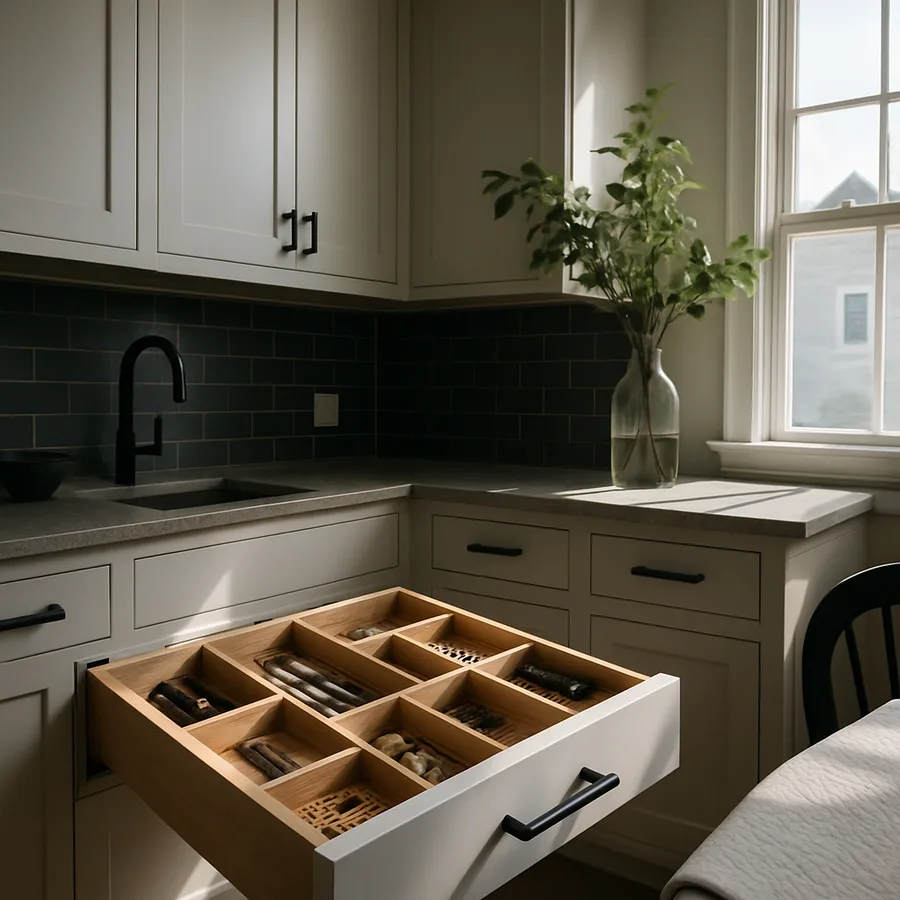
Custom drawer organizers solve this problem by matching compartment sizes and shapes to the specific items you actually store in the drawer. Instead of forcing a standardized grid onto a non-standard collection, a custom approach starts with the contents and designs the organizer around them. This reversal of the typical organizing process is what makes the difference between a drawer that stays tidy for a week and one that remains organized for months or years. When every item has a compartment that fits it precisely, returning things to their correct location becomes effortless rather than aspirational.
The psychological dimension matters too. Research in behavioral design shows that people are far more likely to maintain an organizational system when the "correct" action requires less effort than the "incorrect" one. A custom junk drawer organizer achieves this by making it easier to drop an item into its designated slot than to toss it randomly into the drawer. The compartment openings are sized so that the right item falls naturally into place, creating a path of least resistance toward order rather than chaos. This principle, sometimes called "choice architecture," is why custom organizers succeed where generic trays fail.
Auditing Your Junk Drawer Contents Before You Build
The first step toward a custom junk drawer organizer is a thorough audit of what the drawer actually contains. Empty the entire drawer onto a table or countertop and sort everything into three categories: keep, relocate, and discard. Be ruthless during this process. That dried-up pen, the instruction manual for an appliance you no longer own, the orphaned key that does not fit any lock in your house, and the expired coupons all belong in the discard pile. Items that have a better home elsewhere, like the screwdriver that belongs in the toolbox or the stamps that should be with the stationery, go in the relocate pile. Only the items that genuinely belong in a quick-access kitchen drawer should remain in the keep pile.
Once you have your keep pile finalized, group the remaining items by category and frequency of use. Common categories include writing supplies, adhesives and fasteners, batteries and small electronics, tools, personal items, and miscellaneous hardware. Within each category, note the dimensions of the largest item, because that item determines the minimum compartment size for its group. A tape dispenser is wider than a roll of tape. A pair of scissors needs more length than a pen. These seemingly obvious details are exactly what gets overlooked when people grab a generic organizer and hope for the best.
Count the items in each category and estimate how many you typically accumulate between cleanouts. If you keep a rotating stock of four to six pens, design the pen compartment to hold eight comfortably, providing a buffer that prevents overflow. If you store one roll of tape that gets replaced when it runs out, the tape compartment only needs to fit a single roll. This calibration between actual usage patterns and compartment sizing is the core advantage of the custom approach. The Better Homes and Gardens storage planning guides recommend this inventory-first method for any custom organization project, noting that it reduces the likelihood of outgrowing the system within the first six months by over 60 percent.
Document your inventory with a quick sketch or photograph before returning anything to the drawer. This reference becomes your design blueprint, showing exactly what needs to fit and in what proportions. Mark the items you reach for most frequently, because those should occupy the most accessible compartments, typically the front-center area of the drawer. Items used less often can go in the back corners where they are still retrievable but do not occupy prime real estate. This front-to-back prioritization is a small detail that makes a large difference in how natural the drawer feels to use day after day.
Designing a Compartment Layout That Matches Your Life
With your inventory documented, you can design a compartment layout tailored to your specific needs. Start by measuring the interior dimensions of the drawer: width, depth, and height. Transfer these measurements to a piece of graph paper at a convenient scale, creating a top-down outline of the available space. Then sketch in the compartment boundaries, starting with the largest items and working toward the smallest. The tape dispenser, scissors, and flashlight each need their own dedicated spaces, while smaller items like rubber bands, paperclips, and thumbtacks can share a compartment divided by smaller internal walls.
Avoid the temptation to create too many tiny compartments. A drawer with twenty small sections becomes a puzzle that discourages use rather than encouraging it. The ideal junk drawer organizer has between six and ten compartments of varying sizes, each large enough to hold its designated category without cramming. One wide section for pens and markers. One medium section for tape and adhesives. One small section for batteries. One shallow section for flat items like business cards, stamps, and coupons. One catch-all section for items that do not fit neatly into any other category. The catch-all section is important because it acknowledges reality: junk drawers will always receive items that defy categorization, and providing a space for them prevents those items from disrupting the organized sections.
The shape of compartments matters as much as their size. Rectangular compartments work well for most items, but consider adding one or two L-shaped or irregular sections that wrap around other compartments to maximize the use of corner space. An L-shaped compartment in the back corner of the drawer can hold a flashlight along one arm and a multi-tool along the other, making efficient use of space that a rectangular grid would waste. The American Society of Interior Designers (ASID) highlights that thoughtful space planning at every scale, from room layout down to drawer organization, is a hallmark of well-designed interiors.
Consider adding a small, shallow tray or lid to one compartment for items that need containment rather than just separation. Loose coins, small screws, safety pins, and SIM card ejector tools are the kinds of things that escape from open compartments and migrate to the bottom of other sections. A compartment with a snap-on lid or a recessed tray prevents this migration and keeps the tiniest items corralled. Some custom organizer builders incorporate small magnetic strips at the bottom of certain compartments to hold metal items in place, which is an especially clever solution for households that store spare keys or small hardware in the junk drawer.
Materials and Methods for Building Custom Organizers
Building a custom junk drawer organizer is a straightforward project that requires minimal tools and materials. The simplest approach uses thin plywood or craft wood strips cut to size and assembled with wood glue. Quarter-inch plywood works well for compartment walls because it is thin enough to maximize interior space while thick enough to stand upright without flexing. A sheet of quarter-inch plywood from any hardware store costs less than ten dollars and provides enough material for multiple organizers. Cut the base panel to match the drawer interior dimensions, then cut the divider strips to create your planned compartment layout.
For those who prefer a finished look without the effort of building from scratch, several companies now offer modular organizer components that can be assembled into custom configurations. These systems typically use interlocking bamboo or acacia wood pieces that snap together without glue or fasteners, allowing you to create a tailored layout and reconfigure it later if your needs change. The modular approach costs more than DIY plywood, usually between twenty and forty dollars for a full drawer's worth of components, but the quality of the finished product is noticeably higher than what most home builders can achieve with basic tools.
Three-dimensional printing has opened another avenue for truly custom drawer organizers. If you have access to a 3D printer, whether your own or through a local library or makerspace, you can design an organizer in free CAD software that matches your drawer dimensions and item inventory to the millimeter. The printed organizer can incorporate features that are difficult to achieve with wood, such as curved compartment walls that match the shape of specific items, integrated label holders, and snap-fit connections between modular sections. The material cost for a 3D-printed organizer is typically under five dollars, though the print time for a full drawer insert can range from eight to twenty hours depending on size and complexity.
Repurposed containers offer a no-cost alternative that works surprisingly well. Small boxes, mint tins, jar lids, and cut-down cardboard containers can be arranged inside the drawer to create an improvised custom organizer. While this approach lacks the visual polish of a purpose-built solution, it is an effective way to test a compartment layout before investing in a permanent organizer. Spend a week using the repurposed container layout, adjusting sizes and positions as you discover what works and what needs refinement, then use that proven layout as the template for building or purchasing the final organizer. This prototype-and-iterate approach is how professional organizers develop custom solutions for clients, according to the National Association of Productivity and Organizing Professionals.
Habits That Keep a Custom Junk Drawer From Reverting to Chaos
A custom organizer creates the conditions for a tidy junk drawer, but maintaining that tidiness requires a few simple habits practiced consistently. The most important habit is the one-in-one-out rule: every time a new item enters the junk drawer, an equivalent item should leave. This prevents the gradual accumulation that overwhelms even the best-designed organizer. When you toss a new pack of batteries into the battery compartment, check whether the old batteries are actually dead and remove them. When a new pen arrives, test the existing pens and discard any that have run dry. This micro-editing takes seconds and prevents the slow creep toward overcrowding.
Schedule a quarterly drawer audit, even if the drawer still looks organized. Set a calendar reminder for the first day of each quarter, and spend five minutes emptying the drawer, discarding anything that has expired or is no longer needed, and wiping down the organizer. This regular maintenance catches problems before they compound. A single wayward item that ends up in the wrong compartment is easy to correct during a five-minute audit. A dozen misplaced items that have accumulated over six months require a full reorganization that most people will postpone indefinitely. The quarterly cadence strikes the right balance between maintenance effort and organizational decay.
Label your compartments, at least initially. Small adhesive labels or a strip of painter's tape with handwritten category names on each compartment removes the ambiguity that causes items to end up in the wrong section. Labels are especially helpful in households with multiple people, where one person's organizational logic may not be obvious to another. The pen compartment is obvious, but the distinction between the "adhesives" compartment and the "fasteners" compartment may not be clear to everyone. After a month or two, the labels become unnecessary as household members internalize the layout through repetition, at which point you can remove them if you prefer a cleaner look.
Establish a boundary rule for the catch-all compartment. This section will naturally attract the most diverse assortment of items, and without a boundary it will expand to swallow the entire drawer. A good rule is: if the catch-all compartment is full, it is time to sort through it and either find proper homes for the accumulated items or discard them. Do not allow items to stack on top of other compartments because the catch-all is overflowing. That stacking is the first domino in the chain of events that transforms a tidy custom drawer back into the junk drawer it was before. Treating the catch-all boundary as a hard limit rather than a suggestion is the single most effective habit for long-term drawer maintenance.
When to Consider Professional Organization Help
Most junk drawer organization projects are well within the capability of a motivated homeowner, but there are situations where professional help delivers outsized value. If you have multiple problem drawers across the kitchen, home office, bathroom, and bedroom, a professional organizer can design a whole-home drawer system in a fraction of the time it would take to tackle each one individually. Professional organizers bring experience with hundreds of different drawer configurations and can spot optimization opportunities that a first-time organizer would miss. The cost for a professional drawer organization session typically ranges from one hundred to three hundred dollars and includes the consultation, design, materials, and installation.
Households going through a major life transition, such as a move, a renovation, or a significant downsizing, benefit particularly from professional drawer organization. During these transitions, the contents of every drawer are in flux, and establishing organized systems from the start prevents the formation of new junk drawers in the new space. A professional organizer can work alongside the moving or renovation process, setting up drawer systems as spaces become available, so that the first time you open a drawer in your new kitchen it is already organized rather than serving as a temporary dumping ground that becomes permanent through inertia.
For homeowners who have tried and failed to maintain junk drawer organization on their own, a professional consultation can identify the specific behavioral or structural factors that caused previous attempts to fail. Sometimes the issue is a drawer that is physically too shallow for the items it needs to hold, which no organizer can fix. Sometimes it is a location problem, where the junk drawer is positioned at the main entry point of the kitchen and receives items that should go elsewhere in the house. A professional can diagnose these root causes and recommend solutions that address the underlying problem rather than applying another organizational band-aid on top of a structural issue. The NKBA's consumer guidance on kitchen planning emphasizes that drawer placement and sizing decisions made during the design phase have lasting effects on organizational success.
Do you find yourself reorganizing the same drawer every few months, only to watch it descend back into disorder within weeks? That pattern suggests a mismatch between the organizer design and your actual usage habits, which is precisely the kind of problem that benefits from an outside perspective. A professional organizer observes how you interact with the drawer in real time, identifies the friction points that cause items to end up in the wrong place, and designs a system that works with your natural habits rather than against them. The goal is not a drawer that looks perfect in a photograph but one that stays functional through the ordinary, imperfect reality of daily life.
Conclusion
Custom drawer organizers transform junk drawers from sources of daily frustration into efficient storage zones that serve their households reliably. The critical difference between a custom organizer and an off-the-shelf tray is the alignment between compartment design and actual drawer contents. When every item has a space that fits it precisely, maintaining order becomes the path of least resistance rather than an ongoing battle against entropy. The investment of time required to audit, design, and build a custom organizer pays dividends in reduced search time, lower stress, and a kitchen that functions better at every level.
The materials and methods available for custom junk drawer organization range from free repurposed containers to professional-grade modular systems, with DIY plywood builds and 3D-printed solutions occupying the practical middle ground. Whatever method you choose, the process is the same: empty the drawer, sort ruthlessly, measure carefully, design around the items that remain, and build or assemble an organizer that fits your drawer and your life. The maintenance habits that keep the system working, specifically the one-in-one-out rule, quarterly audits, and catch-all boundary limits, require minimal effort but deliver consistent results.
Which drawer in your home causes the most frustration every time you open it? That drawer is your starting point. Empty it today, sort the contents into keep, relocate, and discard piles, and sketch a compartment layout that gives every keeper item a designated home. The difference between a junk drawer and an organized utility drawer is not the absence of miscellaneous items. It is the presence of a system designed specifically for them.
More Articles You May Like



Comments
Post a Comment