Waterfall Edge Kitchen Island Designs in Quartz and Marble
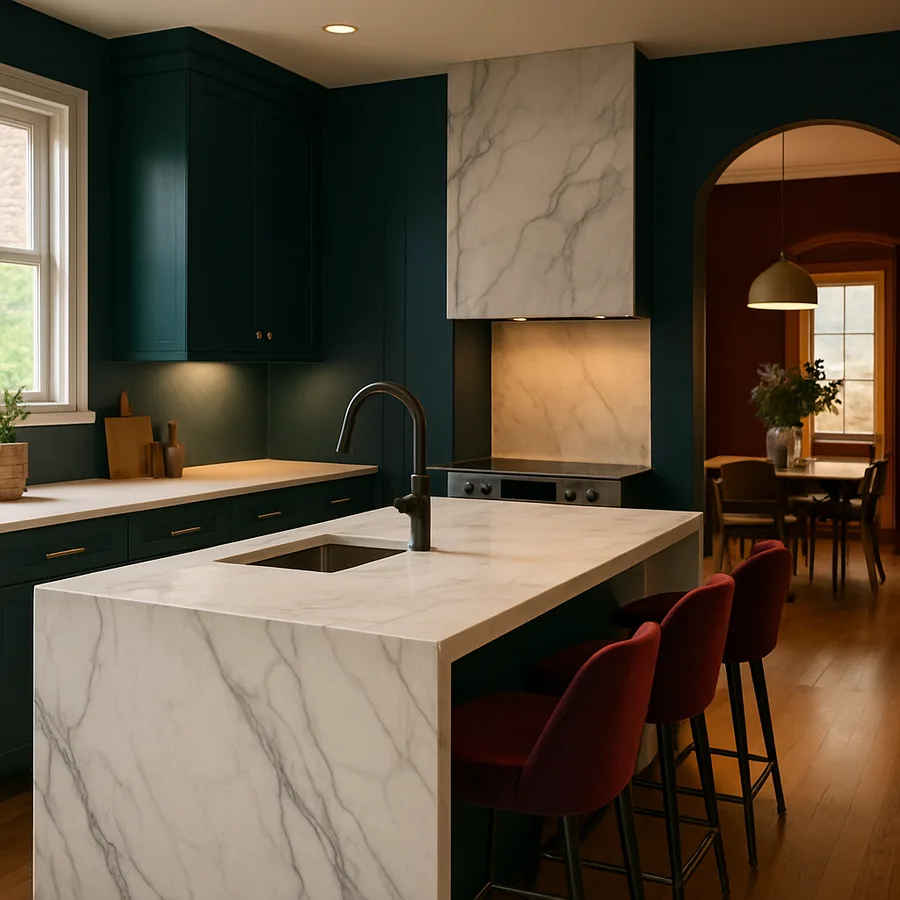
The waterfall edge has moved from a boutique detail to a mainstream kitchen upgrade, and for good reason. When a slab of quartz or marble cascades down the side of an island instead of stopping at the countertop edge, the whole room reads differently. The island stops looking like furniture and starts reading like sculpture. Homeowners considering this upgrade tend to ask the same opening question: is the visual payoff worth the added fabrication cost? The short answer from most kitchen designers is yes, but only when the stone, seam, and support details are handled with care.
According to the National Kitchen and Bath Association (NKBA), roughly 41% of remodels completed in the last eighteen months included some form of continuous-edge stone treatment on the island, up from just 12% five years earlier. The Marble Institute of America (now part of the Natural Stone Institute) has also noted a corresponding rise in bookmatched slab requests for residential kitchens. This guide walks through the decisions that separate a waterfall island that ages gracefully from one that looks dated within a season.
Understanding the Waterfall Edge Concept
A waterfall edge is a countertop detail in which the stone continues vertically down one or both ends of an island, mitered at the corner to give the illusion of a single folded slab. The effect depends on two elements working in tandem: a crisp 45-degree miter joint at the corner and a slab with veining that continues across that joint without interruption. When either element is compromised, the eye immediately catches the break and the design loses its impact.
Before committing, it helps to ask yourself how you actually use your island. Do you frequently scoot a stool sideways, catching the outer face with a shoe? Do children lean against that end with sticky hands? These questions matter because a waterfall face is not just a decorative panel; it is a full vertical countertop, and it will be touched, bumped, and cleaned like one. Fabricators who work with the American Society of Interior Designers (ASID) recommend specifying a slightly higher honing grit on waterfall faces than on the top to reduce fingerprint visibility.
It is also worth distinguishing between a single waterfall, where only one end of the island is wrapped, and a double waterfall, where both ends cascade. Single waterfalls are more common in galley-adjacent islands, where the open end faces the living area, while double waterfalls appear in kitchens with islands visible from multiple angles. The double version roughly doubles the slab quantity and the miter count, so budgeting needs to reflect that.
Quartz vs Marble: Material Trade-Offs
Engineered quartz and natural marble are the two dominant stones for waterfall islands, and they perform very differently. Quartz, made from roughly 90% ground natural stone bound with resin, offers a non-porous, stain-resistant surface that needs no sealing. Marble, by contrast, is a calcium carbonate stone that etches on contact with acidic liquids like lemon juice, vinegar, and red wine. That etching is not damage in the structural sense, but it alters the finish in a way many homeowners find alarming the first time it happens.
Data published by the Freedonia Group in a recent countertop materials report shows quartz holding approximately 34% of the U.S. residential countertop market, with natural stone (including marble) at about 22%. Among waterfall installations specifically, quartz leads because the engineered consistency makes vein continuity across the miter far more predictable. A quartz slab from a single production batch will match itself almost perfectly; a marble slab requires careful book-matching from sequential cuts of the same block.
If you love the look of marble but worry about etching, two middle paths exist. The first is a marble-look quartz such as those in the upper tiers from major manufacturers, which mimic Calacatta or Statuario veining convincingly. The second is honed marble rather than polished, since honing masks etch marks that would be glaring on a glossy surface. Designers affiliated with Houzz Pro report that about 60% of their marble-island clients now opt for a honed finish specifically for this reason.
Slab Selection and Veining Strategy
Choosing slabs for a waterfall island is not the same as choosing slabs for a standard counter. You need to visit the stone yard in person, ideally with your fabricator, and lay eyes on the actual pieces that will be cut. This is where book-matching becomes critical. In a book-matched pair, two consecutive slabs from the same block are opened like a book, creating a mirror image along the shared edge. When that mirror runs across a mitered waterfall corner, the veining appears to pour continuously from top to floor.
Bring tape, a camera, and a floor plan marked with the island dimensions. Photograph each candidate slab in its entirety, then use painter's tape to mock out the top and waterfall face on the slab surface. This step prevents the classic disappointment of discovering, post-install, that a dramatic vein you loved ended up hidden under the sink cutout. Designers who hold NKBA Certified Kitchen Designer (CKD) credentials typically include slab-yard visits as a billable line item precisely because the decisions made there are so hard to reverse.
Have you considered which direction you want the primary veining to travel? Horizontal veining emphasizes the length of the island, ideal for longer runs and open-plan rooms. Vertical or diagonal veining draws the eye downward along the waterfall face, which can exaggerate the apparent height of the island and make a smaller kitchen feel more intimate. There is no wrong answer, but pretending the choice does not exist usually results in the fabricator defaulting to whatever is easiest to cut.
Mitered Joinery and Structural Engineering
The mitered corner is where a waterfall island is made or broken. A proper 45-degree miter brings the two slab edges together at a point so fine that, when bonded, the seam reads as a folded sheet of stone rather than two pieces meeting. Achieving this requires a fabrication shop with a CNC saw capable of consistent angle accuracy to within a quarter degree, plus an adhesive strategy using a color-matched epoxy rather than visible silicone.
Underneath the visible stone, the island cabinet itself needs reinforcement. A typical waterfall face adds roughly 70 to 110 pounds of stone to each end of the island, depending on thickness. Standard cabinet boxes are not engineered to carry that load at the edges, so fabricators usually specify a plywood substructure or a welded steel bracket tying the cabinet to the floor. The National Association of Home Builders (NAHB) publishes residential load guidelines that many inspectors reference when reviewing heavy stone installations in new builds.
Homeowners occasionally ask whether a waterfall can be retrofit onto an existing island. The honest answer is sometimes. If the existing cabinet is plywood-built and the floor beneath is level, a skilled fabricator can add a waterfall face using structural adhesive and a concealed cleat system. If the cabinet is MDF or the floor dips more than an eighth of an inch, you are better off rebuilding the island entirely. Retrofits that skip these checks tend to develop visible gaps at the seam within the first year.
Overhang, Seating, and Ergonomics
Many waterfall islands also serve as seating zones, which introduces a second set of constraints. A waterfall face that terminates at the floor leaves no knee clearance for a stool, so if you want seating on the waterfall end, you need to make a choice. Option one is to keep seating only on the long side opposite the waterfall, treating the cascading end as purely sculptural. Option two is to design an L-shaped waterfall where one leg drops to the floor and the perpendicular leg forms an overhang deep enough for stools.
The NKBA recommends a minimum 12-inch overhang for a 36-inch counter-height seating surface and 15 inches for a 42-inch bar-height surface. When a waterfall terminates on the non-seating end and the seating side uses a standard overhang, the visual rhythm works well. When designers try to force seating under a full waterfall, the result is usually either cramped knees or a stool pushed awkwardly far from the counter.
Another consideration is cleaning access. A waterfall face creates a narrow gap between the stone and the floor, and crumbs, pet hair, and spilled liquids all find their way into that gap. Specifying a slight scribed toe-kick or a stone base detail that continues flush to the floor eliminates this problem. Ignoring it means you will be on your hands and knees with a putty knife every month or two, something no one mentions in the renderings.
Budget, Timeline, and Maintenance Reality
Waterfall islands cost more than standard islands in three specific ways. First, you need additional slab material, typically one to two extra slabs depending on island size. Second, the mitered fabrication labor runs 20 to 40% higher than standard edge work. Third, installation requires two to four people on site instead of the usual two, because the waterfall panels have to be held in place while the epoxy cures. Real-world pricing data from Houzz suggests a typical U.S. waterfall island upcharge of roughly $2,800 to $6,500 over a standard-edge equivalent.
Timeline impacts matter too. A standard island counter might template on Monday and install the following Friday. A waterfall with book-matched slabs typically adds one to two weeks because the fabricator needs to layout, dry-fit, and re-verify vein alignment before cutting. Trying to compress this timeline is the single most common cause of waterfall regrets, because rushed alignment decisions are permanent once the miter is cut. The Natural Stone Institute publishes a consumer timeline guide that is worth reading before you sign a contract.
Maintenance varies dramatically by material. Quartz waterfall faces need only warm water and mild soap. Marble waterfalls benefit from a penetrating sealer applied every six to twelve months, plus prompt blotting of any acidic spill. Both materials should be protected from direct blows; the waterfall face is especially vulnerable to chipping at the bottom corner where it meets the floor. A simple felt pad under any nearby furniture leg reduces this risk substantially.
Conclusion
A waterfall edge kitchen island is one of the few remodel choices that genuinely changes how a room feels rather than simply how it looks. Done well, with the right slab, a precise miter, reinforced cabinetry, and thoughtful seating geometry, it becomes the visual anchor of the kitchen and holds up for decades. Done poorly, it becomes an expensive lesson in why certain details matter more than others. The difference almost always comes down to the time spent at the slab yard and the experience of the fabrication crew.
If you are weighing quartz against marble, weigh your tolerance for patina as honestly as you can. Marble rewards patience and forgives small etchings as part of its character; quartz rewards a busy household that wants predictability. Both can produce a stunning waterfall given the right design discipline. The key is to match the material to your real life rather than to the image in the renderer, because after the photos are taken, you are the one who lives with it.
Before you commit, walk through your decision with a NKBA-certified designer, visit at least two stone yards, and request references from any fabricator you consider. Book a consultation with an Interior Bliss kitchen specialist today to review slab options, confirm structural requirements, and build a realistic timeline for your waterfall island project. A single hour of planning now will save weeks of regret later, and it will help you arrive at a kitchen that feels as considered as it looks.
A small but worthwhile caution concerns resale expectations. Waterfall islands have matured from trend to mainstream, but the specific stone you choose still tracks fashion cycles. Heavy, high-contrast marble veining that reads as current today may feel dated in a decade, whereas quieter, more neutral patterns tend to age more gracefully. Real-estate professionals affiliated with the National Association of Realtors suggest that neutral stone choices recover their renovation cost at noticeably higher rates than very bold veining when homes are sold within five to eight years of the remodel.
Homeowners sometimes also overlook the interaction between a waterfall island and surrounding finishes. A dramatic stone end-panel competes visually with a busy backsplash, a strongly figured wood floor, or cabinetry with aggressive grain. When a waterfall is the design focal point, the perimeter of the kitchen generally wants to quiet down to let it lead. This is not a hard rule, but it is the pattern that consistently appears in the most-photographed kitchens, and it is worth discussing with your designer before finalizing other material selections.
Further reading and verification: the NKBA publishes kitchen design guidelines that address island geometry in detail, the Natural Stone Institute maintains fabrication standards for mitered stonework, and Houzz offers searchable portfolios of completed waterfall islands with detailed project notes.
More Articles You May Like



Comments
Post a Comment